Flexible Solar Panels Marine Solutions for Boats and Offshore Power
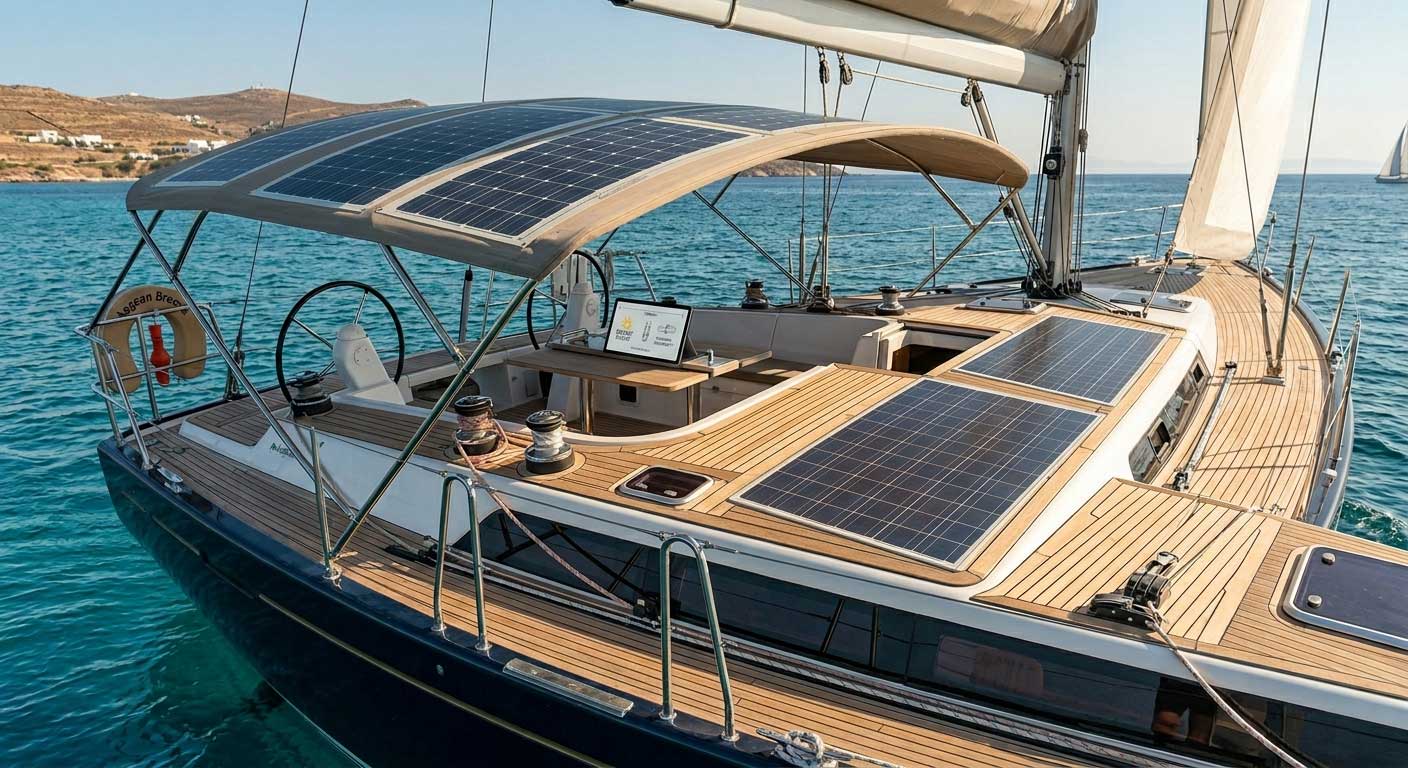
Flexible solar panels marine systems provide lightweight, corrosion-resistant, and space-efficient renewable energy for boats, yachts, sailboats, catamarans, and offshore vessels. Their ability to conform to curved marine surfaces while reducing weight and installation complexity makes them one of the most effective solar solutions for modern marine power systems.
The first thing most boat owners notice about solar power is not the electricity.
It’s the silence.
No generator vibration. No fuel smell. No engine running just to keep batteries alive.
After working with marine solar projects for more than a decade at Bright Solar, I’ve found that sailors rarely become excited about wattage numbers. They become excited when they spend three nights at anchor and their batteries remain fully charged.
That difference matters.
Marine solar isn’t simply about renewable energy. It’s about extending freedom on the water.
A few years ago, a yacht owner in Croatia described solar power as “extra fuel that arrives every morning.”
That may be the simplest explanation I’ve heard.
Why Flexible Solar Panels Marine Systems Are Growing in Popularity
Modern boats consume more electricity than ever before.
Today’s vessels commonly operate:
- GPS chartplotters
- AIS transceivers
- Refrigeration systems
- Cabin lighting
- Watermakers
- Communication equipment
- Battery monitoring systems
- Satellite internet devices
Energy demand has increased dramatically.
According to the International Energy Agency (IEA), solar photovoltaic technology continues expanding worldwide as renewable energy becomes increasingly cost-effective and accessible.
Reference Source:
https://www.iea.org
Marine users face an additional challenge.
Electricity is often needed far from shore power.
That’s where flexible solar panels marine installations provide a practical solution.
Unlike generators, solar systems:
- Produce no noise
- Require no fuel
- Generate power daily
- Reduce maintenance requirements
For long-distance cruisers, these advantages add up quickly.
What Makes Flexible Solar Panels Ideal for Marine Applications?
Marine environments are unlike any other installation location.
Solar equipment must tolerate:
- Saltwater exposure
- UV radiation
- Continuous vibration
- Humidity
- Heavy rainfall
- Temperature fluctuations
Traditional framed panels can work well.
However, flexible panels offer several advantages particularly suited to boats.
| Feature | Flexible Marine Panels | Traditional Marine Panels |
|---|---|---|
| Weight | Very Low | Higher |
| Curved Surface Compatibility | Excellent | Limited |
| Wind Resistance | Low Profile | Higher Profile |
| Installation Flexibility | Excellent | Moderate |
| Aesthetic Integration | Excellent | Moderate |
| Mounting Hardware Requirements | Minimal | Greater |
These differences become especially important on smaller vessels where every kilogram affects performance.
Reduced Weight Above the Waterline
Weight distribution matters aboard a boat.
A traditional 100W glass panel often weighs:
- 6–9 kg
A comparable flexible panel often weighs:
- 2–3 kg
When multiple panels are installed, the savings become substantial.
Reducing weight high on a vessel helps maintain stability and sailing performance.
Experienced sailors notice these differences quickly.
Particularly offshore.
Real-World Case Study: Mediterranean Cruising Yacht
Several years ago, Bright Solar worked with the owner of a 45-foot sailing yacht based in southern Italy.
The vessel’s original energy system relied heavily on:
- Shore power
- Engine charging
- Occasional generator use
The owner wanted greater independence during extended coastal cruising.
The installation included:
- Four 120W flexible marine solar panels
- MPPT charge controller
- 400Ah lithium battery bank
Performance data collected during summer operation showed:
| Performance Metric | Before Installation | After Installation |
|---|---|---|
| Daily Solar Production | Minimal | 1.8–2.4 kWh |
| Generator Runtime | Frequent | Rare |
| Anchorage Duration | 2–3 Days | 7–10 Days |
| Battery Charging Reliability | Variable | Consistent |
What surprised the owner most wasn’t solar production.
It was reduced engine hours.
The yacht felt quieter.
More relaxed.
The solar system changed the onboard experience in ways that electrical calculations alone couldn’t predict.
Common Marine Applications for Flexible Solar Panels
Flexible marine solar systems support a wide range of onboard electrical loads.
Navigation Equipment
Critical systems include:
- GPS chartplotters
- Radar systems
- AIS transceivers
- Autopilot equipment
Reliable charging improves operational safety.
Especially during offshore passages.
Refrigeration Systems
Marine refrigerators often represent one of the largest continuous energy demands onboard.
Solar energy significantly offsets this consumption.
Cabin Comfort Systems
Flexible solar panels commonly support:
- LED lighting
- Ventilation fans
- USB charging stations
- Water pumps
These loads may seem small individually.
Combined, they become substantial.
Communication Equipment
Modern cruisers increasingly depend on:
- Satellite communication systems
- Wi-Fi equipment
- Emergency radios
Reliable energy availability is becoming more important each year.
How Efficient Are Flexible Solar Panels Marine Systems?
One misconception continues to circulate online:
“Flexible solar panels are less efficient.”
That statement is becoming outdated.
Many premium marine solar panels now utilize high-efficiency monocrystalline cells.
According to the National Renewable Energy Laboratory (NREL), photovoltaic efficiency continues improving across commercial solar technologies.
Reference Source:
https://www.nrel.gov
Modern marine flexible panels commonly achieve:
- High conversion efficiency
- Strong low-light performance
- Improved durability
- Enhanced energy production per square meter
In practical marine installations, available deck space often limits system size long before efficiency becomes a problem.
Space is usually the scarce resource.
Not sunlight.
The Hidden Challenge Offshore: Heat Management
This topic rarely appears in sales brochures.
Yet it affects real-world performance.
Flexible panels often sit directly against mounting surfaces.
Reduced airflow can increase operating temperatures.
Higher temperatures lower efficiency.
Experienced marine installers address this by:
- Selecting cooler installation areas
- Avoiding excessive adhesive coverage
- Encouraging airflow where possible
- Monitoring heat buildup during peak summer conditions
One veteran marine electrician once told me:
“The ocean cools the boat. The deck still gets hot.”
That observation remains surprisingly relevant.
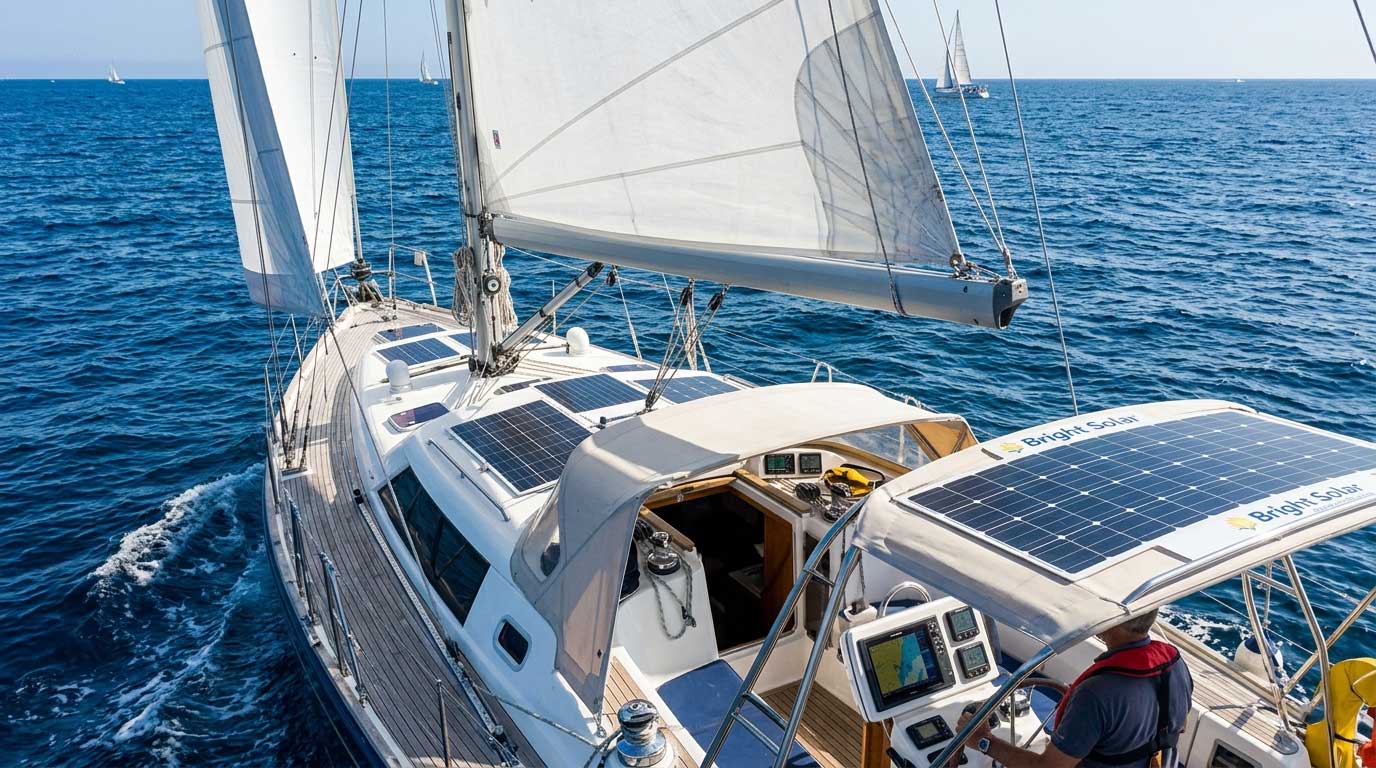
Flexible Marine Solar Panels vs Rigid Marine Panels
The best solar panel depends on the vessel.
Not marketing language.
Not internet opinions.
Actual operating conditions.
| Factor | Flexible Marine Panels | Rigid Marine Panels |
|---|---|---|
| Weight | Excellent | Moderate |
| Curved Surfaces | Excellent | Limited |
| Deck Integration | Excellent | Moderate |
| Structural Strength | Moderate | Excellent |
| Cooling Airflow | Moderate | Excellent |
| Aesthetic Appearance | Excellent | Moderate |
Many yacht owners prioritize:
- Clean appearance
- Low-profile installations
- Weight reduction
Flexible panels often provide clear advantages in these situations.
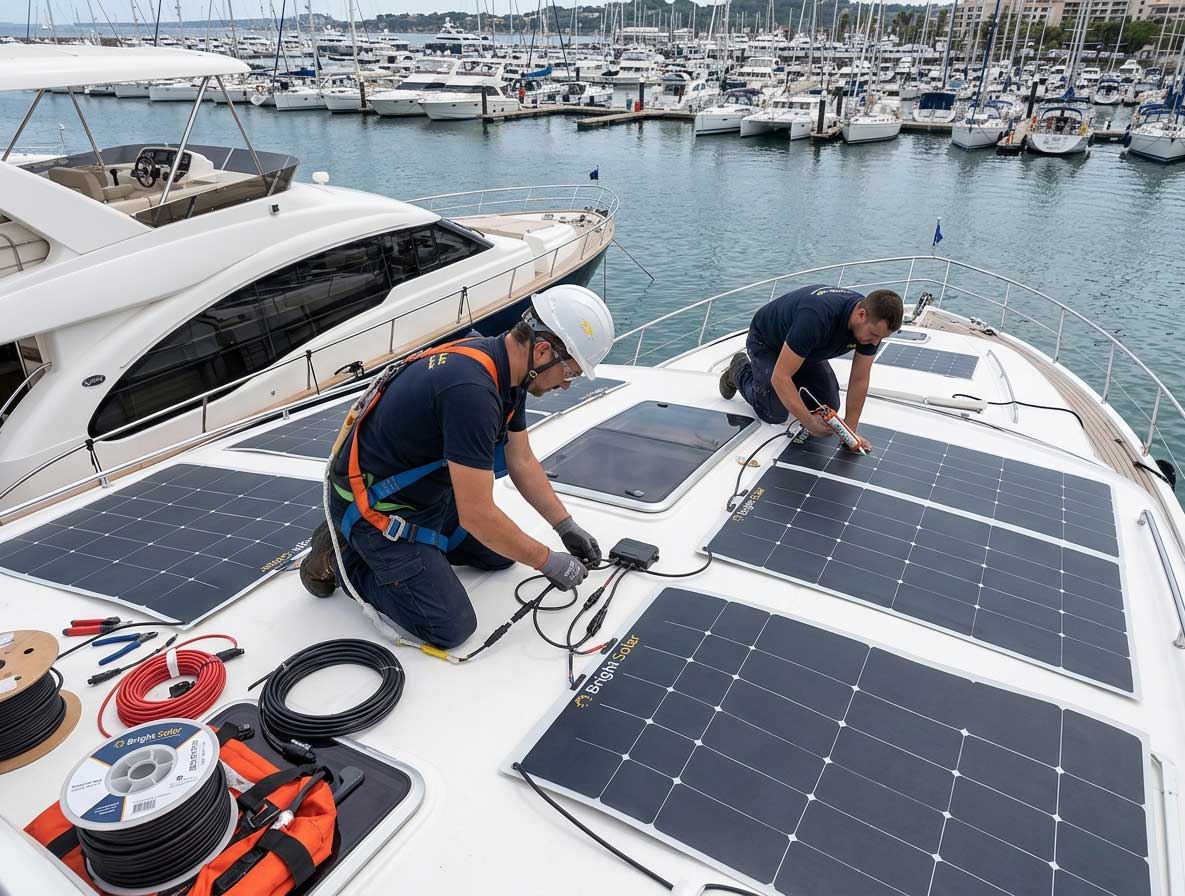
Installation Lessons Learned From Real Marine Projects
After years of marine installations, certain patterns appear repeatedly.
The most successful projects focus on:
- Waterproof cable routing
- UV-resistant wiring
- High-quality connectors
- MPPT charge controllers
- Proper battery sizing
Interestingly, solar panels themselves are rarely the source of problems.
More commonly, issues arise from:
- Poor cable management
- Water intrusion
- Inadequate strain relief
- Incorrect controller settings
A marine solar system is only as reliable as its weakest connection.
That lesson repeats itself constantly.
Marine Durability and Environmental Resistance
The marine environment is relentless.
Solar equipment must withstand years of exposure to:
- Salt spray
- UV radiation
- Humidity
- Mechanical vibration
The International Electrotechnical Commission (IEC) publishes environmental testing standards widely referenced throughout the solar industry.
Reference Source:
https://www.iec.ch
High-quality marine solar panels are designed specifically to meet these challenges.
Material selection matters.
Manufacturing quality matters even more.
FAQ About Flexible Solar Panels Marine Systems
Are flexible marine solar panels waterproof?
Yes. Marine-grade flexible solar panels are designed to withstand rain, salt spray, and harsh marine conditions when properly installed.
Can flexible solar panels be installed on curved boat surfaces?
Yes. Their flexibility makes them ideal for curved decks, cabin tops, and other non-flat marine surfaces.
How long do flexible marine solar panels last?
Premium products can provide many years of reliable service depending on installation quality and environmental exposure.
Are flexible marine solar panels suitable for offshore sailing?
Absolutely. Many offshore cruisers use flexible solar systems to reduce generator usage and extend battery autonomy.
Do flexible marine solar panels require maintenance?
Minimal maintenance is required. Periodic cleaning and inspection of wiring and connectors are generally sufficient.
Final Thoughts on Flexible Solar Panels Marine Applications
The growing demand for flexible solar panels marine systems reflects a simple reality.
Modern boat owners want greater energy independence.
At Bright Solar, we’ve supplied marine solar systems for:
- Cruising yachts
- Offshore sailboats
- Catamarans
- Fishing vessels
- Expedition boats
Every vessel is different.
Yet the priorities remain remarkably consistent:
Reliable power.
Minimal weight.
Maximum freedom.
For boat owners seeking dependable renewable energy at sea, flexible solar panels marine solutions continue to be one of the most practical and effective technologies available today.
Related recommendations
-

Best Marine Solar Panels for Boats and Yachts
242Find the best marine solar panels for boats, yachts and RVs near the water. Compare flexible and rigid panels, salt-mist resistance, mounting, wiring and maintenance.
View details -
Solar Panel Series vs Parallel: Which Connection Method Is Better?
217Compare solar panel series vs parallel wiring methods to choose the right setup. Learn voltage, current, shading, and RV solar solutions with Bright Solar.
View details -
Foldable Camping Solar Panels: How to Choose and Use Them
32Foldable camping solar panels provide portable electricity for outdoor activities, RV travel, and off-grid charging. Their performance depends on sunlight, e...
View details -
400 Watt Flexible Solar Panel for Serious Off-Grid Energy Systems
184Discover how a 400 watt flexible solar panel delivers lightweight, high-output off-grid energy for RVs, boats, vans, and solar battery systems.
View details