Flexible Amorphous Solar Panels: Uses, Efficiency and Buying Guide
Direct answer:
Flexible amorphous solar panels use amorphous silicon thin-film technology in a lightweight, bendable module format. They suit applications where low weight, unusual surfaces, or flexible construction matter more than maximum power density.
What Are Flexible Amorphous Solar Panels?
Flexible amorphous solar panels combine two ideas that are often confused: amorphous silicon describes the photovoltaic material, while flexible describes the physical module construction.
Amorphous silicon, commonly written as a-Si or a-Si:H, does not have the ordered crystal structure found in conventional crystalline-silicon cells. DOE identifies amorphous silicon as one of the established thin-film photovoltaic technologies and notes that thin-film cells can be deposited on materials including glass, plastic, and metal foil.
That distinction matters when evaluating a supplier.
A flexible module can be made with different photovoltaic materials, including crystalline silicon or thin-film technologies. Likewise, an amorphous-silicon cell is not automatically a flexible solar panel. The finished product depends on its substrate, encapsulation, electrical design, and mechanical construction.
For B2B buyers, this is one of the first specifications worth clarifying before comparing quotations.
How Amorphous Silicon Works
A photovoltaic cell converts incoming sunlight into electrical energy through semiconductor materials. In an amorphous-silicon device, the active silicon layer is deposited as a thin film rather than manufactured as a conventional crystalline wafer.
The thin-film approach allows manufacturers to use very small quantities of semiconductor material and opens up module designs that are difficult to achieve with conventional Rigid Solar Panels.
DOE describes thin-film PV as generally easier to fabricate in some configurations and notes that thin-film technologies can be deposited on glass, plastic, or metal foil.
For a flexible product, however, the photovoltaic layer is only part of the engineering problem.
The substrate has to tolerate bending. The encapsulation has to protect the active layer from moisture and mechanical damage. Electrical connections have to survive repeated environmental exposure. The final laminate also needs to match the intended mounting surface.
That is where two panels with the same nominal wattage can behave very differently in an actual installation.
Flexible Amorphous Solar Panel Efficiency and Output
Efficiency is usually the first question from buyers moving from crystalline silicon to thin-film technology.
Historically, amorphous-silicon modules have generally had lower conversion efficiency than mainstream crystalline-silicon products. DOE states that thin-film PV technologies were typically less efficient than silicon wafer-based technologies, although they offer other design and manufacturing advantages.
NREL research also documents the long-standing development history of amorphous-silicon PV, including the effect known as light-induced degradation or the Staebler-Wronski effect.
This means buyers should not judge a flexible amorphous panel solely by its advertised wattage.
A more useful evaluation considers:
- Rated power under the stated test conditions
- Module efficiency
- Active area
- Weight per watt
- Thickness
- Operating temperature
- Encapsulation structure
- Bending capability
- Expected degradation behavior
- Electrical characteristics
- Mounting method
- Environmental exposure
Why Wattage Alone Can Mislead
Suppose two panels both have a 100W rating.
If one has a substantially larger surface area, the lower power density may be perfectly acceptable for a large façade, shelter roof, or other installation where available surface area is abundant.
On a compact RV roof, the calculation changes.
The roof may have vents, air conditioners, skylights, antennas, curved sections and service access points. In that situation, watts per square meter can become more important than the simple 100W label.
This is one reason DOE research on vehicle-integrated photovoltaics emphasizes the importance of limited installation area and the trade-offs between efficiency, flexibility, temperature behavior, form factor and installation requirements.
Light-Induced Degradation in Amorphous Silicon
Amorphous silicon has a specific historical technical characteristic that should not be hidden from procurement teams.
The Staebler-Wronski effect describes light-induced changes in hydrogenated amorphous silicon that can reduce initial performance before the material reaches a more stabilized condition. NREL has studied this behavior through both laboratory work and outdoor exposure testing.
For a commercial purchasing decision, the practical question is therefore not simply:
“What is the initial rated efficiency?”
It is:
“What stabilized performance does the supplier specify, under what test conditions, and what product warranty applies?”
Ask for the manufacturer’s actual datasheet rather than comparing an initial laboratory number with a stabilized field specification from another product.
Where Flexible Amorphous Solar Panels Make Sense
Flexible amorphous solar technology becomes more interesting when conventional rigid modules create a mechanical or packaging problem.
Typical applications include:
- Curved architectural surfaces
- Lightweight mobile structures
- Portable or temporary power systems
- Certain vehicle-integrated PV applications
- Remote monitoring equipment
- Off-grid shelters
- Building-integrated photovoltaic concepts
- Large surfaces where weight and conformability matter
- Specialty OEM products requiring non-standard module geometry
The strongest application is rarely “the place with the highest solar irradiance.”
It is often the place where surface geometry, weight, appearance or installation constraints make conventional modules inconvenient.
RVs and Campervans
RV roofs are a good example.
A rigid 200W module may offer strong power density, but it also creates a defined mounting footprint and additional mechanical structure. A flexible design can conform more closely to a curved roof and may reduce the visual and mechanical profile.
But flexible does not mean automatically better.
Before specifying an amorphous flexible panel for an RV, check:
- Available roof area
- Roof curvature
- Roof material
- Attachment method
- Cable routing
- Junction-box position
- Serviceability
- Walking requirements
- Heat exposure
- Required daily energy
A common field mistake is choosing the panel first and only later discovering that the roof has too many obstructions to provide the expected usable area.
Marine and Specialty Applications
Marine applications introduce another layer of engineering.
Salt spray, humidity, UV exposure, mechanical vibration and temperature cycling all affect the long-term reliability of a module assembly. A flexible panel intended for a yacht or marine platform therefore needs more than a flexible substrate.
The encapsulation system, edge construction, connectors and junction-box protection all deserve attention.
For B2B procurement, ask the supplier for the environmental ratings that actually apply to the finished module rather than assuming that “marine-grade” means the same thing across manufacturers.

Flexible Amorphous vs. CIGS vs. Monocrystalline
A useful procurement comparison starts with the photovoltaic material rather than the word “flexible.”
| Feature | Amorphous Silicon | CIGS Thin Film | Monocrystalline Silicon |
|---|---|---|---|
| Cell structure | Amorphous | Thin-film semiconductor | Crystalline |
| Typical efficiency position | Generally lower | Generally higher than traditional a-Si thin film | Generally high |
| Flexible construction | Possible | Possible | Possible |
| Material format | Thin film | Thin film | Wafer-based |
| Weight potential | Low | Low | Depends on construction |
| Area efficiency | Usually lower | Typically higher than a-Si | Typically high |
| Curved-surface potential | High with suitable substrate | High with suitable substrate | Depends on module design |
| Main strength | Thin-film form factor | Thin-film flexibility and power density | Power density and mature supply chain |
This table should be treated as a technology-level comparison, not a substitute for individual product datasheets.
Actual performance varies with cell architecture, encapsulation, substrate, module design and manufacturing process.
When Monocrystalline Is the Better Fit
If roof area is severely limited, a high-efficiency crystalline-silicon module may provide more power from the same footprint.
That is particularly relevant for:
- Small RV roofs
- Compact boats
- Limited façade areas
- Portable equipment
- High-power installations with restricted surface area
When Thin Film Deserves More Attention
Thin film becomes attractive when the physical shape of the installation is itself a design constraint.
A large curved surface can sometimes accommodate a lower-power-density panel while still delivering enough total energy.
This is an engineering trade-off, not a universal technology ranking.
How to Select Flexible Amorphous Solar Panels for OEM Projects
For distributors, system integrators and equipment manufacturers, product selection should begin with the finished application.
Step 1 — Measure the Real Installation Surface
Do not measure only the nominal roof dimensions.
Record:
- Usable length
- Usable width
- Curvature
- Obstacles
- Drainage areas
- Mounting zones
- Cable entry points
- Maintenance access
A CAD drawing or full-scale roof template is useful for OEM projects with unusual geometry.
Step 2 — Establish the Energy Requirement
Start with daily energy consumption rather than panel wattage.
For example, if a small off-grid monitoring system requires approximately 600 Wh per day, the design cannot simply assume that a 600W panel produces 600 Wh every day.
Solar output varies with irradiance, orientation, temperature, shading, system losses and local weather.
The U.S. Department of Energy and NREL both provide resources explaining why PV production depends on site conditions rather than nameplate wattage alone.
Step 3 — Confirm Mechanical Requirements
Request documented information for:
- Maximum bending radius
- Permitted bending direction
- Static versus repeated bending
- Surface compatibility
- Mounting method
- Minimum installation temperature
- Operating temperature
- Encapsulation construction
Do not assume that a panel described as “flexible” is designed for repeated folding.
Flexible and foldable are not interchangeable engineering terms.
Step 4 — Check Electrical Integration
Before approving samples, confirm:
- Rated power
- Voc
- Vmp
- Isc
- Imp
- Connector specification
- Junction-box configuration
- Series/parallel requirements
- Charge-controller compatibility
- Inverter compatibility
For larger B2B projects, ask the manufacturer for the complete electrical datasheet and drawing rather than relying on marketplace listings.
A Practical OEM Case: Curved Off-Grid Equipment
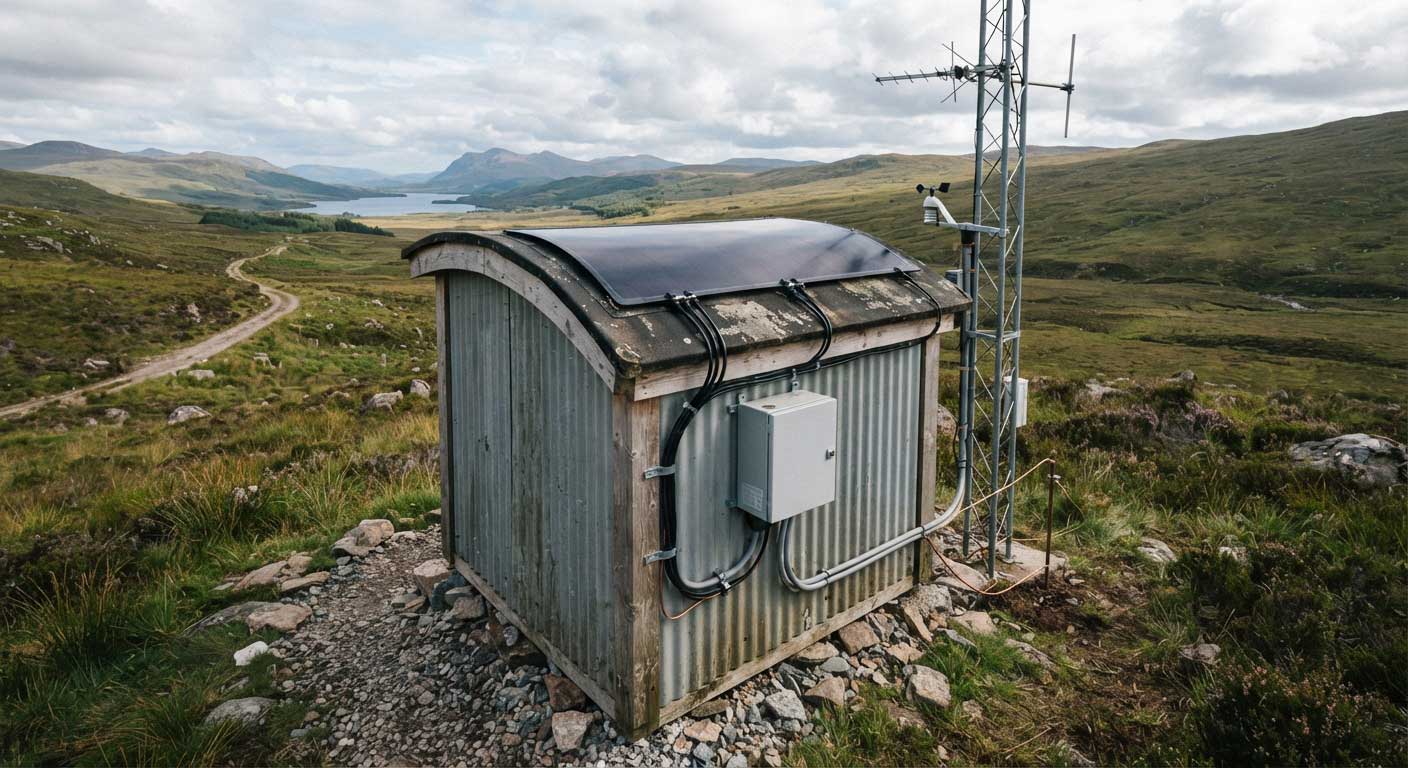
Consider a hypothetical but realistic OEM project: a European manufacturer is developing a remote communications shelter with a shallow curved roof.
The design team initially considers rigid crystalline modules.
The first engineering review identifies three problems: the roof cannot accept conventional mounting rails, the available surface has a noticeable curve, and the equipment enclosure has a strict weight target.
Instead of asking which panel has the highest efficiency, the team changes the procurement question:
Which module can provide the required electrical output while meeting the roof’s weight, geometry and installation constraints?
The supplier evaluation then compares:
- Wattage per module
- Weight per square meter
- Active area
- Curvature compatibility
- Encapsulation
- Connector layout
- Operating temperature
- Warranty
- Sample availability
- OEM customization capability
That approach produces a much more useful engineering comparison than searching for “highest efficiency flexible solar panel.”
Installation Details That Matter
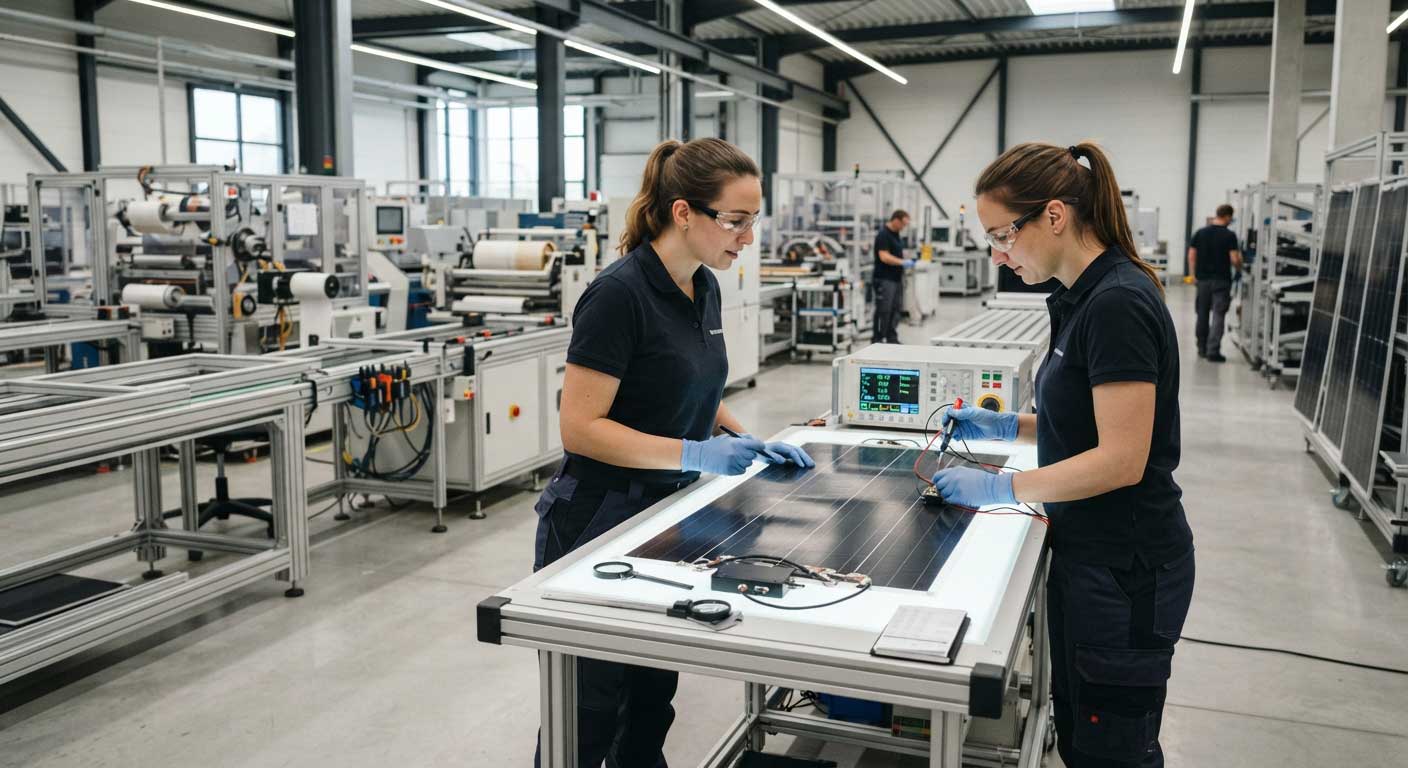
A flexible panel can look simple once it is on the roof. The difficult part is often underneath.
Surface Preparation
For adhesive or bonded installations, the mounting surface should be:
- Clean
- Dry
- Structurally sound
- Free from loose coatings
- Compatible with the selected adhesive system
Dust, wax, silicone residue and poorly prepared coatings can compromise adhesion.
Do not treat the adhesive as an afterthought. For a long-term installation, the bonding system becomes part of the mechanical design.
Avoid Sharp Bends
The panel should be installed according to the manufacturer’s specified bending limits.
A smooth roof curvature and a sharp crease are completely different mechanical conditions.
Never force a flexible module around a corner simply because it appears physically possible during installation.
Plan Cable Routing Before Bonding
This is an easy mistake to avoid.
Dry-fit the module.
Mark the cable route.
Check where the connector will sit.
Confirm that the cable will not become a trip point, pinch point or water-collection path.
Only then complete permanent installation.
Common Mistakes When Buying Flexible Amorphous Solar Panels
Mistake 1 — Comparing Only Wattage
A 200W module is not automatically the better product than a 150W module if the 200W module cannot fit the available surface.
Mistake 2 — Assuming All Thin Film Is Amorphous Silicon
CIGS and amorphous silicon are different thin-film technologies. Ask the manufacturer to identify the actual photovoltaic material.
Mistake 3 — Treating Flexible as Foldable
A flexible module may tolerate a specified installation curvature without being designed for repeated folding.
Mistake 4 — Ignoring Stabilized Performance
For amorphous silicon, ask specifically how rated performance is defined and whether the supplied figures represent initial or stabilized conditions.
Mistake 5 — Choosing From a Product Photo
A photograph cannot tell you the bending radius, electrical characteristics, encapsulation structure or environmental limitations.
For B2B purchasing, the datasheet should come first.
Bright Solar Flexible Solar Panel Solutions for B2B Projects
Bright Solar focuses on flexible and semi-flexible solar panel solutions for applications where standard rigid modules are not always practical.
For OEM and ODM projects, the important conversation is not simply the requested wattage.
A useful specification discussion includes:
- Required power
- Target dimensions
- Available installation area
- Surface curvature
- Weight restrictions
- Cell technology
- Encapsulation requirements
- Electrical configuration
- Connector requirements
- Application environment
- Quantity
- Customization requirements
Bright Solar’s flexible-panel product development covers applications such as RVs, campers, outdoor power, off-grid systems and selected marine applications.
For buyers considering amorphous silicon specifically, the first step should be confirming whether the required module architecture and application are actually suitable for a-Si rather than assuming the material is the best match.
That distinction can save a surprising amount of time during prototype development.
FAQ About Flexible Amorphous Solar Panels
What are flexible amorphous solar panels?
Flexible amorphous solar panels are photovoltaic modules using amorphous silicon thin-film technology in a flexible module construction. They are designed for applications where lightweight construction, conformability or unusual mounting surfaces are important.
Are flexible amorphous solar panels efficient?
Amorphous silicon generally has lower conversion efficiency than mainstream crystalline-silicon PV. DOE identifies lower efficiency as one of the traditional trade-offs of thin-film technologies, although thin film can provide advantages in form factor and manufacturing.
Are amorphous solar panels flexible?
Amorphous silicon can be deposited on flexible substrates, including plastic or metal foil. However, the final panel’s flexibility depends on the complete module construction rather than the silicon material alone.
What is the difference between amorphous and monocrystalline solar panels?
Amorphous silicon uses a thin-film semiconductor structure without the crystalline wafer structure used by monocrystalline silicon. Monocrystalline modules generally provide higher power density, while amorphous thin film can offer different form-factor and flexibility possibilities.
Do flexible amorphous solar panels degrade in sunlight?
Amorphous silicon has a documented light-induced degradation phenomenon known as the Staebler-Wronski effect. NREL has studied both laboratory behavior and outdoor stabilization of amorphous-silicon PV.
Can flexible amorphous solar panels be used on RVs?
They can be considered for RV applications when their electrical output, dimensions, curvature limits, environmental protection and mounting method match the vehicle. Available roof area should be measured before selecting the panel.
What should a B2B buyer request from a supplier?
Request the complete datasheet, electrical parameters, mechanical dimensions, bending specifications, environmental ratings, warranty terms, production samples and information on whether performance figures represent initial or stabilized output.
Conclusion
Flexible amorphous solar panels occupy a specific part of the photovoltaic market. Their value is not simply that they are “flexible.” The real engineering advantage can come from combining thin-film construction with a module format suited to curved, lightweight or unconventional surfaces.
For B2B projects, compare the complete system: usable area, power density, weight, mechanical limits, environmental exposure, electrical configuration and stabilized performance.
The right question is not whether amorphous silicon is universally better than crystalline silicon. It is whether its particular characteristics solve the physical constraints of the application.
Bright Solar can support OEM and ODM discussions around flexible solar panel dimensions, configurations and application requirements, helping buyers evaluate the module according to the actual installation rather than a generic product label.
Related recommendations
-

flexible solar panels for car roof: Lightweight Solar Power Solution for Vehicles
250Discover flexible solar panels for car roof solutions with lightweight design, durable ETFE protection, and reliable solar power for EVs, camping cars, and outdoor travel.
View details -
Car Roof Solar Panel: How It Works and What to Know
305Explore car roof solar panel options for EVs and conventional vehicles. Learn sizing, energy output, flexible PV, installation, shading, safety, and real-world limits.
View details -
12V Folding Solar Panel: Battery Charging, Uses and Setup
10A 12V folding solar panel provides portable solar charging for compatible 12V batteries, RVs, camping equipment, and off-grid applications. Safe, effective c...
View details -
400w Solar Panel Flexible: High Power Solar Solution for RV and Off-Grid Applications
161Discover the 400w solar panel flexible from Bright Solar for RV, marine, and off-grid applications. Learn power output, installation methods, and real-world benefits.
View details