ETFE Solar Panel Flexible: Benefits, Uses and Buying Guide
An ETFE solar panel flexible is a photovoltaic module that combines an ETFE protective surface with a construction designed to bend within specified limits. It can be useful for RVs, boats and off-grid projects where low weight or curved mounting surfaces matter. Selection still depends on verified electrical ratings, mechanical limits, environmental protection and installation requirements.
ETFE is the name of a material, not a performance rating. A panel’s suitability cannot be judged by its surface film alone: the cells, encapsulation, rear layer, connections and mounting method all contribute to how the finished module performs.
How ETFE Solar Panels Work
An ETFE flexible solar module generates electricity through its photovoltaic cells. The ETFE layer serves as the exposed front surface, while the cells convert incoming light into electrical energy. The module’s wiring collects the resulting direct-current output for use by a charge controller, battery system or other compatible equipment.
The front film is only one part of the design. The electrical behavior depends on the cell technology and circuit arrangement; mechanical behavior depends on the full laminate and support structure.
From Sunlight to Usable Power
A typical solar installation follows this path:
- Sunlight passes through the module’s transparent front layer.
- Photovoltaic cells convert part of that light into DC electricity.
- The module’s conductors collect the electrical output.
- A compatible charge controller regulates charging when batteries are used.
- An inverter may convert stored or generated DC electricity to AC for compatible loads.
A module’s rated wattage is not the same as its energy production over a day. Daily energy depends on sunlight, temperature, shading, orientation and system losses.
Why Module Construction Matters
A 2023 comparative study examined polymer front-sheet materials—including ETFE—for lightweight, glass-free crystalline-silicon flexible modules. The research considered optical, mechanical and thermal properties and tested fabricated mini-modules, illustrating that front-sheet selection is part of a broader engineering process. It does not establish that every commercial ETFE panel has the same properties or performance.
For buyers, this is the key distinction: a material study can explain why ETFE is considered, but a product datasheet and test documentation are needed to assess a particular module.
ETFE Flexible Solar Panels for RVs and Campervans

RV roofs often have vents, antennas, air-conditioning units and curved edges. A flexible module can help with some layout constraints, but the available roof area is rarely as simple as a clean rectangle on a product page.
Before selecting a panel, inspect the roof and map the locations of equipment that may cast shadows. A small shaded strip can matter, depending on the cell layout and bypass-diode design. Check the module documentation rather than assuming that every flexible panel responds to shade in the same way.
RV Buyer Checks
- Measure the usable roof area and account for roof fixtures.
- Confirm the panel’s permitted bend and approved mounting method.
- Check cable routing and protect wires from abrasion and movement.
- Verify controller voltage and current limits.
- Consider roof temperature and ventilation behind the module.
- Review maintenance access and warranty conditions.
A low-profile installation can reduce clearance concerns, but it may also limit airflow behind the panel. That trade-off should be considered when estimating performance.
ETFE Flexible Solar Panels for Boats and Marine Use
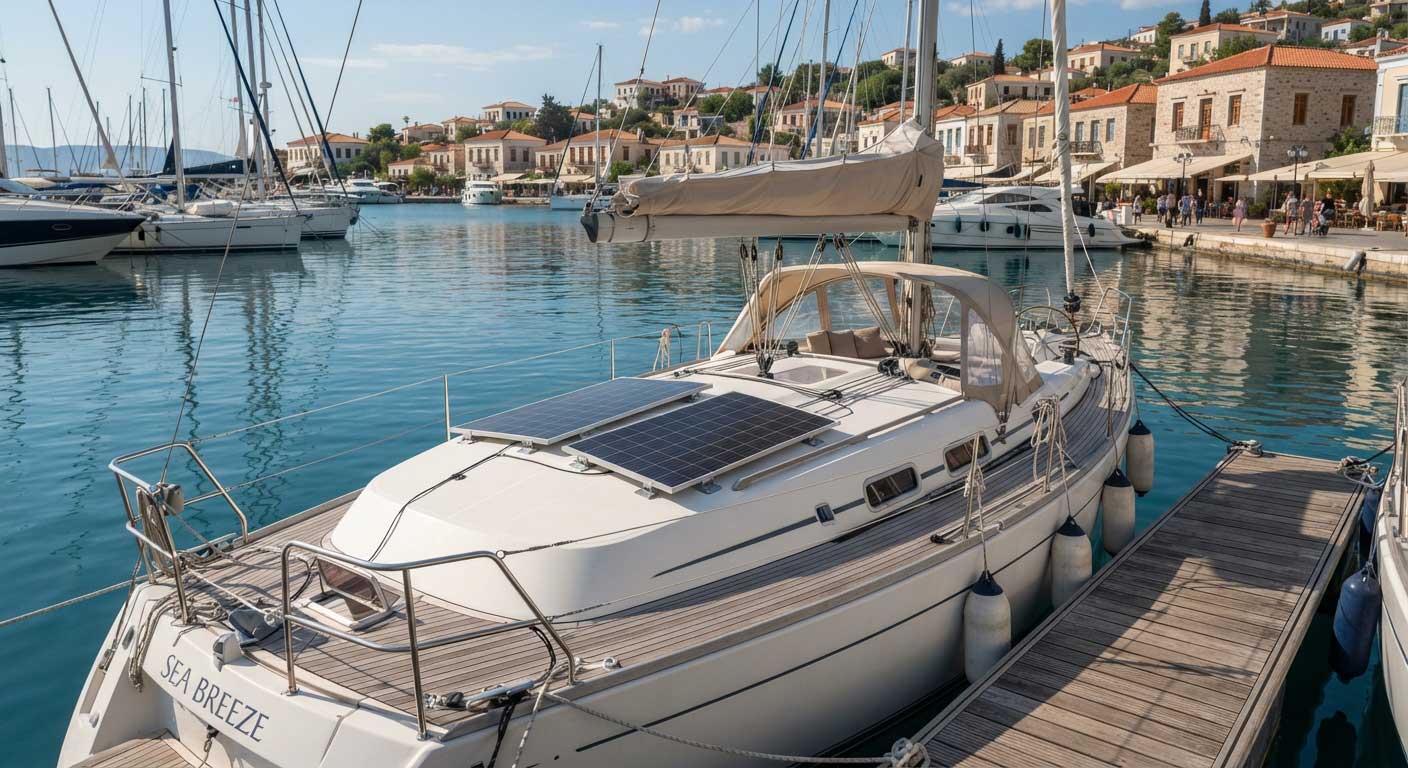
Marine installations place additional demands on a solar module. A panel may be exposed to salt spray, vibration, movement, standing water, changing weather and restricted maintenance access. ETFE as a front-sheet material does not automatically prove that a finished module is suitable for every one of these conditions.
Questions to Ask Before Marine Installation
- Does the manufacturer explicitly approve the model for the intended marine application?
- What environmental testing and ingress-protection information is available?
- Are the connectors, junction box and cable entries suitable for the expected exposure?
- Is the proposed mounting method secure under movement and vibration?
- Is the panel allowed to be walked on, or must foot traffic be avoided?
- What cleaning methods and inspection intervals does the manufacturer recommend?
For a yacht or small boat, also consider where the panel will sit relative to rigging, rails and other objects that can create shade. If the panel is installed close to a deck or cabin surface, account for reduced airflow and the possibility of higher operating temperatures.
A marine-ready claim should be supported by documentation for the complete module and its intended installation. Avoid relying on a single material name or an isolated component rating.
ETFE Flexible Solar Panels for Off-Grid Systems
Off-grid systems may use flexible modules on cabins, trailers, remote equipment or other structures where mounting weight and surface geometry matter. The solar panel is only one part of the energy system, however.
A complete design may include:
- Solar modules sized for the expected energy demand.
- A charge controller compatible with the array and battery.
- Battery storage sized for the intended autonomy.
- An inverter where AC loads are required.
- Correctly sized wiring, connectors, isolation and overcurrent protection.
- Monitoring and maintenance access.
Estimate Energy Before Choosing the Array
A simple preliminary calculation is:
Daily energy (Wh) = rated power (W) × equivalent peak-sun hours × performance factor
For example, a hypothetical 200W panel receiving four equivalent peak-sun hours would produce 800Wh before applying a performance factor. This is an illustration, not a prediction for a particular site.
A site estimate should consider seasonal sunlight, shading, orientation, soiling, temperature and system losses. NREL’s PVWatts tool allows users to model a system using location and configuration inputs, rather than treating rated power as a daily energy guarantee.
ETFE Solar Panel Flexible — Installation Considerations
Installing an ETFE flexible module requires attention to the mounting surface, permitted curvature, thermal conditions and electrical connections. The exact procedure varies by product, so the manufacturer’s manual and datasheet should take priority over general advice.
Step 1 — Inspect and Measure the Mounting Surface
Check the intended roof, deck or other surface for damage, loose coatings, sharp edges and irregularities. Measure the actual usable area rather than the overall dimensions of the roof.
Mark the position of vents, hatches, rigging, roof seams and other obstructions. Consider how their shadows may move during the day. If the surface is curved, confirm that its shape is within the module’s permitted bend limits.
Step 2 — Confirm the Mounting Method
Do not assume that every flexible panel should be glued directly to the surface. Some products may specify particular adhesives, fasteners, support arrangements or surface-preparation procedures.
Before installation:
- Check compatibility between the mounting surface and the specified adhesive or fastener.
- Follow all preparation and curing requirements.
- Avoid creasing, twisting or sharply bending the module.
- Keep drainage paths and maintenance access clear.
- Do not assume that the panel is walkable unless the exact product documentation confirms it.
Step 3 — Plan the Electrical Connections
Check the panel’s Vmp, Imp, Voc and Isc against the charge controller and the rest of the system. For multiple modules, calculate the array voltage and current for the proposed series or parallel configuration.
Include cold-weather voltage considerations and use wiring and protective devices suitable for the system. Confirm polarity and connector compatibility before making connections. Where local regulations or system complexity require it, use a qualified installer.
Step 4 — Inspect and Record the Installation
After mounting, inspect the panel edges, cable routing and connection points. Verify that the module is secure and that wires are protected from abrasion, heat and movement.
Record the model, installation date and initial electrical readings. These records can provide a useful baseline for future checks, but a single reading cannot establish expected daily energy production.
Heat, Airflow and Flexible Panel Performance
A flexible module installed close to a roof can experience different thermal conditions from a module mounted on an open rack. This is important because cell temperature affects electrical output.
NREL’s System Advisor Model documentation distinguishes rack-mounted, flush-mounted, integrated and gap-mounted configurations. Its modeling approach accounts for mounting conditions because airflow and heat transfer vary with the space between the module and the mounting surface.
NREL has also reported that module temperature can have a substantial effect on power: its discussion of array spacing describes maximum power dropping by approximately 0.3% to 0.5% per °C increase in module temperature. This is a general finding, not a guaranteed temperature coefficient for every ETFE module.
What This Means for Low-Profile Installations
When evaluating a roof-mounted flexible panel, consider:
- The amount of airflow available behind the module.
- The color and material of the mounting surface.
- The local ambient temperature and solar exposure.
- Whether the module will be directly bonded, mounted with a gap or installed using another method.
- The temperature limits and power temperature coefficient in the product datasheet.
A panel’s low profile may be valuable for clearance and appearance, but the thermal environment still needs to be included in the design and output estimate.
A Practical Example — Planning a Campervan Solar System
Consider a hypothetical campervan project using one 200W flexible module. The roof has limited clear space, and a vent may cast a shadow in the late afternoon. The owner wants to use solar energy for lighting, device charging and other auxiliary loads.
The initial calculation assumes four equivalent peak-sun hours:
200W × 4 hours = 800Wh before system losses.
That number is a planning reference only. It does not account for weather, shading, temperature, orientation, dirt, wiring or controller losses. The owner should use local solar-resource information and a realistic performance assumption before deciding whether the panel will meet the daily load.
Next, the owner lists each load and estimates its daily consumption:
| Load | Information needed |
|---|---|
| LED lighting | Rated watts and hours used each day |
| Phone and device charging | Charging power and frequency |
| Ventilation fan | Power draw and daily operating time |
| Refrigerator or other larger load | Actual energy consumption from its specifications or monitoring |
The roof layout also needs a closer look. The owner checks the vent’s shadow at different times and confirms that the proposed panel position fits the module’s dimensions and mounting requirements. Controller input limits and battery charging requirements are verified before the equipment is purchased.
Practical insight: a panel that fits the roof is not necessarily a panel that fits the energy plan. For mobile installations, the load estimate, shading pattern and mounting details should be reviewed together.
Comparing ETFE Flexible Solar Panels for Procurement
For distributors, OEM buyers and system integrators, comparisons should use equivalent information from each supplier. Avoid treating ETFE as a complete specification or assuming that all products using the same surface material have identical characteristics.
| Evaluation area | What to verify |
|---|---|
| Front-sheet material | Is ETFE specified, and what product documentation describes it? |
| Cell technology | What cell type and electrical configuration are used? |
| Power rating | What is the rated output and stated tolerance? |
| Electrical data | Are Vmp, Imp, Voc and Isc available for the exact model? |
| Mechanical limits | What bend radius or curvature is permitted? |
| Construction | What are the encapsulant, rear layer and edge-sealing details? |
| Environmental suitability | What module-level tests and ratings are documented? |
| Installation | Which adhesives, fasteners or support methods are approved? |
| Thermal behavior | Is a power temperature coefficient or relevant thermal data provided? |
| Warranty and support | What coverage, exclusions, manuals and technical support are available? |
Bright Solar offers flexible and semi-flexible solar panel products for B2B projects. Its L Series is described as providing up to 30% flexibility, a DuPont ETFE surface and salt-water resistance. Its H Series is positioned for marine and yacht applications, with double ETFE construction, a walkable design and an IP67 junction box. Buyers should confirm all details against the exact model’s current documentation.
A useful procurement practice is to send the same application brief to every supplier. Include the mounting surface, expected environmental exposure, target power, system voltage, project quantity and any requirements for customization. This makes it easier to identify missing information before the design is finalized.
FAQ About ETFE solar panel flexible
What is an ETFE solar panel flexible module?
An ETFE solar panel flexible module uses ETFE film as a protective front surface and has a construction designed to bend within specified limits. ETFE identifies the material; the module’s complete structure determines its flexibility and operating characteristics.
What are the benefits of ETFE on flexible solar panels?
ETFE film is used in solar applications for properties such as optical transparency retention, weatherability and flexibility. Those material properties do not guarantee the performance or service life of a finished module; product-level testing and warranty information are still necessary.
Can ETFE flexible solar panels be mounted on curved roofs?
They may be suitable for some curved roofs if the curvature is within the module’s stated limits and the mounting method is approved. Do not crease the panel or force it to fit a surface outside those limits.
Are ETFE flexible solar panels suitable for boats?
Some flexible modules may be designed for marine applications, but suitability must be confirmed for the exact product. Review environmental ratings, connectors, mounting security, salt exposure guidance and warranty conditions.
Do ETFE flexible solar panels overheat when mounted close to a roof?
Close mounting can restrict airflow and affect module temperature. NREL’s modeling documentation treats mounting configuration as a factor in heat transfer and module-temperature estimates. Review the product’s thermal data and installation instructions before selecting a mounting method.
Can ETFE flexible solar panels be walked on?
Only when the manufacturer explicitly identifies the exact module as suitable for foot traffic and specifies the conditions. An ETFE front layer or flexible construction does not automatically make a panel walkable.
How do I estimate the daily output of an ETFE flexible solar panel?
Start with rated power multiplied by equivalent peak-sun hours, then account for temperature, shading, orientation, soiling and system losses. A calculation based only on wattage and sunlight hours is a preliminary estimate, not a guaranteed output.

Conclusion
An etfe solar panel flexible module combines an ETFE front surface with a construction designed to bend within defined limits. It may be a practical option for selected RV, marine and off-grid installations, but the ETFE material alone cannot establish its output, durability or environmental suitability.
Check the complete module specifications, permitted curvature, mounting method, temperature behavior, electrical compatibility and warranty before buying. For B2B projects, compare suppliers using the same application requirements and request model-specific documentation. Bright Solar’s flexible and semi-flexible products can be evaluated through this same process, with selection based on the actual project rather than the surface material alone.
Related recommendations
-

Flexible 200W Solar Panel: Output, Uses and Installation Guide
128A flexible 200W solar panel can suit selected RV, marine, and off-grid systems, but actual output depends on sunlight, temperature, shading, orientation, and...
View details -
Enphase Expands Mini Inverter Deployment in Southern California
336Enphase expands Mini inverter deployment in Southern California, with more homes adopting IQ8 Microinverters and IQ Batteries to prepare for summer outages. Local installers from Anaheim to Riverside share how sunlight-only backup and flexible sys...
View details -
Flexible 400 Watt Solar Panel: Output, Uses and Installation
148A flexible 400 watt solar panel can suit selected RV, marine, and off-grid systems, but actual energy output depends on sunlight, temperature, shading, orien...
View details -
400w Solar Panel Size: Dimensions, Power Output, and Installation Guide
231A 400W solar panel typically measures about 65–82 × 39–44 inches, with actual dimensions varying by manufacturer, cell technology, and module design.
View details