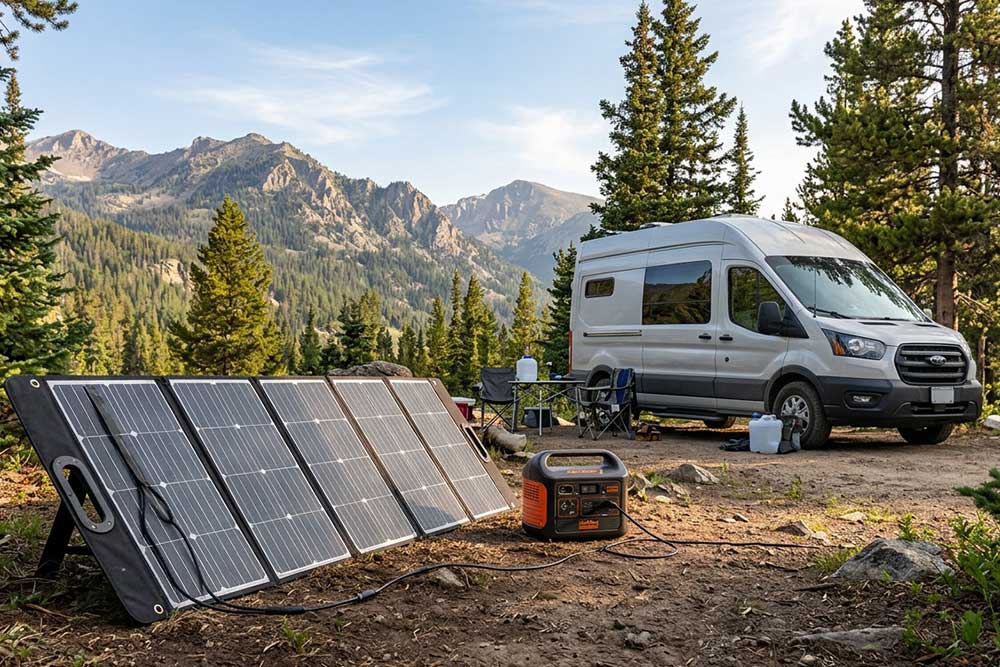
eco worthy flexible solar panels: Features, Uses and Buying Guide
eco worthy flexible solar panels are lightweight photovoltaic modules designed for installations where conventional rigid panels may be difficult to mount. They can suit curved or weight-sensitive surfaces on RVs, boats and other off-grid equipment, but buyers should check rated output, dimensions, mounting limits, heat exposure and electrical compatibility before choosing a panel.
Flexible panels are not automatically suitable for every curved roof or marine environment. The right choice depends on the surface, operating conditions and the system they will connect to.
What Are ECO-WORTHY Flexible Solar Panels?
Flexible solar panels are photovoltaic modules built to bend within specified limits rather than rely on a rigid glass-and-frame structure. They are intended for installations where weight, profile or surface shape can make a conventional framed panel awkward to use.
The ECO-WORTHY range includes flexible products designed for mobile and off-grid applications. For example, the company’s 130W 18BB flexible mono panel is promoted for RVs, boats, cabins, tents, trailers and other irregular surfaces. Its listed construction is just 0.1 inch thick and weighs 6.28 lb. These are model-specific details, not specifications that should be assumed for every flexible panel.
Flexible Does Not Mean Foldable
The terms are often used interchangeably in casual conversation, but they describe different product formats.
- Flexible Solar Panels: Can curve within the manufacturer’s stated bending limits.
- Foldable panel: Usually has hinged or segmented sections designed to fold for transport and unfold during use.
- Rigid Solar Panels: Uses a comparatively stiff structure, often with a glass front and frame.
A flexible panel should not be creased, sharply folded or repeatedly bent beyond its documented limits. Its permitted curve and mounting method must come from the instructions for that exact model.
Why Buyers Consider Flexible Modules
The appeal is practical. On a campervan roof, for example, a low-profile panel may reduce the need for a tall mounting structure. On a boat, the available mounting area may be curved or constrained by deck fittings. A lighter module can also be easier to handle during installation.
But flexibility alone does not establish durability, suitability for walking on, or resistance to a particular marine environment. Those depend on the module’s construction, installation method and published ratings.
ECO-WORTHY Flexible Solar Panel Features and Specifications
A product page is a useful starting point, but the model number matters. ECO-WORTHY sells multiple panel types, and the specifications of one module should not be transferred to another.
The following table summarizes the manufacturer’s published details for its 130W 18BB flexible monocrystalline panel. Check the current product listing and manual before designing a system, particularly if the product version or SKU differs.
| Specification | ECO-WORTHY 130W flexible panel |
|---|---|
| Rated power | 130W |
| Maximum power voltage (Vmp) | 21.10V |
| Maximum power current (Imp) | 6.16A |
| Open-circuit voltage (Voc) | 24.50V |
| Short-circuit current (Isc) | 6.50A |
| Solar cell type | Monocrystalline |
| Output tolerance | ±3% |
| Dimensions | 37.8 × 27.1 × 0.1 in |
| Weight | 6.28 lb |
| Listed temperature range | −40°C to +85°C |
| Cable and connector | 4 mm² (11 AWG), MC4 |
| Junction box rating | IP68, as listed by the manufacturer |
| Mounting features | Six reinforced mounting holes |
Important: The table describes this specific 130W model. It does not establish the specifications, warranty, bend limits or installation requirements of all ECO-WORTHY flexible panels.
Understanding the Electrical Ratings
Rated power is measured under specified test conditions. It is not a promise that a panel will continuously deliver 130W on a vehicle roof or boat deck.
Vmp and Imp describe voltage and current at the module’s maximum-power point. Voc is the open-circuit voltage, while Isc is the short-circuit current. These values are used when checking controller compatibility, wiring arrangements and protective equipment.
A charge controller must be selected using the complete system design—not merely the panel’s wattage. In particular, the array’s voltage under the coldest expected conditions must remain within the controller’s permitted input range. Follow the controller and module manuals, and have a qualified installer verify the design where required.
Where Can ECO-WORTHY Flexible Solar Panels Be Used?

RVs, Campervans and Mobile Homes
RVs and campervans are common use cases because roof space, height and weight can be restricted. A flexible module may be worth evaluating when the roof is curved or when the owner wants a low-profile installation.
Before mounting one, inspect the roof material, available flat or gently curved area, drainage paths, vents and air-conditioning equipment. Avoid placing a panel where it will be regularly shaded by roof accessories if another layout is practical.
The installation should also allow for cable routing, strain relief and access to the electrical components. A panel that fits physically may still be unsuitable if it cannot be secured as required or if the roof surface is not compatible with the proposed adhesive or fasteners.
Boats and Marine Applications
Flexible modules may be considered for boats where deck geometry and weight are important. However, a boat environment introduces additional concerns: salt exposure, standing water, vibration, movement, maintenance access and the risk of damage from foot traffic.
Do not assume that a flexible panel is walkable or suitable for permanent marine exposure simply because it can bend. Confirm the manufacturer’s marine-use guidance, ingress-protection rating, installation limitations and maintenance requirements for the exact model.
Cabins, Trailers and Off-Grid Equipment
Small off-grid installations may use flexible panels where the mounting surface is curved or where a lightweight module is useful. The system still needs a compatible controller, battery or other load arrangement, suitable wiring and appropriate protection.
ECO-WORTHY’s product information identifies several mobile and off-grid use cases, but actual suitability depends on site conditions and the specific module’s documentation.
How Much Electricity Can a Flexible Solar Panel Produce?
A panel’s wattage is its rated power under standard test conditions, not its guaranteed daily energy production. Real-world output changes with sunlight intensity, module temperature, orientation, shading and the electrical system connected to it.
The U.S. Department of Energy explains that photovoltaic cells convert sunlight into electrical energy and that modules are combined into arrays to meet different power requirements. It also identifies temperature and other factors as influences on PV performance.
Estimate Daily Energy Output
A simple planning estimate is:
Daily energy (Wh) = panel rated power (W) × equivalent peak-sun hours × system performance factor
For an illustrative 130W panel:
| Assumed peak-sun hours | Theoretical energy before losses |
|---|---|
| 2 hours | 260Wh/day |
| 4 hours | 520Wh/day |
| 5 hours | 650Wh/day |
These figures are arithmetic examples, not a forecast for a specific location. They assume the panel receives the equivalent of the stated number of full-power sunlight hours. Actual energy can be lower because of weather, shading, heat, orientation, dirt, wiring and controller losses.
ECO-WORTHY advertises up to 520Wh per day for its 130W product under four hours of full sunlight. Treat that as a seller’s stated estimate under its assumptions rather than a guaranteed daily result.
Why Roof Temperature and Shading Matter
A panel mounted close to a roof may have less airflow behind it than a raised, rack-mounted module. Heat can reduce electrical output: the U.S. Department of Energy notes that higher cell temperatures generally reduce voltage and can lower PV performance.
Shading is another concern. On an RV, a roof vent, antenna or air conditioner can cast a shadow across part of the array. Even when most of the panel is in sunlight, the effect of partial shading depends on the module’s electrical layout and bypass-diode design.
For this reason, evaluate the installation location at different times of day rather than judging it from a single midday photograph.
What to Check Before Buying ECO-WORTHY Flexible Solar Panels
The following checks can help prevent a panel that looks suitable from becoming a poor fit once installation begins.
1. Measure the Available Mounting Area
Measure the usable surface rather than the entire roof or deck. Leave room for cable exits, mounting points, drainage and access to nearby equipment.
Check:
- Panel length and width against the actual mounting area.
- Whether the surface is flat or curved.
- Whether roof fixtures will shade the panel.
- Whether the proposed location allows safe maintenance.
- Whether the surface material is suitable for the intended mounting method.
2. Confirm the Permitted Bend and Mounting Method
Do not estimate a panel’s bend limit by hand. Use the manual for the exact model and follow its instructions on curvature, support, adhesive, fasteners and handling.
ECO-WORTHY’s 130W product listing describes a flexible design and several installation approaches. The product’s published claims should still be checked against the current manual and the requirements of the surface where it will be installed.
3. Check Controller and Battery Compatibility
Before connecting a panel, verify:
- The controller’s permitted PV input voltage and current.
- The panel’s Voc and Isc.
- The number of panels and whether they will be wired in series, parallel or a combination.
- The battery voltage and chemistry supported by the charge controller.
- Cable size, connector compatibility, fusing and isolation requirements.
Never assume that a panel described as “12V” can be connected directly to any 12V battery. The module’s operating voltage and the battery charging requirements are different considerations.
4. Read the Warranty and Installation Conditions
Warranty coverage can depend on the model, seller, installation method and operating conditions. Review the applicable warranty document and retain proof of purchase. If the panel will be used in a marine environment or bonded directly to a roof, confirm that the installation method is allowed.
The official ECO-WORTHY manual resources include a manual entry for the 130W 12V flexible monocrystalline panel. Use the document matching the product you intend to purchase.
How Bright Solar Approaches Flexible Solar Panel Selection
For B2B buyers, the question is not simply whether a panel bends. It is whether its construction and electrical characteristics match the installation, the operating environment and the project’s requirements.
Bright Solar manufactures flexible and semi-flexible solar panel products for applications including mobile, outdoor and marine-related systems. Its L Series is described as offering up to 30% flexibility, a DuPont ETFE surface and salt-water resistance; its H Series is positioned for marine and yacht applications, with double ETFE construction and a walkable design. These are Bright Solar product-family descriptions and should not be treated as specifications for ECO-WORTHY products.
When comparing products, buyers should request the exact datasheet and verify at least the rated power, voltage and current values, dimensions, weight, bending limits, surface material, junction-box rating, mounting requirements and warranty conditions. Matching those details to the installation is more useful than relying on broad labels such as “ultra-flexible” or “marine-ready.”
How to Install ECO-WORTHY Flexible Solar Panels
Installing flexible solar panels requires more than attaching a lightweight module to a roof. The mounting surface, bend limits, cable routing and electrical protection all affect the result. Always follow the instructions supplied with the exact panel model; the steps below are a general planning guide, not a substitute for the manufacturer’s installation manual.
Step 1 — Inspect and Prepare the Surface
Start with a careful inspection of the intended mounting area.
- Check the roof or deck for cracks, loose coatings, corrosion or other damage.
- Measure the usable area and mark obstructions such as vents, hatches and roof-mounted equipment.
- Confirm that the panel’s dimensions and permitted curvature suit the surface.
- Clean and prepare the mounting area using a method compatible with the roof material and the manufacturer’s instructions.
- Plan the cable route before fixing the module in place.
A surface can appear smooth but still have a crown, channel or raised seam that places stress on the panel. Avoid forcing a module to conform to a shape beyond its stated limits.
Step 2 — Position and Secure the Panel
Dry-fit the panel first. Check that it lies within the permitted curvature and that its mounting points can be used as intended.
Use only the mounting approach allowed by the product documentation. If adhesive is specified, confirm compatibility with both the panel and the mounting surface. If fasteners are used, make sure the installation does not create water-ingress points or put excessive stress on the module.
Do not assume that a flexible panel can be walked on. A walkable rating must be explicitly stated for the particular product and installation conditions.
Step 3 — Route and Protect the Wiring
Plan wiring so that it is protected from abrasion, sharp edges, water accumulation, excessive heat and movement. On a vehicle or boat, allow for vibration and movement without leaving cables loose or unsupported.
Before connecting the panel:
- Confirm polarity and connector compatibility.
- Check that the charge controller supports the panel’s voltage and current.
- Verify that array voltage remains within the controller’s limits, including under cold conditions.
- Install appropriate overcurrent protection and isolation in accordance with the system design and applicable electrical requirements.
- Follow the controller and battery manufacturers’ connection sequence.
If you are uncertain about the electrical design, have a qualified installer check it before energizing the system.
Step 4 — Test the System and Record a Baseline
Once installation is complete, inspect the module, cable entries and mounting points. Check the controller display or monitoring system for plausible voltage, current and charging behavior.
Record the date, panel model, installation location and initial readings. A baseline can help identify later changes caused by shading, dirt, loose connections or damage. Do not treat a single reading as proof of expected daily energy production; sunlight and module temperature change throughout the day.
Practical Example — Planning a 130W Flexible Panel for a Campervan
Consider a hypothetical campervan owner evaluating one 130W flexible panel for a modest auxiliary electrical system. This example illustrates the planning method; it is not a measured ECO-WORTHY installation or a performance guarantee.
The owner estimates that the panel could receive an average of four equivalent peak-sun hours on a favorable day. The simple theoretical energy estimate is:
130W × 4 hours = 520Wh per day before system losses.
That figure does not account for shading, high module temperature, wiring losses, controller conversion losses or poor weather. The owner should therefore avoid treating 520Wh as a dependable daily supply.
The next step is to list the loads. For instance, suppose the daily energy budget includes a few LED lights, phone charging and a small ventilation fan. The owner should estimate each device’s wattage and daily operating time, then compare the total with realistic solar production and available battery capacity.
Before purchasing, the owner also needs to check whether the roof is suitable for the module’s dimensions and mounting method. If a roof vent casts a shadow across the panel for part of the day, the installation position may matter as much as the nominal wattage.
What this example demonstrates: panel sizing should begin with the load estimate and mounting conditions, not with the largest wattage that will physically fit. The owner should verify the current product datasheet and controller requirements before proceeding.
Common Mistakes to Avoid
Choosing by Wattage Alone
Two panels with similar rated power may differ in dimensions, operating voltage, weight, construction and permitted mounting conditions. Compare the complete specifications rather than assuming that the wattage tells the whole story.
Ignoring Heat and Ventilation
A low-profile installation can restrict airflow behind the module. Since PV output is affected by cell temperature, the roof environment should be considered during system planning. Avoid promising a fixed output based only on the panel’s nameplate rating.
Bending the Panel Too Far
“Flexible” does not mean the panel can be folded, creased or bent in any direction. Respect the model-specific bending limits and do not apply force to make the module fit an unsuitable surface.
Overlooking Partial Shade
Roof accessories, rigging, nearby structures and trees can cast shadows. Inspect the proposed location over the likely operating hours, and consider how partial shading may affect the array’s electrical behavior.
Assuming Every Model Has the Same Protection
Ingress protection, surface materials, walkability, salt-water resistance and warranty conditions vary by product. Check the exact model’s documentation before using it in a demanding environment.
ECO-WORTHY Flexible Solar Panels — Buyer Checklist
Use this checklist when reviewing a product listing or requesting information from a supplier.
| Item to verify | Why it matters |
|---|---|
| Exact model and SKU | Prevents specifications from being confused between product versions |
| Rated power and tolerance | Establishes the stated output rating and its permitted variation |
| Vmp, Imp, Voc and Isc | Supports controller, wiring and protection design |
| Dimensions and weight | Confirms fit and handling requirements |
| Permitted bend limits | Helps prevent mechanical stress and installation damage |
| Mounting instructions | Confirms approved adhesives, fasteners and surface requirements |
| Temperature range | Helps assess the intended operating environment |
| Junction-box and connector details | Supports environmental and electrical compatibility checks |
| Warranty terms | Clarifies coverage, exclusions and installation conditions |
| Marine or walkable approval, if needed | Avoids relying on assumptions based on appearance or flexibility |
For the ECO-WORTHY 130W product, the manufacturer lists MC4 connectors, a junction box rated IP68, six reinforced mounting holes and a −40°C to +85°C temperature range. Confirm those details against the current listing and matching manual before using them in a project specification. ECO-WORTHY 130W flexible solar panel
Flexible Solar Panel Applications — RV, Marine and Off-Grid Projects
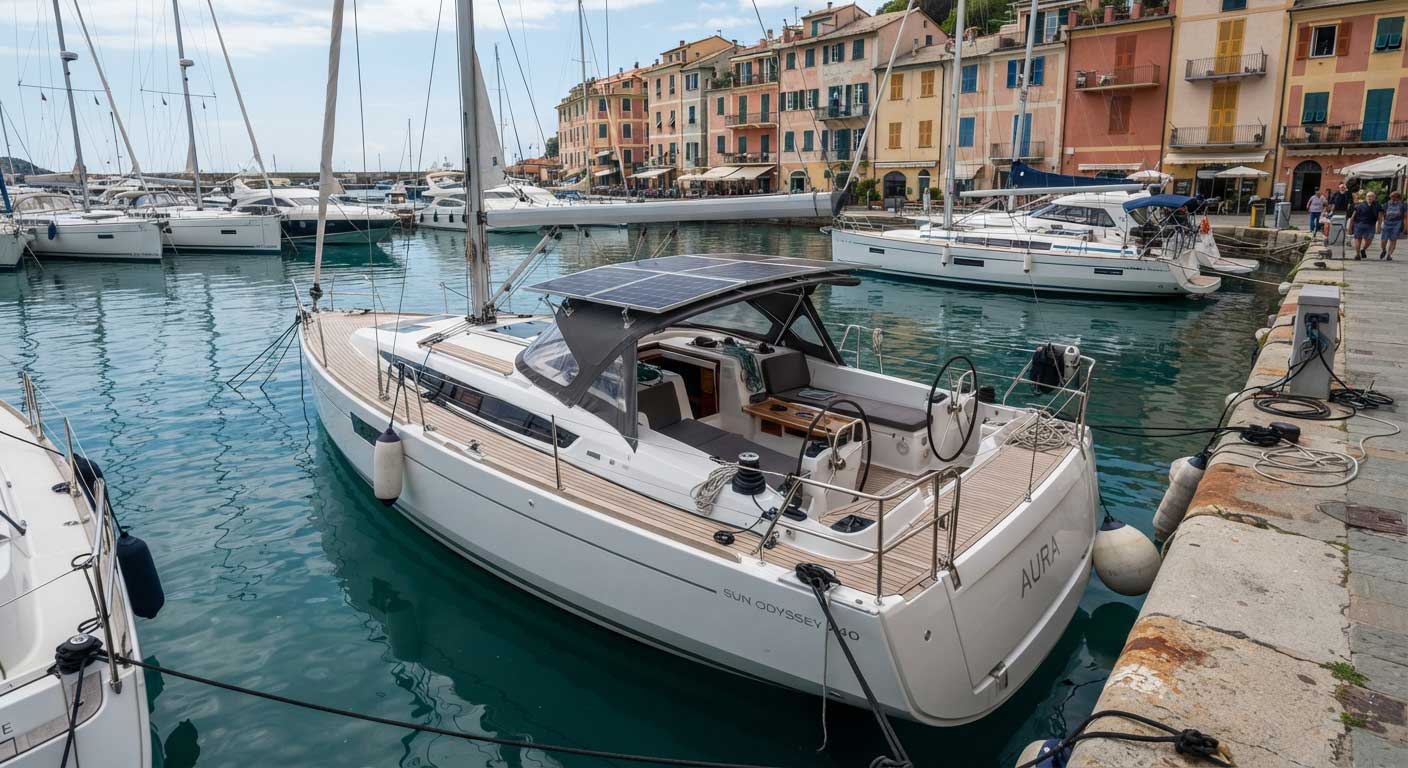
Flexible panels may be considered for several installation types, but the same product is not necessarily appropriate for every one.
- RVs and campervans: Evaluate roof curvature, shading from accessories, vibration and the available mounting area.
- Boats and yachts: Confirm marine suitability, environmental ratings, mounting security and resistance to the conditions expected at the installation site.
- Trailers and mobile homes: Consider roof construction, movement during transport and cable protection.
- Cabins and off-grid equipment: Check the available surface, local sunlight conditions, controller compatibility and the energy requirements of the loads.
A good installation is one that meets the site’s physical and electrical requirements—not simply one where the panel can be made to fit.
ECO-WORTHY Flexible Solar Panels vs. Other Flexible Panel Options
A useful comparison should be based on verifiable specifications rather than brand reputation or broad product labels. When evaluating ECO-WORTHY alongside another supplier, compare the exact models and the intended application.
| Comparison point | Questions to ask |
|---|---|
| Mechanical design | What curvature is permitted, and how must the panel be supported? |
| Module construction | What materials protect the cells, and how is the module sealed? |
| Electrical ratings | Are Vmp, Imp, Voc and Isc provided for the exact model? |
| Environmental suitability | What temperature and ingress-protection ratings are documented? |
| Installation | Are adhesives, mounting holes or specific fasteners required? |
| Performance information | Are output estimates tied to stated sunlight and test assumptions? |
| After-sales support | Are warranty terms, manuals and technical support available? |
Bright Solar’s flexible and semi-flexible products are developed for B2B applications. The L Series is described as offering up to 30% flexibility, a DuPont ETFE surface and salt-water resistance. The H Series is positioned for marine and yacht applications and is described as having double ETFE construction, a walkable design and an IP67 junction box. Buyers should verify the specifications and limitations of the precise Bright Solar model being considered.
For OEM, project or distribution purchasing, request current datasheets and clarify the installation environment before comparing prices. A lower initial price does not by itself establish lower lifetime cost; installation labor, replacement access, warranty terms and system compatibility can also affect project economics.
FAQ About eco worthy flexible solar panels
Are ECO-WORTHY flexible solar panels suitable for RVs?
They may be suitable for some RV installations, depending on the model, roof surface, curvature, shading and electrical system. Check the manufacturer’s mounting instructions and verify that the module is approved for the intended roof and operating conditions.
Can ECO-WORTHY flexible solar panels be bent?
Flexible modules can curve only within their specified mechanical limits. Do not crease or fold a panel unless its documentation explicitly permits that movement. Confirm the allowable bend and mounting geometry for the exact model.
How much energy can a 130W flexible solar panel produce per day?
Daily production depends on sunlight, temperature, shading, orientation and system losses. As a simple theoretical example, 130W multiplied by four equivalent peak-sun hours gives 520Wh before losses. This is an estimate under stated assumptions, not a guaranteed daily output.
Can I connect a flexible solar panel directly to a 12V battery?
Do not assume that direct connection is appropriate. Check the panel’s electrical ratings and the battery’s charging requirements, and use a compatible charge controller and correctly designed protection and wiring unless the system documentation explicitly specifies otherwise.
Are all ECO-WORTHY flexible panels waterproof?
Do not assume every model has the same water-resistance rating. Check the product’s junction-box and module documentation, including any limitations on immersion, exposure, connectors and installation orientation. An IP rating for one component does not automatically establish the rating of the entire installed system.
Can flexible solar panels be installed on a boat?
Some flexible panels are marketed for marine applications, but suitability depends on the specific model and installation. Verify its environmental ratings, mounting requirements, exposure limitations and whether the manufacturer permits the intended use on a boat.
What should I compare before buying ECO-WORTHY flexible solar panels?
Compare the exact model’s power, voltage and current ratings, dimensions, weight, bending limits, construction, mounting instructions, environmental ratings, warranty and compatibility with the charge controller. Match these details to the installation site and expected loads.
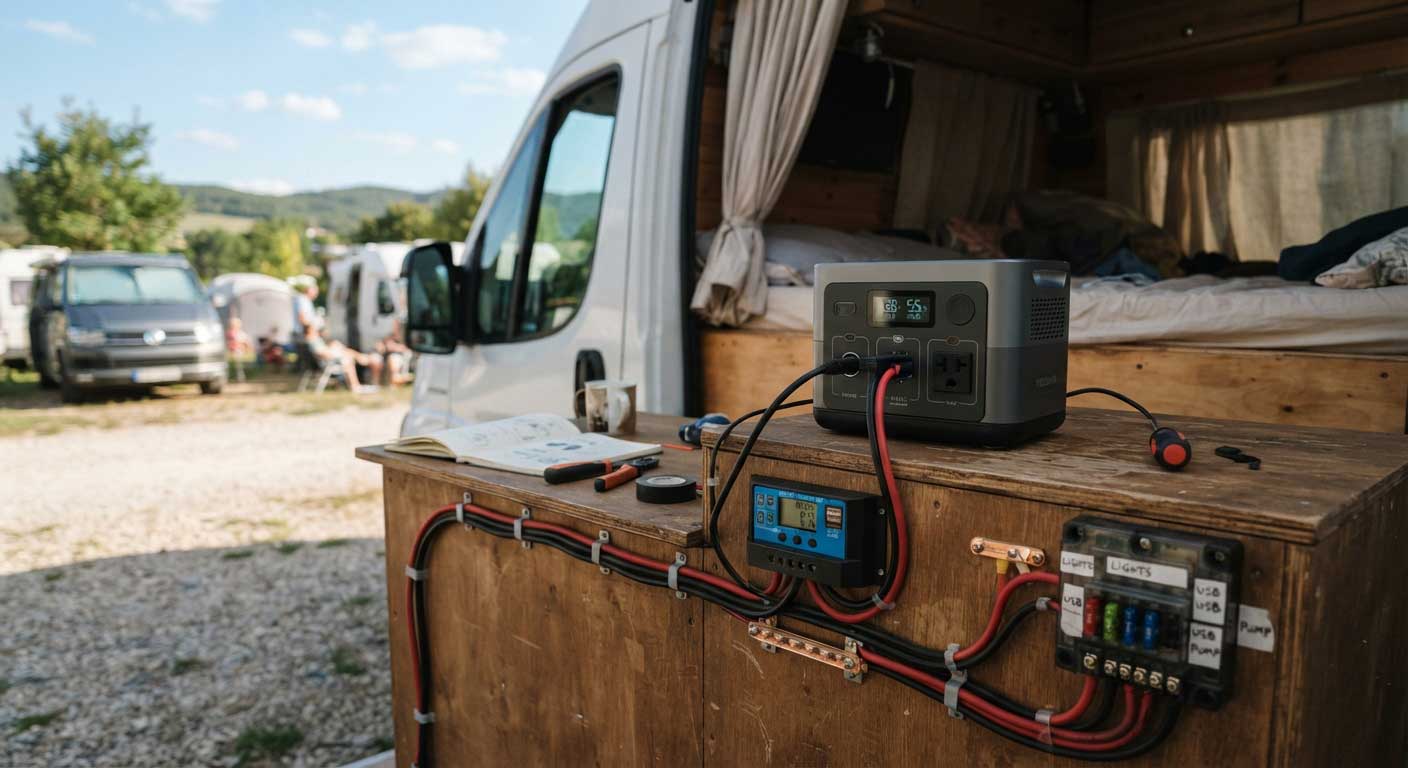
Off-Grid Solar System Planning
A solar system is made up of more than its panels. Before choosing equipment, estimate the energy used by each load and decide how much of that energy should come from solar generation versus stored energy or another source.
A planning worksheet can include:
- Loads: device wattage, hours of use and estimated daily energy consumption.
- Solar array: panel ratings, expected sunlight, orientation and possible shading.
- Storage: usable battery capacity and the required reserve.
- Power conversion: controller and inverter ratings, where applicable.
- Installation constraints: available surface, ventilation, cable routes and service access.
This process helps identify whether a single 130W module is a useful contribution to the system or whether the project requires a larger array. It also makes it easier to compare different panel formats on a consistent basis.
Conclusion
eco worthy flexible solar panels can be worth evaluating when an installation calls for a low-profile, lightweight module that can curve within defined limits. Their suitability still depends on the precise model, mounting surface, environmental exposure and electrical design.
For RV, marine and off-grid projects, verify the datasheet and manual before installation. Compare the actual specifications—not just wattage or the word “flexible”—and plan for shading, heat, cable protection and controller compatibility. Bright Solar buyers can apply the same checklist when assessing flexible and semi-flexible modules for project or OEM requirements.
Related recommendations
-

flexible solar panel 100w: Lightweight Solar Solution for RV, Marine and Off-Grid Applications
240Discover flexible solar panel 100w solutions from Bright Solar with lightweight design, durable materials, and reliable solar power for RV, marine, camping, and off-grid use.
View details -
73 MW Photovoltaic Project in California Now Online in Tulare County
324he 73 MW photovoltaic project in California, known as the Luciana solar project in Tulare County, has entered commercial operation. Built near Ducor, CA, it supplies clean power for over 20,000 homes, supports local jobs, and advances California’s...
View details -
Foldable 400W Solar Panel: Output, Uses and Buying Guide
31A foldable 400W solar panel provides portable solar power for RVs, camping, and off-grid applications. Actual energy production depends on sunlight, panel po...
View details -
Solar Panels for AC Units: How Many Do You Need?
226Solar panels for AC units should be sized from actual AC power, operating hours, solar production, efficiency, and system losses—not BTU alone.
View details