Charge Battery with Solar Panel: Complete Guide
To charge battery with solar panel safely, connect the solar panel to a properly sized solar charge controller, then connect the controller to the battery. Match the PV voltage, charging current, battery voltage, chemistry, wiring, and protection devices to the system.
That sounds straightforward.
In actual installations, the problems usually appear in the details: a panel with the wrong voltage, an undersized controller, excessive cable loss, a battery profile that does not match the chemistry, or a system designed around the panel rating instead of the battery’s daily energy needs.
At Bright Solar, we approach solar battery charging from the system level. The panel is only one part of the charging chain.
The basic architecture is:
Solar Panel → Charge Controller → Battery → DC/AC Loads
The U.S. Department of Energy explains that combining solar generation with storage allows energy produced when sunlight is available to be used later when solar production falls or stops.
For RVs, boats, tiny homes, backup systems, remote equipment, and off-grid applications, that simple idea becomes extremely useful.
How Does Charging a Battery With Solar Panel Work?
A solar panel produces electricity whenever light reaches its photovoltaic cells. The output varies continuously with sunlight, temperature, shading, panel orientation, and electrical load.
The battery, however, needs controlled charging.
That’s the job of the solar charge controller.
A properly designed controller regulates the energy from the PV array and applies a charging strategy appropriate for the battery.
A typical system contains:
- Solar panel or solar array
- Solar charge controller
- Battery
- DC wiring
- Fuse or circuit protection
- Connectors
- Optional inverter
- Electrical loads
The controller sits between the panel and battery rather than treating the PV module as a simple battery charger.
Victron Energy’s technical documentation describes the distinction clearly: PWM controllers pull array voltage toward battery voltage, while MPPT controllers operate the array around its maximum-power point and convert that energy for the battery and loads.
That difference becomes important as the solar array gets larger.
Can You Connect a Solar Panel Directly to a Battery?
In most practical systems, no—you should not connect a conventional solar panel directly to a rechargeable battery without an appropriate charge-control method.
The reason is simple.
Solar output changes.
Battery charging requirements also change as the battery moves through its charging cycle.
A controller manages this relationship.
For example, a modern MPPT controller can move through different charging stages rather than continuously forcing maximum available panel output into a battery. Victron’s documentation describes bulk, absorption, and float charging for supported battery systems.
Direct connection can also create problems involving:
- Overcharging
- Incorrect charging voltage
- Battery damage
- Excessive current
- Poor charging efficiency
- Unsafe wiring conditions
The exact charging profile should always follow the battery manufacturer’s specifications.
Solar Panel Battery Charger: Choosing PWM or MPPT
This is one of the first decisions to make.
PWM Solar Charge Controller
PWM, or Pulse Width Modulation, is relatively simple.
It works well in smaller systems where the solar panel voltage is closely matched to the battery voltage.
The drawback is that the array voltage is pulled toward the battery voltage rather than being independently optimized.
MPPT Solar Charge Controller
MPPT stands for Maximum Power Point Tracking.
Instead of simply pulling the PV voltage down toward the battery voltage, an MPPT controller can operate the solar array around its maximum-power point and convert that energy to the battery’s required charging voltage.
Victron’s published technical comparison explains that MPPT effectively decouples the PV-array voltage from the battery voltage.
That becomes particularly useful when:
- The PV array voltage is significantly higher than battery voltage
- Cable runs are longer
- The system is several hundred watts or larger
- Weather and irradiance change quickly
- You want to reduce PV-side current
For larger installations, MPPT is usually the more flexible architecture.
How to Size a Solar Panel to Charge a Battery
Start with the battery’s energy capacity.
A simple calculation is:
Battery energy ≈ Voltage × Amp-hours
For example:
12V × 100Ah = 1,200Wh
So a nominal 12V 100Ah battery represents approximately 1.2kWh of stored energy.
But don’t assume all 1.2kWh should be replaced every day.
Actual usable energy depends on battery chemistry, permitted depth of discharge, system losses, temperature, and the battery manufacturer’s specifications.
Example: 12V 100Ah Battery
Suppose the battery has used approximately 50% of its nominal capacity.
Energy to replace:
1,200Wh × 50% = 600Wh
Now imagine a 200W solar array receives four equivalent peak-sun hours.
The theoretical PV energy would be:
200W × 4h = 800Wh
That looks sufficient on paper.
Real output will be lower.
Panel temperature, wiring, controller conversion, battery charging efficiency, shading, dirt, weather, and other losses all reduce the energy actually stored.
This is why a system should have some design margin rather than being sized to the exact mathematical minimum.
How Long Does It Take to Charge a Battery With Solar Panel?
There isn’t one universal answer.
Charging time depends on:
- Battery capacity
- Battery state of charge
- Solar panel wattage
- Solar irradiance
- Charge-controller efficiency
- Battery chemistry
- Temperature
- Shading
- Electrical loads operating during charging
A simplified estimate can start with:
Charging time ≈ Energy required ÷ Average solar charging power
For example, if a system needs to replace 600Wh and averages 150W of useful charging power:
600Wh ÷ 150W = 4 hours
But four hours of clock time does not necessarily mean four hours of full-rated panel output.
Clouds move.
The sun angle changes.
The panel gets hot.
A vehicle may park under a tree at 2 p.m.
This is why experienced solar sizing uses solar-resource data and realistic system losses rather than assuming the panel produces its nameplate wattage continuously.
Battery Voltage Matters More Than Many Beginners Expect
A common mistake is seeing “12V solar panel” and “12V battery” and assuming the two are automatically compatible.
They aren’t necessarily.
The nominal labels are only part of the electrical specification.
You need to check:
- PV open-circuit voltage (Voc)
- PV operating voltage (Vmp)
- PV short-circuit current (Isc)
- PV operating current (Imp)
- Controller maximum PV voltage
- Controller maximum charging current
- Battery charging voltage
- Battery chemistry
For example, Victron’s MPPT documentation shows controllers designed to accept a higher PV voltage and charge lower-voltage battery banks. One model family supports PV input up to 100V while charging 12V, 24V, 36V, or 48V batteries depending on the controller model.
So a higher-voltage solar array can be perfectly reasonable when the controller is designed for it.
How to Charge a 12V Battery With Solar Panel
A typical 12V battery system can be arranged as:
Solar Panel → MPPT/PWM Controller → 12V Battery
Step 1: Check the battery
Confirm:
- Nominal voltage
- Battery chemistry
- Capacity
- Recommended charging voltage
- Maximum charging current
Step 2: Check the solar panel
Record:
- Rated wattage
- Voc
- Vmp
- Isc
- Imp
Don’t size the controller from wattage alone.
Step 3: Select the controller
The controller must handle the maximum PV voltage and expected charging current.
Step 4: Install protection
Use appropriately rated fuses, breakers, disconnects, and wiring according to the system design and applicable electrical requirements.
Step 5: Connect the battery side
Follow the controller manufacturer’s recommended connection sequence.
Some controllers use the battery connection to detect system voltage and initialize correctly. For example, Victron’s MPPT documentation specifies battery and PV connection requirements and operating thresholds for its controllers.
Step 6: Connect the PV array
Confirm polarity before connecting.
Step 7: Configure the battery profile
Use the battery manufacturer’s recommended settings.
Step 8: Check actual charging current
Don’t stop at “the controller is on.”
Look at the actual PV voltage, PV power, battery voltage, and charging current.
That is where installation problems usually reveal themselves.

How Many Solar Panels Do You Need to Charge a Battery?
The answer depends on how much energy you need to replace each day.
A useful starting point is:
Required PV energy = Daily energy consumption + battery recharge requirement + system losses
Consider a small off-grid setup consuming:
1,000Wh/day
If you expect four equivalent peak-sun hours and assume a planning factor for real-world losses, you might start around:
1,000Wh ÷ 4h = 250W
Then add design margin rather than installing exactly 250W.
A practical system might therefore use something closer to 300W–400W, depending on the location, season, battery requirements, and acceptable backup period.
This is a planning example—not a universal sizing rule.
NREL’s System Advisor Model can model PV and battery systems using detailed PV and battery performance models, including temperature and degradation effects.
For larger commercial or off-grid projects, resource modeling is far more reliable than a simple “watts divided by hours” calculation.
Solar Battery Charging for RVs
RV systems are one of the most practical applications for charging batteries with solar panels.
An RV may have:
- Limited roof space
- A 12V or 24V battery bank
- Refrigerator loads
- Lighting
- Fans
- Water pumps
- Electronics
- Inverter loads
Flexible solar panels can be attractive because they can sit close to the roof and follow modest roof curves.
Current RV solar guidance from Victron identifies flexible panels as an option where lightweight, low-profile installation is useful.
But there is a detail that gets missed online:
The RV’s daily energy consumption matters more than the panel’s advertised wattage.
A 400W array may be excellent for one RV and insufficient for another.
If one owner uses only lights, phones, and a small refrigerator, the system may be comfortable.
If another runs a microwave, induction cooktop, air conditioner, and inverter loads, the battery bank and solar array need to be much larger.
Solar Battery Charging for Marine Applications
Marine systems add another layer of difficulty.
Saltwater.
Humidity.
Constant vibration.
Limited mounting space.
Partial shading from masts and equipment.
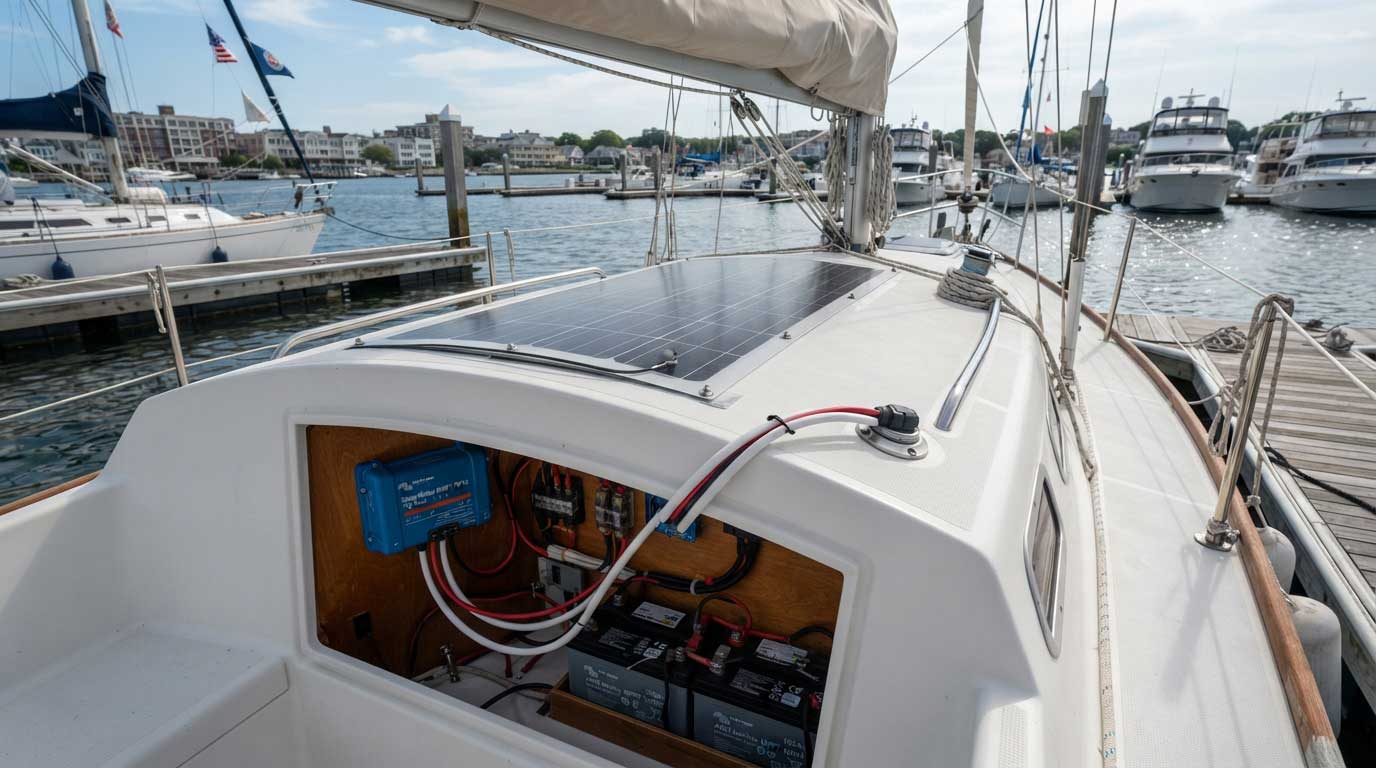
A marine solar panel needs to be evaluated not just for electrical performance but also for its surface construction, waterproofing, connectors, cable routing, and long-term environmental exposure.
A flexible module can make sense on curved deck areas where a rigid framed panel would be difficult to install.
The electrical design still follows the same basic structure:
PV → Controller → Battery → Loads
The environment changes.
The electrical principles don’t.
MPPT vs PWM for Battery Charging
| Feature | PWM | MPPT |
|---|---|---|
| System complexity | Lower | Higher |
| Cost | Usually lower | Usually higher |
| PV/battery voltage matching | More important | More flexible |
| Larger PV arrays | Less attractive | Better suited |
| Higher PV voltage | Limited benefit | Useful |
| Energy harvesting | Generally lower in mismatched conditions | Generally better |
| Common application | Small systems | RV, off-grid, larger systems |
Victron’s technical comparison notes that MPPT can harvest power from an array at its maximum-power point while supplying the battery’s changing voltage requirements.
Its current product documentation also describes MPPT controllers for mobile, off-grid, and home applications.
For a small 20W maintenance system, PWM may be perfectly adequate.
For a larger array on an RV roof, MPPT often makes more sense.
Common Reasons a Solar Panel Is Not Charging the Battery
When a system isn’t charging as expected, don’t immediately blame the panel.
Check the system in this order:
Is there enough sunlight?
Heavy cloud, shade, dirt, or poor orientation can reduce output dramatically.
Is the panel producing voltage?
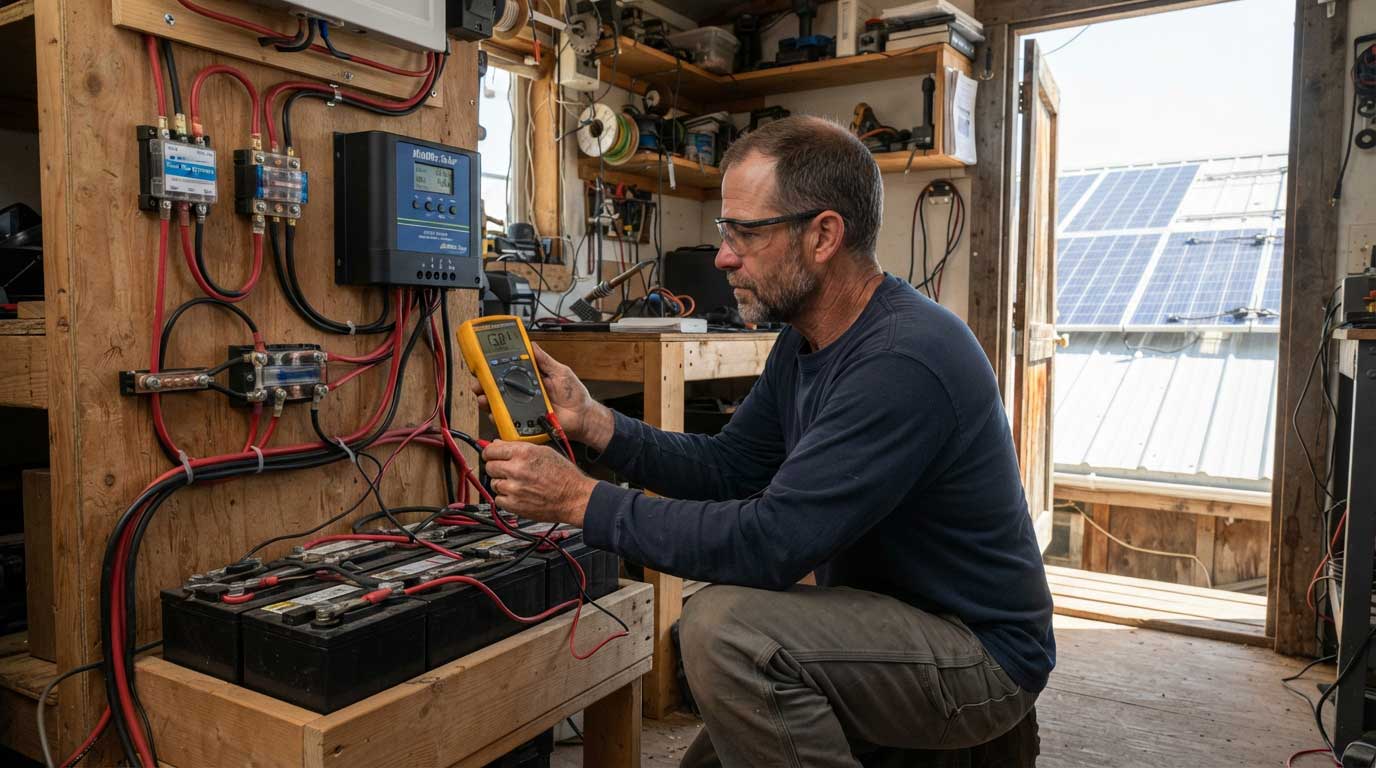
Measure PV voltage rather than guessing.
Is polarity correct?
Reverse polarity can prevent normal operation and may damage equipment depending on the system.
Is the controller correctly configured?
The battery chemistry and charging parameters must be correct.
Is there excessive cable voltage drop?
Long, undersized cables can waste energy.
Is the battery already nearly full?
Charging current naturally changes as the battery approaches its target state.
Are loads consuming the solar energy?
A controller may be producing power while the battery’s net charging current appears low because appliances are operating simultaneously.
Victron’s troubleshooting documentation lists insufficient solar supply, high DC loads, battery-cable voltage drop, incorrect temperature compensation, and incorrect battery charging settings among potential causes of undercharging.
That list is useful because it reflects what actually happens in working systems.
How Bright Solar Panels Fit Battery Charging Systems
At Bright Solar, flexible solar panels are designed for applications where conventional rigid modules are not always convenient.
That includes:
- RVs
- Boats
- Vans
- Tiny homes
- Portable systems
- Remote equipment
- Off-grid battery systems
- Vehicle applications
The advantage is not simply that a panel bends.
The more useful question is whether the panel can make better use of a difficult surface without adding unnecessary bulk.
For battery charging, I recommend evaluating the complete specification:
| Parameter | Why It Matters |
|---|---|
| Rated power | Determines maximum nominal output |
| Voc | Must stay within controller limits |
| Vmp | Helps determine operating performance |
| Isc | Important for controller and protection sizing |
| Imp | Useful for estimating charging current |
| Dimensions | Determines usable installation area |
| Weight | Important for RV and vehicle applications |
| Bend radius | Critical for curved surfaces |
| Surface material | Affects durability |
| Junction box | Important for environmental protection |
A high-wattage panel with the wrong voltage is not necessarily a better panel.
A lower-wattage panel that fits the surface perfectly may produce more useful energy over its service life.
Case Study: Charging a 12V 100Ah Battery
Consider a small remote monitoring station.
The system uses:
- 12V 100Ah lithium battery
- 300W flexible solar array
- MPPT charge controller
- 12V DC monitoring equipment
- Small communications equipment
The nominal battery energy is:
12V × 100Ah = 1,200Wh
Suppose the daily load averages:
400Wh
A 300W PV array receiving four equivalent peak-sun hours gives a theoretical:
300W × 4h = 1,200Wh/day
At first glance, that looks like a perfect match.
It isn’t.
There will be losses.
There may be cloudy days.
The panel will not remain at its rated test-condition output all day.
And the battery may not always start the morning at the same state of charge.
A better design question is:
How much energy does the system need during the worst useful solar period—not just on the best sunny day?
That’s where battery reserve and solar oversizing become valuable.
FAQ: Charge Battery With Solar Panel
Can I charge a battery with a solar panel?
Yes. A properly sized solar panel can charge a battery through an appropriate solar charge controller. The controller regulates charging according to the battery and PV system specifications.
Do I need a charge controller?
For most conventional solar battery systems, yes. The controller manages PV energy before it reaches the battery and helps prevent inappropriate charging conditions.
What size solar panel do I need for a 12V 100Ah battery?
There is no single correct panel size. A 12V 100Ah battery has approximately 1.2kWh nominal energy, but the required PV size depends on daily consumption, allowable depth of discharge, sunlight, losses, and desired recharge time.
Is MPPT better than PWM?
MPPT is generally more flexible and can provide better energy harvesting when PV voltage differs significantly from battery voltage. PWM can still be appropriate for small, simple systems with closely matched panel and battery voltages.
Can a 100W solar panel charge a 12V battery?
Yes, provided the panel, charge controller, battery, wiring, and charging profile are compatible. The actual charging rate depends on sunlight and system conditions.
Can solar charge a battery at night?
No. A conventional PV panel does not generate useful charging power without sufficient light. The battery supplies stored energy at night, while the solar array recharges it when sunlight returns.
Why is my solar panel producing power but the battery is not charging?
Possible causes include insufficient solar input, high loads, cable voltage drop, incorrect battery settings, temperature-related issues, or a battery/controller fault. These should be checked systematically rather than assuming the panel is defective.
Final Thoughts
To charge battery with solar panel reliably, don’t think of the project as buying a panel and connecting two wires.
Think in terms of a complete energy system:
PV generation → charge control → battery storage → electrical loads
The panel provides energy.
The controller manages it.
The battery stores it.
The wiring moves it.
And the system design determines whether all of those parts actually work well together.
For a small RV battery, that might mean a compact 100W–300W setup. For a larger off-grid system, the array, controller, battery bank, wiring, protection, and inverter can all scale considerably.
Bright Solar focuses on flexible PV solutions for applications where conventional panels can be difficult to install. When roof space is limited or surfaces are curved, a lightweight flexible module can make the available area more useful.
The best solar battery system isn’t necessarily the one with the largest panel.
It’s the one that produces enough useful energy, charges the battery correctly, survives the environment, and keeps doing its job after the installation day is long forgotten.
Related recommendations
-

Flexible 200W Solar Panel: Output, Uses and Installation Guide
85A flexible 200W solar panel can suit selected RV, marine, and off-grid systems, but actual output depends on sunlight, temperature, shading, orientation, and...
View details -
Portable Solar Generator for RV: Complete Buying and Setup Guide
214A portable solar generator for RV stores solar energy in a battery and provides power through an inverter for compatible RV appliances and electronics.
View details -
300w flexible solar panel for RV, Marine and Off-Grid Solar Applications
210Explore 300w flexible solar panel technology from Bright Solar for RV, marine, and off-grid applications. Learn output, installation methods, materials, and real project experience.
View details -
Solar Panels for Mobile Homes: A Practical Guide Based on Real Installations
176Discover how solar panels for mobile homes reduce electricity costs, improve energy independence, and deliver long-term savings. Learn sizing, costs, installation tips, and real project insights.
View details