Car Roof Solar Panel: How It Works and What to Know
A car roof solar panel can generate useful electricity from a vehicle roof, but it is usually best treated as an auxiliary power source rather than a complete replacement for grid charging or fuel. Available roof area, shading, curvature, temperature, panel efficiency, and vehicle energy demand determine the practical benefit.
That distinction matters.
A passenger car simply does not have the roof area of a house or RV. Even when the entire roof is covered with photovoltaic material, the available energy is limited by surface area and changing sunlight angles.
The U.S. Department of Energy classifies vehicle-integrated photovoltaics (VIPV) as a developing solar application in which photovoltaic elements are integrated into the vehicle exterior and electrical system. DOE also distinguishes this from vehicle-added PV, where conventional or flexible modules are attached to an existing vehicle.
At Bright Solar, I approach car solar differently from a conventional rooftop project.
The first question is not “How many watts can we put on the roof?”
It is:
“What useful electrical job should the roof solar actually perform?”
For one vehicle, that may mean maintaining a 12V battery. For another, it may support auxiliary electronics. For an EV, the objective may be to add a small amount of energy to the traction battery.
Those are three very different engineering problems.
What Is a Car Roof Solar Panel?
A car roof solar panel is a photovoltaic module installed on or integrated into a vehicle roof to convert sunlight into electrical energy.
There are two broad approaches.
Vehicle-Added Photovoltaics
A flexible, semi-flexible, or rigid solar module is added to the existing vehicle.
The module may be:
- Adhesive-mounted
- Mechanically mounted
- Semi-flexible
- Flexible
- Designed as a removable system
This approach is easier to retrofit.
Vehicle-Integrated Photovoltaics
The PV material becomes part of the vehicle’s exterior design.
DOE describes VIPV as photovoltaic elements integrated into areas such as the vehicle roof, hood, doors, or fenders, where they can provide electrical energy while also serving part of the vehicle’s exterior function.
This is a much more demanding application.
The solar material must coexist with:
- Automotive styling
- Curved surfaces
- UV exposure
- Vibration
- Impact
- Thermal cycling
- Maintenance
- Electrical safety
- Vehicle repair procedures
That is why automotive solar should not simply be treated as “a small rooftop solar panel.”
How Much Power Can a Car Roof Solar Panel Produce?
A typical passenger-car roof provides a limited photovoltaic surface, so a car roof solar panel normally produces hundreds of watts rather than several kilowatts. Actual energy depends on roof area, module efficiency, sunlight, temperature, shading, curvature, and orientation.
Consider a simplified example.
Suppose a vehicle can physically accommodate:
300W of PV
and receives an average equivalent of:
4 peak-sun hours/day
The theoretical energy is:
300W × 4h = 1,200Wh/day
or:
1.2kWh/day
That is not a guaranteed real-world output.
After temperature, conversion, wiring, angle, shading and other losses, actual harvested energy will be lower.
This is exactly why I avoid promising a fixed “miles per day” figure from a roof panel without knowing the vehicle and location.
The International Energy Agency Photovoltaic Power Systems Programme (IEA PVPS) specifically identifies vehicle PV energy-yield modeling as challenging because vehicle orientation changes, the vehicle moves, and the PV surface can have different angles of incidence throughout the day.
Solar Panel for Car Roof: Why Roof Area Matters
Roof area is the first physical limitation.
A passenger car might have a roof roughly around:
1.5–2.5 m²
depending on body style.
But the usable photovoltaic area is smaller.
You have to leave room for:
- Roof antennas
- Roof rails
- Sunroofs
- Glass panels
- Mounting points
- Drainage channels
- Roof curvature
- Electrical cable routing
A panoramic glass roof creates another complication.
You may have plenty of visual roof area but very little practical surface for a conventional retrofit module.
This is where lightweight flexible PV can become interesting.
It can conform to surfaces that would be awkward for a framed glass module.
NREL identifies lightweight PV and flexible materials as an area of research for transportation applications, including automotive uses.
Flexible Solar Panel for Car Roof: Why Flexibility Matters
A flexible solar panel can follow a vehicle roof more closely than a rigid framed module.Visit product page:Flexible Solar Panels
That sounds like a simple mechanical advantage.
It isn’t the whole story.
Vehicle roofs are rarely perfect flat rectangles.
They curve:
- Front to rear
- Side to side
- Around roof edges
- Around roof features
When a panel follows those curves, the sunlight does not strike every cell at exactly the same angle.
That creates electrical and thermal differences across the module.
IEA PVPS research published in 2025 found measurable energy losses associated with curved PV roofs. In its tested vehicle-roof configuration, curvature-related irradiance and temperature non-uniformity resulted in reported energy losses of 17% on sunny days and 6% on rainy days compared with a flat PV surface.
That is a useful number because it changes the conversation.
Flexibility solves a mechanical problem.
It does not automatically solve the optical problem.
A good car roof solar design has to account for both.
Car Roof Solar Panel Efficiency: More Watts Are Not Always Better
When roof area is limited, efficiency becomes important.
Imagine two hypothetical panels occupying the same roof area:
| Parameter | Panel A | Panel B |
|---|---|---|
| Area | 1.8 m² | 1.8 m² |
| Rated power | 280W | 360W |
| Power density | Lower | Higher |
| Roof space required | Same | Same |
If the roof cannot accommodate more area, Panel B offers more installed capacity without increasing the footprint.
This is one reason high-efficiency PV technologies are attractive for vehicle applications.
The DOE’s vehicle-PV research summary notes that limited vehicle surface area makes high-efficiency PV important, while flexibility can justify accepting trade-offs when the vehicle surface is curved.
In other words:
The smallest roof does not necessarily need the smallest panel.
It may need the most productive panel that can physically and safely fit.
Car Roof Solar Panel for EVs
For electric vehicles, the idea becomes especially interesting.
A vehicle roof can generate electricity while the car is:
- Parked at work
- Parked at home
- Sitting outdoors
- Traveling under suitable conditions
But the roof should not be viewed as a standalone EV charger.
An EV battery may contain tens of kilowatt-hours of stored energy.
A few hundred watts of roof PV is much smaller than that battery.
IEA PVPS reports that efficient solar-electric vehicles can have consumption as low as 9 kWh/100 km, while its 2025 VIPV fact sheet cites the Lightyear 0 as an example that could travel up to 4,500 km annually on solar power alone under its stated conditions.
Those figures illustrate the potential.
They do not mean every EV with a solar roof will achieve the same result.
Vehicle efficiency, roof area, solar resource and operating conditions are fundamentally different from one model to another.
Solar Roof for Electric Car: Range vs Auxiliary Power
There are two ways to think about car solar.
1. Traction Energy
Solar electricity is sent toward the vehicle’s propulsion battery.
The theoretical benefit is additional driving energy.
2. Auxiliary Energy
Solar electricity supports smaller electrical loads.
For example:
- Cabin ventilation
- Electronics
- Sensors
- Communications
- Battery maintenance
- Refrigeration in specialized vehicles
DOE’s vehicle PV research specifically identifies both propulsion and auxiliary loads as potential applications.
This second use can be surprisingly practical.
If a vehicle spends long periods parked in sunlight, solar energy does not need to compete directly with the traction motor.
It can offset smaller electrical loads.
That changes the economics.
Can a Car Roof Solar Panel Charge an EV Battery?
Yes, technically, but the amount of energy is usually limited by the vehicle’s available roof area and solar conditions.
For example, assume:
400W PV array
and:
4 equivalent sun hours
The simplified daily energy is:
400 × 4 = 1,600Wh
or:
1.6kWh
If an EV consumes approximately:
15kWh/100km
then 1.6kWh would theoretically represent:
1.6 ÷ 15 × 100 ≈ 10.7km
before system and environmental losses.
This is a calculation example, not a promised driving range.
Actual recovered range could be considerably different.
That is the kind of calculation I prefer because it keeps the discussion grounded in energy rather than marketing claims.
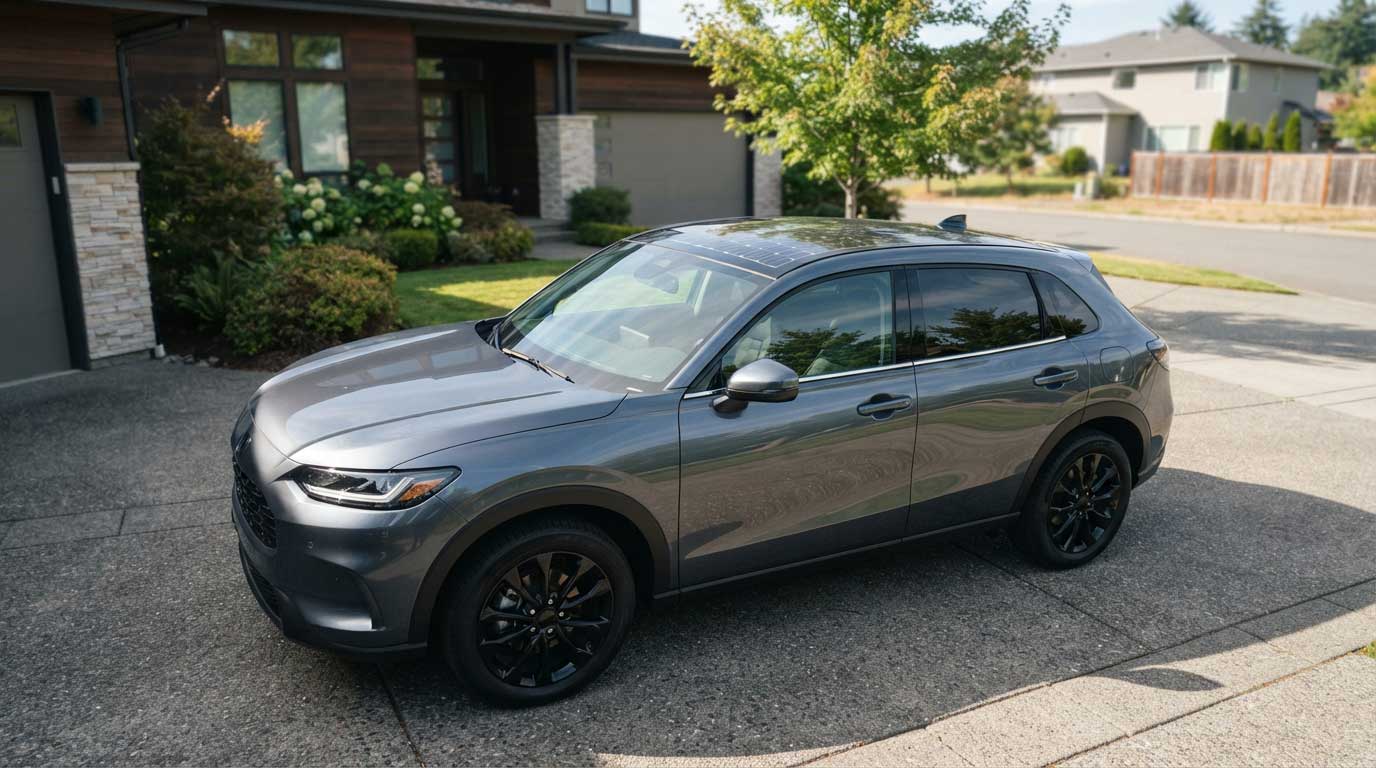
Car Roof Solar Panel Installation: What Must Be Checked First?
Before attaching anything to a vehicle roof, I would check five things.
1. Roof construction
Is the roof:
- Steel?
- Aluminum?
- Composite?
- Glass?
- Carbon fiber?
- Painted metal?
The mounting method must be compatible with the substrate.
2. Roof curvature
Measure the actual radius rather than assuming a panel will bend naturally.
3. Existing equipment
Mark:
- Antennas
- Roof rails
- Sunroof
- Drain channels
- Roof seams
4. Electrical path
Determine where the cable will enter the vehicle.
This is often harder than selecting the panel.
5. Service access
The solar installation must not make normal vehicle maintenance unnecessarily difficult.
DOE’s vehicle PV research identifies repair access as a significant integration challenge because PV must be securely attached while still allowing maintenance and repair.
How to Install a Flexible Solar Panel on a Car Roof
For a retrofit application, the physical installation should be treated as an automotive integration project rather than a simple adhesive job.
Step 1: Measure the roof
Create a full roof outline.
Do not measure only the center section.
Step 2: Identify the usable PV zone
Keep clear of:
- Moving roof components
- Drainage paths
- Sharp edges
- Service points
- High-impact areas
Step 3: Test-fit the panel
Place the panel without permanently attaching it.
Check:
- Curvature
- Cable exit
- Edge clearance
- Door clearance
- Roof features
Step 4: Prepare the surface
The surface must be clean, dry and compatible with the selected mounting system.
Step 5: Install the panel
Use the mounting method approved for the specific panel and vehicle surface.
Do not improvise adhesives based only on a generic internet recommendation.
Step 6: Protect the wiring
Vehicle wiring experiences:
- Vibration
- Heat
- Water
- UV exposure
- Mechanical movement
Cable routing must account for all five.
Step 7: Test before final sealing
Verify:
- Open-circuit voltage
- Polarity
- Continuity
- Controller operation
- Charging behavior
Step 8: Perform a road-condition inspection
After installation, inspect the panel and cable routing after initial driving.
A stationary solar test does not reproduce highway vibration.
Car Roof Solar Panel and Vehicle Safety
This deserves more attention than it usually gets.
A solar panel on a house roof does not experience highway wind.
A car does.
At highway speed, the panel, adhesive, cable routing and mounting system experience aerodynamic loads and vibration.
DOE’s vehicle PV research specifically identifies resistance to vibration, impact, UV exposure, safety, reliability and secure mounting as key product requirements.
There is also a second issue.
Collision safety.
The solar system should not interfere with:
- Airbag systems
- Roof structural components
- Emergency access
- Electrical isolation
- First-responder procedures
This is one reason a professional vehicle-integrated solar product cannot be evaluated by panel wattage alone.
Weight Matters More on a Car Than on a House
A solar panel adds weight.
The effect may be small, but automotive engineering considers weight continuously because the vehicle moves.
IEA PVPS notes that PV system weight can affect vehicle efficiency and describes the need to balance added weight against energy yield. It also notes that energy generated while parked can help offset weight-related losses.
This creates an interesting engineering trade-off.
Suppose:
Panel A = 20kg
Panel B = 8kg
If both produce similar useful energy for the application, the lighter system can be attractive.
But if the heavier panel produces substantially more energy per unit area, the answer may change.
So the better metric is not simply:
“How light is the panel?”
It is closer to:
“How much useful energy do I gain for the mass and roof area added?”
That is a more useful vehicle metric.
Flexible Solar Panel for Car: Temperature and Curvature
A vehicle roof can become extremely hot under direct sunlight.
At the same time, a flexible panel may be installed close to the vehicle surface with limited airflow.
Those conditions need to be considered during product selection.
Curvature introduces another issue.
IEA PVPS’s vehicle-roof research found that curved surfaces can produce non-uniform irradiance and temperature across the PV surface, contributing to measurable energy losses.
For a product engineer, this means the panel should not be evaluated only under a perfectly flat laboratory condition.
The real question is:
How does it perform after it has been shaped onto the actual vehicle?
That is where testing becomes valuable.
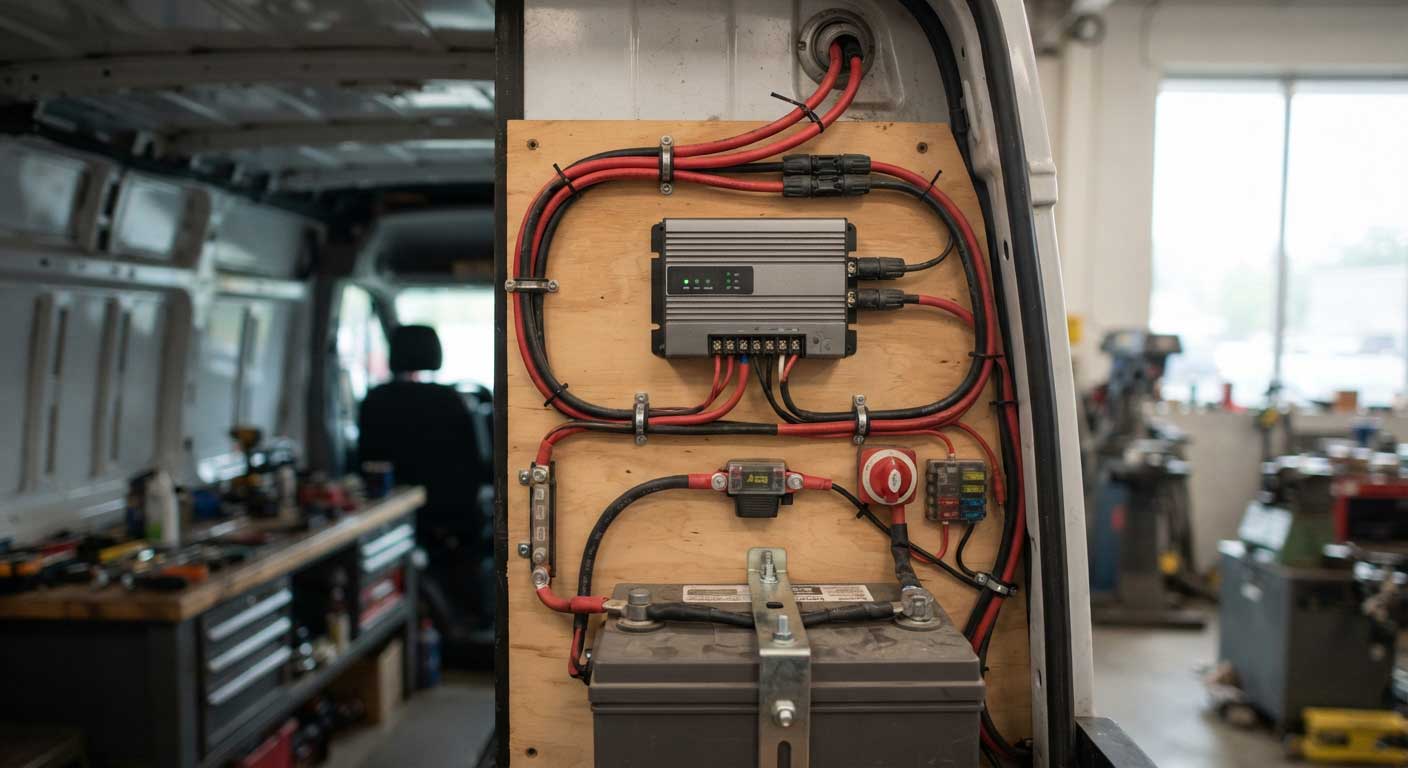
Car Roof Solar Panel Wiring
The wiring architecture depends on the panel electrical characteristics and the vehicle electrical system.
For example, a PV system may require:
- Solar module
- MPPT controller
- DC protection
- DC-DC conversion where appropriate
- Battery connection
- Monitoring
A common mistake is trying to connect a PV module directly to a vehicle battery without considering charging requirements.
A solar panel is not a battery charger by itself.
The controller must be matched to:
- PV voltage
- PV current
- Battery voltage
- Battery chemistry
- Maximum charging current
- Temperature conditions
For EV applications, the electrical architecture is substantially more complex than a conventional 12V auxiliary system.
The PV system may need dedicated power electronics and integration with the vehicle’s battery management architecture.
Shading Is a Serious Problem on Car Roof Solar
A car is rarely parked in an ideal solar position all day.
You may park:
- Under a tree
- Beside a building
- Next to another vehicle
- In a parking garage
- Facing a different direction each day
The roof itself can also create complex shading because of:
- Roof rails
- Antennas
- Roof-mounted equipment
- Curved edges
IEA PVPS research on curved vehicle roofs demonstrates why solar modeling becomes more complicated when irradiance is uneven across the PV surface.
For a small car roof, losing 50W from one shaded section can represent a meaningful fraction of the entire system.
This is another reason module layout matters.
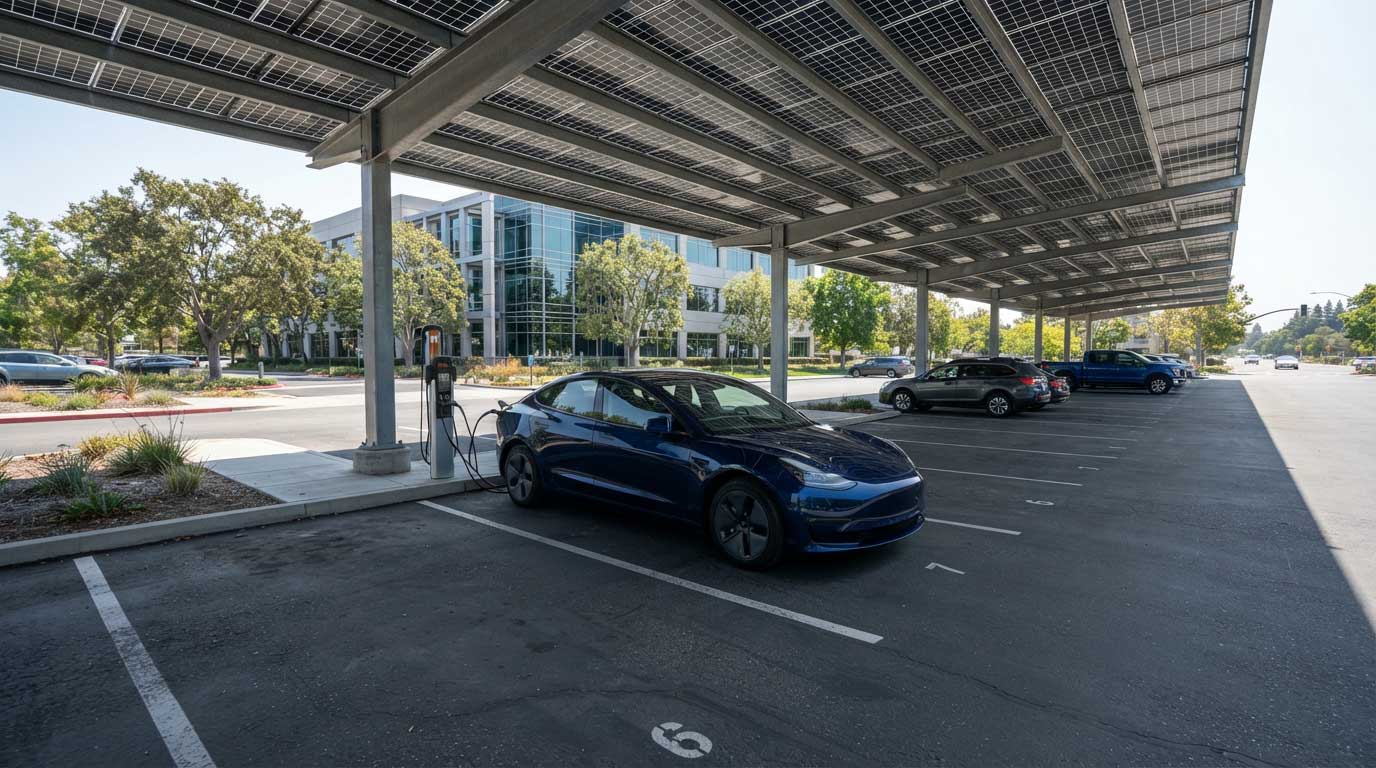
Car Roof Solar Panel vs Solar Carport
Sometimes the better solar solution is not on the car.
It is above the car.
A solar carport has substantially more available surface area.
A vehicle roof may provide a few hundred watts.
A carport can provide several kilowatts.
DOE recognizes vehicle-integrated photovoltaics as one branch of a much broader solar-transport ecosystem, while IEA PVPS also emphasizes the relationship between vehicle PV and solar charging infrastructure.
For someone trying to reduce EV charging costs, a roof panel can supplement energy.
A solar carport can potentially become the primary generation asset.
The two technologies are not competitors in every application.
They can work together.
Is a Car Roof Solar Panel Worth It?
For some applications, absolutely.
For others, the economics are difficult.
It becomes more attractive when:
- The vehicle is parked outdoors for long periods
- The roof has substantial usable area
- Weight is tightly controlled
- Auxiliary electrical loads are significant
- Charging access is limited
- The solar system can be integrated during vehicle manufacturing
- The application values energy autonomy
It becomes less attractive when:
- The roof is heavily shaded
- The vehicle spends most time indoors
- Available roof area is very small
- Installation is expensive
- The panel adds significant weight
- The vehicle already has very easy access to low-cost charging
IEA PVPS notes that VIPV still faces challenges involving cost, technical integration, durability, performance measurement and market adoption.
That is a much more honest assessment than simply calling vehicle solar “the future.”
Realistic Case Study: 300W Car Roof Solar System
Consider a delivery-oriented electric vehicle that spends most of its day outdoors.
The vehicle has:
- Approximately 300W of roof PV
- High daily mileage
- A large traction battery
- Auxiliary electronics
- Long parking periods
The roof system is not expected to power the vehicle.
Instead, the goal is to offset a portion of energy consumption and support auxiliary loads.
Assume:
300W × 4 equivalent sun hours = 1.2kWh/day
With system losses, the usable energy might be lower.
Over 250 useful solar days, a simplified upper-bound energy estimate would be:
1.2kWh × 250 = 300kWh/year
Again, this is an engineering example rather than a production guarantee.
Weather, shading, seasonal solar availability, curvature and vehicle orientation can change the result significantly.
But the example reveals something important:
A relatively small solar surface can still produce a meaningful annual energy contribution when the vehicle is deployed every day.
That is why DOE identified commercial vehicles, trucks, buses and other high-utilization transportation applications as promising areas for vehicle PV.
Why Bright Solar Flexible PV Is Relevant to Vehicle Applications
Vehicle solar places unusual demands on a photovoltaic module.
The panel has to work with a surface that moves.
It may need to conform to a curved roof.
It needs to remain lightweight.
It must tolerate outdoor exposure.
And the installation cannot be designed like a stationary rooftop system.
Bright Solar’s flexible solar technology is suited to applications where conventional framed modules create limitations in weight, profile or surface geometry.
For car roof applications, however, product selection should always be based on the complete engineering specification.
Important parameters include:
- Module weight
- Dimensions
- Bend radius
- Electrical characteristics
- Encapsulation
- UV resistance
- Surface durability
- Junction-box construction
- Cable design
- Temperature range
- Mounting method
The vehicle determines the requirements.
The solar module follows them.
Car Roof Solar Panel: Practical Selection Checklist
Before selecting a product, I would check the following.
Vehicle
- Vehicle type
- Roof dimensions
- Roof material
- Roof curvature
- Roof equipment
- Maximum permitted additional weight
Solar
- Rated wattage
- Efficiency
- Dimensions
- Weight
- Voc
- Vmp
- Isc
- Imp
- Temperature characteristics
Installation
- Adhesive or mechanical mounting
- Cable-entry method
- Waterproofing
- Vibration resistance
- UV exposure
- Maintenance access
Electrical
- Battery voltage
- Controller type
- Maximum PV voltage
- Maximum PV current
- Protection devices
- Monitoring
Real-world conditions
- Parking location
- Annual sunlight
- Shading
- Climate
- Driving frequency
- Expected service life
This list looks long on paper.
In practice, it prevents the expensive mistakes.
FAQ About Car Roof Solar Panels
Can you put a solar panel on a car roof?
Yes. Solar panels can be integrated into or attached to vehicle roofs, provided the panel, mounting method, electrical system and vehicle structure are suitable. Flexible PV is particularly useful where the roof is curved or weight-sensitive.
How much power can a car roof solar panel produce?
A passenger-car roof typically supports a few hundred watts rather than several kilowatts. Actual production depends on usable roof area, panel efficiency, sunlight, temperature, shading, curvature and vehicle orientation.
Can a solar panel charge an electric car?
Yes, a properly designed vehicle PV system can provide energy to an EV’s electrical system. However, the roof’s limited area means it generally supplements conventional charging rather than replacing it.
Are flexible solar panels good for car roofs?
Flexible solar panels can be useful for curved and lightweight vehicle roofs because they conform more easily than rigid framed modules. Their thermal behavior, bend radius, durability and mounting method must be evaluated for the specific vehicle.
Can a car solar panel charge the 12V battery?
Yes, with an appropriately designed charge controller and electrical connection. The solar panel should not simply be connected directly to the battery unless the system is specifically designed for that charging method.
Does a curved car roof reduce solar output?
It can. IEA PVPS research found measurable losses associated with non-uniform irradiance and temperature on curved vehicle PV surfaces, including a reported 17% loss on sunny days in one experimental configuration compared with a flat surface.
Is a solar car roof worth the cost?
It depends on vehicle usage. Solar roofs make more sense when the vehicle spends substantial time outdoors, has useful roof area, and benefits from additional energy autonomy. High installation cost or heavy shading can reduce the value significantly.
Conclusion: Is a Car Roof Solar Panel Practical?
A car roof solar panel is practical when its purpose is clearly defined and the system is designed around the vehicle rather than simply attached to it.
For passenger cars, the biggest limitation is available surface area.
For EVs, that means roof solar is usually a supplement to charging rather than a replacement for it. For commercial vehicles, auxiliary loads and long outdoor operating periods can make the proposition considerably more attractive.
Flexible PV adds another option.
It can follow curved surfaces, reduce profile and open up roof areas that are difficult to use with rigid framed modules. But curvature itself can introduce energy losses, and vehicle applications demand attention to vibration, impact, UV exposure, weight, electrical protection and maintenance.
The strongest vehicle solar projects start with a simple question:
What job should the solar system perform?
Maintain a battery?
Run auxiliary electronics?
Reduce EV charging demand?
Add energy during long parking periods?
Once that is clear, panel wattage becomes much easier to determine.
Bright Solar’s flexible PV technology provides a practical platform for vehicle applications where low weight, compact installation and surface conformity matter. The final system should always be engineered around the specific vehicle, roof geometry and electrical architecture.
That is the difference between putting solar on a car and actually designing a useful car roof solar panel system.
Related recommendations
-

USB Solar Panel Flexible: Portable Solar Charging Solution for Outdoor Power Needs
142USB solar panel flexible provides lightweight portable charging for camping, hiking, and emergency power. Explore Bright Solar technology, performance, and real outdoor applications.
View details -
300 watt flexible solar panels for RV, Marine and Off-Grid Applications
138Explore 300 watt flexible solar panels from Bright Solar for RV, marine, and off-grid applications. Learn real installation experience, output, materials, and performance.
View details -
mobile home power pole Solutions from Bright Solar
228Bright Solar’s mobile home power pole provides reliable off-grid power for solar movable houses, tiny homes, studios, and temporary structures, making energy flexible and sustainable.
View details -
Tiny Homes Solar Power: How to Size a Solar System
244Discover how tiny homes solar power systems are sized for daily loads, batteries, roof space, and off-grid living with practical calculations and expert tips.
View details