Complete Solar Systems for Off Grid Living
Complete solar systems for off grid use combine solar panels, batteries, charge controllers, inverters, wiring, and protection into one coordinated power system. The correct design depends on daily energy use, peak loads, sunlight, battery capacity, and required backup time.
Going off-grid changes the question.
It is no longer simply, “How many solar panels do I need?”
The better question is: How much electricity does the property actually need, when is that electricity used, and how long must the system continue operating when the weather turns bad?
That distinction matters.
A cabin with LED lighting, a refrigerator, water pump, Wi-Fi router, and laptop may have modest daily consumption but still need a surprisingly capable battery because some loads operate after sunset.
A workshop with power tools is different again. The daily energy may be manageable, but the inverter needs to survive short periods of very high demand.
The U.S. Department of Energy explains that solar generation is variable and can be affected by clouds, dust, snow, rain, shadows, and time of day. Battery storage allows solar energy produced earlier to be used when the sun is no longer producing electricity.
That is the foundation of a properly designed off-grid system.
What Are Complete Solar Systems for Off Grid Applications?
A complete off-grid solar system is an independent electrical system designed to generate, store, convert, distribute, and protect electricity without relying on the utility grid.
A typical system contains:
- Solar panels
- Solar charge controller or hybrid inverter
- Battery bank
- Inverter
- DC disconnects
- AC breakers
- Fuses
- PV wiring
- Battery cables
- Grounding and bonding equipment where required
- Monitoring equipment
- Mounting hardware
- Distribution equipment
The basic energy path looks like this:
Sunlight → Solar Panels → Charge Controller → Battery → Inverter → AC Loads
Some systems use a hybrid inverter that combines several functions in one enclosure.
Others use separate components.
Both approaches can work.
The important part is that every component has to be electrically compatible with the others.
DOE describes batteries as a way to store PV-generated electricity for later use, while inverters convert the DC electricity produced by solar modules into AC electricity used by most household appliances.
That sounds obvious until you start sizing the system.
A 5kW solar array does not automatically mean a 5kW inverter.
A 10kWh battery does not automatically mean 10kWh of usable daily energy.
And a 5kW inverter does not mean a battery can necessarily supply 5kW continuously.
Those ratings describe different parts of the system.
Off Grid Solar System Components Explained
Solar Panels
The solar array is the energy source.
Panel selection should consider:
- Rated power
- Voc
- Vmp
- Isc
- Imp
- Temperature coefficient
- Dimensions
- Weight
- Mounting method
- Environmental conditions
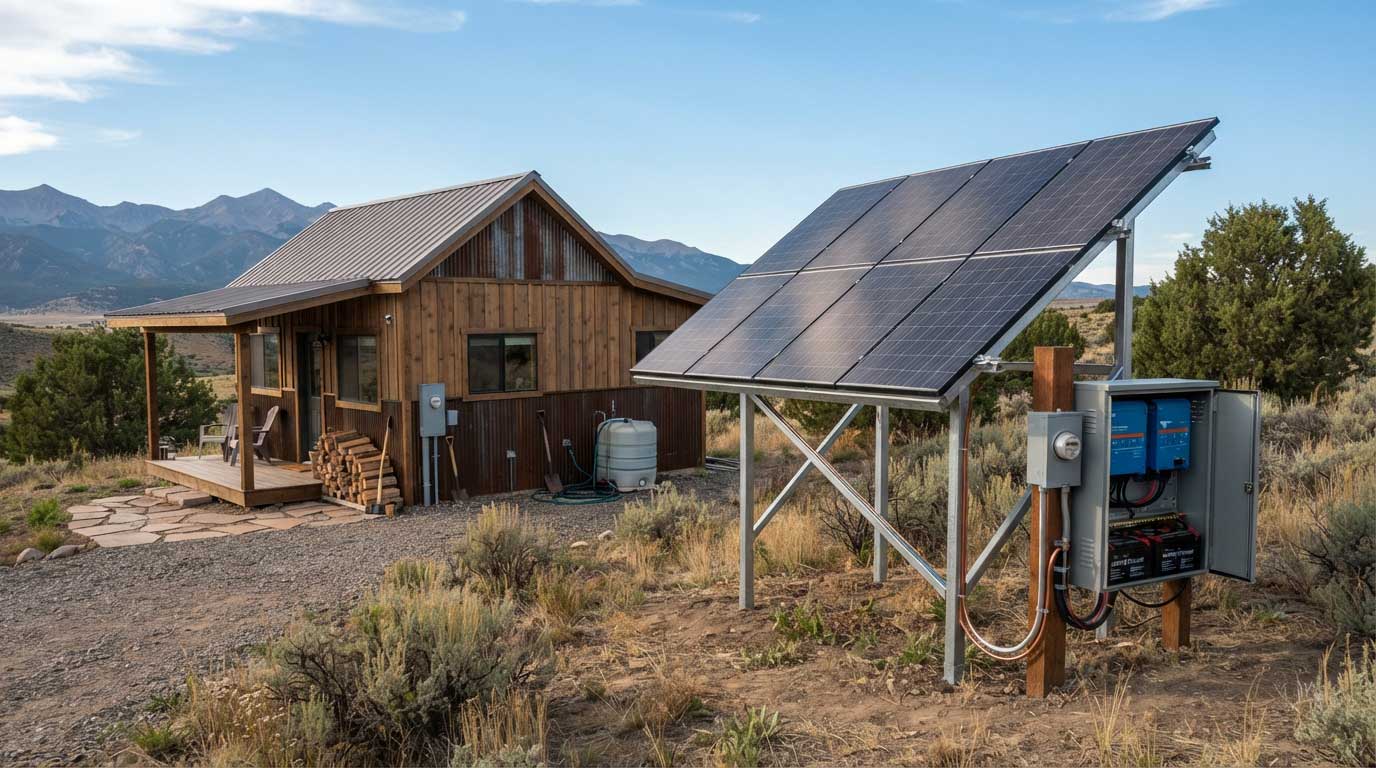
For a conventional ground-mounted cabin system, rigid framed panels are common.
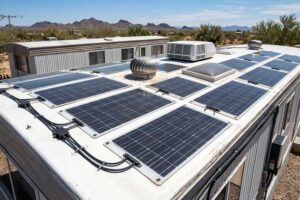
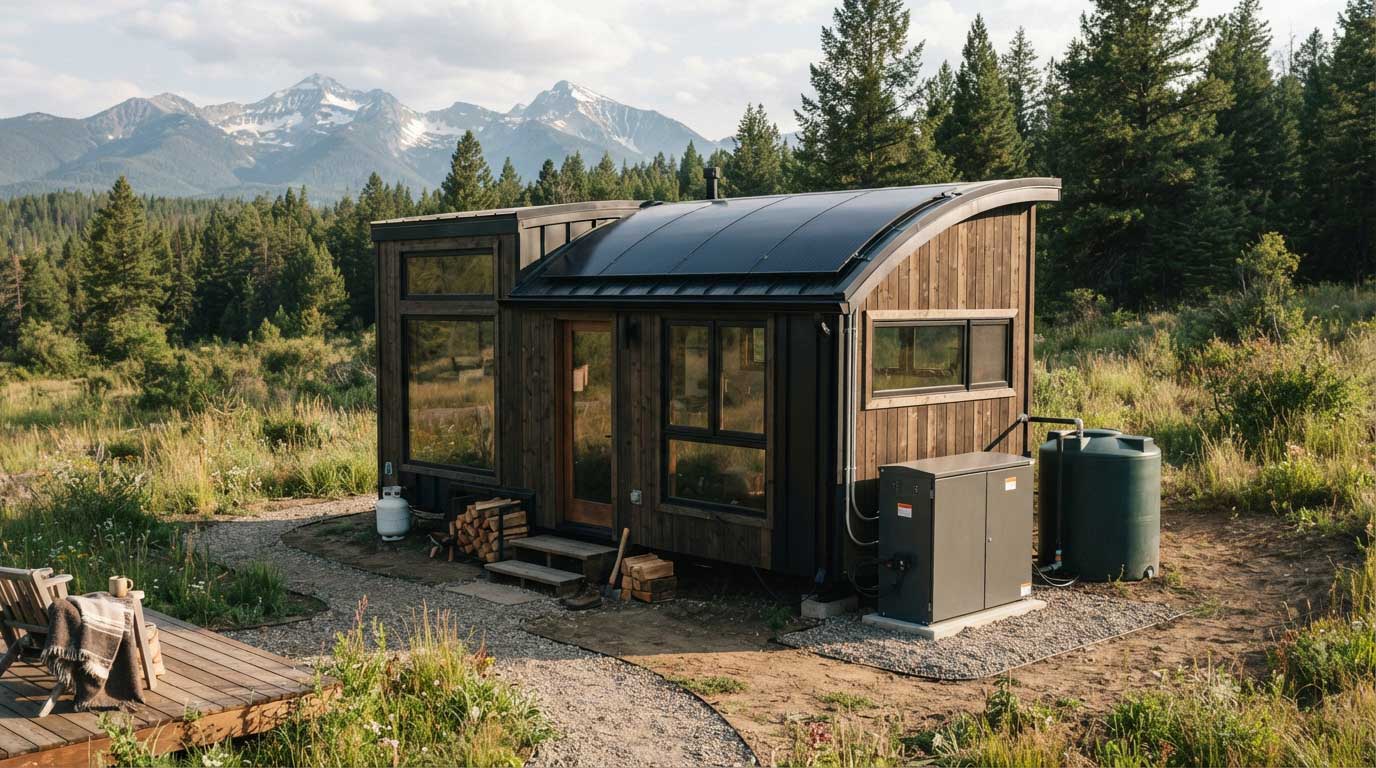
For RVs, boats, vans, curved roofs, and lightweight structures, flexible modules can be more practical.
This is one reason Bright Solar develops flexible solar solutions rather than treating every application as a rooftop installation.
The best panel is the one that fits the actual installation.
A 400W module that cannot be mounted efficiently is less useful than a smaller module that can occupy otherwise wasted surface area.
Solar Charge Controller
The charge controller regulates electricity flowing from the PV array into the battery.
Two common technologies are:
PWM — Pulse Width Modulation
MPPT — Maximum Power Point Tracking
For larger off-grid systems, MPPT is usually the more capable choice because it can operate the PV array at an appropriate maximum-power voltage while converting the energy to the battery’s charging requirements.
This becomes particularly valuable when the solar array voltage is substantially higher than the battery-bank voltage.
Battery Bank
The battery is what makes an off-grid system genuinely useful after sunset.
Battery capacity is commonly expressed in kilowatt-hours (kWh).
For example:
48V × 200Ah = 9.6kWh nominal battery capacity
But nominal capacity is not necessarily the same as energy that should be routinely consumed.
The usable capacity depends on:
- Battery chemistry
- Manufacturer specifications
- Depth of discharge
- Temperature
- Battery management system
- Charging and discharging limits
- System efficiency
For many modern off-grid installations, lithium iron phosphate (LiFePO4) batteries are attractive because of their energy density, cycle characteristics, and relatively low maintenance requirements.
But battery selection should be based on the manufacturer’s complete specifications rather than chemistry alone.
Inverter
The inverter converts DC electricity from the battery or PV system into AC electricity.
That allows an off-grid battery bank to operate common household equipment such as:
- Refrigerators
- Televisions
- Computers
- Pumps
- Lighting
- Kitchen appliances
- Power tools
- HVAC equipment
Inverter sizing has two separate questions:
How much power do the loads consume simultaneously?
and
How much surge power does the equipment require when starting?
A refrigerator compressor is a good example.
Its running power may look modest, while startup demand can be substantially higher.
The same issue appears with pumps, compressors, workshop tools, and certain air-conditioning equipment.
DOE notes that advanced inverters and solar-plus-storage systems can be configured to operate without grid support during outages when the system is designed for that purpose.
For a true off-grid installation, that capability isn’t a luxury.
It is fundamental.
How to Size a Complete Off Grid Solar System
Start with the loads.
Not the panels.
This is the part I would spend the most time on before purchasing equipment.
Make a list of everything that will run from the system.
| Load | Typical Power | Hours/Day | Daily Energy |
|---|---|---|---|
| LED lighting | 40W | 5h | 200Wh |
| Refrigerator | 100W average* | 10h equivalent | 1,000Wh |
| Laptop | 60W | 5h | 300Wh |
| Wi-Fi router | 15W | 12h | 180Wh |
| Water pump | 500W | 0.5h | 250Wh |
| TV | 100W | 3h | 300Wh |
| Example total | — | — | 2,230Wh/day |
*The refrigerator figure is an illustrative planning value, not a manufacturer’s consumption specification.
This example uses approximately:
2.23kWh/day
Now add the loads that people often forget:
- Inverter standby consumption
- Battery charging losses
- Pump startup
- Electronics left on overnight
- Seasonal heating or cooling
- Workshop tools
- Water heating
- Occasional kitchen appliances
That last category can completely change the design.
How Much Solar Power Does an Off Grid Home Need?
A basic first-pass calculation is:
PV array size ≈ Daily energy consumption ÷ usable solar hours ÷ system efficiency
Suppose an off-grid cabin needs:
3,000Wh/day
and the design location provides an average of:
4 peak-sun-hours/day
A theoretical minimum would be:
3,000Wh ÷ 4h = 750W
But installing exactly 750W would leave little margin.
Real systems experience losses from:
- Heat
- Wiring
- Conversion
- Dust
- Shading
- Battery charging
- Inverter operation
- Weather
So a practical design might move toward a 1kW–1.2kW array depending on the location, season, battery strategy, and acceptable backup requirements.
For serious projects, use location-specific solar-resource data rather than relying on a generic “four hours of sun” assumption.
NREL’s modeling tools are designed to evaluate PV performance using location and system characteristics rather than a single universal production number.
Battery Sizing for Off Grid Solar
Battery sizing should start from nighttime consumption and the number of backup days you want.
Consider a property consuming:
3kWh/day
If the owner wants approximately two days of energy autonomy:
3kWh × 2 = 6kWh
That is before accounting for usable battery limits and system losses.
A battery marketed as 6kWh may therefore be too small if the design requires 6kWh of usable energy.
This distinction causes a lot of confusion in online solar calculators.
One-day autonomy
Lower battery cost.
Less backup capacity.
Greater dependence on the following day’s sunshine.
Two-day autonomy
More resilience.
Higher battery investment.
Better for locations where cloudy periods are common.
Three or more days
Much greater resilience, but the battery bank becomes substantially larger and the system economics change.
There isn’t a universal “best” number.
A hunting cabin used occasionally does not need the same battery reserve as a full-time off-grid home.
DOE also emphasizes that storage capacity and power capacity are different measurements: one describes how much energy can be stored, while the other describes how quickly that energy can be delivered.
That distinction is critical.
A 15kWh battery with a 3kW continuous discharge rating behaves very differently from a battery with the same energy capacity but a 10kW power rating.
48V Off Grid Solar Systems: Why Higher Battery Voltage Helps
As system power increases, battery-bank voltage becomes increasingly important.
Consider a simplified 4,800W load.
At 12V:
4,800W ÷ 12V = 400A
At 24V:
4,800W ÷ 24V = 200A
At 48V:
4,800W ÷ 48V = 100A
These are simplified values, ignoring conversion losses.
The point is obvious.
Higher system voltage can dramatically reduce current for the same power.
Lower current can make cable sizing, connection design, and thermal management more manageable.
This is one reason 48V architectures are common in larger off-grid residential and commercial battery systems.
DC-Coupled vs AC-Coupled Off Grid Solar
There are two common system architectures.
| Configuration | Basic Path | Main Advantage |
|---|---|---|
| DC-coupled | PV → MPPT/DC charging → Battery | Efficient direct battery charging |
| AC-coupled | PV inverter → AC bus → Battery inverter | Flexible for certain existing systems |
DOE explains that solar-plus-storage systems can use DC- or AC-coupled configurations, with different inverter arrangements and system considerations.
For a new off-grid installation, DC coupling can be attractive because PV energy can charge the battery without unnecessary conversion steps.
For retrofits or systems using existing AC solar equipment, AC coupling may make more sense.
The architecture should be selected before buying individual components.
Otherwise, compatibility problems tend to show up later—usually when equipment is already sitting in the garage.
Real-World Off Grid Solar Example
Consider a small 900-square-foot cabin in the western United States.
The owner uses:
- Refrigerator
- LED lighting
- Laptop
- Wi-Fi
- Water pump
- Small kitchen appliances
- Occasional power tools
Average daily consumption:
4.2kWh/day
Peak simultaneous load:
4.5kW
The initial system concept might look like:
- 4–5kW solar array
- 48V battery bank
- 10kWh–15kWh usable storage
- 5kW or larger inverter
- MPPT solar charging
- DC and AC protection
- System monitoring
Why isn’t a 4.2kWh battery enough?
Because the cabin doesn’t consume exactly 4.2kWh every day.
A cloudy day followed by another cloudy morning changes the equation.
And the owner wants to run a refrigerator overnight.
The design therefore includes storage headroom rather than matching the average daily load exactly.
This is a more useful way to think about off-grid design.
What Loads Should an Off Grid Solar System Run?
Not every electrical load deserves equal priority.
A good off-grid system separates essential loads from high-consumption discretionary loads.
Essential loads
- Refrigerator
- Lighting
- Communications
- Water pump
- Medical equipment where applicable
- Security systems
- Essential electronics
Flexible loads
- Washing machine
- Dishwasher
- Power tools
- Water heating
- EV charging
- Large kitchen appliances
The trick is to move flexible loads into daylight hours whenever practical.
If the washing machine runs while the PV array is producing strongly, the battery doesn’t have to supply the entire load later.
DOE describes energy storage as a mechanism for shifting energy from periods of high generation to periods when demand is higher.
In an off-grid home, load management can sometimes be cheaper than adding another battery.
That is an overlooked design lever.
Off Grid Solar Wiring and Protection
Large batteries and PV arrays can deliver significant fault current.
Protection is not an afterthought.
A complete installation should account for:
- PV disconnects
- Battery fusing
- DC breakers
- AC breakers
- Appropriate cable sizing
- Overcurrent protection
- Grounding/bonding
- Surge protection where appropriate
- Weatherproof cable entries
- Battery enclosure requirements
- Equipment clearances
For an actual installation, local electrical codes and equipment manuals must take priority.
Battery installations can also have specific fire-safety and building requirements. DOE recommends reviewing local building codes and fire-code requirements when preparing for residential battery storage.
A beautiful solar array with poor cable management is not a professional system.
I pay particular attention to cable routing around outdoor equipment because UV exposure, abrasion, water ingress, and unsupported cable weight can become maintenance problems long after commissioning.
How Weather Changes Off Grid Solar Performance
One of the biggest mistakes in off-grid planning is designing around a perfect sunny day.
Real weather is messy.
Clouds.
Smoke.
Dust.
Snow.
Rain.
Seasonal sun-angle changes.
Partial shading from trees.
DOE specifically identifies clouds, dust, haze, shadows, rain, snow, and dirt as factors that can affect solar production.
This is why I prefer to examine the site’s worst useful solar period rather than only its annual average.
An annual average can make a system look excellent on paper while hiding a difficult winter.
For year-round off-grid homes, seasonal production matters.
For summer cabins, it matters less.
The system should reflect how the property is actually used.
Flexible Solar Panels for Off Grid Applications
Bright Solar flexible modules are particularly relevant when the available installation surface is not a conventional flat roof.Visit product page:Flexible Solar Panels
Potential applications include:
- RV roofs
- Camper vans
- Boats
- Tiny homes
- Curved structures
- Lightweight shelters
- Remote monitoring equipment
Flexible panels can reduce the installation constraints associated with rigid framed modules.
But flexibility should never be treated as a substitute for electrical engineering.
You still need to evaluate:
- Panel voltage
- Panel current
- Array configuration
- Controller limits
- Battery voltage
- Cable losses
- Environmental exposure
- Mounting method
- Thermal conditions
For larger off-grid systems, several flexible modules can be combined into an appropriately designed PV array.
The important word is designed.
How to Build Complete Solar Systems for Off Grid Use
A professional design process can be broken into practical stages.
Step 1: Measure the loads
List every appliance.
Record wattage and estimated operating hours.
Don’t guess if you can measure.
A plug-in energy meter can be useful for refrigerators, computers, entertainment equipment, and other AC loads.
Step 2: Identify peak load
Find the maximum number of appliances that may operate simultaneously.
This determines inverter size.
Step 3: Determine daily energy use
Add the watt-hours.
Then include realistic system losses.
Step 4: Evaluate solar resource
Use the actual location.
Seasonal differences matter.
Step 5: Select battery capacity
Decide how many hours or days of autonomy you actually need.
Step 6: Choose system voltage
For larger residential systems, 48V can substantially reduce DC current compared with 12V architectures.
Step 7: Select PV array size
Size the array to recover daily consumption and recharge the battery under realistic solar conditions.
Step 8: Select inverter and controller
Check:
- Voltage
- Current
- Surge rating
- Battery chemistry compatibility
- PV voltage limits
- PV current limits
Step 9: Design protection
Don’t leave fusing and disconnects until the end.
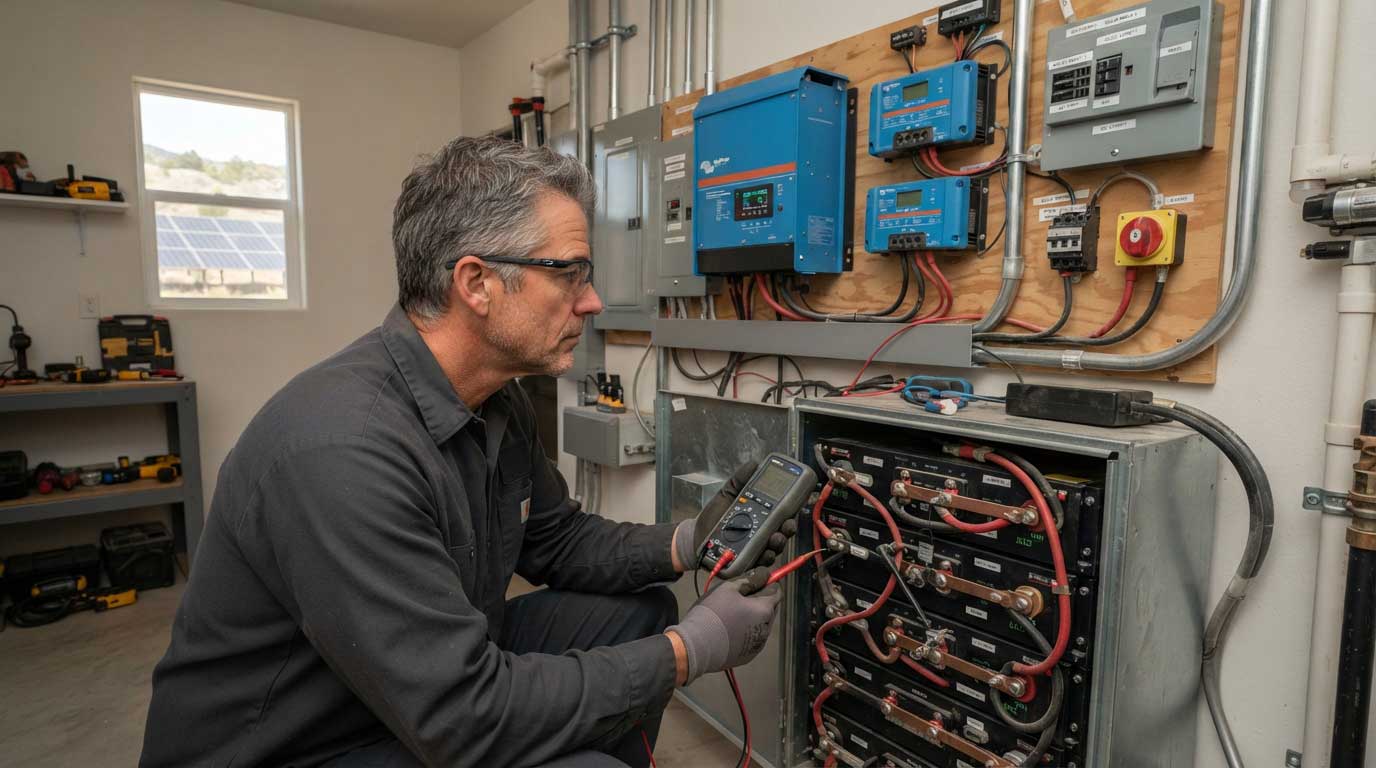
Step 10: Commission the system
Record:
- PV voltage
- PV current
- Battery voltage
- Battery state of charge
- Inverter load
- Charging current
- Daily energy production
Those numbers create a baseline for future troubleshooting.
How Much Battery Storage Does an Off Grid Home Need?
There is no universal battery size.
Consider three example households:
| Daily Energy Use | Suggested Planning Concept |
|---|---|
| 2–3kWh | Small cabin / essential loads |
| 4–8kWh | Tiny home / moderate household |
| 10–20kWh+ | Full-time home with larger loads |
These are planning ranges, not engineering specifications.
A home using electric heating, electric water heating, induction cooking, and air conditioning can exceed these numbers quickly.
That is why appliance-level measurement is more useful than copying another homeowner’s system size.
The same 10kWh battery can be generous for one property and inadequate for another.
Common Mistakes When Buying Complete Off Grid Solar Systems
Buying panels first
The array should be designed around energy demand and available solar resource.
Ignoring inverter surge power
Motors and compressors can require substantial startup power.
Using nominal battery capacity as usable capacity
Always check the manufacturer’s usable-energy and discharge specifications.
Installing too little solar
A battery can only be useful if the array can recharge it.
Ignoring winter production
Annual averages can hide seasonal shortages.
Undersizing cables
High current on the battery side makes voltage drop and heat particularly important.
Forgetting standby consumption
An inverter that remains energized 24 hours a day consumes energy even when the house is quiet.
FAQ: Complete Solar Systems for Off Grid
What does a complete off-grid solar system include?
A complete system normally includes solar panels, battery storage, charge-control equipment, inverter equipment, wiring, disconnects, overcurrent protection, mounting hardware, and monitoring. The exact equipment depends on the application.
How many solar panels do I need for an off-grid home?
Panel count depends on daily electricity consumption, panel wattage, local solar resource, seasonal conditions, system losses, and required battery recharge time. There is no reliable universal panel count.
Is 48V better for an off-grid solar system?
For larger systems, 48V can reduce DC current substantially compared with 12V or 24V at the same power level. That can simplify high-power battery-bank and cable design.
How many batteries do I need for off-grid solar?
Battery quantity depends on required energy capacity, battery voltage, usable depth of discharge, daily consumption, and desired autonomy. Start with kWh requirements rather than battery count.
Can an off-grid solar system run a refrigerator?
Yes. Refrigerators are common off-grid loads, but the system must account for their daily energy consumption and compressor startup demand.
Can solar panels power a house at night?
Solar panels do not normally generate useful electricity at night. An off-grid system uses battery storage to supply nighttime loads. DOE identifies energy storage as the mechanism that allows solar energy to be used at a different time from when it was generated.
Can flexible solar panels be used for off-grid systems?
Yes. Flexible panels can be useful where roof weight, curved surfaces, or installation geometry make conventional rigid modules inconvenient. Their electrical specifications still need to match the controller, battery bank, and system architecture.
Conclusion
Complete solar systems for off grid living work best when the entire system is designed as one electrical architecture rather than assembled from unrelated components.
Start with the loads.
Measure actual consumption.
Size the battery around the required autonomy.
Choose the system voltage based on power requirements.
Then size the PV array around real solar conditions and recharge requirements.
The panel is important, but it is not the whole system.
At Bright Solar, we focus on flexible solar-panel solutions for applications where conventional modules can be difficult to install, including RVs, marine environments, curved roofs, tiny homes, and other off-grid applications.
A good off-grid installation should feel almost boring after commissioning.
The lights come on.
The refrigerator keeps running.
The battery charges during the day.
The inverter handles the loads.
And when the weather changes, the system has enough margin to keep going.
That is what a complete solar systems for off grid design should deliver: not simply solar generation, but dependable energy independence.
Related recommendations
-

Flexible Marine Solar Panels: Reliable Solar Power for Boats and Yachts
196Discover how flexible marine solar panels provide lightweight, reliable power for boats and yachts. Learn about efficiency, durability, installation, and marine applications.
View details -
300 w flexible solar panel (High-Power Mobile Energy System Guide from Bright Solar)
199300 w flexible solar panel explained with real RV field performance data, installation insights, energy output behavior, and off-grid system design notes.
View details -
Solar Panels in Parallel: When Parallel Wiring Is the Smartest Choice
235Learn how solar panels in parallel improve system reliability, reduce shading losses, and optimize 12V battery charging. Expert guide from Bright Solar.
View details -
400W Flexible Solar Panel: High-Output Solar Power Without the Weight
153400w flexible solar panel solutions for RVs, boats, and off-grid systems. Discover lightweight ETFE solar panels with high efficiency and real-world durability.
View details