Best Flexible Solar Panels for Van: How to Choose the Right One
The best flexible solar panels for van builds are lightweight, low-profile modules that match the roof curve, available space, daily power demand, and electrical system. For most curved van roofs, flexibility and weight matter first; panel wattage, efficiency, temperature behavior, and installation method determine whether the system works well after installation.
What Makes the Best Flexible Solar Panels for Van?
A van roof is not simply a smaller house roof.
It moves.
It vibrates on rough roads, heats up under direct summer sun, collects dust, encounters rain and snow, and has roof equipment competing for every usable square inch.
That changes the way a solar panel should be selected.
NREL research on vehicle-integrated photovoltaics specifically identifies flexibility, weight, aerodynamic contours, and specific power as important considerations for vehicle-mounted PV. NREL also notes that conventional crystalline-silicon modules are rigid and therefore not naturally suited to many vehicle applications.
For a van conversion, I would start with these specifications rather than with the product’s marketing label:
| Specification | Why It Matters on a Van |
|---|---|
| Rated power | Determines nominal solar capacity |
| Dimensions | Determines how much roof can actually be used |
| Weight | Affects roof loading and vehicle payload |
| Bending capability | Determines compatibility with roof curvature |
| Cell technology | Influences efficiency and physical construction |
| Operating temperature | Important on hot, exposed van roofs |
| Junction-box protection | Matters for permanent outdoor exposure |
| Connector | Must match the electrical system |
| Voc / Vmp | Required for charge-controller compatibility |
| Warranty | Useful indicator of manufacturer’s confidence |
| Mounting method | Determines installation complexity |
The important point is that no single specification makes a panel “the best.”
A 200W panel that fits perfectly can be a better choice than a 300W panel that forces the installer to remove useful roof space around a fan or air conditioner.
Flexible Solar Panels for Van vs. Rigid Solar Panels
The flexible-versus-rigid decision usually comes down to the roof.
If the van has a relatively flat roof and already uses a roof rack, rigid panels can be attractive because they are mechanically robust and can be installed with an air gap beneath the module.
If the roof has pronounced curves, a flush installation is required, or minimizing additional roof height is important, flexible panels become much more interesting.
NREL’s PV research specifically recognizes lightweight, flexible modules as advantageous for applications involving weight limitations, curved surfaces, and mobile or portable installations.
Comparison for a Typical Van Conversion
| Feature | Flexible Panel | Rigid Panel |
|---|---|---|
| Curved roof | Excellent fit | Usually requires structure |
| Roof profile | Very low | Higher with mounting hardware |
| Weight | Usually lower | Usually higher |
| Installation | Can be direct-mounted depending on product | Usually requires brackets/rack |
| Air circulation | Limited when flush-mounted | Usually better |
| Roof penetrations | Can potentially be minimized | Depends on mounting design |
| Replacement | Often straightforward | Often straightforward |
| Long-term mechanical protection | Product-dependent | Generally robust glass construction |
The final decision should be based on the van rather than on a generic claim that one technology is always superior.
How Much Solar Power Does a Van Need?
Before choosing the best flexible solar panels for van life, estimate the electrical load.
A simple daily load calculation might look like this:
| Van Load | Example Daily Use |
|---|---|
| LED lighting | 40 Wh |
| Phones and small electronics | 60 Wh |
| Laptop | 100 Wh |
| Refrigerator | 500 Wh |
| Cellular router | 120 Wh |
| Water pump and miscellaneous DC loads | 80 Wh |
| Example total | 900 Wh/day |
These figures are an example planning model, not universal consumption values.
A van with an induction cooker, compressor refrigerator, Starlink-type communications equipment, diesel heater controls, camera equipment, or air conditioning can have a very different energy profile.
Suppose the target is approximately 900 Wh per day and the planned array is 400W.
At four equivalent peak-sun hours:
400W × 4h = 1,600Wh
That is 1.6kWh of theoretical energy before accounting for real-world losses.
The actual battery charge will be lower or higher depending on solar conditions and system design.
The U.S. Department of Energy explains that PV performance is affected by factors including temperature, wavelength, reflection, and other operating conditions. Higher temperatures generally reduce PV voltage and can reduce efficiency.
This is why simply multiplying panel wattage by an assumed number of hours should be treated as a planning estimate, not a production guarantee.
How Many Watts of Flexible Solar Panels Are Best for a Van?
There is no universal number.
For many compact van builds, 200W–400W is a practical starting range when roof space is limited. Larger vans with sufficient usable roof area may accommodate substantially more.
Current van-solar guides commonly report roughly 60–120 square feet of usable roof area on popular cargo-van configurations after accounting for fans, air-conditioning units, and antennas, although the actual usable area varies significantly by vehicle and build.
A useful planning approach is:
| Van Type | Illustrative Solar Range |
|---|---|
| Small camper van | 100–300W |
| Compact conversion van | 200–400W |
| Sprinter/Transit-style build | 300–600W |
| High-energy full-time build | 500W+ |
These are planning ranges, not fixed recommendations.
The roof should be measured first.
For example, a long-wheelbase van might appear to have room for four 200W panels. After marking the roof fan, skylight, antenna, cable entry, and required maintenance clearance, only three positions may remain practical.
That is normal.
Roof layout should be treated as an engineering constraint, not an afterthought.
Why Flexible Panels Work Well on Curved Van Roofs
The biggest advantage is physical conformity.
A rigid glass module wants a relatively stable mounting plane. A flexible module can follow a controlled roof curve, allowing the installer to use surface area that would otherwise be difficult to exploit.
That matters on vehicles such as:
- Mercedes-Benz Sprinter conversions
- Ford Transit camper vans
- Ram ProMaster conversions
- Compact camper vans
- Fiberglass camper bodies
- Custom expedition vans
A low-profile panel can also reduce the visual height of the installation.
For stealth-oriented builds, that difference is practical rather than cosmetic. Roof hardware can affect how the van looks, how equipment is arranged, and how much clearance remains around roof-mounted accessories.
But there is a limit.
Flexible does not mean foldable.
A van panel should only be bent within the manufacturer’s specified mechanical limits. Do not create a crease to make a module fit around a vent.
If the roof shape is too complex, change the panel arrangement instead.
What Cell Technology Should You Choose?
Flexible van panels are available using different photovoltaic technologies.
Flexible Monocrystalline Panels
Flexible monocrystalline products are widely used where relatively high power is needed within a limited footprint.
Their appeal is straightforward: more electrical capacity can be fitted into constrained roof space.
For a van with a refrigerator, communication equipment, laptop, lighting, and other daily loads, that space efficiency can matter more than extreme mechanical flexibility.
CIGS Thin-Film Flexible Panels
CIGS technology can be manufactured on flexible substrates.
NREL documentation has described CIGS photovoltaic modules as capable of being produced on flexible substrates, creating lightweight modules suitable for applications where conventional rigid construction is less appropriate.
The trade-off is that cell technology should not be judged only by how easily the panel bends.
A sharply curved roof may justify a more flexible technology. A gently curved van roof may not.
That distinction can save money.
Heat Is a Bigger Issue Than Many Van Buyers Expect
A flexible panel mounted directly against a van roof does not have the same thermal environment as a rigid panel raised above the roof with an air gap.
The roof may already be hot.
Add:
- Dark exterior paint
- Direct summer sunlight
- Minimal backside airflow
- High ambient temperature
- Several hours of solar exposure
and the module can operate in a demanding thermal environment.
DOE explains that higher temperatures generally cause a much larger decrease in PV voltage than the corresponding increase in current, which is one reason temperature management matters for PV performance.
This is one of the reasons I would not select a flexible van panel based on efficiency alone.
Look at the complete specification sheet.
Check operating temperature.
Check the installation instructions.
Then consider the actual roof.
A panel rated for outdoor use still needs to be installed according to its intended design.
Practical Selection Checklist for the Best Flexible Solar Panels for Van
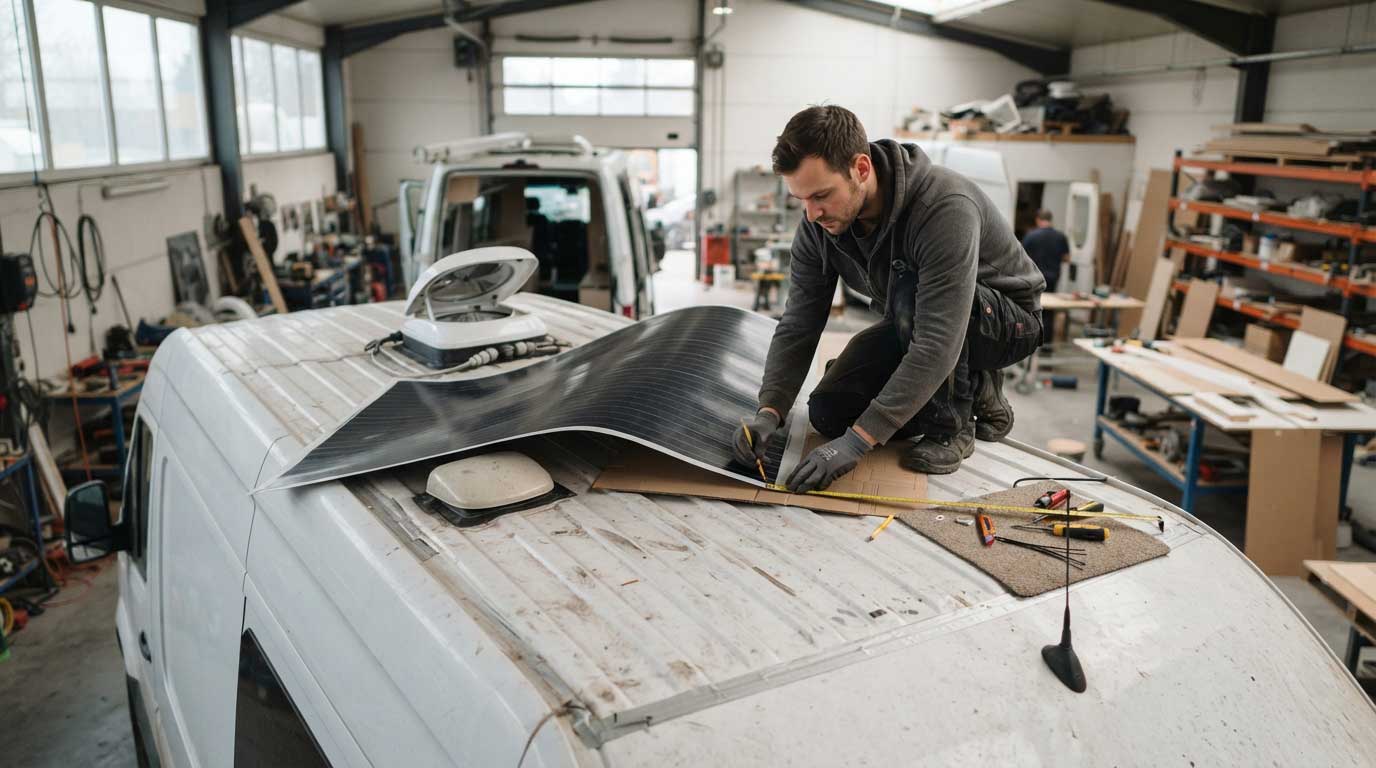
Before placing an order, I recommend checking the following specifications together rather than reading only the wattage on the product title.
1. Measure the Actual Roof
Record the usable length and width.
Then subtract space for:
- Roof fans
- Skylights
- Antennas
- Air conditioners
- Roof racks
- Service access
- Cable routing
Do not measure the entire roof and assume it is all solar real estate.
2. Confirm the Bending Specification
Look for an actual bending specification or radius from the manufacturer.
Avoid vague descriptions such as “super flexible” when no mechanical limit is provided.
3. Check Electrical Compatibility
The panel’s Voc, Vmp, Isc, and Imp must be compatible with the selected charge controller and battery architecture.
DOE emphasizes that PV modules are only one part of a complete PV system; mounting, power electronics, storage, and other components all affect how the generated electricity becomes usable energy.
4. Check the Junction Box and Connectors
A permanent van installation is exposed to rain, condensation, road spray, dust, and repeated temperature changes.
The junction-box protection and connector specifications therefore deserve more attention than they often receive on shopping pages.
5. Think About Maintenance Before Installation
This is an easy field detail to overlook.
A panel placed directly underneath another piece of roof equipment may technically fit, but cleaning the surrounding area or servicing the equipment later can become awkward.
Leave sensible access where the roof layout allows it.
Bright Solar’s Approach to Flexible Van Solar
At Bright Solar, flexible solar panel selection starts with the installation rather than simply choosing the highest wattage available.
For van applications, the relevant questions are:
- How much usable roof area is available?
- How curved is the roof?
- What daily energy demand is expected?
- How much additional roof weight is acceptable?
- What temperature range will the module experience?
- What controller and battery system will be used?
- Is the van exposed to marine air, dust, snow, or high summer heat?
- Does the customer need a particular size or shape?
This application-first approach is important for B2B buyers, van conversion companies, distributors, and system integrators because the same nominal wattage can require very different mechanical and electrical specifications.
Bright Solar’s flexible product range includes options designed around lightweight construction, controlled flexibility, outdoor protection, and application-specific requirements. Product selection should always be based on the actual module datasheet and the installation conditions rather than assumptions about all flexible panels.
How to Install Flexible Solar Panels on a Van
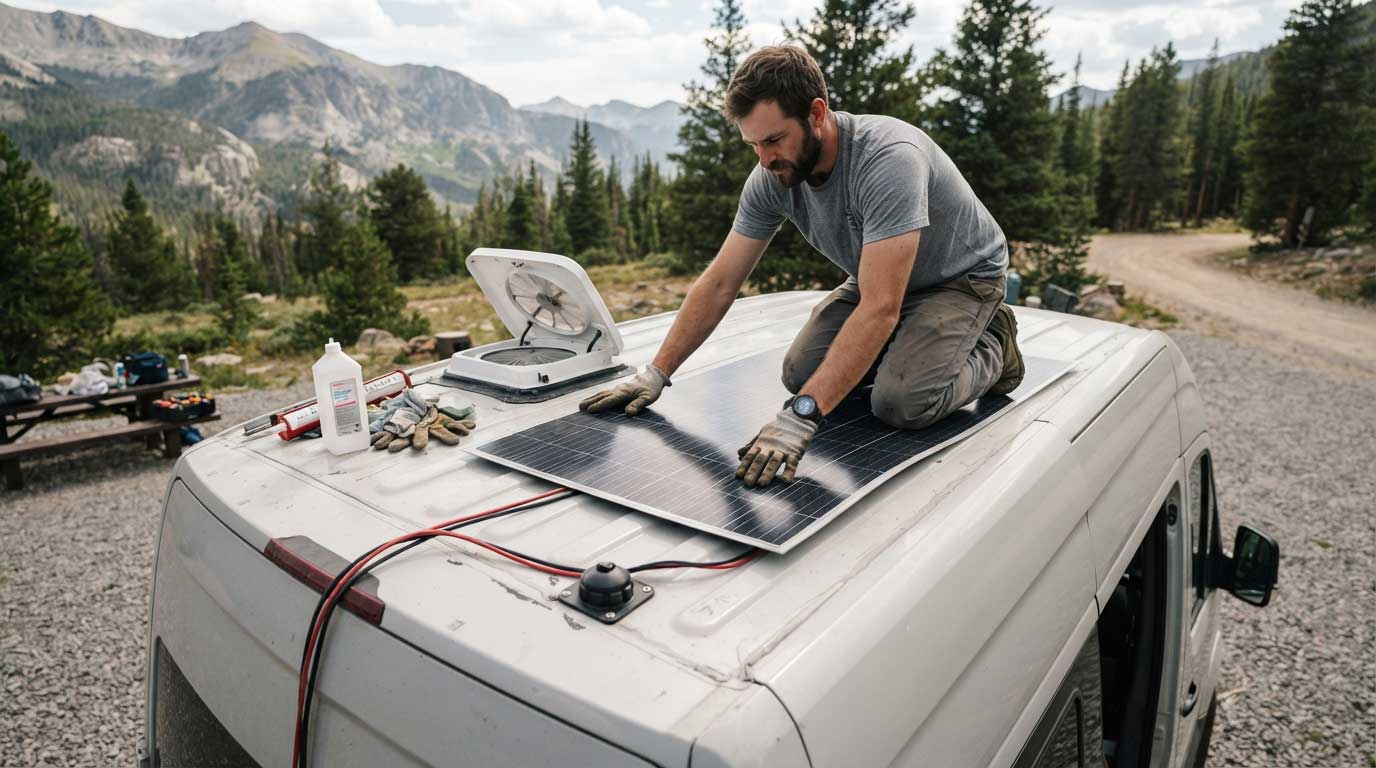
Once the panel size and electrical configuration are decided, installation becomes the next major concern. A flexible module can conform to a van roof, but that does not mean it should be forced into every curve.
The roof should be inspected before installation. Look for old sealant, oxidation, damaged coatings, dirt, roof accessories, and areas where water can collect.
A practical installation sequence is:
- Place the panel on the roof without fixing it.
- Confirm the planned position from several angles.
- Mark the cable-entry route.
- Check clearance around vents and roof equipment.
- Prepare and clean the mounting surface according to the mounting system.
- Position the panel without creating sharp bends.
- Route and secure the cables.
- Complete the electrical connections according to the system design.
- Inspect the finished installation before the van goes on the road.
The temporary positioning step is surprisingly valuable. Once adhesive has been applied, correcting a panel that is 50 mm out of position is no longer a simple adjustment.
Keep the Panel Within Its Bending Limit
This is one of the most important specifications when choosing flexible van solar panels.
A panel can be flexible without being designed for repeated folding.
There is a substantial difference between:
- Following a gentle roof curve
- Bending around a corner
- Folding the module
- Rolling the module tightly
Only the first—or whatever range the manufacturer specifically permits—should be assumed safe.
For B2B buyers, a product datasheet should state the mechanical limit clearly. If the bending radius is missing, ask the manufacturer before committing to a large installation.
Do Flexible Solar Panels Need an Air Gap?
Not every flexible solar panel is installed in the same way, so there is no universal answer.
A conventional rigid panel is commonly mounted above a roof with space underneath it. This allows air to move beneath the module.
A flush-mounted flexible panel has a different thermal environment.
That distinction matters because PV module temperature affects electrical performance. The U.S. Department of Energy notes that temperature is one of the factors influencing photovoltaic performance, with higher temperatures generally reducing voltage and efficiency.
For a van parked in direct summer sunlight, this deserves attention.
A black van roof can become extremely hot. Add a panel directly above that surface and there may be limited opportunity for backside cooling.
That does not make flush-mounted flexible panels unusable. It means the product and installation method should be designed for that condition.
For a manufacturer, this is also why the installation instructions should be considered part of the product—not an afterthought.
How Much Energy Can a Flexible Van Solar System Produce?
The rated wattage printed on a panel is not the same thing as daily energy delivered to a van battery.
For example, a 400W array under an illustrative four-hour equivalent solar resource would have:
400W × 4 hours = 1,600Wh
or 1.6kWh of theoretical energy.
Actual energy reaching the battery depends on sunlight, temperature, shading, panel orientation, wiring, charge-controller behavior, and other system losses.
The U.S. Department of Energy explains that solar radiation varies by location, time of day, season, landscape, and weather conditions.
That makes a van installation particularly interesting.
The vehicle moves.
A panel may receive excellent sunlight while driving through open countryside and considerably less when the van is parked beneath trees at a campsite.
The same 400W array can therefore produce very different results on different days.
A More Useful Way to Size a Van System
Instead of asking only:
“How many watts can I put on the roof?”
ask:
“How much energy does the van consume, and how much roof area can reliably produce it?”
Consider an illustrative van with the following daily consumption:
| Load | Approximate Daily Energy |
|---|---|
| Refrigerator | 500Wh |
| Lighting | 40Wh |
| Phones and tablets | 60Wh |
| Laptop | 100Wh |
| Router and communications | 120Wh |
| Water pump and miscellaneous DC loads | 80Wh |
| Total | 900Wh/day |
If the roof can accommodate a 400W flexible array, the theoretical four-hour example above produces 1.6kWh before losses.
That gives the designer useful headroom.
But the system should still be evaluated against cloudy days, parking conditions, seasonal changes, and battery capacity.
This is much more useful than telling a van owner that “400W is enough” without knowing how the van is actually used.
What Size Flexible Solar Panel Is Best for Van Life?
For many builds, 100W, 200W, and 400W configurations are convenient starting points because they can be combined to fit different roof layouts.
A simple example:
| Array | Configuration Example | Nominal Capacity |
|---|---|---|
| Small | 1 × 100W | 100W |
| Compact | 2 × 100W | 200W |
| Medium | 2 × 200W | 400W |
| Larger | 3 × 200W | 600W |
| High-capacity | 4 × 200W | 800W |
These combinations are examples rather than universal system recommendations.
The physical dimensions of each module can be more important than the arithmetic.
Imagine a van roof where two 200W panels fit neatly beside the roof fan. A third panel might technically increase capacity but interfere with the antenna or leave an unsafe cable route.
In that situation, the additional nominal wattage may not justify the compromise.
This is one reason customized panel dimensions can be useful for professional van converters.
Flexible Solar Panels for Van Roofs: A Practical Case
Consider a medium-size camper van converted for two people who spend several days away from grid power.
The roof contains:
- One roof fan
- One compact skylight
- A roof antenna
- Limited usable space near the rear section
The electrical system includes a refrigerator, lighting, mobile communications, laptops, and occasional kitchen loads.
The initial proposal is four 100W panels.
During the roof-layout stage, however, the installer finds that the four modules would leave an awkward gap around the roof equipment and push the cable entry closer to an area where water runoff is expected.
A different arrangement using fewer, larger modules may provide a cleaner installation.
This is a realistic type of design decision because solar capacity is not installed in an empty rectangle. The roof has existing hardware.
The installer can then compare:
- Total wattage
- Module dimensions
- Cable length
- Shading
- Weight
- Bending radius
- Controller limits
- Maintenance access
The best configuration is the one that works as a system.
Not necessarily the one with the largest number printed on the product page.
Series or Parallel Wiring for Van Solar?
Panel wiring should be selected together with the charge controller.
In a series connection, panel voltages add while current remains approximately at the level of the string.
In a parallel connection, current adds while voltage remains approximately at the level of the connected panels.
That difference can affect cable sizing and charge-controller selection.
For example, connecting two identical modules in series approximately doubles the array operating voltage, while connecting them in parallel approximately doubles the current.
The controller’s maximum PV voltage must not be exceeded, particularly under cold conditions when module open-circuit voltage can increase.
Victron Energy’s technical documentation likewise emphasizes checking the PV array’s voltage against the solar charger’s maximum PV voltage and designing the DC wiring around the expected current.
For a van system, there is another consideration: shading.
A roof vent can cast a shadow across part of an array. Depending on the panel layout and electrical configuration, partial shading can have a noticeable effect on output.
The U.S. Department of Energy also identifies shading as an important factor in PV system performance.
So the wiring decision should come after the roof layout—not before it.
What Should Van Conversion Companies Look for in a Flexible Solar Panel Supplier?
For a single DIY van, buying one panel is relatively simple.
For a van conversion company or distributor, the requirements are different.
The supplier should be able to provide clear technical information for:
- Rated power
- Vmp
- Imp
- Voc
- Isc
- Cell technology
- Module efficiency
- Dimensions
- Weight
- Bending radius
- Operating temperature
- Connector type
- Junction-box protection
- Warranty
- Available customization
A manufacturer that cannot provide the basic electrical and mechanical parameters creates unnecessary risk for the installer.
Customization Can Matter More Than a Higher Wattage
Professional converters often work with multiple vehicle platforms.
One van may have a broad, relatively flat roof.
Another may have a strong longitudinal curve.
A third may have roof equipment positioned exactly where a standard panel would normally be installed.
A flexible solar panel manufacturer capable of discussing dimensions and application requirements can therefore provide more value than a supplier selling only standardized wattages.
For Bright Solar’s B2B customers, this application-oriented approach is especially relevant to distributors, system integrators, vehicle conversion companies, and specialty solar installers.
Why Lightweight Construction Matters on a Van
Weight is not just a specification for the roof.
Every kilogram added to a conversion contributes to the vehicle’s overall payload.
A van may already carry:
- Water tanks
- Batteries
- Kitchen equipment
- Beds
- Refrigeration
- Tools
- Spare tires
- Camping equipment
- Passengers
NREL has studied lightweight PV for transportation applications because vehicle-mounted solar creates different weight and integration requirements from stationary rooftop systems.
This is one reason flexible modules can be attractive in van applications.
However, “lighter” should never mean “less suitable.”
The module still needs appropriate environmental protection and mechanical durability for the intended installation.
The right question is:
How much weight can be saved while still meeting the project’s electrical, mechanical, and environmental requirements?

Flexible Solar Panel Maintenance on a Van
Maintenance is usually straightforward, but the roof should not be ignored.
Dust, pollen, bird droppings, road grime, and tree residue can accumulate on a vehicle-mounted panel.
Cleaning frequency depends heavily on where the van travels and where it is parked.
A van spending months in a dry, dusty region has different maintenance requirements from one regularly parked in a rainy forest.
During inspection, look for:
- Dirt accumulation
- Loose cable routing
- Damaged connectors
- Sealant deterioration
- Edge lifting
- Surface damage
- Signs of water ingress
- Changes in panel appearance
Do not use aggressive cleaning methods simply because the panel is outdoors.
Follow the panel manufacturer’s cleaning instructions and avoid tools that could scratch or damage the module surface.
A quick visual inspection after a long road trip is often worthwhile.
Are Flexible Solar Panels Worth It for a Van?
For the right van, yes.
The strongest reason is not that flexible panels are automatically more powerful. It is that they can solve several physical constraints at the same time:
- Curved roof compatibility
- Low-profile installation
- Reduced mounting hardware
- Lower roof weight
- Better use of irregular roof space
- Integration with certain vehicle designs
But they are not automatically the best choice for every van.
If a vehicle has a large flat roof, plenty of payload capacity, and an existing rack system, conventional rigid panels may remain attractive.
If the roof curvature is significant and low-profile integration matters, flexible technology becomes much more compelling.
That is the decision point.
FAQ About Best Flexible Solar Panels for Van
What are the best flexible solar panels for van conversions?
The best flexible solar panels for van conversions are those that match the roof dimensions, bending radius, power requirements, weight limits, electrical system, temperature range, and installation method. There is no single panel that is best for every van.
How many watts of solar do I need for van life?
The required wattage depends on daily electricity consumption and available roof space. A 200W system may suit a low-energy build, while a van using refrigeration, computers, communications equipment, and other loads may benefit from 400W or more.
Are flexible solar panels good for van roofs?
Yes. They are particularly useful when the roof is curved, available space is limited, or a low-profile installation is preferred. The panel must still be installed within its specified mechanical limits.
Can I walk on a flexible solar panel installed on my van?
Do not assume that a flexible panel is walkable. Only a product specifically designed and rated for foot traffic should be treated as walkable. Otherwise, avoid stepping on the module.
Are flexible solar panels better than rigid panels for van life?
Flexible panels can be better for curved, lightweight, low-profile installations. Rigid panels can be preferable where maximum mechanical protection, raised mounting, and ventilation are priorities. The van’s roof and electrical requirements should determine the choice.
Can I connect flexible solar panels directly to a van battery?
A PV module should normally be connected through an appropriately sized solar charge controller rather than directly to the battery. The controller and wiring must be compatible with the panel’s voltage and current specifications.
What should I check before buying flexible van solar panels?
Check rated power, Vmp, Imp, Voc, Isc, dimensions, weight, bending radius, operating temperature, connector type, environmental protection, warranty, and compatibility with the charge controller. These specifications are more useful than wattage alone.
Conclusion
The best flexible solar panels for van applications are not simply the panels with the highest wattage or the lowest price. They are the modules that fit the vehicle’s roof, electrical architecture, weight constraints, environmental conditions, and real energy requirements.
For a van conversion, start with the roof. Measure the usable area, mark every obstruction, study the curvature, and determine where cables can safely enter the vehicle. Then size the solar array around actual loads.
For B2B van converters and distributors, the same principle applies at a larger scale: consistent specifications, dependable manufacturing, appropriate customization, and clear technical support make flexible solar easier to integrate across different vehicle platforms.
Bright Solar provides flexible solar panel solutions for mobile and specialty applications, including options where lightweight construction, controlled flexibility, outdoor protection, and customized dimensions are important.
The phrase best flexible solar panels for van therefore has a practical meaning: the best panel is the one engineered for the actual van, not merely the one with the biggest number on the label.
Related recommendations
-

Solar Battery Charger for Boat: Reliable Marine Battery Charging Anywhere
101Discover the best solar battery charger for boat applications. Keep marine batteries charged with efficient, waterproof solar charging systems for yachts and fishing boats.
View details -
Durable Flexible Solar Panel: Built for Long-Term Solar Performance
149Explore durable flexible solar panel solutions designed for RV, marine and off-grid applications. Learn durability factors, materials, testing, and real installation experience from Bright Solar.
View details -
Folding Solar Panels for Camping: A Practical Guide to Portable Power
14Folding solar panels provide portable camping power and can be repositioned to capture better sunlight when campsites become shaded.
View details -
Best RV Solar Kit for Off-Grid Travel
152Find the best rv solar kit for off-grid travel. Learn how to size solar panels, batteries, charge controllers and wiring for reliable RV power.
View details