Best Marine Solar Panels for Boats and Yachts
The best marine solar panels are lightweight, salt-resistant, weather-resistant modules matched to the boat’s available mounting area, battery voltage, daily energy demand, and installation conditions. For many boats, flexible panels offer the best combination of low weight and conformability, while rigid modules make more sense where there is a strong, flat mounting surface.
That answer sounds simple.
On an actual boat, it isn’t.
A solar panel mounted beside a marina is exposed to salt mist, humidity, vibration, heat, standing water, foot traffic and sometimes complete lack of maintenance for weeks at a time. The panel itself may survive perfectly while a connector, fastener, cable gland or bonding point starts deteriorating.
The U.S. Department of Energy specifically identifies marine environments as moderately to highly corrosive locations and notes that corrosion can affect module materials, connectors, racking, fasteners, electrical panels and other balance-of-system components.
That is why I would never choose a marine panel by wattage alone.
For Bright Solar projects, I look at the entire installation: panel construction, salt-mist qualification, weight, mounting surface, cable routing, ventilation, shading, battery demand and how the boat will actually be used.
What Makes the Best Marine Solar Panels Different?
A marine solar panel does not necessarily need a completely different photovoltaic cell technology.
The difference is often in how the module survives the environment around those cells.
A boat installation exposes the system to a combination that is unusually hard on electrical hardware:
- Salt spray
- High humidity
- Condensation
- UV exposure
- Wind
- Vibration
- Mechanical flexing
- Temperature cycling
- Standing water
- Dissimilar metals
- Limited access for maintenance
Salt is particularly troublesome because moisture containing dissolved salts can act as an electrolyte.
The DOE explains that galvanic corrosion occurs when dissimilar metals are electrically connected in the presence of an electrolyte. Solar installations can contain aluminum, stainless steel, copper and other metals in close proximity, making fastener and bonding choices important.
This is one of those problems that rarely appears in a product photograph.
Six months later, it can be obvious.
Marine Solar Panels for Boats: The First Specification I Check
Salt-Mist Resistance
If a panel will spend years near seawater, I want evidence that its construction has been evaluated for salt-mist exposure.
IEC 61701:2020 is the international standard specifically covering salt-mist corrosion testing of photovoltaic modules. The standard describes test sequences for evaluating PV module resistance to corrosion caused by salt mist containing compounds such as sodium chloride and magnesium chloride.
This gives buyers something concrete to ask for.
Instead of:
“Is this panel marine grade?”
Ask:
“What salt-mist test has this module passed, and at what severity level?”
The DOE currently recommends that modules intended for highly marine-corrosive sites achieve IEC 61701 Level 6 and also recommends checking recognized module reliability scorecards such as PVEL or RETC.
That is a much more useful purchasing conversation.
Rigid vs Flexible Marine Solar Panels
There is no single winner.
The correct choice depends heavily on the boat.
| Feature | Flexible Marine Panel | Rigid Marine Panel |
|---|---|---|
| Weight | Very low | Higher |
| Curved surfaces | Excellent | Limited |
| Walkable installation | Depends on product | Depends on structure |
| Air circulation underneath | Usually limited | Usually better |
| Installation profile | Very low | Higher |
| Foot traffic | Usually less suitable | Can be designed for specific applications |
| Mounting hardware | Minimal | More hardware |
| Ideal application | Curved decks, cabins, RV-style marine use | Hardtops, rails, flat structures |
| Maintenance access | Can be difficult | Usually easier |
| Heat dissipation | Requires careful design | Generally easier |
NREL recognizes photovoltaic applications for transportation and specifically notes that PV can provide auxiliary power for boats, including lightweight PV that can conform to curved surfaces.
That matters on boats because every square meter is contested space.
The best roof location may already belong to a hatch.
The best sunny section may be curved.
The flat section may be where people walk.
The technically “perfect” panel may therefore be completely wrong for the vessel.
Flexible Marine Solar Panels for Curved Boat Surfaces
Flexible modules are particularly interesting on:
- Sailboat cabins
- Bimini tops
- Curved cabin roofs
- Narrow decks
- Dinghy support structures
- Yacht superstructures
- Lightweight marine platforms
The major advantage is not simply flexibility.
It is installation freedom.
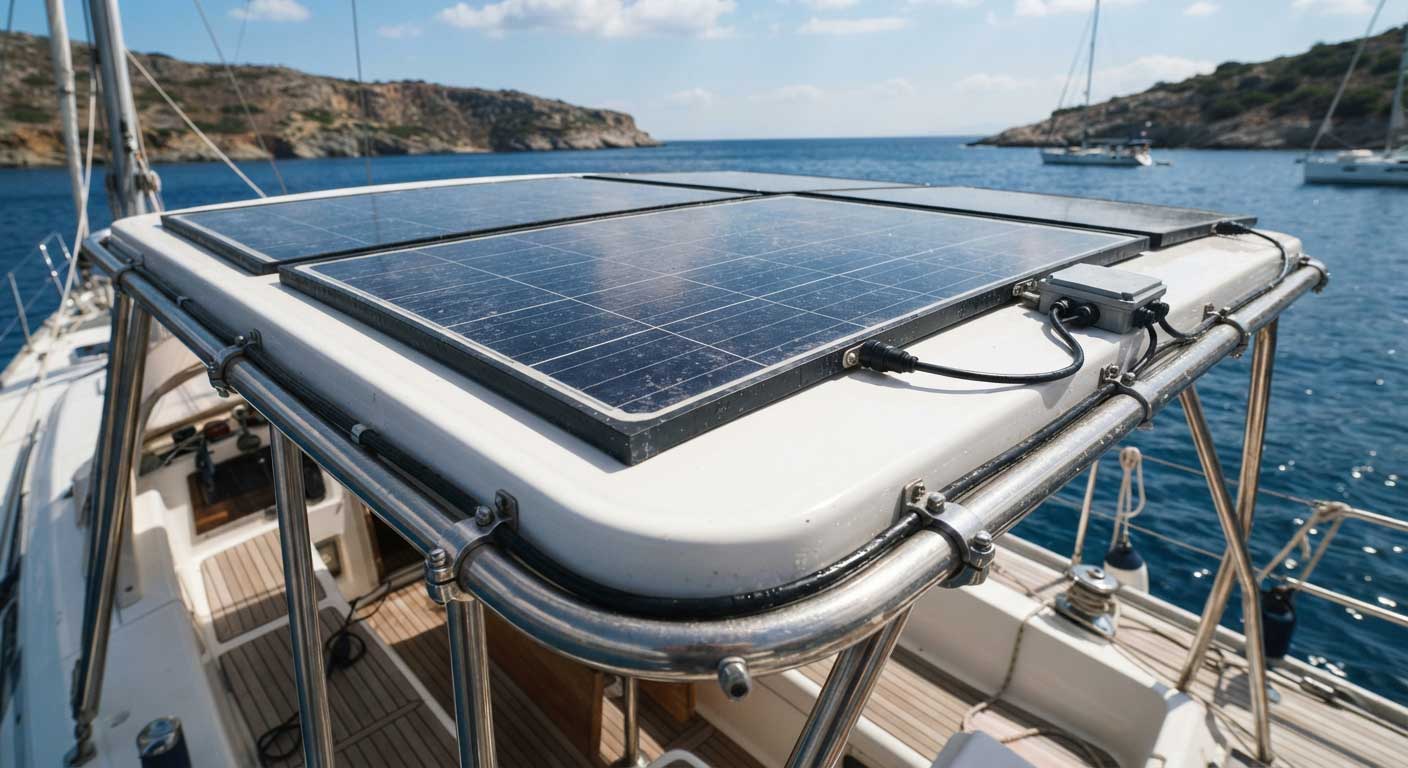
A rigid module may require brackets, rails and sufficient structural support. A flexible module can often follow a curved surface with a much lower profile.Visit product page:Flexible Solar Panels
But there is a tradeoff.
A flexible panel installed directly against a surface can have less opportunity to shed heat than a rigid module elevated above the deck.
That deserves attention because PV output is temperature-dependent.
I have seen marine solar designs focus heavily on fitting the panel into every available centimeter while barely considering how hot the panel will become under a dark fiberglass roof.
That is backwards.
Surface area is valuable.
So is thermal management.
How Much Solar Power Does a Boat Actually Need?
Before buying the best marine solar panels, calculate the loads.
A useful starting table looks like this:
| Load | Example Power | Daily Runtime | Daily Energy |
|---|---|---|---|
| Navigation electronics | 30W | 8h | 240Wh |
| Refrigerator | 50W average | 12h | 600Wh |
| Cabin lighting | 20W | 5h | 100Wh |
| USB charging | 30W | 4h | 120Wh |
| Wi-Fi/communications | 15W | 10h | 150Wh |
| Water pump | 80W | 1h | 80Wh |
| Example total | — | — | 1,290Wh/day |
These are illustrative values, not universal marine-load ratings.
A refrigerator may cycle rather than consume its rated wattage continuously. Electronics behave differently. Pumps may run for only a few minutes at a time.
The useful number is measured daily energy consumption.
If your boat consumes roughly 1.3kWh per day, a 400W array producing an effective four hours of equivalent full output would give a simple theoretical figure of:
400W × 4h = 1.6kWh
But that is not what I would promise a boat owner.
Real-world production is affected by:
- Shading from the mast
- Boom shadows
- Rigging
- Cloud cover
- Panel temperature
- Salt deposits
- Orientation
- Cable losses
- Controller efficiency
- Battery charging conditions
NREL’s PVWatts methodology accounts for system losses including soiling, shading, wiring, mismatch, connections and other factors.
On a sailboat, shading deserves particular attention.
A mast shadow crossing one section of a multi-panel array is not the same problem as a clean roof with uniform sunlight.
Real-World Case: A 40-Foot Cruising Sailboat
Consider a realistic cruising sailboat with:
- 12V house battery system
- Refrigerator
- Navigation instruments
- Autopilot
- Cabin lighting
- VHF radio
- USB charging
- Small water pump
- Occasional inverter use
The owner wants approximately 1.5kWh of daily solar production.
The available mounting area is not a neat rectangle.
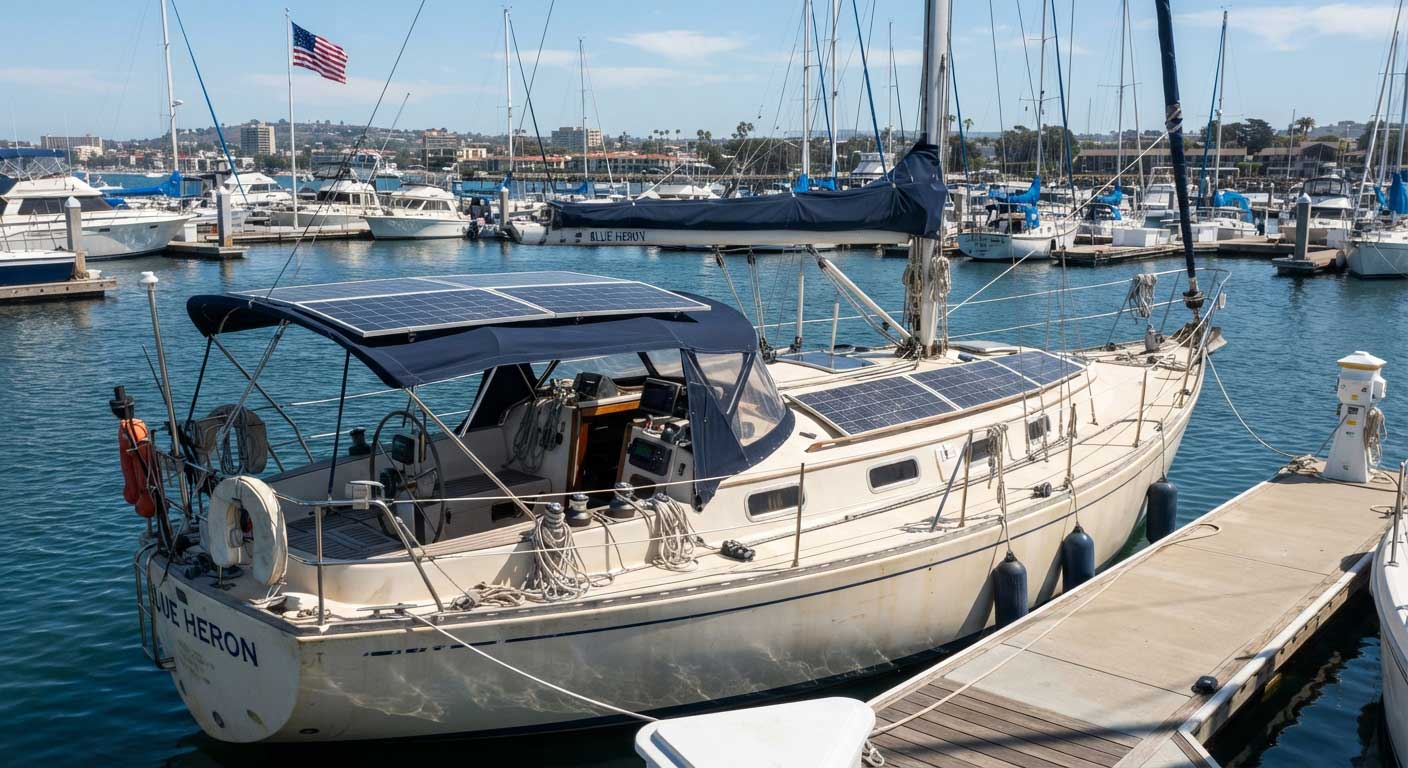
There is a bimini, a boom shadow, a radar arch and several areas that cannot be covered because crew members need access.
A 600W rigid array looks attractive on paper.
But the owner does not want another 40–50kg of equipment above the deck, nor a forest of brackets.
A lightweight flexible arrangement becomes more practical.
The design conversation changes from:
“How many watts can we install?”
to:
“How many useful watts can we generate without interfering with sailing, maintenance or safety?”
That is the more important question.
Best Marine Solar Panels for Saltwater Environments
The panel is only one part of the corrosion problem.
The DOE identifies three common corrosion mechanisms relevant to PV systems:
- Oxidation corrosion
- Galvanic corrosion
- Crevice corrosion
It also points out that fasteners and bonding points can become particularly vulnerable in corrosive environments.
That changes how I evaluate a marine solar installation.
Fasteners
For coastal installations, material selection matters.
NREL’s severe-weather guidance specifically recommends 316-grade stainless-steel fasteners for marine environments and notes that common stainless-steel alloys can corrode in coastal conditions.
That does not mean “316 stainless everywhere” is a substitute for engineering.
It means the hardware should be selected with the environment in mind.
Connectors
A connector sitting directly on a deck where water collects is a bad location regardless of how good the panel is.
Cable loops should not create permanent water traps.
Connections should be protected according to the connector manufacturer’s specifications.
Mixed Metals
Aluminum panel structures, stainless fasteners and copper conductors are common combinations.
The problem isn’t that these materials cannot coexist.
The problem is careless contact, moisture and poor isolation.
The DOE specifically describes galvanic corrosion as a risk when dissimilar metals are electrically connected in the presence of moisture and minerals.
Marine Solar Panel Installation: Where Should Panels Go?
The highest point on the boat is not automatically the best place.
Before installation, inspect:
- Available solar exposure
- Mast and boom shading
- Radar and antenna shadows
- Crew walking areas
- Hatches and service openings
- Water drainage
- Cable-entry locations
- Panel ventilation
- Mechanical loading
- Future maintenance access
On a powerboat, the hardtop may be ideal.
On a sailboat, the bimini can be better.
On a small fishing boat, available deck area may be extremely limited.
On a yacht, several smaller panels may outperform one large panel from a practical standpoint simply because they can be positioned around equipment.
That is an important marine-design insight:
The best panel layout is often not the layout with the highest nameplate wattage. It is the layout that produces the most useful energy without creating operational problems.
Marine Solar Panel Wiring
A marine solar installation should be designed around the battery system and charge controller.
For a common 12V boat system, an MPPT controller can accept the PV array voltage and regulate charging to the battery.
When choosing the controller, check:
- Maximum PV open-circuit voltage
- Maximum PV current
- Maximum PV power
- Battery voltage compatibility
- Charging profile
- Environmental rating
- Installation location
Series wiring raises voltage.
Parallel wiring raises current.
For example, two hypothetical 200W modules with:
- Vmp = 20V
- Imp = 10A
In series:
40V × 10A = 400W
In parallel:
20V × 20A = 400W
The power remains approximately the same.
The electrical behavior changes.
This matters because higher PV voltage can reduce current on the PV-side wiring, while parallel configurations can simplify some designs where shading or controller limitations influence the architecture.
The final choice should come from the module specifications and controller limits, not a generic rule that one wiring method is always superior.
Solar Panels for Sailboats and Shading Problems
Sailboats are especially difficult because the mast, boom and rigging constantly create shadows.
This is where a single large panel can become less attractive.
Several smaller modules can sometimes be positioned around shade-prone areas.
For example:
| Layout | Potential Advantage |
|---|---|
| One large panel | Simple installation |
| Two medium panels | More placement flexibility |
| Several smaller panels | Better use of irregular surfaces |
| Flexible panels | Conform to curved surfaces |
| Rigid panels | Better airflow and mechanical rigidity |
There is no universal winner.
The boat itself decides.
NREL’s PV research recognizes that PV can be used as auxiliary power on boats and other transportation applications, including lightweight PV solutions that conform to curved surfaces.
Rigid Marine Solar Panels vs Flexible Panels: Which Lasts Longer?
This question comes up constantly.
The honest answer is:
There is no lifespan number that can be assigned solely because a panel is rigid or flexible.
Service life depends on:
- Module construction
- Encapsulation
- Surface material
- Cell technology
- Temperature
- Mechanical stress
- UV exposure
- Salt exposure
- Installation method
- Maintenance
- Actual operating environment
Flexible panels deserve special attention to mechanical installation.
A panel designed to flex should not necessarily be treated as something that can be repeatedly bent beyond its specified radius.
Permanent installation is different from repeatedly folding a portable module.
Likewise, rigid panels should not be assumed to be immune to marine damage simply because their frames are aluminum.
The DOE specifically warns that marine corrosion can affect module materials, frames, fasteners, racking and electrical components.
Marine Solar Panel Maintenance
Maintenance on a boat should be simple enough that someone will actually do it.
A practical inspection routine includes:
Monthly or routine visual checks
- Look for salt buildup
- Inspect cable entry points
- Check visible connectors
- Inspect fasteners
- Look for corrosion staining
- Check for cracked or damaged surfaces
- Look for water accumulation
After severe weather
Inspect:
- Panel edges
- Mounting points
- Cable routing
- Bimini attachments
- Fasteners
- Electrical enclosures
Cleaning
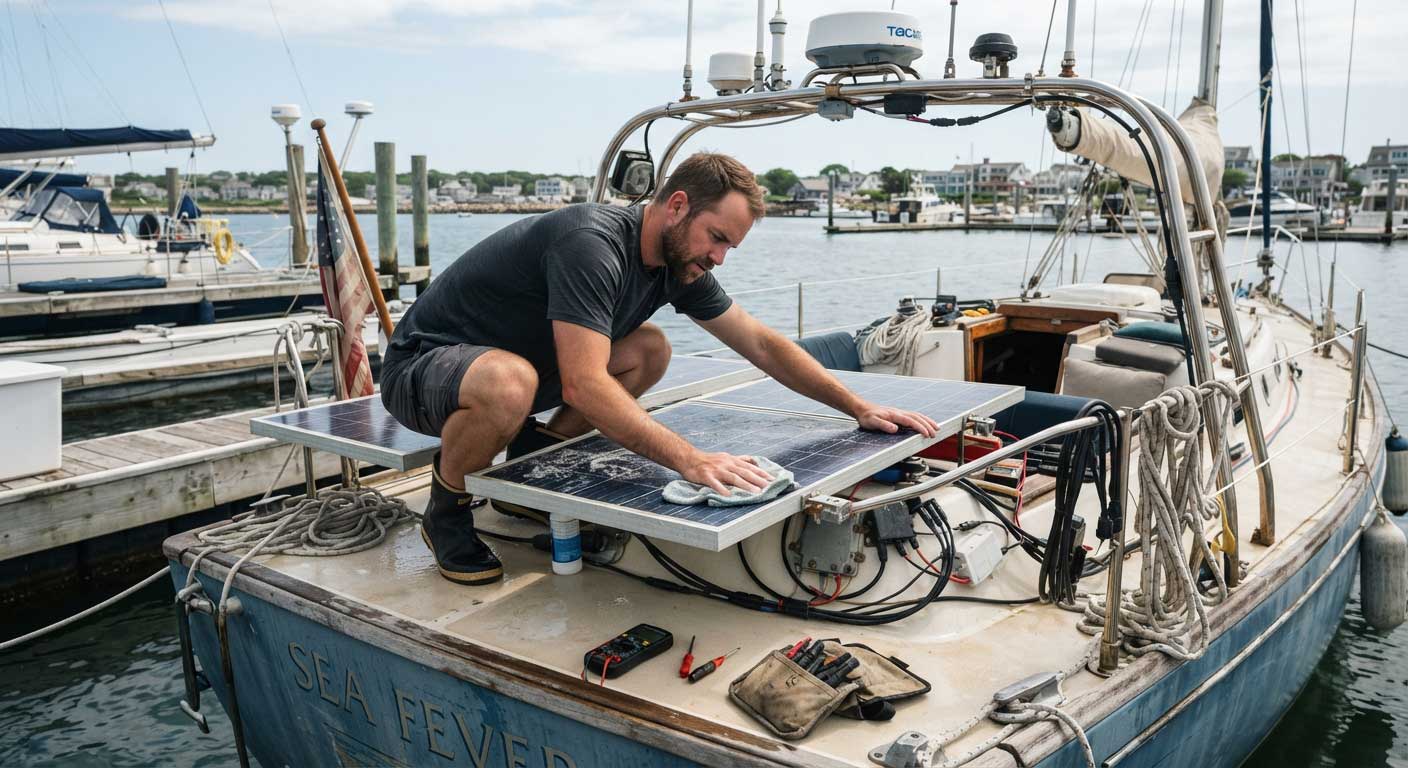
Salt deposits should not be allowed to accumulate indefinitely.
The DOE recommends regular cleaning and maintenance practices in corrosive environments and notes that cleaning can reduce salt-related contamination and corrosion risks.
NREL also maintains a U.S. PV soiling database covering 255 locations, demonstrating that soiling can be measured as a real source of energy loss rather than treated as a cosmetic issue. For example, an insolation-weighted soiling ratio of 0.95 corresponds to approximately 5% annual energy loss to soiling.
Marine salt deposits are not identical to ordinary dust soiling.
But the practical lesson is the same:
A dirty panel is not producing at its clean-panel potential.
How I Would Select the Best Marine Solar Panels
If I were specifying a panel for a boat today, my shortlist would look like this:
1. Confirm the installation environment
Is it:
- Open ocean?
- Coastal marina?
- Freshwater lake?
- Saltwater harbor?
- Tropical environment?
2. Identify the available mounting area
Measure the usable surface rather than the theoretical roof area.
3. Calculate daily energy use
Use actual measured loads whenever possible.
4. Decide between rigid and flexible
Choose based on:
- Weight
- Shape
- Foot traffic
- Ventilation
- Mounting structure
- Maintenance access
5. Check salt-mist qualification
Look for IEC 61701 testing, with Level 6 being particularly relevant for highly marine-corrosive locations according to DOE guidance.
6. Check electrical specifications
Review:
- Pmax
- Vmp
- Voc
- Imp
- Isc
- Maximum system voltage
7. Design the controller and battery together
Don’t buy the panels first and figure out the electronics afterward.
Marine Solar Panel Comparison
| Requirement | Flexible Panel | Rigid Panel |
|---|---|---|
| Curved cabin roof | ★★★★★ | ★★ |
| Low weight | ★★★★★ | ★★★ |
| Hardtop installation | ★★★ | ★★★★★ |
| Airflow under panel | ★★ | ★★★★★ |
| Irregular surface | ★★★★★ | ★★ |
| Easy replacement | ★★★ | ★★★★★ |
| Low-profile appearance | ★★★★★ | ★★★ |
| Long-term structural rigidity | ★★★ | ★★★★★ |
| Bimini applications | ★★★★★ | ★★ |
| Large flat yacht roof | ★★★★ | ★★★★★ |
These ratings are practical design guidance rather than laboratory performance scores.
FAQ About the Best Marine Solar Panels
What are the best marine solar panels?
The best marine solar panels combine appropriate power output with salt-mist resistance, suitable construction, reliable electrical connections, low weight where necessary, and a mounting design that fits the boat.
Are flexible solar panels good for boats?
Yes. Flexible solar panels are particularly useful for curved surfaces, biminis, cabins and installations where low weight and a low profile are important.
What is the best solar panel for a sailboat?
A lightweight flexible panel is often a strong choice for sailboats because it can use curved or irregular surfaces. However, rigid panels can be better where a strong, flat mounting structure is available.
Do marine solar panels need saltwater protection?
Yes. Salt and humidity can accelerate corrosion in module materials, fasteners, connectors, racking and other electrical components. IEC 61701 provides a specific salt-mist corrosion test framework for PV modules.
Are 100W solar panels enough for a boat?
A 100W panel can be useful for maintaining a small battery or powering modest loads, but it may not provide enough daily energy for refrigeration, electronics, autopilot and other continuous loads. Actual consumption should determine the array size.
How do I protect marine solar panel wiring from corrosion?
Use appropriately rated marine electrical components, carefully manage cable entry points, avoid standing water, select compatible metals and inspect connectors and fasteners regularly. Corrosion protection should cover the entire system, not just the panel.
Should I choose rigid or flexible marine solar panels?
Choose flexible panels when weight, curved surfaces and low-profile installation are priorities. Choose rigid panels when airflow, mechanical rigidity, flat mounting space and long-term accessibility matter more.
Conclusion: Best Marine Solar Panels
The best marine solar panels are not simply the panels with the highest wattage or the lowest price.
A good marine installation starts with the boat.
Where can the panel sit? How much shading will the mast create? Will people walk across it? Can the surface dissipate heat? Where will water collect? What happens to the connectors after three years of salt exposure?
Those questions are more useful than a generic “marine grade” label.
For coastal and offshore applications, salt-mist resistance deserves particular attention. IEC 61701 provides a recognized framework for evaluating PV module resistance to salt-mist corrosion, while DOE guidance recommends IEC 61701 Level 6 for highly marine-corrosive sites.
For Bright Solar, the practical target is a marine solar system that remains useful when the boat is actually being used—not just a panel specification that looks impressive on a datasheet.
That means matching panel construction, electrical output, mounting method, battery capacity and marine exposure as one design.
In a saltwater environment, the weakest connector can become more important than the strongest solar cell.
Related recommendations
-

mounting flexible solar panels (Field Installation Guide from Bright Solar)
190mounting flexible solar panels explained with real RV roof installations, adhesive methods, airflow design, durability insights, and field-tested mounting practices.
View details -
RV Solar Panel Installation: Complete Guide for Off-Grid RV Power
82Learn rv solar panel installation with our complete guide covering solar panel selection, wiring, mounting, costs, and tips for reliable off-grid RV power with Bright Solar.
View details -
solar panel golf cart roof Solutions from Bright Solar
259Bright Solar’s solar panel golf cart roof keeps golf cart batteries topped up while driving, reducing downtime and electricity use. Ideal for eco-conscious courses with solar charging options.
View details -
400w Solar Panel Flexible: High Power Solar Solution for RV and Off-Grid Applications
124Discover the 400w solar panel flexible from Bright Solar for RV, marine, and off-grid applications. Learn power output, installation methods, and real-world benefits.
View details