How Flexible Are Solar Panels?
How Flexible Are Solar Panels?
Most flexible solar panels can safely bend between 30° and 50°, depending on their construction and materials. They easily adapt to RV roofs, boats, camper vans, and curved surfaces, but they are not designed to be folded repeatedly or rolled like a mat.
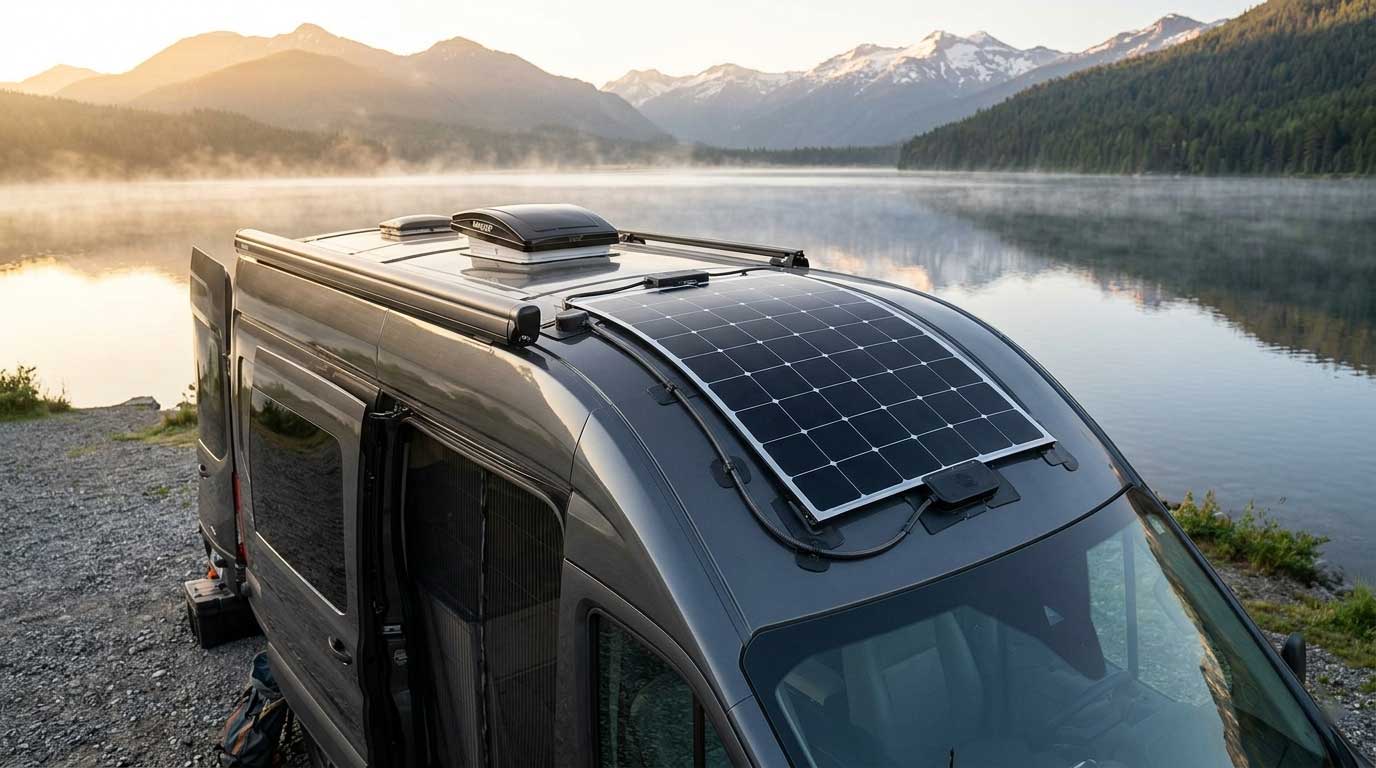
A few years ago, I visited a customer who had converted an old Sprinter van into an off-grid camper. The roof wasn’t perfectly flat. It had subtle curves and ridges that made installing conventional glass panels difficult. He chose flexible solar panels primarily because he didn’t want bulky aluminum racks. Three years later, those panels were still powering his refrigerator, lights, and communication equipment.
That project taught me something I’ve seen repeatedly in the field.
Most people ask how flexible solar panels are.
The better question is whether they’re flexible enough for the surface you’re installing them on.
In most cases, the answer is yes.
What Makes a Solar Panel Flexible?
The word “flexible” creates a misleading image.
Many buyers picture something similar to a yoga mat or sheet of plastic.
That’s not how solar technology works.
The photovoltaic cells inside flexible panels are still made from silicon. Silicon generates electricity efficiently, but it isn’t naturally flexible. The flexibility comes from replacing heavy tempered glass and aluminum framing with advanced polymer layers and lightweight backing materials.
The result is a panel that can conform to moderate curves while remaining durable enough for outdoor use.
Compared with traditional solar modules, flexible panels offer:
- Significantly lower weight
- Easier transportation
- Simpler installation
- Better compatibility with curved surfaces
- Reduced wind resistance
According to the U.S. Department of Energy’s National Renewable Energy Laboratory (NREL), lightweight photovoltaic technologies continue expanding solar applications in transportation and mobile energy systems.
Source:
https://www.nrel.gov
Related Questions About Flexible Solar Panel Technology
How Do Flexible Solar Panels Work?
One question I hear surprisingly often is: how do flexible solar panels work if solar cells themselves are fragile?
The answer is that the electricity generation process remains exactly the same as in conventional solar panels. Sunlight strikes the photovoltaic cells, creating an electrical current. The difference lies in the panel structure. Instead of thick tempered glass and heavy aluminum framing, flexible designs use lightweight polymer layers that allow the module to conform to curved surfaces.
At Bright Solar, many customers are surprised to learn that flexibility comes from the panel construction—not from the silicon cells themselves. The cells still perform the same job; the surrounding materials simply make installation easier on non-flat surfaces.This section provides an in-depth look at: How Flexible Solar Panels Work
Flexible PV Solar Panels
Flexible PV solar panels have become increasingly popular in applications where weight and installation space are limited. Unlike traditional rooftop systems, mobile energy projects often require equipment that can adapt to irregular surfaces without adding excessive load.
I recently reviewed a camper conversion project where every kilogram mattered. The owner selected flexible PV solar panels because rigid modules would have required additional mounting structures. The result was a cleaner installation and lower overall roof weight without sacrificing essential charging capability.This section provides an in-depth look at:Flexible PV Solar Panels
Bendable Solar Panel
The term bendable solar panel sounds simple, but there are limits. A bendable solar panel can follow moderate curves, yet it should never be sharply folded or twisted.
In practical installations, the goal is not to maximize the bend angle. The goal is to create a smooth fit against the mounting surface while minimizing mechanical stress. Some of the longest-lasting systems I have seen were installed on gently curved roofs where the panel operated well below its maximum bending specification.
Are Flexible Solar Panels Any Good?
Are flexible solar panels any good?
For the right application, absolutely.
They are particularly useful for RVs, boats, camper vans, portable power systems, and lightweight off-grid projects. What they lack in structural rigidity, they often make up for in installation flexibility and reduced weight.
That said, they are not automatically the best solution for every project. A residential rooftop with abundant space may benefit more from traditional framed modules. Bright Solar generally recommends matching the panel type to the installation environment rather than assuming one technology is universally superior.
Curved Solar Panels
Many people search for curved solar panels when they are actually looking for flexible solar technology. Most commercial products are manufactured flat and then installed onto curved surfaces rather than being permanently produced with a curved shape.
This distinction matters because the panel only needs enough flexibility to follow the contour of the roof, boat cabin, or equipment enclosure. In most real-world installations, the curve is far less dramatic than buyers initially expect.
Bendable Solar Panels
Bendable solar panels have opened opportunities that were difficult or impossible with traditional glass modules. Marine vessels, expedition vehicles, communication trailers, and compact recreational vehicles often have limited mounting options.
One installer I worked with joked that bendable solar panels solved problems he used to address with custom metal fabrication. While that may be an exaggeration, there is some truth behind it. When the mounting surface is irregular, flexibility can simplify an installation significantly.
For Bright Solar customers, the biggest advantage is often not the bend itself. It is the ability to place solar power where rigid panels simply cannot fit comfortably.
Real-World Flexibility vs Marketing Claims
Manufacturers often advertise maximum bending angles.
30 degrees.
40 degrees.
Sometimes even 50 degrees.
Those numbers are technically correct.
But after years of seeing installations on RVs, fishing boats, work trailers, and remote monitoring stations, I’ve learned that maximum flexibility rarely tells the whole story.
Think about a pickup truck.
Its speedometer may show 120 mph.
That doesn’t mean driving at 120 mph every day is a good idea.
Solar panels are similar.
The most reliable installations usually operate well below the maximum rated bend limit.
Less stress means longer life.
Less stress means fewer hidden problems.
And hidden problems are often what separate a panel that lasts fifteen years from one that starts degrading after three.
Typical Bend Capability
| Solar Panel Type | Typical Bend Range |
|---|---|
| Entry-Level Flexible Panel | 20°–30° |
| Premium ETFE Flexible Panel | 30°–40° |
| Marine-Grade Flexible Panel | Up to 50° |
The exact limit depends on the manufacturer and cell technology.
Always verify the specifications before installation.
Can Solar Panels Be Rolled or Folded?
This is where many installation mistakes begin.
Flexible solar panels are designed to bend.
They are not designed to be folded repeatedly.
There is a major difference between those two actions.
One customer once stored his flexible panel by wrapping it around a large storage drum every weekend. The panel appeared fine for months. Eventually, power output began falling. Laboratory testing later revealed microcracks in several solar cells.
The damage wasn’t visible.
Performance simply declined.
Research from NREL has shown that mechanical stress can contribute to microcrack formation within photovoltaic cells, affecting long-term energy production.
Source:
https://www.nrel.gov
For permanent installations, the safest approach is simple:
Install the panel once.
Allow it to follow the surface naturally.
Avoid repeated bending.
Why Material Quality Matters More Than Flexibility
The solar industry has changed dramatically over the past decade.
Early flexible solar panels often used PET surface materials.
Some performed well.
Many did not.
After prolonged exposure to UV radiation, some PET surfaces became cloudy or discolored, reducing light transmission.
Today, most premium manufacturers use ETFE instead.
ETFE offers several advantages:
- Better UV resistance
- Higher light transmission
- Improved scratch resistance
- Superior weather durability
- Better performance in marine environments
According to published material data from ETFE manufacturers, ETFE films can maintain excellent optical performance even after years of outdoor exposure.
Source:
https://www.dupont.com
In practical terms, the surface material often influences lifespan more than the bend rating printed on the box.
How Flexible Are Solar Panels on RVs and Boats?
This is where flexible solar technology really shines.
Most RV roofs are only slightly curved.
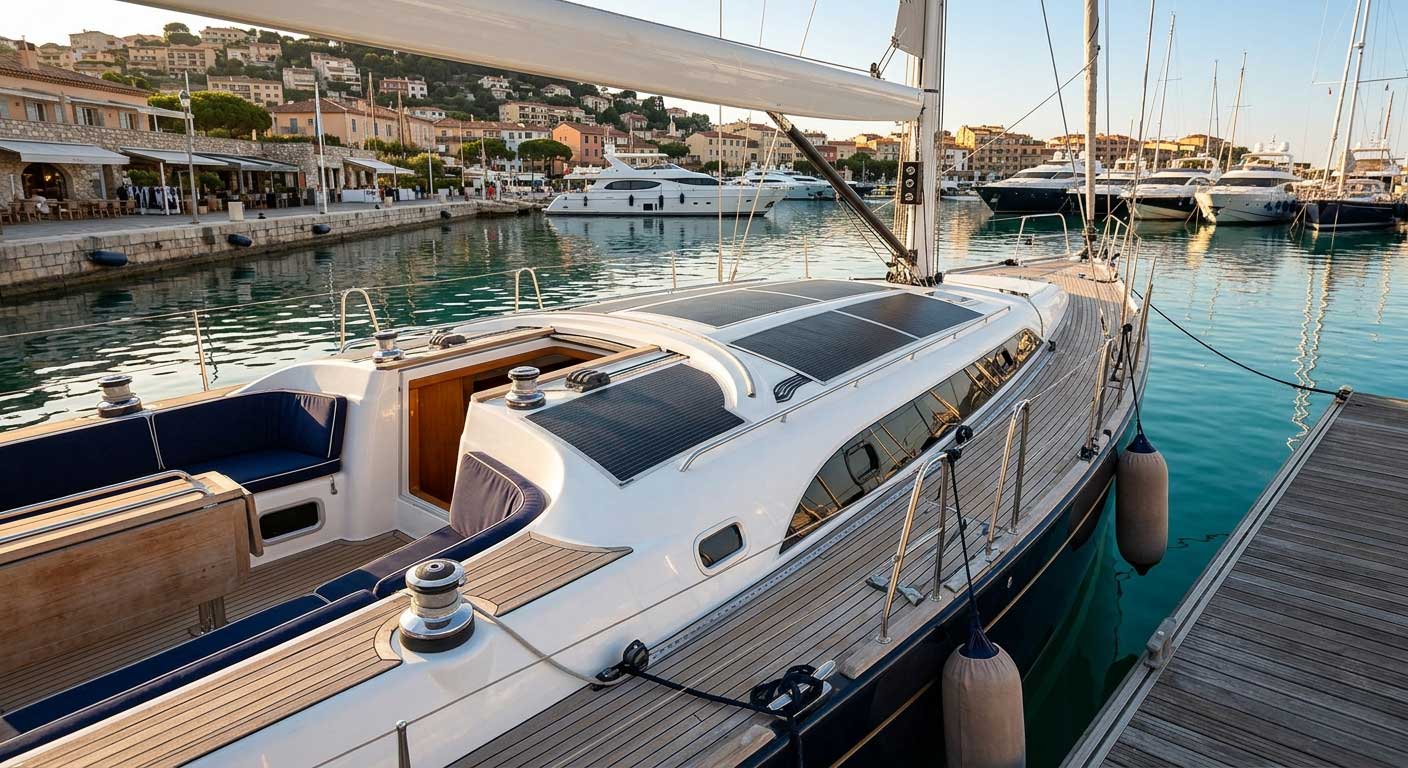
Most boat cabins are moderately curved.
These shapes fall comfortably within the operating range of modern flexible solar panels.
Typical applications include:
| Application | Suitability |
|---|---|
| Camper Vans | Excellent |
| RV Roofs | Excellent |
| Sailboats | Excellent |
| Fishing Boats | Excellent |
| Tiny Homes | Very Good |
| Portable Systems | Good |
One marine installer I spoke with described flexible panels as “the easiest way to add power where rigid panels simply don’t fit.”
That statement may sound like sales language.
It’s not.
Anyone who has spent a day trying to mount framed glass panels on a curved fiberglass roof understands exactly what he meant.
Does Greater Flexibility Reduce Efficiency?
Not directly.
Efficiency depends on several factors:
- Solar cell quality
- Temperature
- Shading
- Manufacturing precision
- Installation quality
The larger issue is heat.
Flexible panels often sit directly against the mounting surface, leaving less airflow underneath compared to framed glass panels.
Higher temperatures reduce solar efficiency.
The International Energy Agency (IEA) notes that photovoltaic output generally declines as cell temperatures rise above standard testing conditions.
Source:
https://www.iea.org
This doesn’t make flexible panels ineffective.
It simply means installation quality matters.
A well-installed flexible panel often outperforms a poorly installed rigid panel in real-world conditions.
Lessons Learned from Field Installations
After reviewing hundreds of customer projects at Bright Solar, one pattern appears repeatedly.
The best-performing systems are rarely the most extreme.
They aren’t bent to the limit.
They aren’t mounted in impossible locations.
They simply match the application.
A quality ETFE panel.
A reasonable roof curve.
Proper adhesive or mounting methods.
Good cable management.
Those details matter far more than whether a panel can bend 40 degrees or 50 degrees.
Specification sheets rarely tell that story.
Field experience does.
FAQ:How Flexible Are Solar Panels?
How flexible are solar panels compared to traditional panels?
Flexible solar panels can bend approximately 30°–50°, while traditional glass solar panels are rigid and cannot bend.
Can flexible solar panels be installed on curved roofs?
Yes. Flexible solar panels are specifically designed for applications such as RV roofs, camper vans, boats, and other curved surfaces.
Are flexible solar panels durable?
High-quality ETFE flexible solar panels can provide reliable performance for 10–20 years when properly installed and maintained.
Can flexible solar panels crack?
Yes. Excessive bending, twisting, or repeated folding can create microcracks inside the solar cells.
Are flexible solar panels good for marine environments?
Yes. Marine-grade ETFE flexible solar panels are widely used on sailboats, yachts, and fishing vessels because they resist moisture, UV exposure, and salt spray.
Final Thoughts
So, how flexible are solar panels?
Flexible enough to follow the curves of most RV roofs, boat cabins, and mobile installations. Not flexible enough to be treated like fabric. In real-world applications, moderate flexibility combined with quality materials delivers the best long-term performance. That reality matters far more than any marketing claim about extreme bend angles.
Related recommendations
-

400 Watt Flexible Solar Panel for Serious Off-Grid Energy Systems
143Discover how a 400 watt flexible solar panel delivers lightweight, high-output off-grid energy for RVs, boats, vans, and solar battery systems.
View details -
Solar Camping Gear: A Practical Guide to Off-Grid Power
208Solar camping gear combines portable solar generation and battery storage for reliable off-grid power during camping, RV travel, boating, and outdoor work.
View details -
Best flexible solar panels for boats: Lightweight Marine Solar Solutions
175Find the best flexible solar panels for boats with Bright Solar. Learn marine installation tips, durability factors, power output, and real-world sailing applications.
View details -
Solar Panels for Cloudy Days Trailers: What You Need to Know
179Solar panels can still charge trailers on cloudy days, but output decreases with cloud cover. Proper sizing requires real weather data, daily energy use, roo...
View details