
Best flexible solar panels for boats: Lightweight Marine Solar Solutions
The best flexible solar panels for boats combine lightweight construction, marine durability, and reliable energy output. Bright Solar flexible panels are designed for curved decks, limited installation spaces, and harsh marine environments where traditional rigid solar modules are difficult to use.
When a boat owner asks us which solar panel is “the best,” we rarely start with wattage.
The first question we ask is:
“Where will the panel actually be installed?”
A sailing yacht, fishing boat, and catamaran all have different challenges.
A panel that performs perfectly on a flat roof may become impractical on a boat because of curved surfaces, limited deck space, saltwater exposure, and constant movement.
At Bright Solar, our experience with flexible photovoltaic products comes from working with marine suppliers, RV manufacturers, and off-grid installers. Over the years, we have learned that marine solar is less about adding the biggest panel and more about finding the right balance between weight, durability, and usable surface area.
That is why choosing the best flexible solar panels for boats requires looking beyond the product specification sheet.
Why flexible solar panels are becoming popular for marine applications
Traditional solar panels were originally designed for stationary installations.
A house roof provides:
- Flat mounting space
- Strong structural support
- Easy cable routing
A boat environment is completely different.
Marine solar installations usually face:
- Limited available area
- Curved surfaces
- Wind exposure
- Saltwater corrosion
- Weight restrictions
- Continuous vibration
A rigid glass solar panel may provide excellent efficiency, but it often requires:
- Aluminum mounting rails
- Additional brackets
- Drilling into the deck
- Reinforced support structures
For many boat owners, these modifications are not ideal.
Flexible solar panels solve this problem by allowing installation on surfaces that were previously difficult to use.
Common installation locations include:
- Cabin tops
- Bimini covers
- Cockpit areas
- Curved deck sections
- Hardtop roofs
What makes the best flexible solar panels for boats?
Not every flexible solar panel is suitable for marine environments.
A boat solar panel needs different characteristics compared with a normal outdoor solar product.
The most important factors include:
1. Marine-grade surface protection
Saltwater is one of the biggest challenges for marine equipment.
A solar panel installed near the ocean experiences:
- Salt spray
- High humidity
- UV exposure
- Temperature changes
At Bright Solar, we focus on ETFE surface protection for flexible modules because the outer layer directly affects long-term outdoor performance.
ETFE provides:
- Strong UV resistance
- Scratch protection
- Better transparency compared with some plastic surfaces
- Easier cleaning after marine exposure
A yacht solar panel may look clean after installation, but after months at sea, surface aging becomes a real consideration.
2. Lightweight construction
Weight matters on boats.
Every additional kilogram affects:
- Fuel consumption
- Sailing performance
- Load distribution
A conventional glass solar panel can weigh around 18–22kg depending on size.
A flexible marine solar panel can significantly reduce system weight.
For smaller sailing boats, this difference can influence installation decisions.
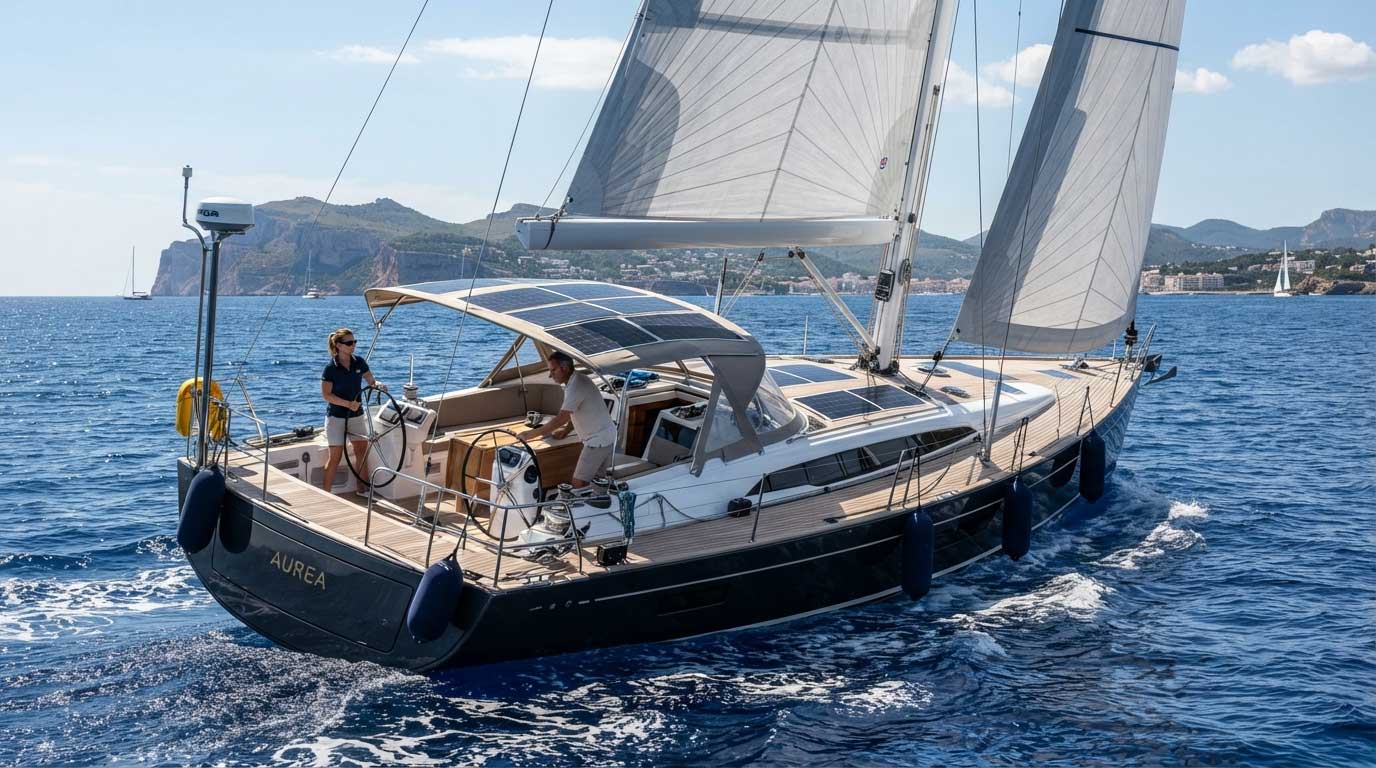
One European sailing equipment supplier we worked with originally planned to install rigid modules on a 38-foot yacht.
During the site inspection, the owner changed direction.
The reason was simple:
The available roof area was not flat enough.
After switching to flexible modules:
- Installation avoided additional aluminum framing
- Weight reduction was approximately 14kg
- More usable deck area remained available
The owner was not chasing maximum wattage.
He wanted solar power without changing the boat design.
How much power can flexible solar panels produce on a boat?
Marine customers often ask:
“Will a flexible solar panel provide enough energy for my boat?”
The answer depends on:
- Panel wattage
- Available sunlight
- Installation angle
- Shading conditions
- Battery capacity
A simple calculation:
Daily Energy = Solar Panel Wattage × Peak Sun Hours × System Efficiency
For example, a 300W flexible solar panel installed on a boat may produce approximately:
| Location | Estimated Daily Output |
|---|---|
| Florida, USA | 1.3–1.5kWh |
| Mediterranean region | 1.2–1.6kWh |
| Northern Europe | 0.7–1.1kWh |
This power can support:
- Navigation equipment
- LED cabin lighting
- GPS systems
- Communication devices
- Small refrigeration systems
According to the National Renewable Energy Laboratory (NREL), photovoltaic output depends strongly on solar resource availability, system orientation, shading, and environmental conditions.
Source:
National Renewable Energy Laboratory Solar Resource Data
https://www.nrel.gov/gis/solar-resource-maps.html
Real marine installation experience from Bright Solar projects
One project that changed our understanding of boat solar installation involved a catamaran owner in Southern Europe.
The customer wanted additional solar capacity but refused to install rigid panels because they would create:
- More wind resistance
- Visual impact
- Additional maintenance points
The available installation surface was irregular.
There were:
- Curved roof sections
- Existing ventilation openings
- Limited walking space
After evaluating the layout, the final flexible solar design achieved:
| Project Factor | Result |
|---|---|
| Installation method | Low-profile mounting |
| Additional drilling | Not required |
| Weight reduction | About 12kg compared with rigid design |
| Maintenance | Easier surface cleaning |
The interesting part was not the power increase.
The biggest improvement was that the solar system became part of the boat rather than an attachment added afterward.
Flexible solar panels vs rigid solar panels for boats
Choosing between flexible and rigid solar panels for a boat is not simply a comparison of efficiency numbers.
Marine installation is different from residential solar.
A yacht owner may have only a few square meters of usable space. A fishing boat may need panels that can handle vibration. A sailing boat may require a low-profile solution that does not interfere with movement.
The right choice depends on the boat design.
| Feature | Flexible Solar Panels for Boats | Rigid Solar Panels |
|---|---|---|
| Weight | Lightweight construction | Heavier glass and aluminum frame |
| Installation surface | Works on curved and irregular areas | Requires flat mounting space |
| Mounting method | Adhesive mounting or lightweight fixing | Rails, brackets, drilling |
| Appearance | Low-profile integration | More visible structure |
| Maintenance | Simple surface cleaning | Requires checking frames and mounts |
| Best applications | Sailboats, yachts, RV boats, small vessels | Large flat marine surfaces |
For many marine projects, flexible panels provide a better balance between practicality and energy production.
However, we also tell customers that rigid panels still have advantages.
If a boat has a large flat roof area and weight is not a concern, traditional modules may remain a suitable choice.
The goal is not choosing the newest technology.
The goal is choosing the technology that matches the boat.
How to install flexible solar panels on boats correctly
A marine solar installation requires more planning than simply placing a panel on the deck.
Saltwater environments are unforgiving.
A small installation mistake can become a serious issue after months of exposure.
Based on Bright Solar project feedback from marine installers, we recommend following these steps.
Step 1: Evaluate available sunlight area
Before purchasing the panel, check:
- Where sunlight is available throughout the day
- Areas blocked by sails or equipment
- Possible shading from antennas or rails
- Walking areas that should remain clear
A smaller panel installed in a better location can sometimes outperform a larger panel installed in poor conditions.
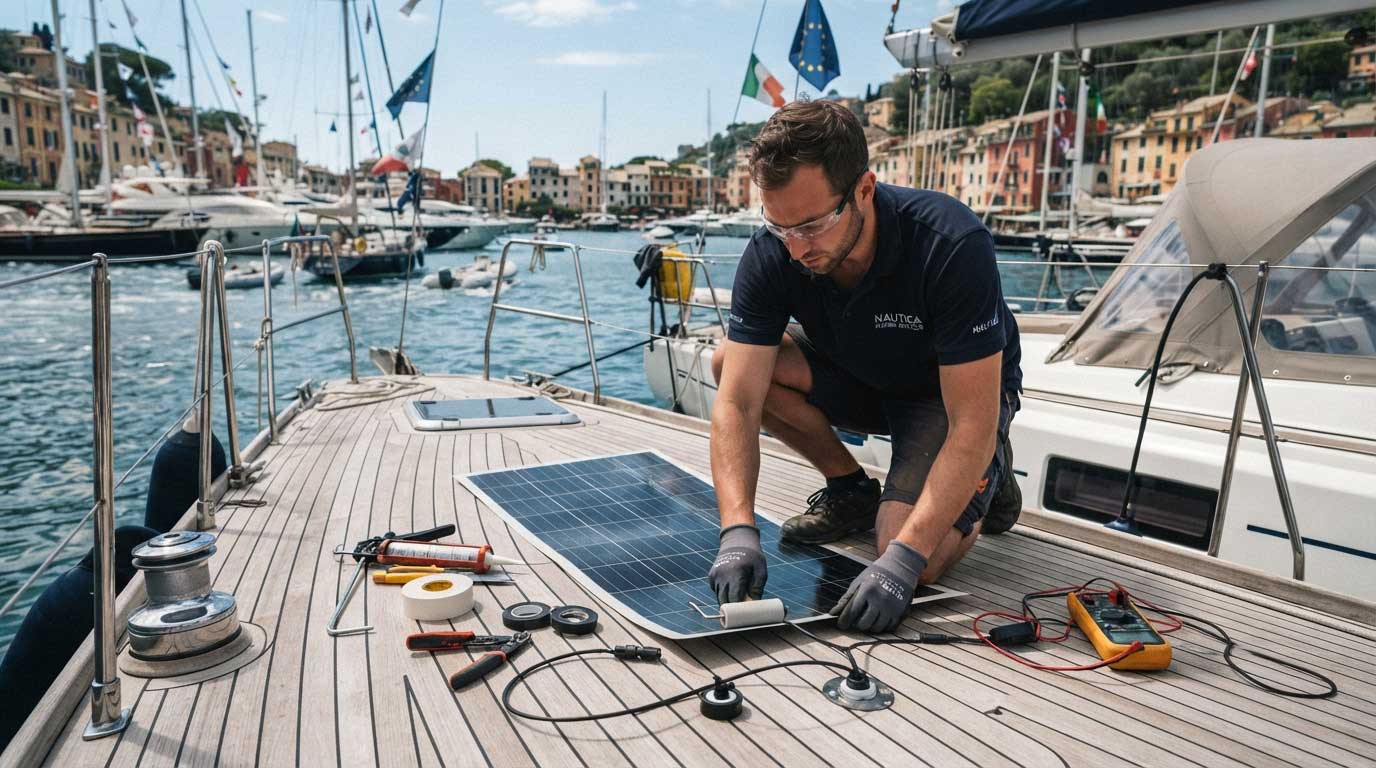
Step 2: Prepare the mounting surface
The surface should be:
- Clean
- Dry
- Free from oil or wax
- Structurally stable
Marine surfaces often contain protective coatings that can reduce adhesion.
A proper cleaning process is essential.
During one inspection, we found a flexible solar panel that had started separating from a boat roof after several months.
The issue was not product failure.
The installer had applied the adhesive over a wax-treated surface.
After correcting the preparation process, the installation remained stable.
This type of experience is why installation training matters.
Step 3: Protect cables and electrical connections
Water protection is not only about the panel surface.
The electrical system must also be protected.
Important areas include:
- Junction box
- Cable entry points
- Controller connections
- Battery terminals
A marine solar system normally works together with:
- MPPT charge controller
- Marine battery bank
- Battery monitoring system
The panel is only one part of the complete energy system.
Best applications for flexible solar panels on boats
Different boats have different energy requirements.
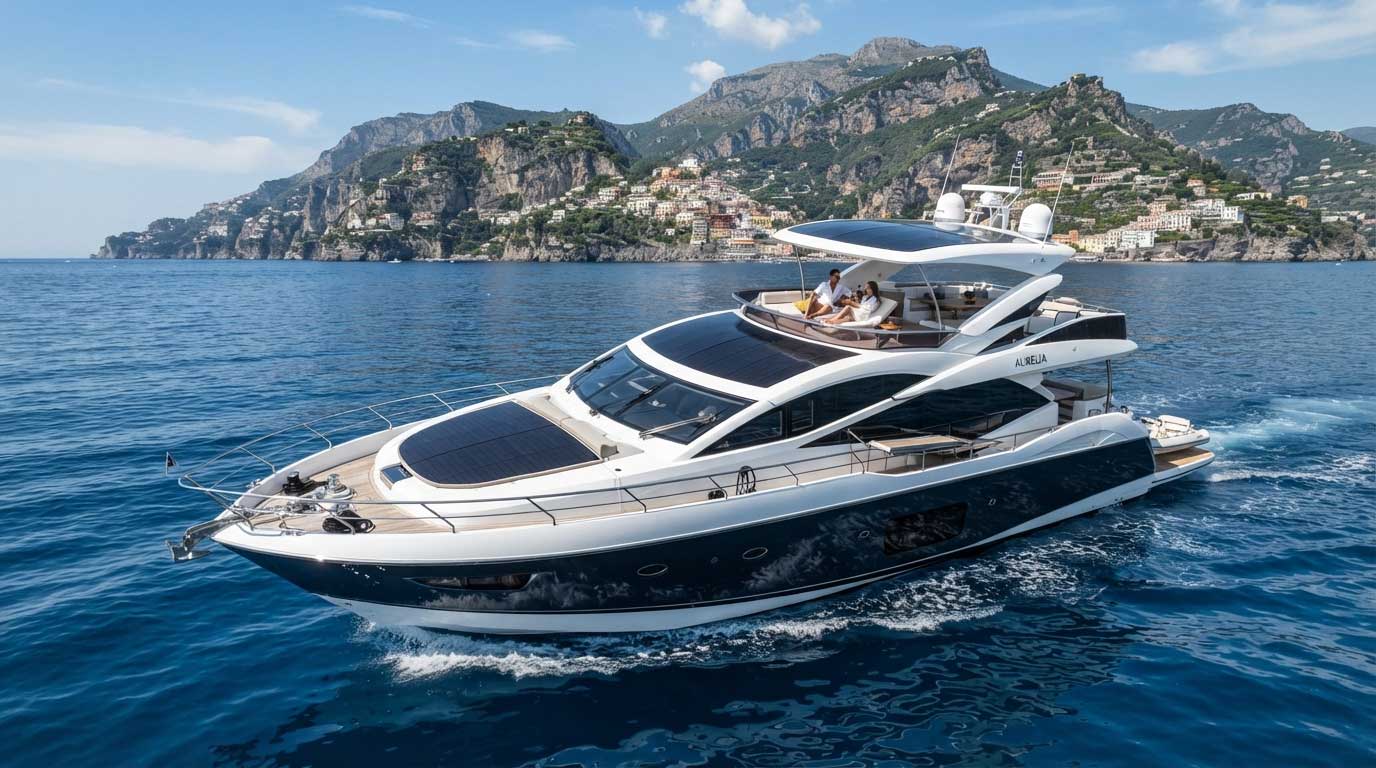
The best flexible solar panels for boats are commonly used in:
Sailboats
Sailing boats benefit from lightweight solar systems because:
- Space is limited
- Weight affects performance
- Quiet energy generation is preferred
Flexible panels can be installed on:
- Cabin roofs
- Bimini tops
- Curved deck sections
Fishing boats
Fishing boats often require continuous power for:
- Navigation electronics
- Communication systems
- Lighting
- Small refrigeration equipment
A lightweight solar solution helps reduce dependence on engine charging.
Catamarans
Catamarans usually provide more available surface area, but owners still prefer low-profile installations.
Flexible panels can follow curved surfaces and maintain a cleaner appearance.
mall electric boats
Electric boat systems require careful energy management.
Solar panels may help extend operating time by supporting battery charging during daylight hours.
How Bright Solar evaluates marine flexible solar panel quality
At Bright Solar, product evaluation is based on real application feedback.
Laboratory specifications are important, but field conditions reveal problems that testing cannot always predict.
For marine applications, we focus on:
| Testing Area | Purpose |
|---|---|
| UV exposure testing | Check long-term sunlight resistance |
| Waterproof inspection | Improve outdoor reliability |
| Temperature cycling | Evaluate performance changes |
| Mechanical flexibility testing | Confirm bending capability |
| Surface durability testing | Reduce aging issues |
The International Energy Agency (IEA) highlights that photovoltaic module reliability depends on product quality, environmental exposure, and proper installation practices.
Source:
International Energy Agency – Solar PV Tracking Report
https://www.iea.org/reports/solar-pv
How much do the best flexible solar panels for boats cost?
The price of marine flexible solar panels depends on:
- Power output
- Cell technology
- Protective materials
- Certification
- Manufacturing quality
Typical market ranges:
| Panel Type | Approximate Price |
|---|---|
| Small flexible marine panel | $100–$250 |
| 200W flexible solar panel | $200–$400 |
| 300W flexible solar panel | $350–$600 |
| Premium marine flexible panel | $600+ |
The cheapest option is not always the most economical.
A marine installation requires durability.
Replacing a failed panel on a boat can involve:
- Removing old adhesive
- Cleaning the surface
- Re-routing cables
- Losing sailing time
A slightly higher-quality panel may reduce future maintenance costs.
FAQ About Best Flexible Solar Panels for Boats
What are the best flexible solar panels for boats?
The best flexible solar panels for boats should provide lightweight construction, marine durability, waterproof protection, and reliable power output. Bright Solar flexible panels are designed for these requirements.
Are flexible solar panels good for sailboats?
Yes. Sailboats often benefit from flexible panels because they can be installed on curved surfaces without heavy mounting structures.
Can flexible solar panels handle saltwater environments?
Quality marine flexible panels with protective coatings are designed to withstand outdoor exposure, including UV radiation and humidity. Proper installation is also important.
How many watts of solar panels does a boat need?
The required wattage depends on energy consumption. Small boats may use a few hundred watts, while larger vessels may require larger solar arrays combined with battery storage.
Can I install flexible solar panels myself on my boat?
Yes, many smaller systems can be installed by experienced owners. However, cable protection and waterproof connections should be handled carefully.
Do flexible solar panels work when the boat is moving?
Yes. Flexible panels are designed for mobile applications, but installation quality is critical because vibration and movement create additional stress.
Are flexible solar panels better than rigid panels for boats?
For curved, lightweight, and space-limited marine applications, flexible panels are often the better choice. For large flat areas, rigid panels may still be suitable.
Final Thoughts: Choosing the Best Flexible Solar Panels for Boats
The best flexible solar panels for boats are not simply the panels with the highest watt rating.
They are the panels that fit the environment.
A boat moves.
Saltwater changes materials.
Available space is limited.
Installation decisions made today affect performance years later.
After working with Bright Solar customers across different markets, we have found that successful marine solar projects usually share one thing: the panel becomes part of the boat design instead of an afterthought.
Flexible solar technology gives boat owners more freedom to use unused surfaces while keeping the system lightweight and practical.
For sailors, yacht owners, and marine operators looking for reliable renewable energy, Bright Solar flexible solar panels provide a balanced solution built around real-world conditions.
Related recommendations
-

Motorhome Solar Kit: Reliable Off-Grid Power for Modern RV Travel
104Compare series vs parallel solar panels for RVs, homes, and off-grid systems. Bright Solar explains voltage, current, shading, and wiring efficiency.
View details -
Flexible 200 Watt Solar Panel: Reliable Off-Grid Energy Without the Extra Weight
126Discover how a flexible 200 watt solar panel delivers lightweight, reliable off-grid energy for RVs, boats, campers, and mobile solar systems.
View details -
flexible solar panels for rv (Real Field Engineering Guide from Bright Solar)
107flexible solar panels for rv explained with real installation cases, durability insights, RV roof design tips, and off-grid performance data for travelers.
View details -
Flexible RV Solar Panels: Complete Guide to Choosing, Installing, and Using Solar Power for RVs
180Discover flexible RV solar panels for campers and motorhomes. Learn benefits, installation, sizing, and how to choose reliable solar solutions for off-grid travel.
View details