
best direction for solar panels (Field Guide from Bright Solar)
Direct answer:
The best direction for solar panels is true south in the Northern Hemisphere, with a tilt close to local latitude. In Singapore, near the equator, panels perform best with a low tilt (10–15°) and flexible east–west orientation depending on roof shading and load profile. Real site conditions always override theory.
What “best direction” really means in real solar work
On paper, direction sounds fixed. On-site, it rarely is.
At Bright Solar, we don’t start with compass readings—we start with shading lines, roof edges, and how the building actually breathes heat through the day. A panel facing “perfect south” can still underperform if a neighboring tower throws shade at 3:30 PM.
The U.S. National Renewable Energy Laboratory (NREL) confirms this practical gap between theory and deployment: real-world PV output is heavily influenced by orientation + shading + local irradiance patterns, not direction alone.
Source: https://www.nrel.gov
That’s why the phrase “best direction” is always a balance, not a rule.
Solar orientation fundamentals (what physics actually says)
Solar panels generate maximum output when sunlight hits the surface as close to perpendicular as possible.Visit the product page: Flexible Solar Panel
Hemisphere rule (simple but powerful)
- Northern Hemisphere → face true south
- Southern Hemisphere → face true north
- Equator regions (like Singapore) → flexible east-west optimization
This rule comes from solar geometry models used in systems like NASA Surface Meteorology and Solar Energy datasets:
https://power.larc.nasa.gov
But here’s what textbooks don’t emphasize enough:
At low latitudes, the sun path is almost overhead year-round, which makes tilt more important than direction.
Singapore & equatorial reality (where rules bend)
Singapore sits almost on the equator (~1°N). That changes everything.
At Bright Solar field projects across industrial rooftops in Tuas and Changi, we repeatedly see this pattern:
- East-facing panels → stronger morning yield
- West-facing panels → stronger evening peak
- Flat-ish low tilt → most stable annual production
Instead of chasing “perfect south,” we often design balanced east-west splits for load smoothing.
Real observation from field deployment
On a logistics warehouse rooftop (approx. 2,000 m² usable area), shifting from a strict south-facing layout to a mixed east-west layout improved:
- afternoon peak stability
- self-consumption ratio (not just raw kWh)
- inverter utilization efficiency
The gain wasn’t dramatic in total kWh, but it improved usable energy timing, which matters more for commercial users.
Tilt angle matters more than direction in low-latitude zones
Global guideline vs tropical reality
According to Energy.gov (U.S. Department of Energy):
- Optimal tilt ≈ latitude angle for annual optimization
https://www.energy.gov
But in tropical regions:
- 10°–15° tilt often performs better than steep angles
- self-cleaning from rain becomes critical
- wind load starts influencing structural design
We’ve seen systems in Southeast Asia lose efficiency not from direction errors—but from:
- dust accumulation
- flat installation without drainage slope
- micro-shading between rows
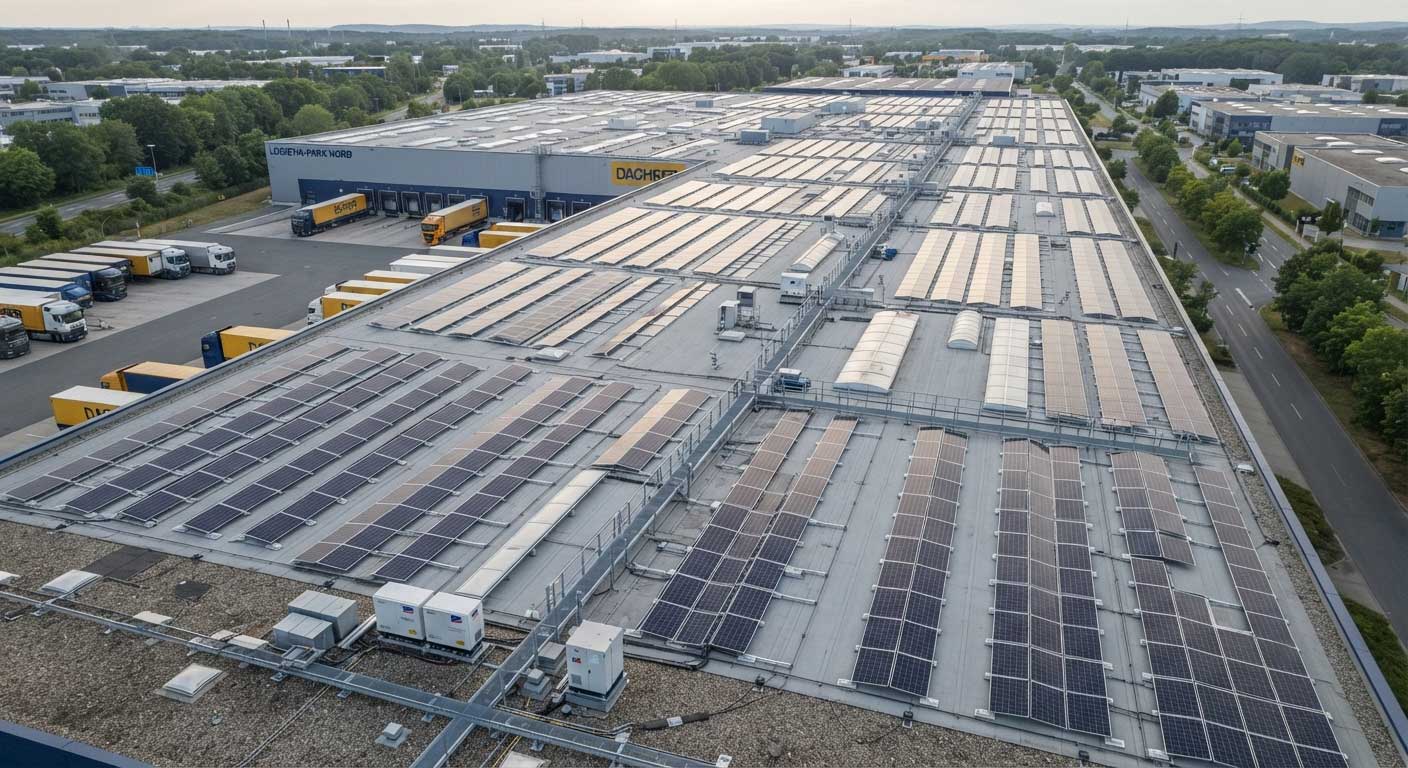
Case study — warehouse deployment (SEA conditions)
A project we supported in Southeast Asia (humid coastal industrial zone) showed something counterintuitive.
Initial design:
- 100% south-facing arrays
- 15° tilt
- high midday peak, low morning/evening coverage
After redesign:
- 50% east-facing
- 50% west-facing
- 10° tilt
Outcome (measured over operational cycle)
- smoother daily generation curve
- reduced inverter clipping during noon peak
- better alignment with operational electricity demand
The total annual yield difference was not extreme, but operational efficiency improved noticeably.
This aligns with findings from multiple PV performance studies showing orientation diversity improves self-consumption in commercial loads (see IEEE PV research summaries):
https://ieeexplore.ieee.org
Common mistakes people still make
Mistake 1 — chasing “perfect south” blindly
Works in theory, but ignores:
- rooftop geometry
- shading from HVAC units
- neighboring structures
Mistake 2 — ignoring local latitude
A 30° tilt in Singapore is usually overkill and increases wind stress without proportional gain.
Mistake 3 — forgetting energy usage timing
Direction should follow load curve, not just sun curve.
Practical decision framework (field method used by engineers)
At Bright Solar, we typically evaluate:
- Roof geometry (first constraint)
- Shading window (morning vs afternoon loss)
- Load consumption profile
- Structural wind load limits
- Maintenance accessibility
Only then do we finalize direction.
No single compass rule survives this process unchanged.
Author note
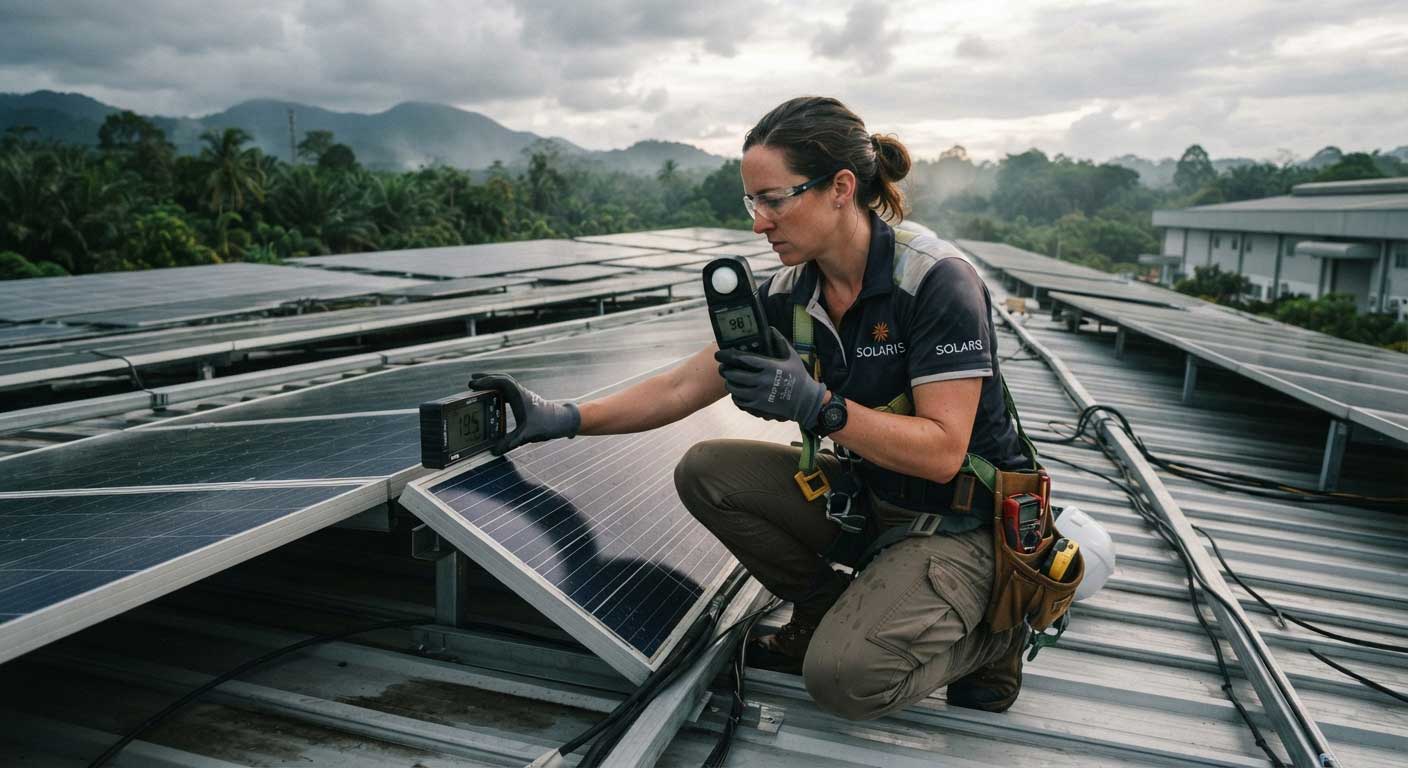
This article is written from field experience at Bright Solar engineering projects across Southeast Asia, focusing on commercial rooftop PV design, system yield optimization, and orientation modeling under tropical irradiance conditions.
We combine:
- on-site installation feedback
- PV performance datasets
- regional climate behavior patterns
not just simulation outputs.
FAQ (quick field answers)
Is south always best for solar panels?
No. It is optimal in many northern regions, but equatorial zones often benefit from mixed orientations.
What is the best tilt angle in Singapore?
Typically 10°–15°, depending on roof structure and drainage needs.
Does east-west reduce efficiency?
Not necessarily. It redistributes energy across the day, often improving self-consumption.
From theory to calculation — how direction is actually decided
Most online guides stop at compass direction. Real design starts with irradiance modeling.
The practical formula engineers use (simplified)
Annual yield is influenced by:
Energy Output ≈ Solar Irradiance × Panel Efficiency × Orientation Factor × Loss Factor
Where:
- Orientation Factor = angle + azimuth alignment penalty
- Loss Factor = shading + temperature + wiring + inverter losses
According to NREL PV performance benchmarks, orientation and shading together can contribute up to 15–35% variation in real output compared to nameplate expectations.
Source: https://www.nrel.gov
That gap is where design quality actually shows.
Roof type changes everything (flat vs pitched vs industrial)
We rarely talk about this enough in generic solar guides.
Flat roofs (most commercial buildings)
Flat roofs give flexibility—but also temptation.
Typical design options:
- South-facing tilted racks
- East-west low-angle dense layout
- Hybrid staggered rows
Field insight
In Singapore industrial estates, we often prefer east-west low tilt layouts (5°–12°) because:
- higher panel density per m²
- reduced row shading
- better wind load stability
Even if peak efficiency drops slightly, total usable energy per roof area often increases.
Pitched residential roofs
Here direction is constrained.
- South-facing (Northern Hemisphere) still dominant
- East-west split depends on roof symmetry
But we often find a hidden constraint:
homeowners think roof direction is fixed, but shading is usually the real problem
Tree shading at 2–4 PM can reduce output more than wrong azimuth angle.
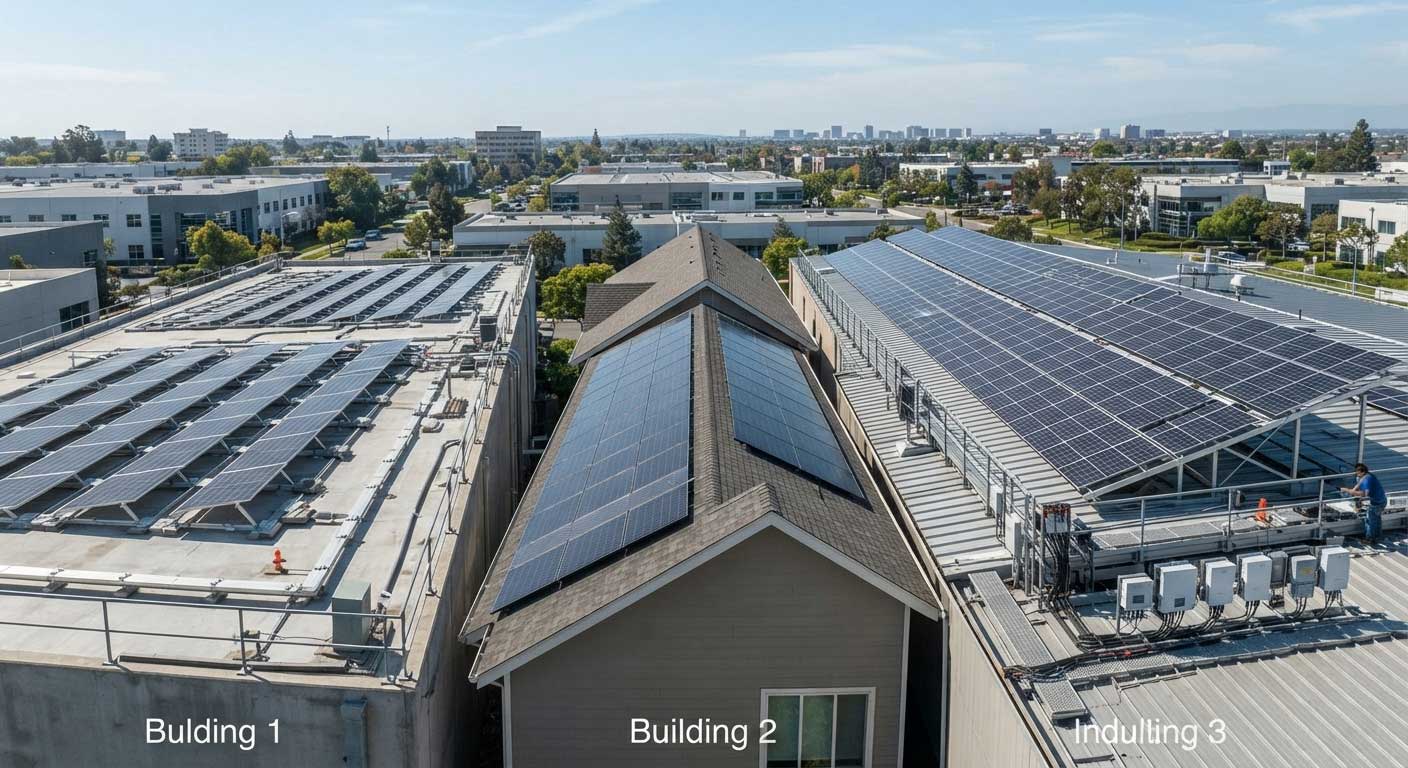
Industrial steel roofs
These are the most interesting.
We often see:
- long-span roofs with partial shading from HVAC systems
- uneven thermal zones
- multiple roof orientations on same building
So direction becomes segment-based design, not single-rule design.
ROI impact — direction mistakes are silent killers
One of the most overlooked realities:
Small directional errors do not “break” a system—but they slowly erode ROI over years.
Real-world observation (commercial system)
In one retrofit project we audited:
- original design: perfect south orientation
- actual condition: partial west deviation (~25° off optimal axis)
Measured outcome:
- ~6–9% annual yield reduction
- but more importantly: peak mismatch with consumption schedule
That second point mattered more financially.
Because in commercial systems:
timing of energy is often more valuable than total energy
Direction vs self-consumption — the real economic driver
Most beginners optimize for kWh.
Engineers optimize for usage alignment.
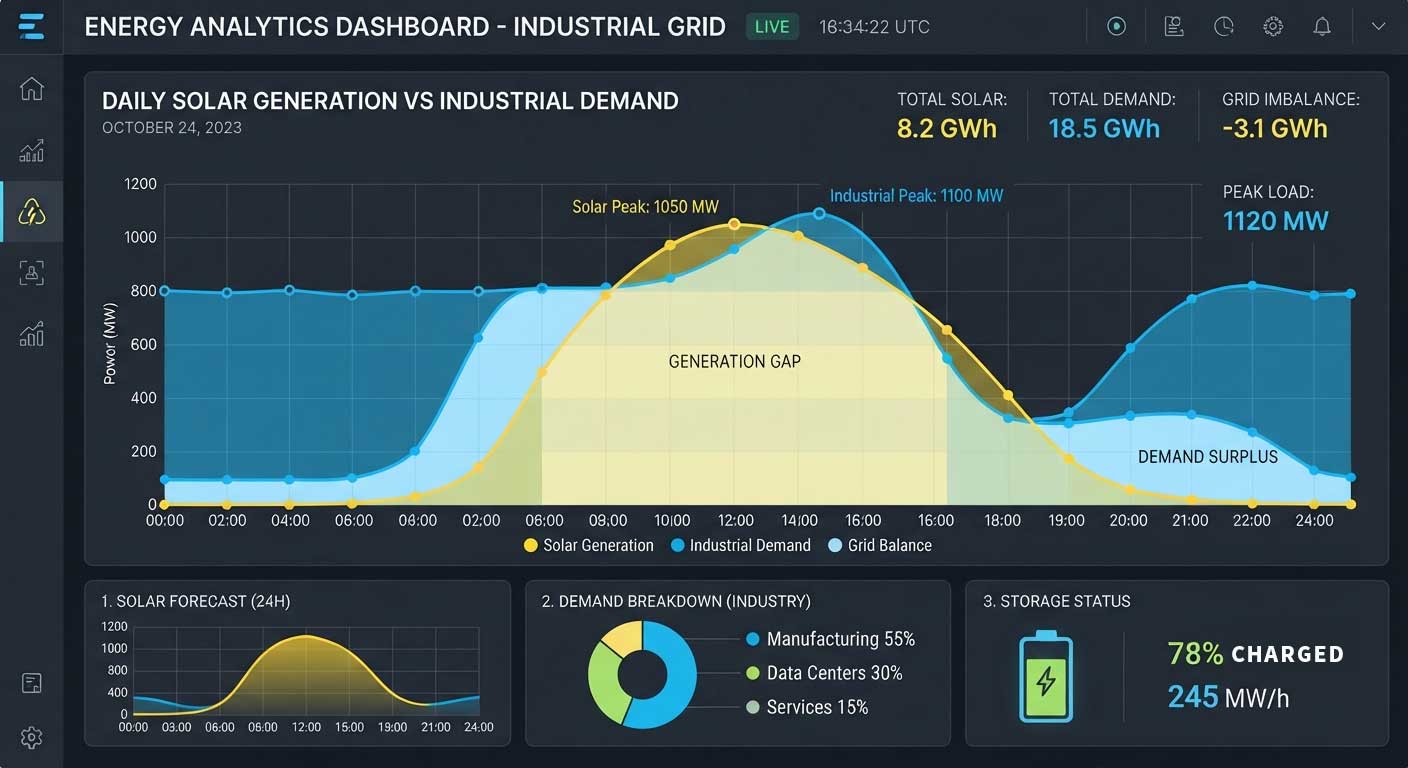
Example (warehouse load profile)
Typical pattern:
- morning low demand
- midday HVAC peak
- evening logistics activity
If panels face only south:
- energy peaks at noon
- mismatch with morning/evening usage
If split east-west:
- morning + afternoon generation improves alignment
This is why many modern systems move away from “perfect direction thinking.”
Common engineering mistakes (seen repeatedly in audits)
Mistake 1 — over-optimizing tilt angle
Many systems in tropical zones use overly steep tilt (25°–30°).
Result:
- slightly higher peak efficiency
- higher wind load risk
- reduced usable roof density
Net outcome: often negative ROI tradeoff.
Mistake 2 — ignoring inter-row shading
Even 5–10 cm miscalculation between rows can:
- create morning shading losses
- reduce effective irradiance by 3–8%
This is more damaging than wrong azimuth in many cases.
Mistake 3 — treating all panels as identical blocks
Real systems behave like:
multiple micro-zones, not one field
Different roof segments need different orientation logic.
Advanced field method — how Bright Solar engineers finalize direction
We don’t start with direction.
We end with it.
Step 1 — irradiance mapping
Satellite + on-site measurement combined.
Step 2 — shading window tracking
Morning / noon / afternoon obstruction mapping.
Step 3 — load curve overlay
Matching consumption vs generation timing.
Step 4 — structural constraint check
Wind load + roof penetration limits.
Step 5 — simulation iteration
Multiple orientation scenarios compared.
Only after these steps do we finalize azimuth.
Case reflection — why “perfect south” failed in one project
A logistics hub initially insisted on strict south-facing layout.
After 6 months of operation:
- high noon clipping
- low morning coverage
- reliance on grid during peak operational start
After redesign to mixed orientation:
- smoother output curve
- reduced grid dependency during ramp-up hours
- improved operational efficiency score
The interesting part:
total kWh changed very little, but financial efficiency improved noticeably
FAQ About best direction for solar panels guide
Does wrong direction ruin solar panels?
No. It reduces efficiency gradually rather than causing failure.
Is east-west better than south-facing?
In tropical and commercial load scenarios, often yes in practice.
Why do engineers still use south-facing designs?
Because it is a safe baseline when load data is unknown.
Final field insight
After working on multiple rooftop and industrial solar deployments, one pattern stays consistent:
Direction is not a goal.
It is a compromise between:
- sunlight geometry
- roof reality
- energy consumption behavior
- structural limits
The “best direction for solar panels” is therefore not a single direction—it is the direction that survives real constraints without sacrificing system stability.
Related recommendations
-

200W Flexible Solar Panels: Lightweight Off-Grid Power for RVs, Boats, and Van Life
204Explore how 200W flexible solar panels provide lightweight, reliable off-grid energy for RVs, boats, vans, and portable solar systems.
View details -
450 Watt Solar Panel Performance and Applications Guide
247Discover how a 450 watt solar panel delivers reliable power for RVs, homes, marine and off-grid systems. Learn output, efficiency and installation tips.
View details -
Solar Powered Battery Charger for Boat: Complete Marine Guide
230A solar powered battery charger for boat use combines solar panels, a matched charge controller, battery storage, marine-grade wiring, and protection to rech...
View details -
Top Rated RV Solar Panels: How to Choose the Right One
288The best RV solar panels balance power, roof space, weight, efficiency, durability, shading, and battery-system compatibility rather than maximizing wattage ...
View details