Flexible Marine Solar Panels: Reliable Solar Power for Boats and Yachts
Flexible marine solar panels provide lightweight, corrosion-resistant, and space-efficient renewable energy for boats, yachts, sailboats, and marine applications. Their ability to conform to curved surfaces while minimizing weight makes them one of the most effective solar solutions for modern vessels operating both nearshore and offshore.
There is a moment every boat owner eventually experiences.
The engine is off.
The shoreline is miles away.
The refrigerator is running, navigation electronics remain active, and battery capacity suddenly becomes more valuable than fuel.
That moment explains why marine solar systems have become standard equipment on many modern vessels.
At Bright Solar, we have worked with sailing yachts, fishing boats, catamarans, and expedition vessels across Europe and North America. In almost every project, the challenge is the same: limited space, constant motion, harsh weather, and the need for reliable energy.
Traditional glass panels can work well on boats.
But flexible marine solar panels often fit where rigid systems simply cannot.
The result is not just clean energy.
It is greater independence on the water.
Why Flexible Marine Solar Panels Are Becoming Essential
Marine electrical systems have changed dramatically over the last decade.
Modern vessels commonly rely on:
- GPS navigation systems
- AIS transponders
- Refrigeration
- LED lighting
- Water pumps
- Communication equipment
- Battery charging systems
- Mobile devices
Power consumption has increased.
Battery capacity has increased.
Expectations have increased.
According to the International Energy Agency (IEA), solar photovoltaic technology continues to expand globally as renewable energy solutions become more accessible and efficient.
Reference Source:
https://www.iea.org
For marine users, solar power offers an advantage that generators cannot:
Silent operation.
No fuel deliveries.
No engine hours.
No vibration.
That combination is difficult to ignore.
What Makes Flexible Marine Solar Panels Different?
Flexible marine solar panels are specifically designed for environments where traditional solar modules face limitations.
Instead of using heavy tempered glass and thick aluminum frames, flexible panels utilize:
- Lightweight composite materials
- Marine-grade encapsulation
- Corrosion-resistant components
- Flexible backing structures
These design differences create several advantages.
| Feature | Flexible Marine Solar Panels | Traditional Solar Panels |
|---|---|---|
| Weight | Very Low | High |
| Curved Surface Installation | Excellent | Limited |
| Corrosion Resistance | Excellent | Good |
| Wind Profile | Low | Higher |
| Mounting Complexity | Lower | Moderate |
| Marine Adaptability | Excellent | Moderate |
On a boat, reducing unnecessary weight matters.
Even small reductions can improve vessel efficiency and balance.
Why Boat Owners Prefer Flexible Solar Technology
Many vessels have limited flat mounting surfaces.
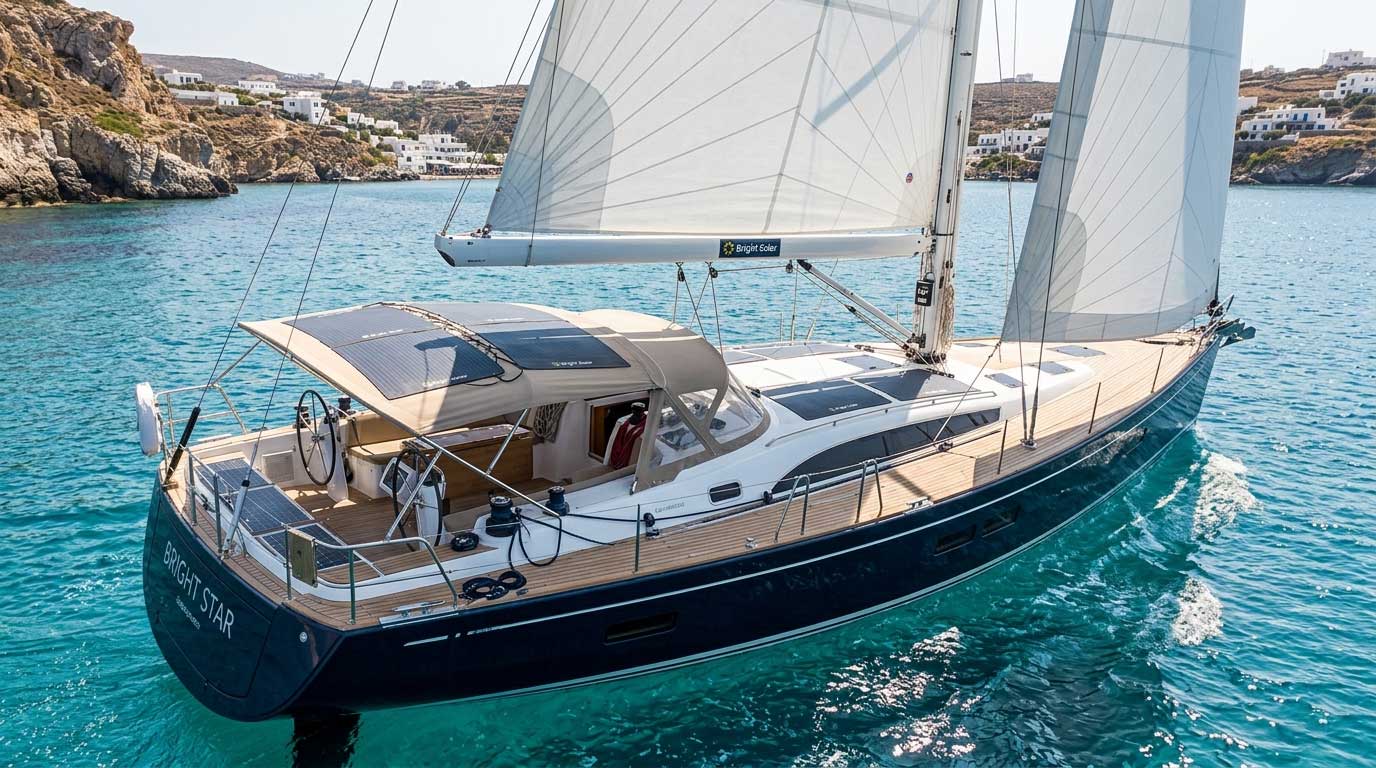
A typical sailing yacht may include:
- Curved cabin roofs
- Rounded deck sections
- Hatches
- Rigging systems
- Safety equipment
These obstacles complicate solar installation.
Flexible marine solar panels adapt to these conditions more naturally.
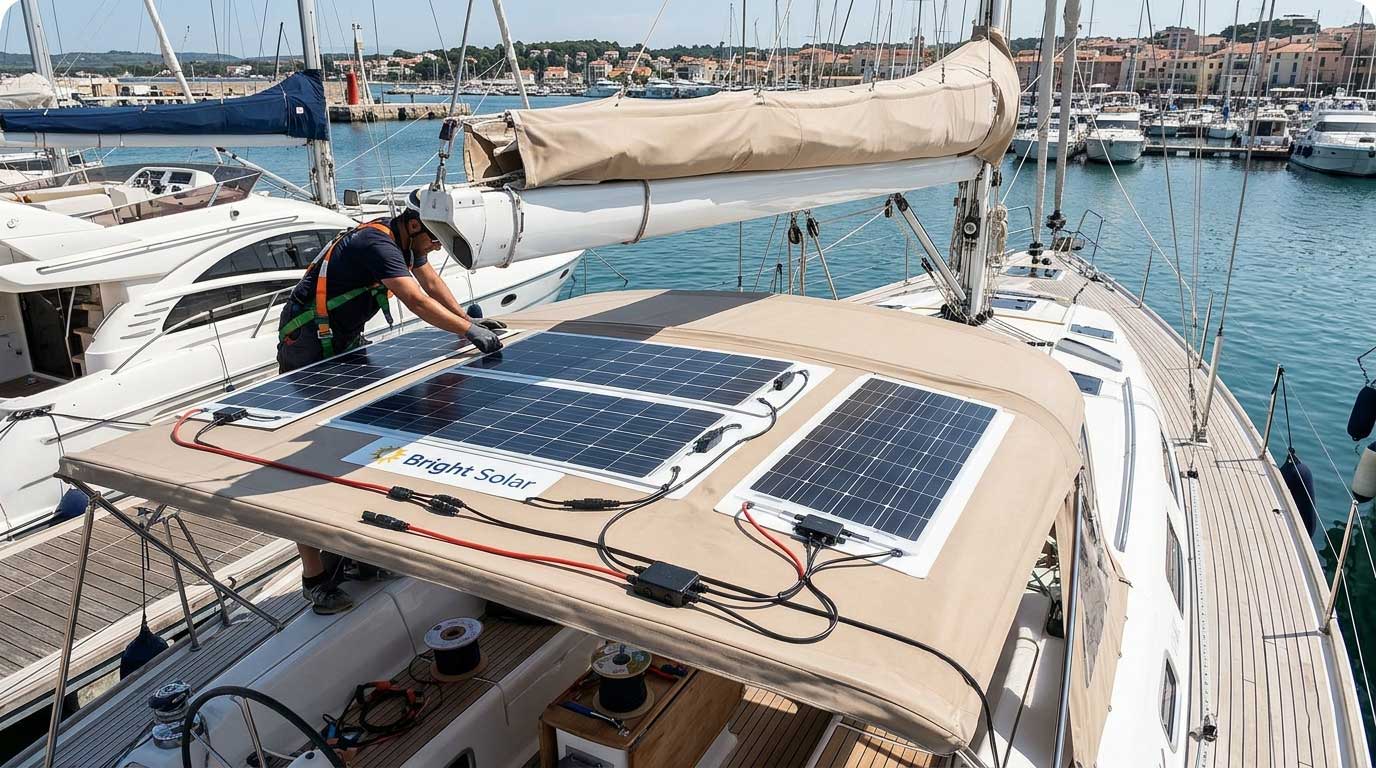
Instead of constructing large support frames, installers can often mount panels directly onto suitable surfaces.
This reduces:
- Installation time
- Wind resistance
- Structural modifications
And in marine environments, fewer components generally mean fewer maintenance concerns.
Reduced Weight Above the Waterline
Weight distribution matters.
Adding heavy equipment high on a vessel affects stability.
A traditional 100W glass solar panel often weighs 6–9 kg.
A comparable flexible marine panel may weigh only 2–3 kg.
For larger installations, the difference becomes substantial.
Boat owners notice these details quickly.
Especially offshore.
Real-World Marine Case Study
Several years ago, a yacht owner from southern France approached Bright Solar while upgrading a 42-foot cruising sailboat.
The challenge was straightforward.
The vessel needed:
- Reliable battery charging
- Extended anchorage capability
- Minimal visual impact
The owner strongly disliked bulky solar frames.
The solution included:
- Three 120W flexible marine solar panels
- MPPT charge controller
- Lithium battery upgrade
Performance results during peak summer months:
| Metric | Before Upgrade | After Upgrade |
|---|---|---|
| Daily Battery Deficit | Frequent | Rare |
| Generator Runtime | Daily | Occasional |
| Solar Production | Minimal | 1.4–1.8 kWh/day |
| Anchorage Duration | 2–3 Days | 6–8 Days |
What surprised the owner most wasn’t solar output.
It was noise reduction.
The generator operated far less frequently.
The boat felt different.
Quieter.
More self-sufficient.
That benefit rarely appears on product packaging.
Marine Durability: Built for Harsh Environments
Marine environments are unforgiving.
Solar equipment faces:
- Salt spray
- UV exposure
- Constant vibration
- Temperature fluctuations
- Humidity
- Heavy rainfall
A solar panel designed for residential rooftops may not perform optimally under these conditions.
Marine-grade products incorporate specialized materials designed to resist corrosion and environmental degradation.
The International Electrotechnical Commission (IEC) publishes environmental testing standards widely used throughout the photovoltaic industry.
Reference Source:
https://www.iec.ch
Quality manufacturing becomes especially important offshore.
Failures at sea are significantly more inconvenient than failures in a driveway.
How Efficient Are Flexible Marine Solar Panels?
One misconception continues to appear in online discussions.
“Flexible solar panels are inefficient.”
That statement may have been partially true many years ago.
It is increasingly outdated today.
Modern flexible marine solar panels commonly utilize:
- Monocrystalline solar cells
- Advanced cell interconnection methods
- High-transmission surface materials
According to the National Renewable Energy Laboratory (NREL), solar cell efficiency has steadily improved across photovoltaic technologies.
Reference Source:
https://www.nrel.gov
Premium marine panels now regularly achieve efficiency levels above 20%.
For most boat owners, available mounting space becomes the limiting factor long before panel efficiency does.
Common Marine Applications
Flexible marine solar panels support a wide range of onboard systems.
Typical applications include:
Navigation Systems
Critical electronics require dependable power.
Examples:
- GPS
- Chartplotters
- AIS systems
- Radar support equipment
Refrigeration Systems
Marine refrigeration often represents one of the largest daily energy loads onboard.
Solar power helps offset this demand.
Battery Maintenance
Solar charging keeps batteries healthier during:
- Storage periods
- Long voyages
- Seasonal use
Communication Equipment
Reliable energy supports:
- Satellite communications
- VHF radios
- Emergency systems
Energy independence increases safety.
Especially offshore.
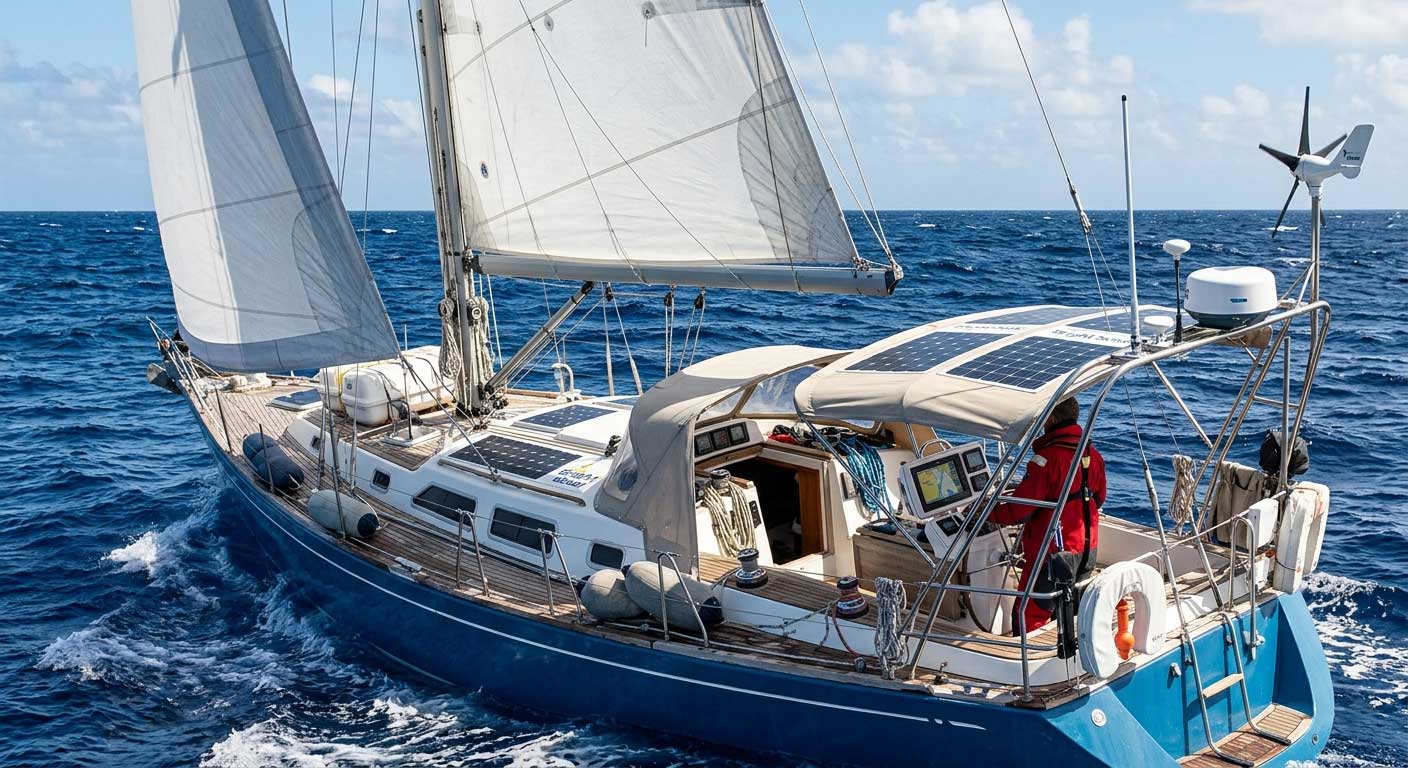
Flexible Marine Solar Panels vs Rigid Marine Panels
Choosing between flexible and rigid panels depends on the vessel.
Neither technology is universally superior.
| Factor | Flexible Marine Panels | Rigid Marine Panels |
|---|---|---|
| Weight | Excellent | Moderate |
| Curved Surface Compatibility | Excellent | Limited |
| Installation Flexibility | Excellent | Moderate |
| Structural Strength | Moderate | Excellent |
| Deck Integration | Excellent | Moderate |
| Airflow Cooling | Moderate | Excellent |
Many yacht owners prioritize aesthetics and low-profile installations.
Flexible panels often win in those situations.
Commercial vessels sometimes prioritize maximum durability and may choose rigid systems.
Project requirements determine the answer.
Not marketing claims.
Installation Lessons From Real Boats
After years of marine projects, certain patterns appear repeatedly.
The most successful installations typically focus on:
- Proper cable sealing
- UV-resistant wiring
- High-quality charge controllers
- Waterproof connectors
- Thoughtful panel placement
Interestingly, most long-term issues are not caused by solar panels.
They originate from:
- Poor wiring
- Water intrusion
- Inadequate strain relief
One experienced marine electrician summarized it well:
“The panel usually survives. The shortcuts don’t.”
That observation remains remarkably accurate.
FAQ About Flexible Marine Solar Panels
Are flexible marine solar panels waterproof?
Yes. Quality marine solar panels are designed to withstand rain, sea spray, and harsh outdoor marine environments when installed correctly.
Can flexible solar panels be mounted on curved boat surfaces?
Yes. Their flexibility allows installation on many curved decks, cabin roofs, and marine structures.
How long do marine solar panels last?
Lifespan depends on manufacturing quality, environmental exposure, and installation practices. Premium products can provide many years of dependable service.
Are flexible marine solar panels suitable for offshore sailing?
Absolutely. Many offshore vessels rely on flexible solar technology to reduce generator usage and support essential onboard systems.
Do flexible marine solar panels require maintenance?
Very little. Periodic cleaning and visual inspections are usually sufficient to maintain performance.
Final Thoughts on Flexible Marine Solar Panels
The appeal of flexible marine solar panels extends beyond renewable energy.
They solve practical challenges unique to life on the water.
At Bright Solar, we have supplied solar solutions for:
- Coastal cruising yachts
- Offshore sailboats
- Fishing vessels
- Catamarans
- Expedition boats
Each project is different.
Yet the requirements remain remarkably consistent.
Reliable power.
Minimal weight.
Maximum independence.
As marine energy systems continue evolving, flexible marine solar panels remain one of the most efficient ways to generate clean, silent power wherever the water leads.
Related recommendations
-

50w flexible solar panel: Lightweight Solar Solution for RV, Camping and Portable Power Applications
261Discover 50w flexible solar panel solutions from Bright Solar with lightweight design, reliable output, and easy installation for RV, marine, camping, and off-grid applications.
View details -
450w Solar Panels: Output, Size and Applications
245450w solar panels deliver high power in limited space. Compare output, efficiency, dimensions, wiring and applications for RV, home and off-grid solar systems.
View details -
Sungrow Inverter Helps Chilean Photovoltaic Project in the Atacama Desert
215Sungrow Inverter turnkey PV inverter solutions and solar panel cleaning robots to a 480 MW photovoltaic project in Chile’s Atacama Desert, supporting the country’s Energy Policy 2050 with high-efficiency inverters, anti-PID technology, and waterle...
View details -
300w flexible solar panel for RV, Marine and Off-Grid Solar Applications
274Explore 300w flexible solar panel technology from Bright Solar for RV, marine, and off-grid applications. Learn output, installation methods, materials, and real project experience.
View details