Solar Panels Serial or Parallel: Which Wiring Method Is Better?
Solar panels serial or parallel wiring depends on your system voltage, shading conditions, cable distance, and charge controller setup. Series wiring increases voltage and improves efficiency over long distances, while parallel wiring increases current and performs better under partial shading conditions.
I learned this lesson the expensive way in Nevada.
A van owner had installed three rooftop solar panels himself before driving through the desert southwest in late July. On paper, everything looked correct. The wattage matched the battery bank. The inverter sizing was acceptable. Cable quality was decent.
But by the second afternoon, the system kept triggering low-voltage charging warnings.
Not because the panels were defective.
Because the wiring strategy was wrong for the environment.
He wired everything in parallel across a relatively long cable run. Under intense heat, voltage drop became severe enough that charging efficiency collapsed during peak afternoon temperatures.
We rewired the system in series that evening beside a campground maintenance shed.
The next morning, charging performance improved immediately.
That experience changed how I evaluate mobile solar systems permanently.
People often debate solar panels serial or parallel like it is a universal rule. It is not. The correct answer depends heavily on the actual installation environment.
And real-world conditions rarely behave like clean textbook diagrams.
Understanding Solar Panels Serial or Parallel Wiring
Before comparing performance, it helps to understand the basic electrical difference.
Series Wiring
In a series connection:
- Voltage increases
- Current stays the same
Example:
- Two 12V 100W panels in series
- Result: 24V output
This setup is commonly used when:
- Cable runs are long
- MPPT charge controllers are installed
- Higher system efficiency is needed
Parallel Wiring
In a parallel connection:
- Current increases
- Voltage stays the same
Example:
- Two 12V 100W panels in parallel
- Result: 12V output with doubled current
Parallel wiring is common for:
- RV systems
- Small battery banks
- Partial shading environments
The important detail most beginners miss is that neither approach is automatically “better.”
The environment decides.
Real-World Case Study: RV Roof Shading Problem
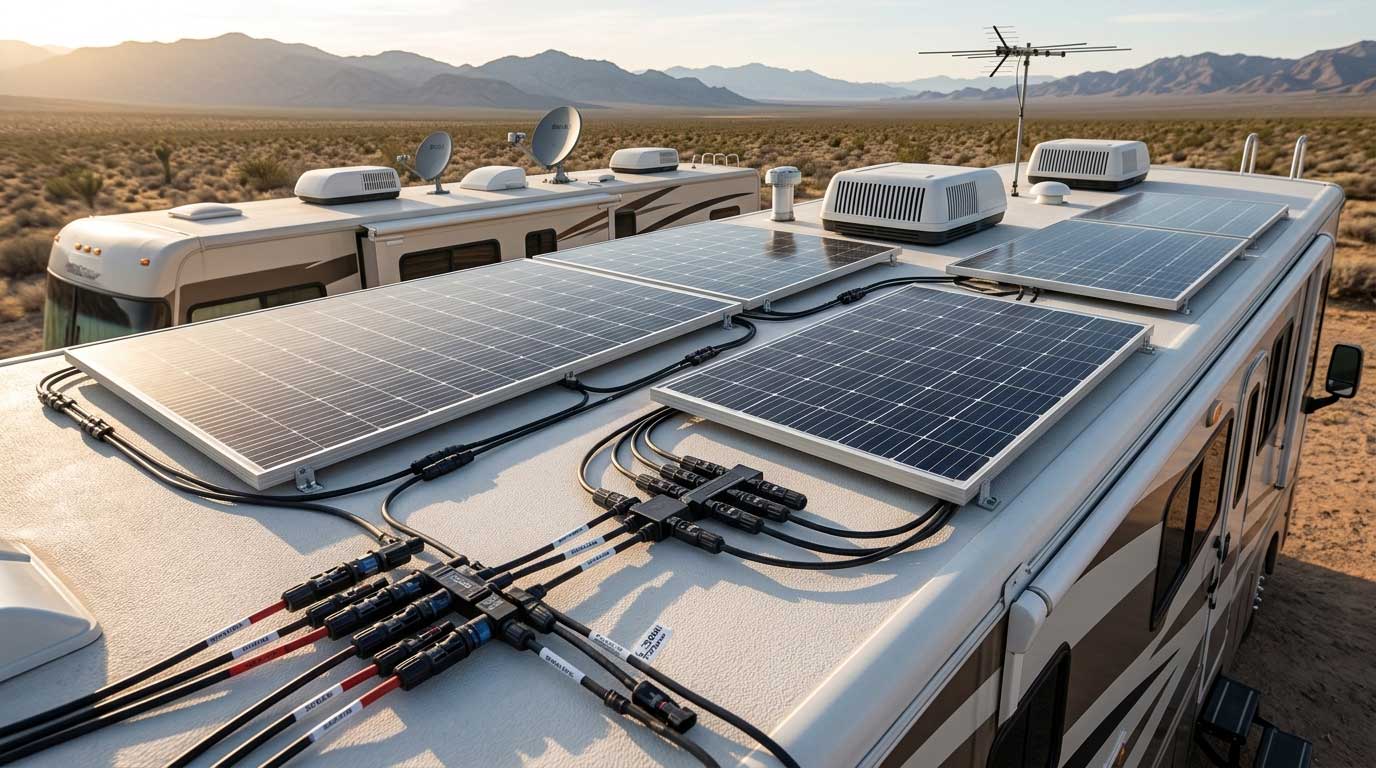
One Bright Solar customer in Oregon operated a compact Class B camper van with:
- Two roof fans
- A satellite antenna
- Three flexible solar panels
Initially, the system was wired entirely in series.
Under ideal sunlight, output looked impressive.
Then the customer parked beneath partial tree cover during a five-day camping trip near Crater Lake.
Performance dropped dramatically.
One small shadow from the antenna reduced production across the entire series string.
Daily battery charging fell nearly 40%.
After rewiring the panels into parallel configuration, power stability improved substantially during shaded conditions.
Peak wattage became slightly lower.
Real-world consistency became much better.
That distinction matters far more during actual travel.
Series Wiring Advantages
Series wiring becomes especially useful when voltage loss matters.
Higher voltage systems reduce transmission loss across long cables.
According to the U.S. Department of Energy, higher-voltage solar systems can improve transmission efficiency and reduce resistive power loss.
Source: U.S. Department of Energy
https://www.energy.gov/eere/solar
Benefits of Series Wiring
| Advantage | Why It Matters |
|---|---|
| Higher voltage | Better long-distance efficiency |
| Lower current | Smaller cable requirements |
| Improved MPPT performance | Faster battery charging |
| Cleaner wiring layout | Fewer parallel branch connectors |
Best Uses for Series Solar Wiring
Series wiring works well for:
- Large RV systems
- Off-grid cabins
- Long cable installations
- MPPT controllers
- Cold-weather environments
Cold temperatures actually increase solar voltage output.
That becomes important in northern climates.
One cabin installation in Alberta consistently achieved better winter charging performance after converting from parallel to series wiring because voltage remained high even during low-temperature mornings.
Parallel Wiring Advantages
Parallel wiring shines when shading becomes unavoidable.
And honestly, shading happens constantly in mobile solar environments.
Air conditioners.
Roof racks.
Satellite antennas.
Tree branches.
Boat rigging.
All create intermittent shadows.
Benefits of Parallel Wiring
| Advantage | Why It Matters |
|---|---|
| Better shading tolerance | One panel shaded does not cripple entire system |
| Stable voltage | Easier for smaller systems |
| Simple expansion | Easier to add extra panels |
| Reliable mixed sunlight performance | Useful for RVs and boats |
Marine Solar Example
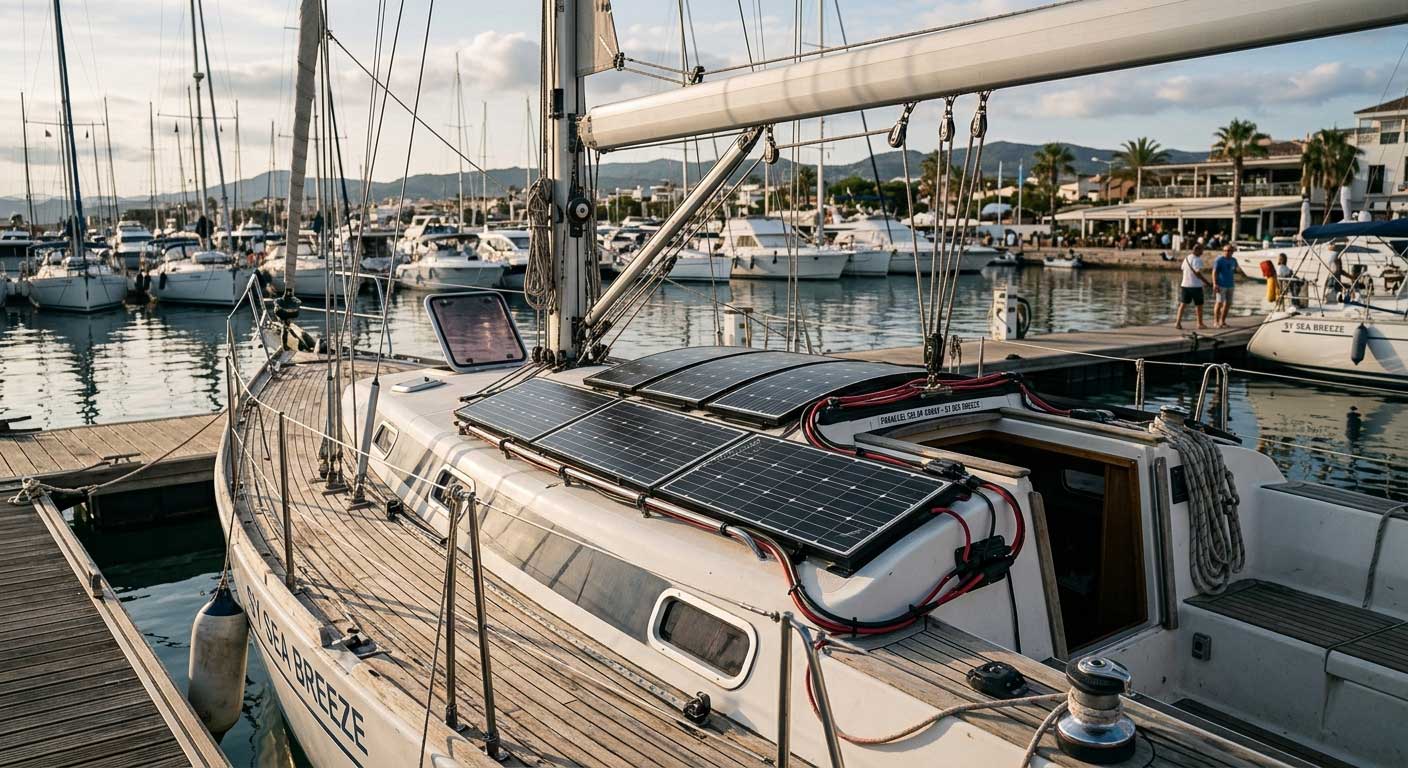
A sailboat owner near Fort Lauderdale installed:
- Four 100W flexible solar panels
- Lithium battery storage
- Refrigeration system
- Navigation electronics
Initially, the installer wired everything in series.
At sea, mast shadows constantly crossed portions of the array.
Charging became inconsistent throughout the day.
After reconfiguring to parallel wiring:
- Midday output stabilized
- Battery recovery improved
- Refrigeration runtime became more reliable
The owner accepted slightly lower peak efficiency in exchange for steadier real-world production.
For marine systems, that tradeoff is often worth it.
When Hybrid Wiring Makes More Sense
Sometimes the best answer is neither fully series nor fully parallel.
Larger systems often combine both.
This is called series-parallel wiring.
Example:
- Two panels connected in series
- Multiple series strings connected in parallel
This approach balances:
- Voltage efficiency
- Shading resistance
- Cable management
- System scalability
Many professional RV installers now prefer hybrid configurations for systems above 400W.
Especially when rooftop shading cannot be avoided completely.
How MPPT Controllers Change the Decision
MPPT charge controllers dramatically improve series wiring performance.
Unlike PWM controllers, MPPT systems convert excess voltage into usable charging current more efficiently.
According to Victron Energy technical documentation, MPPT controllers can significantly improve charging efficiency under varying environmental conditions.
Source: Victron Energy
https://www.victronenergy.com
In practical field conditions, I have repeatedly seen:
- Faster morning charging
- Better cold-weather performance
- Improved low-light recovery
when MPPT controllers are paired with series wiring.
Real Installation Example
One overlanding truck in Utah used:
- 600W rooftop solar
- 24V lithium battery bank
- MPPT charging
- Long rooftop cable routing
Parallel wiring initially caused excessive current and cable heating during summer conditions.
After converting to series-parallel configuration:
- Cable temperatures dropped
- Charging efficiency improved
- Voltage stability became far better
The improvement was visible directly on the controller display.
Not theoretical.
Immediate.
Common Mistakes When Wiring Solar Panels
Most failures are not caused by the panels themselves.
They come from installation decisions.
Mixing Different Panel Ratings
Combining unmatched solar panels creates uneven electrical behavior.
Especially problematic in series strings.
Ignoring Shading Patterns
One rooftop vent can reduce system performance dramatically depending on panel arrangement.
Using Undersized Cable
Voltage drop becomes severe in high-current parallel systems.
Cable sizing matters enormously.
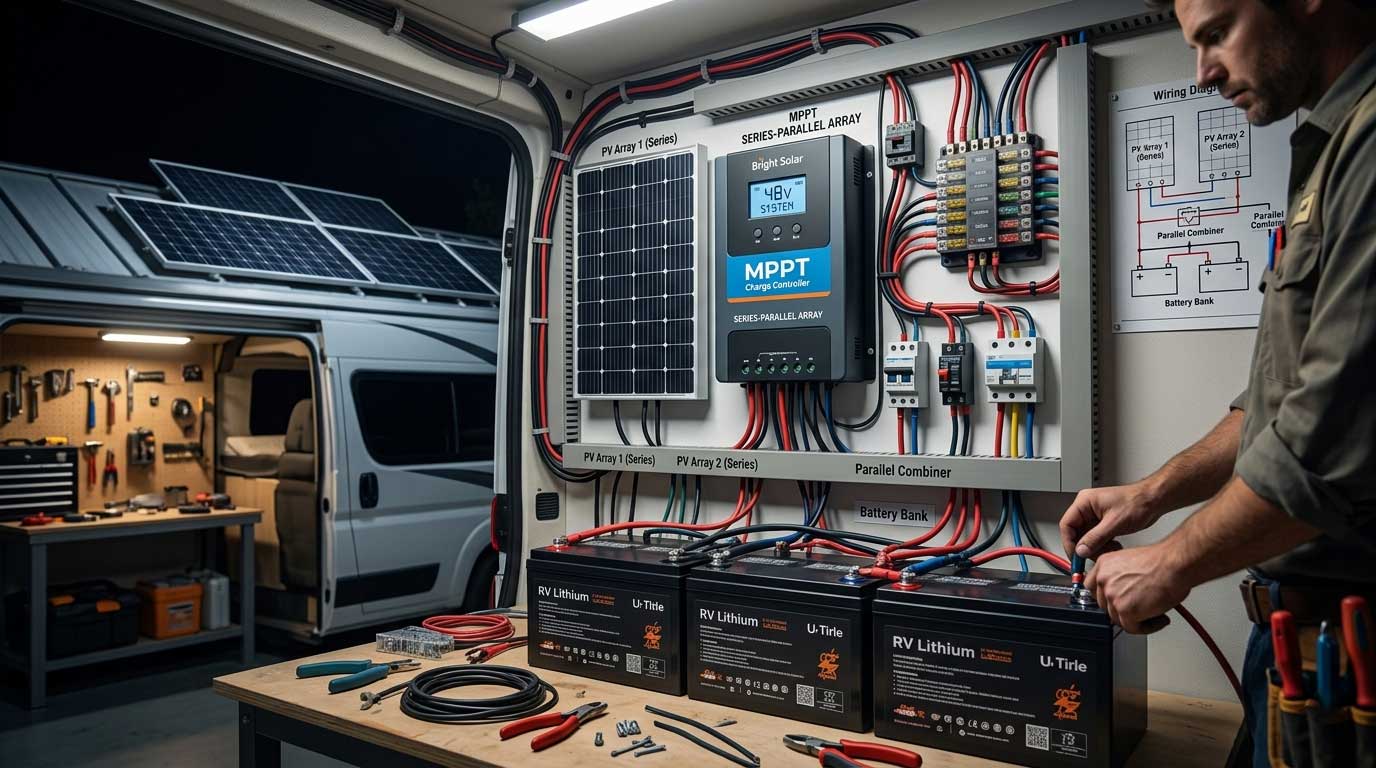
Series vs Parallel Comparison Table
| Feature | Series Wiring | Parallel Wiring |
|---|---|---|
| Voltage | Higher | Lower |
| Current | Lower | Higher |
| Shading Resistance | Lower | Better |
| Cable Efficiency | Better | Lower |
| Best For | Long cable runs | Partial shading |
| Ideal Controller | MPPT | PWM or MPPT |
FAQ: Solar Panels Serial or Parallel
Is it better to wire solar panels in series or parallel?
It depends on the system. Series wiring improves efficiency and reduces voltage loss, while parallel wiring performs better under partial shading.
Do solar panels charge faster in series?
Series wiring often improves charging efficiency with MPPT controllers because higher voltage reduces transmission loss.
What happens if one panel is shaded in series?
In series wiring, shading one panel can reduce output across the entire string significantly.
Is parallel solar wiring safer?
Parallel systems operate at lower voltage, which some installers prefer for small RV and marine systems.
Can I combine series and parallel wiring?
Yes. Many larger solar systems use hybrid series-parallel configurations to balance efficiency and shading tolerance.
Final Thoughts
The debate around solar panels serial or parallel often sounds more complicated than it really is.
Real installations usually reveal the answer quickly.
If your system faces:
- Long cable runs
- Minimal shading
- MPPT charging
Series wiring often performs better.
If your setup deals with:
- Tree cover
- Boat rigging shadows
- Rooftop obstructions
Parallel wiring may produce more stable daily energy.
And after years around mobile solar systems, one thing becomes obvious:
The best solar wiring design is rarely the most impressive on paper.
It is the one that keeps batteries charged consistently after days of bad weather, highway vibration, heat, and imperfect sunlight.
That is what matters outdoors.
Related recommendations
-

100 Watt Folding Solar Panel: Output, Uses and Setup Guide
30A 100 watt folding solar panel provides portable electricity for camping, RV travel, and small off-grid systems. Actual energy production depends on sunlight...
View details -
Solar Camping Gear: A Practical Guide to Off-Grid Power
303Solar camping gear combines portable solar generation and battery storage for reliable off-grid power during camping, RV travel, boating, and outdoor work.
View details -
300 Watt Flexible Solar Panel: Serious Off-Grid Power Without Heavy Roof Loads
295Discover how a 300 watt flexible solar panel delivers lightweight, reliable off-grid energy for RVs, boats, vans, and mobile solar systems.
View details -
Series vs Parallel Solar Panels: Which Wiring Method Performs Better?
147Compare series vs parallel solar panels for RVs, homes, and off-grid systems. Bright Solar explains voltage, current, shading, and wiring efficiency.
View details