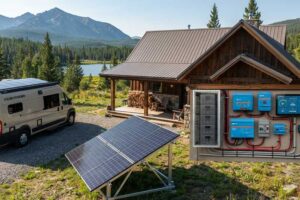
1000w Flexible Solar Panel: Output, Sizing and Installation Guide
A 1000w flexible solar panel system provides 1,000 watts of rated DC capacity under standard test conditions, making it suitable for larger RVs, boats, vans, cabins, and off-grid systems. Actual daily energy depends on sunlight, temperature, shading, orientation, roof design, wiring, and system losses.
The important part is understanding what that 1,000-watt number actually means.
A panel label can say 1,000W, but the roof does not know what the label says. It responds to sunlight, temperature, shading, orientation and airflow. The battery only sees the energy that survives all of those variables.
That is why I would evaluate a 1000w flexible solar panel installation as a complete electrical and mechanical system rather than simply counting watts.
The U.S. Department of Energy states that PV module ratings are measured under standard test conditions of 1,000 W/m² irradiance and a 25°C cell temperature. Real installations normally operate under different conditions.
For Flexible Solar Panels, there is another layer: the roof itself.
A curved RV roof, a yacht deck, or a low-profile mobile power system may have usable surface area that would be difficult to cover with conventional framed modules. That is where flexible construction becomes genuinely useful.
What Is a 1000w Flexible Solar Panel?
A 1000w flexible solar panel system is an array of photovoltaic modules with a combined rated capacity of 1,000 watts.
It does not necessarily mean one 1,000W flexible sheet.
In practice, the system may be built from several modules:
| Example Configuration | Number of Panels | Total Rated Power |
|---|---|---|
| 100W modules | 10 | 1,000W |
| 200W modules | 5 | 1,000W |
| 250W modules | 4 | 1,000W |
| 400W modules | 2 + 200W | 1,000W |
The actual combination should be determined by the available roof area and the electrical specifications of the selected modules.
That sounds obvious, but it becomes important when the roof contains air conditioners, vents, antennas, skylights or other equipment.
A five-panel layout may be electrically elegant and physically impossible.
A ten-panel layout may fit better but create more connections, longer cable routes and different current requirements.
The best design is the one that works electrically and physically.
1000W Does Not Mean 1000W All Day
The nameplate rating represents the module’s rated DC capacity under defined laboratory conditions.
It is not a promise that the array will continuously deliver 1,000W.
DOE explains that real-world irradiance is usually below 1,000 W/m² and module cell temperatures are typically above 25°C. Solar resource also changes with time of day, season, angle of incidence and clouds.
That distinction is critical when estimating the energy available to an RV or off-grid battery.
How Much Energy Can a 1000w Flexible Solar Panel Produce?
A simple planning equation is:
Daily solar energy = Array power × equivalent peak sun hours
For a 1,000W array:
| Equivalent Peak Sun Hours | Theoretical Daily Energy |
|---|---|
| 2 hours | 2,000Wh |
| 3 hours | 3,000Wh |
| 4 hours | 4,000Wh |
| 5 hours | 5,000Wh |
| 6 hours | 6,000Wh |
These are simplified energy estimates, not production guarantees.
For example, 1,000W × 5 hours gives 5,000Wh, or 5kWh, before accounting for temperature, wiring, controller, battery and other system effects.
The difference between this simple calculation and actual production is where system design becomes interesting.
Why Actual Output Is Lower Than the Nameplate
Several factors can reduce real-world production:
- Solar irradiance below STC
- High module temperature
- Partial shading
- Suboptimal orientation
- Dirt and surface contamination
- Cable resistance
- Connector losses
- Charge-controller conversion losses
- Battery charging limitations
- Module mismatch
- Weather
- Aging
NREL‘s PVWatts model accounts for irradiance, wind speed and ambient temperature when estimating operating cell temperature. It also distinguishes roof-mounted systems from open-rack installations because restricted airflow can result in higher operating temperatures.
That point is especially relevant to flexible solar.
A low-profile panel installed close to a roof does not necessarily have the same thermal environment as a raised rigid module.
A Better Way to Estimate Energy
Instead of telling a customer:
“Your 1,000W array produces 5kWh every day,”
I would phrase the calculation as a planning range.
For example:
1,000W × 4 peak sun hours = 4,000Wh/day before system losses.
Then evaluate the actual site.
NREL’s PVWatts tool is designed to estimate PV energy production using location and system parameters rather than relying solely on nameplate capacity.
That is a much more defensible approach.
Where Is a 1000w Flexible Solar Panel System Useful?
A 1000w flexible solar panel system is particularly useful where a large amount of solar capacity is needed but conventional framed modules are inconvenient because of roof shape, weight or mounting constraints.
Typical applications include:
- Large RVs
- Motorhomes
- Camper vans
- Boats and yachts
- Off-grid cabins
- Mobile workstations
- Remote monitoring equipment
- Outdoor communication systems
- Agricultural equipment
- Small off-grid power systems
For a small camper used two weekends a month, 1,000W may be more capacity than necessary.
For a motorhome with refrigeration, fans, lighting, communications equipment, laptops and other electrical loads, it can be much more appropriate.
The roof area usually decides the first part of the design.
The electrical load decides the second.
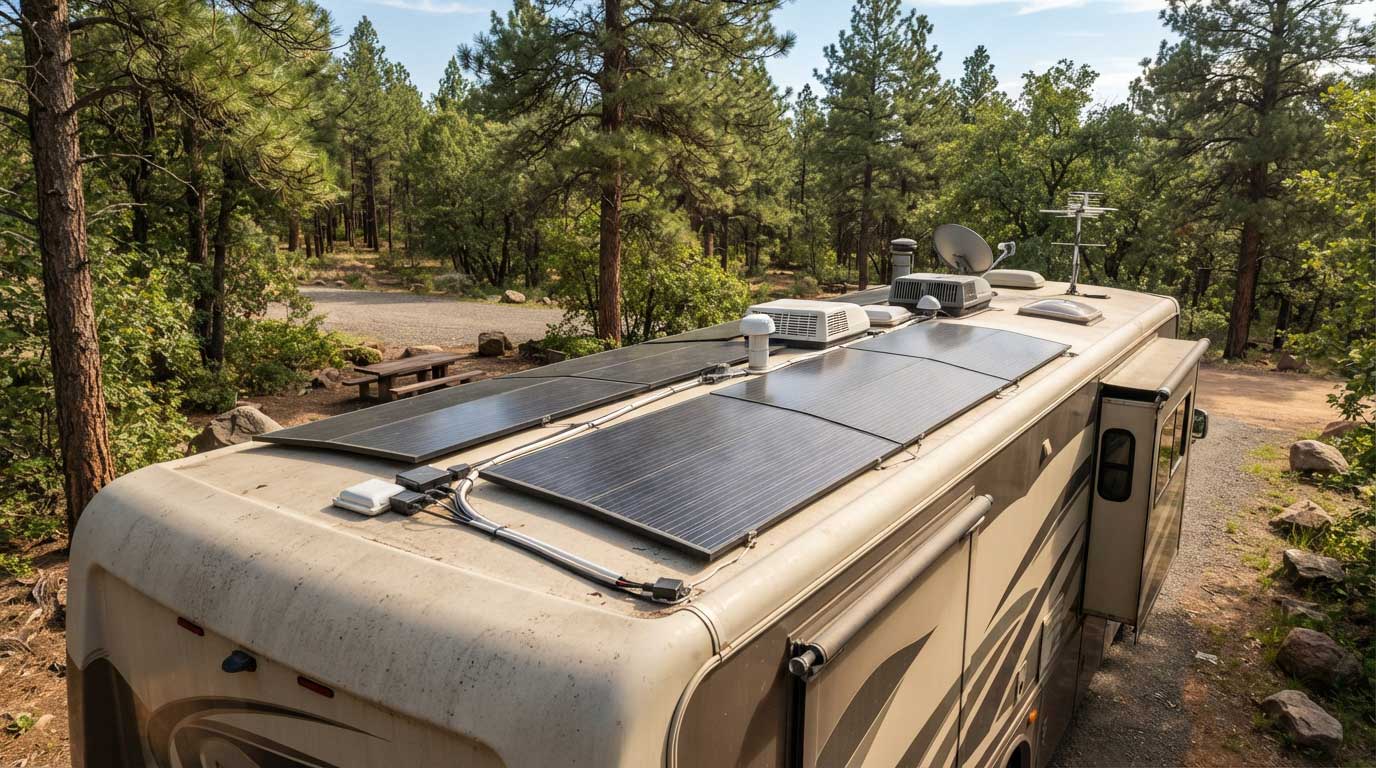
1000w Flexible Solar Panel for RVs
RVs are one of the most practical applications for a large flexible solar array.
The reason is not simply weight.
Roof geometry matters.
A typical RV roof can contain multiple pieces of equipment that interrupt a conventional panel layout. Flexible modules can provide additional layout options when the installation surface has suitable curvature and the module’s mechanical limits are respected.
Before permanent installation, I would do something very simple:
Put the panels on the roof first.
Do not start with adhesive.
Lay out the modules.
Walk around the roof.
Look at the spacing.
Then imagine yourself servicing the air conditioner two years later.
That usually reveals problems that a computer layout misses.
What I Check Before Installing on an RV
I would inspect:
- Available uninterrupted roof area
- Roof material and condition
- Panel dimensions
- Maximum allowable curvature
- Roof vents
- Air-conditioning units
- Antennas and satellite equipment
- Cable-entry position
- Charge-controller location
- Battery location
- Potential morning and afternoon shading
- Future service access
A technically correct solar layout can still be a bad RV layout if it prevents access to equipment.
That is an installation detail worth taking seriously.
How to Design a 1000W Flexible Solar Panel System
The electrical design should start with the individual panel specifications.
The key values are:
| Specification | Why It Matters |
|---|---|
| Pmax | Rated panel power |
| Vmp | Operating voltage at maximum power |
| Imp | Operating current at maximum power |
| Voc | Open-circuit voltage |
| Isc | Short-circuit current |
| Maximum system voltage | Defines electrical system limit |
| Temperature coefficient | Helps estimate temperature-related output changes |
| Dimensions | Determines physical roof layout |
| Weight | Important for mobile installations |
| Connector type | Determines cable compatibility |
Do not design the array from wattage alone.
A 1,000W array can have very different voltage and current characteristics depending on how the modules are connected.
Series Wiring
In a series configuration, voltage increases while current remains approximately the same as one module.
Suppose a hypothetical 200W module has:
- Vmp = 20V
- Imp = 10A
Five modules in series would theoretically give:
20V × 5 = 100V
At approximately:
10A
The rated array power would be:
100V × 10A = 1,000W
Those values are only an illustration.
The actual module’s Vmp, Voc and temperature behavior must be used when designing a real system.
Most importantly, the cold-weather Voc must remain within the charge controller’s maximum PV input voltage.
Parallel Wiring
Parallel wiring keeps voltage approximately the same while increasing current.
Using the same hypothetical 200W module:
Five modules in parallel would be approximately:
20V × 50A = 1,000W
The resulting current is much higher.
That affects:
- Cable size
- Fuse requirements
- Connector loading
- Controller input current
- Voltage drop
So the question is not simply:
“Series or parallel?”
It is:
Which electrical architecture best matches the modules, controller, battery and cable layout?
Series-Parallel Configuration
A larger 1,000W system may use a combination of series strings and parallel branches.
This can be useful when the charge controller has specific voltage and current limits.
Before finalizing the configuration, calculate:
- Maximum operating voltage
- Maximum cold-weather Voc
- Maximum array current
- Controller PV voltage range
- Controller maximum input current
- Cable ampacity
- Fuse and disconnect requirements
This is the part of the installation where a datasheet is more useful than a generic wiring diagram.
Battery Sizing for a 1000w Flexible Solar Panel
A 1,000W solar array does not automatically require a specific battery size.
Battery capacity should be based on energy consumption and the amount of stored energy required between charging periods.
The basic relationship is:
Battery energy = Battery voltage × Battery capacity
For example:
12V × 200Ah = 2,400Wh nominal
That is 2.4kWh of nominal stored energy.
It does not mean the entire 2.4kWh should necessarily be treated as usable energy.
Battery chemistry, depth-of-discharge limits, temperature, inverter efficiency and manufacturer specifications all matter.
Example RV Load Calculation
Consider a hypothetical RV with this daily load:
| Load | Daily Use | Estimated Energy |
|---|---|---|
| LED lighting | 5 hours | 150Wh |
| Refrigerator | 8 hours equivalent | 400Wh |
| Router/communications | 8 hours | 160Wh |
| Laptop | 3 hours | 180Wh |
| Ventilation fan | 4 hours | 240Wh |
| Phones/tablets | — | 100Wh |
| Miscellaneous DC loads | — | 200Wh |
| Total | — | 1,430Wh/day |
This example uses approximately 1.43kWh/day.
A 1,000W array could potentially provide substantially more energy than this on a good solar day.
That does not mean the extra energy is wasted.
It can recharge the battery, support additional loads or provide more useful reserve during variable weather.
The design still needs to account for poor-weather periods.
How to Install a 1000w Flexible Solar Panel
The installation process should be deliberate, especially because flexible panels are often installed directly or semi-directly on a roof surface.
Step 1 — Measure the Roof
Measure the usable area rather than the total roof area.
Exclude:
- Roof vents
- Air conditioners
- Skylights
- Access areas
- Drainage paths
- Service zones
- Areas with unsuitable curvature
Draw the usable rectangle or irregular area on paper.
Then place the panel dimensions inside it.
Step 2 — Dry-Fit Every Module
Place the modules without permanent attachment.
Check:
- Panel spacing
- Connector positions
- Cable routes
- Roof equipment clearance
- Curvature
- Maintenance access
Take photographs.
This sounds basic, but it gives you a record of the final layout before anything becomes permanent.
Step 3 — Check the Electrical Configuration
Confirm the final series and parallel arrangement.
Calculate:
Array Vmp
Array Voc
Array Imp
Array Isc
Then compare those values against the charge controller and other system components.
Step 4 — Prepare the Roof Surface
The surface should be clean, dry and compatible with the selected mounting system.
Do not assume every adhesive works on every roof material.
Follow both the solar-module instructions and the roof-material manufacturer’s requirements.
Step 5 — Plan Cable Entry
Decide where the PV cables will enter the interior before attaching the modules.
Avoid creating unnecessary cable loops.
Protect cables from:
- Sharp edges
- Abrasion
- Excessive heat
- Moving components
- Standing water
- Uncontrolled movement
Step 6 — Install the Modules
Follow the manufacturer’s mounting instructions.
Do not force a flexible module beyond its specified bending capability.
“Flexible” describes a mechanical characteristic.
It does not mean the module can tolerate arbitrary folding, twisting or repeated mechanical stress.
Step 7 — Commission the System
Before final connection:
- Check polarity
- Measure relevant voltages
- Inspect connectors
- Verify string configuration
- Confirm controller limits
- Check cable routing
- Confirm battery connections
Then monitor the system after commissioning.
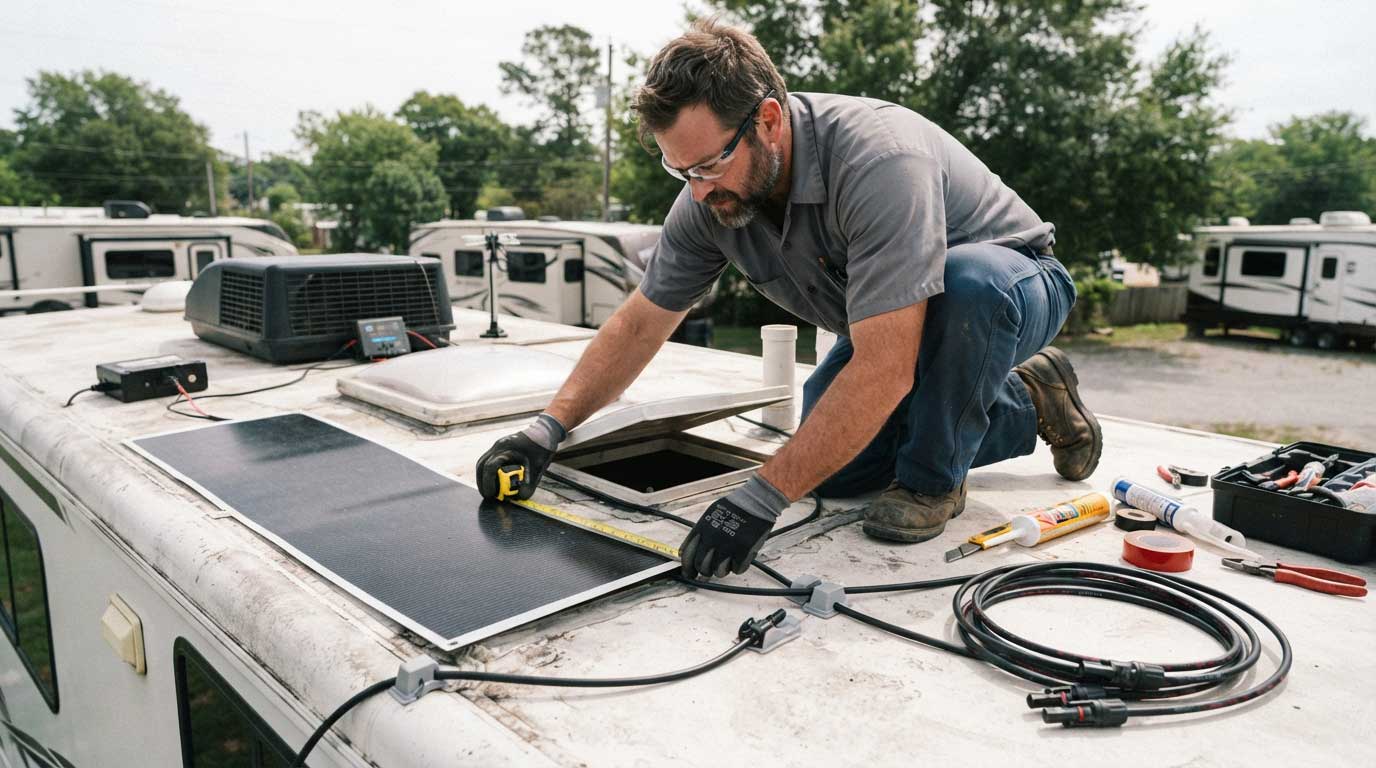
Flexible vs Rigid Solar Panels
Flexible and rigid solar modules solve different installation problems.
| Factor | Flexible Solar Panel | Rigid Solar Panel |
|---|---|---|
| Weight | Generally lower | Generally higher |
| Profile | Low | Raised |
| Curved roof | Strong advantage | Limited |
| Mounting hardware | Potentially reduced | Usually required |
| Airflow underneath | Often limited | Usually better |
| RV applications | Excellent fit | Also common |
| Boats | Very useful | Depends on deck |
| Flat roof | Useful | Often highly practical |
| Mechanical installation | Requires attention to bending | Requires attention to mounting/support |
The correct choice depends on the site.
For a large flat roof where airflow and conventional mounting are easy, rigid panels can make excellent sense.
For a curved RV or boat roof where a low-profile array is valuable, flexible modules can offer a much cleaner installation.
That distinction is more useful than saying one technology is universally “better.”
Temperature and 1000W Flexible Solar Panel Output
Temperature is one of the easiest variables to underestimate.
DOE explains that solar cells generally perform better at lower temperatures, while higher temperatures cause voltage to decrease.
NREL’s PVWatts model incorporates operating cell temperature based on irradiance, wind and ambient temperature, and its documentation notes that roof-mounted configurations can have higher operating temperatures because airflow is more restricted.
For a roof-mounted flexible system, this creates a practical design question:
Where does the heat go?
The answer depends on the roof, module construction, mounting method and environmental conditions.
This is one reason I would not compare two flexible modules only by their laboratory efficiency number.
The thermal environment matters too.
Shading Is Often More Important Than People Expect
Walk around the installation site during different times of the day.
At 9 a.m., an antenna may cast a short shadow.
At 2 p.m., that same object may shade a completely different section of the array.
On an RV, vehicle orientation changes the picture again.
For a fixed cabin, tree growth can change the situation over several years.
This is why site inspection should happen before panel selection, not after.
How Long Does a 1000w Flexible Solar Panel Last?
There is no single lifetime number that applies to every flexible solar panel.
Actual service life depends on materials, construction, installation, climate, mechanical stress, UV exposure, moisture, operating conditions and maintenance.
DOE describes typical PV system lifespans in the range of 20–30 years and notes that PV module efficiency degrades at about 0.5% per year as a general performance consideration.
DOE also reports that analysis of nearly 19,000 U.S. inverters found a median system performance loss of around 0.75% per year across the analyzed fleet. That is a system-level result, not a universal degradation rate for every module.
This distinction matters.
A module degradation figure and a complete system performance-loss figure are not interchangeable.
When evaluating a flexible solar product, I would check:
- Product warranty
- Power warranty
- Module construction
- Encapsulation materials
- Surface material
- Bending specifications
- Environmental ratings
- Electrical certifications
- Temperature range
- Installation requirements
IEC 61215 testing is useful for module design qualification, but IEC notes that qualification testing itself is not a quantitative prediction of service lifetime.
Bright Solar 1000w Flexible Solar Panel Solutions
Bright Solar focuses on flexible solar applications where traditional rigid modules are not always the most convenient physical solution.
For a 1,000W installation, the design should begin with the application rather than the product name.
I would start with four questions:
How much energy is needed?
How much roof area is actually usable?
What electrical architecture does the battery and controller require?
What mechanical conditions will the modules experience?
Only then should the final module combination be selected.
For an RV, this might mean maximizing useful roof coverage without blocking service equipment.
For a boat, it may mean fitting modules around deck geometry.
For an off-grid cabin, the priority may shift toward energy yield, battery autonomy and seasonal conditions.
That is the practical difference between selling “1,000 watts” and designing a 1,000W solar system.
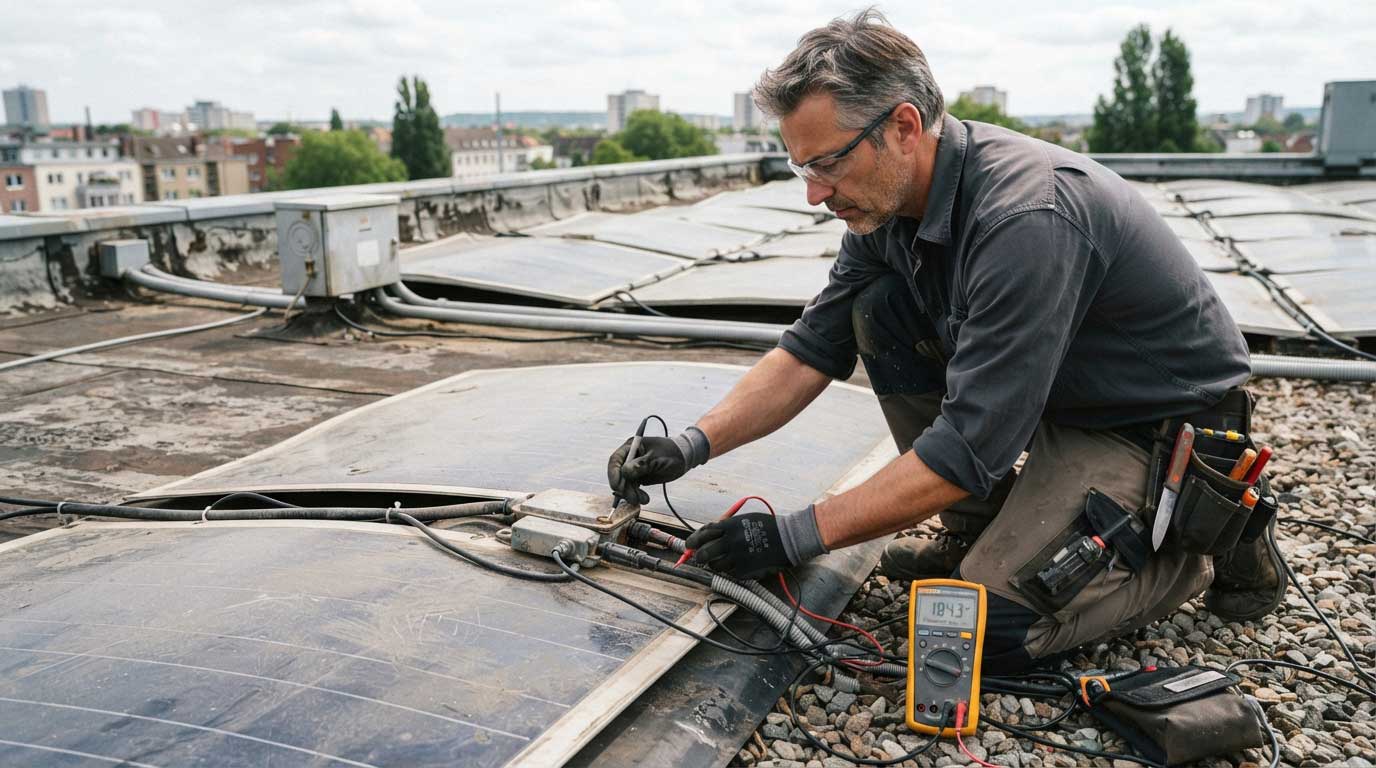
Common 1000W Flexible Solar Panel Installation Mistakes
Mistake 1 — Treating 1,000W as Continuous Power
A 1,000W rating describes rated DC capacity, not continuous daily production.
Mistake 2 — Ignoring Voc
Array voltage can increase in cold conditions.
The controller’s maximum PV voltage must be respected.
Mistake 3 — Designing Only From Roof Dimensions
The usable roof is smaller than the physical roof once vents, equipment and service areas are considered.
Mistake 4 — Overlooking Cable Routing
A panel layout that looks perfect from above can create poor cable paths underneath.
Mistake 5 — Assuming Flexible Means Foldable
Flexible modules still have mechanical limits.
Do not exceed the manufacturer’s specified bend radius or installation requirements.
Mistake 6 — Forgetting Future Maintenance
Leave access around equipment that will eventually need inspection or replacement.
This is especially important on RV roofs.
1000w Flexible Solar Panel FAQ
How much power does a 1000w flexible solar panel produce?
A 1000w flexible solar panel system has a rated DC capacity of 1,000W under standard test conditions. Actual output changes with sunlight, temperature, shading, orientation, wiring and other system conditions.
How many panels are needed for 1000W?
It depends on the wattage of each module. Ten 100W panels, five 200W panels or four 250W panels can each total 1,000W. Physical dimensions and electrical specifications should determine the final configuration.
Is a 1000w flexible solar panel system enough for an RV?
It can be suitable for a large RV or motorhome with substantial daily energy demand. Whether it is sufficient depends on the refrigerator, inverter, appliances, battery capacity, climate, travel pattern and available roof area.
Can flexible solar panels be installed on a curved RV roof?
Yes, when the panel is designed for the intended application and installed within the manufacturer’s bending limits. Flexible does not mean unlimited bending or folding.
What battery size should I use with a 1000W solar array?
There is no universal battery size. The battery should be selected from daily energy consumption, required autonomy, battery chemistry, system voltage and allowable depth of discharge rather than from the 1,000W panel rating alone.
Does a 1000W solar system make 1,000W every hour?
No. The 1,000W rating is a laboratory-based nameplate value. Real output changes with irradiance, temperature, shading, orientation and system conditions. DOE confirms that field conditions normally differ from standard test conditions.
Are flexible solar panels better than rigid panels?
Neither is universally better. Flexible panels are particularly useful for curved, weight-sensitive or low-profile installations, while rigid panels can be advantageous on large flat roofs where conventional mounting and rear ventilation are easy.
Final Takeaway
A 1000w flexible solar panel system can provide substantial solar capacity for RVs, boats, vans, cabins and other off-grid applications where roof shape, weight and installation profile matter.
But the 1,000W number is only the starting point.
A good installation connects the dots between panel specifications, usable roof area, solar resource, temperature, battery capacity, charge-controller limits, wiring and long-term maintenance.
For Bright Solar, that is the more useful way to look at flexible solar: not as a panel that happens to say 1,000W on its label, but as a complete power system that has to work on a real roof, in real weather, with real electrical loads.
Technical Sources
- U.S. Department of Energy — Solar PV Performance and Longevity
- U.S. Department of Energy — Solar PV Performance and Efficiency Basics
- U.S. Department of Energy — Understanding Solar Photovoltaic System Performance
- U.S. Department of Energy — PV Fleet Performance Data Initiative
- National Renewable Energy Laboratory — PVWatts Version 5 Manual
- NREL — PVWatts Calculator
Related recommendations
-

Flexible Adhesive Solar Panels: Uses, Mounting and Buying Guide
142Flexible adhesive solar panels suit selected low-profile installations when the panel, adhesive, and mounting surface are compatible.
View details -
Best Solar Panel Setup for RV and Off-Grid Systems: Complete Guide
270Discover the best solar panel setup for RV and off-grid systems with wiring options, battery sizing, MPPT controllers, and flexible solar panel solutions.
View details -
Best Solar Panel for RV: How to Choose the Right One
243Find the best solar panel for rv use. Compare flexible and rigid panels, wattage, batteries, shading, wiring and installation for reliable off-grid travel.
View details -
1000 Watt Flexible Solar Panel: Output, Sizing and Installation Guide
296A 1000 watt flexible solar panel system is suitable for large RVs, vans, boats, and cabins where roof shape and weight matter. Actual energy production depen...
View details