120W Folding Solar Panel: Output, Uses and Buying Guide
A 120w folding solar panel provides portable solar power for camping, RV travel, boating, and off-grid activities. Its actual energy output depends on sunlight, panel orientation, shading, and charging equipment, making it a practical option for charging compatible power stations and batteries.
For people who need electricity away from a fixed installation, 120W is a useful middle ground: more capable than a small phone-charging panel, but easier to transport than a large rigid solar array. The key is to match the panel’s real-world output to the devices you intend to run.
At Bright Solar, portable solar panel selection should begin with the application, the electrical requirements of the connected equipment, and the space available when the panel is unfolded. Buyers should also check connector compatibility, controller requirements, and the manufacturer’s rated specifications before placing an order.
What Is a 120W Folding Solar Panel?
A 120W folding solar panel is a portable photovoltaic module or set of connected modules designed to fold for transport and unfold for solar collection. The 120W rating represents nominal power under specified test conditions, not a promise that the panel will continuously produce 120 watts outdoors.
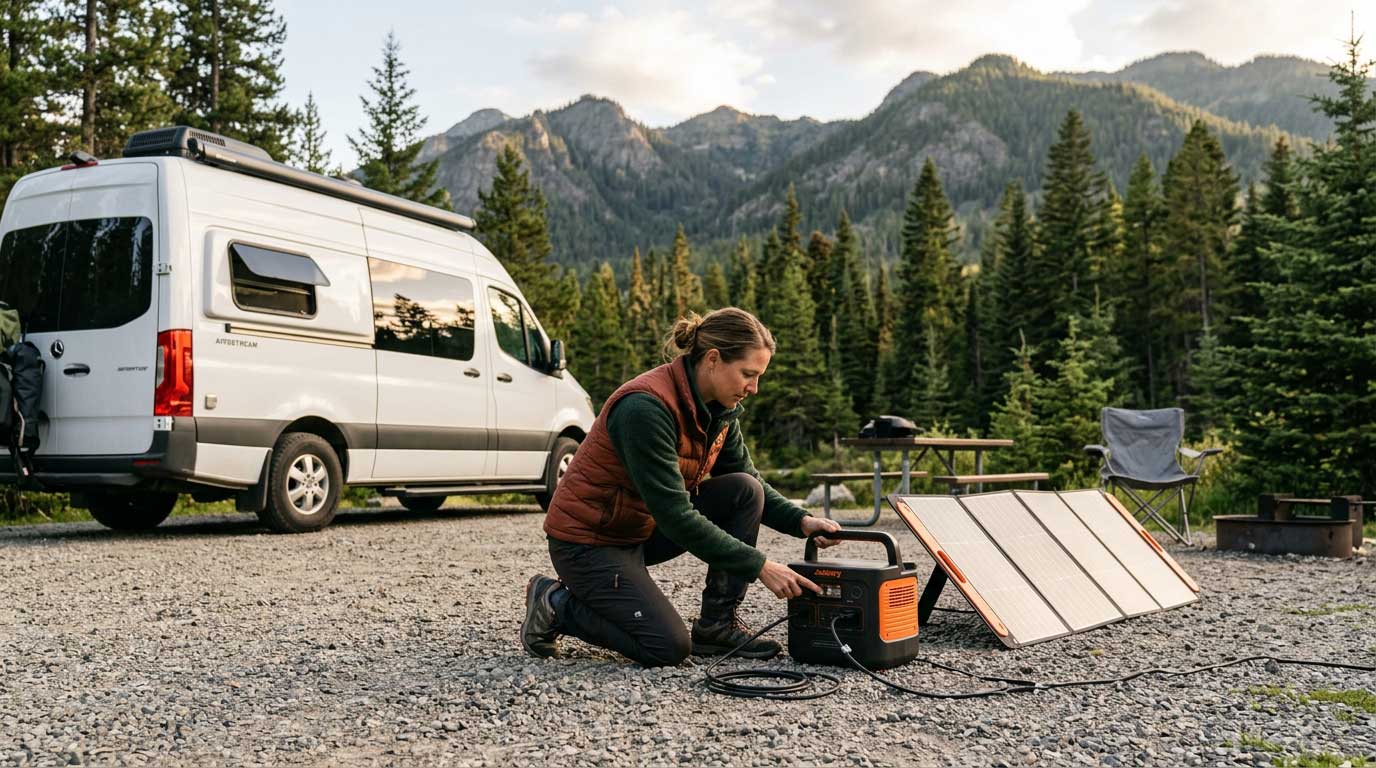
Unlike conventional rigid panels that are usually installed on roofs or mounting frames, folding panels are commonly deployed on the ground, beside a camper, at a campsite, or in another sunny location. Depending on the design, integrated support legs can help users adjust the angle toward the sun.
Typical applications include:
- Charging compatible portable power stations.
- Replenishing batteries through a suitable solar charge controller.
- Supporting lighting, phones, tablets, cameras, and other small electronics.
- Providing supplemental energy during RV trips and camping holidays.
- Supplying temporary power where grid access is unavailable.
A folding panel is not automatically waterproof, walkable, or suitable for permanent outdoor installation. Those characteristics depend on the product’s construction and published protection ratings.
How Much Power Can a 120W Folding Solar Panel Generate?
A 120W folding solar panel can theoretically generate 120 watt-hours in one hour if it maintains its rated 120W output throughout that hour. Outdoor production varies with sunlight intensity, panel temperature, orientation, shading, and electrical losses.
The U.S. Department of Energy explains that photovoltaic module ratings use standard test conditions, including 1,000 W/m² irradiance and a cell temperature of 25°C. Those conditions are a reference for testing, not a guarantee of everyday performance.
Estimated Daily Energy Output
A practical first estimate uses peak sun hours multiplied by rated panel power. The following figures are planning scenarios, not guaranteed results or measured Bright Solar product data.
| Equivalent peak sun hours | Theoretical energy from 120W |
|---|---|
| 2 hours | 240 Wh (0.24 kWh) |
| 3 hours | 360 Wh (0.36 kWh) |
| 4 hours | 480 Wh (0.48 kWh) |
| 5 hours | 600 Wh (0.60 kWh) |
| 6 hours | 720 Wh (0.72 kWh) |
Actual energy delivered to a battery or device will usually be lower because sunlight varies and the system incurs conversion and charging losses. For example, if a planning estimate assumes 80% overall energy delivery, 4 peak sun hours would provide approximately 384 Wh of usable energy:
120 W × 4 hours × 0.80 = 384 Wh.
The 80% figure is an illustrative assumption, not a measured efficiency specification for a particular panel or power station.
For a location-specific estimate, use the National Renewable Energy Laboratory’s PVWatts Calculator. Its production modeling draws on solar-resource and system information, although it is primarily intended for grid-connected PV systems, so a portable setup still requires application-specific judgment.
What Can 120W Realistically Power?
Consider a portable power station with a 500Wh battery. Under the illustrative 384Wh daily charging scenario above, one sunny day could replace a substantial portion of its stored energy, assuming the station accepts the panel’s output and charging conditions remain suitable.
That does not mean the panel can supply every appliance directly. A device drawing 60W may operate while the panel produces sufficient power, but passing clouds can reduce output abruptly. A power station or battery helps bridge those fluctuations.
Check three values before buying:
- Rated input: The maximum solar input accepted by the power station or charge controller.
- Voltage range: The panel’s operating voltage must fall within the receiving equipment’s permitted range.
- Connector and polarity: The plug must match, or use a manufacturer-approved compatible adapter.
A 120W rating alone does not establish electrical compatibility.
Best Uses for a 120 Watt Foldable Solar Panel
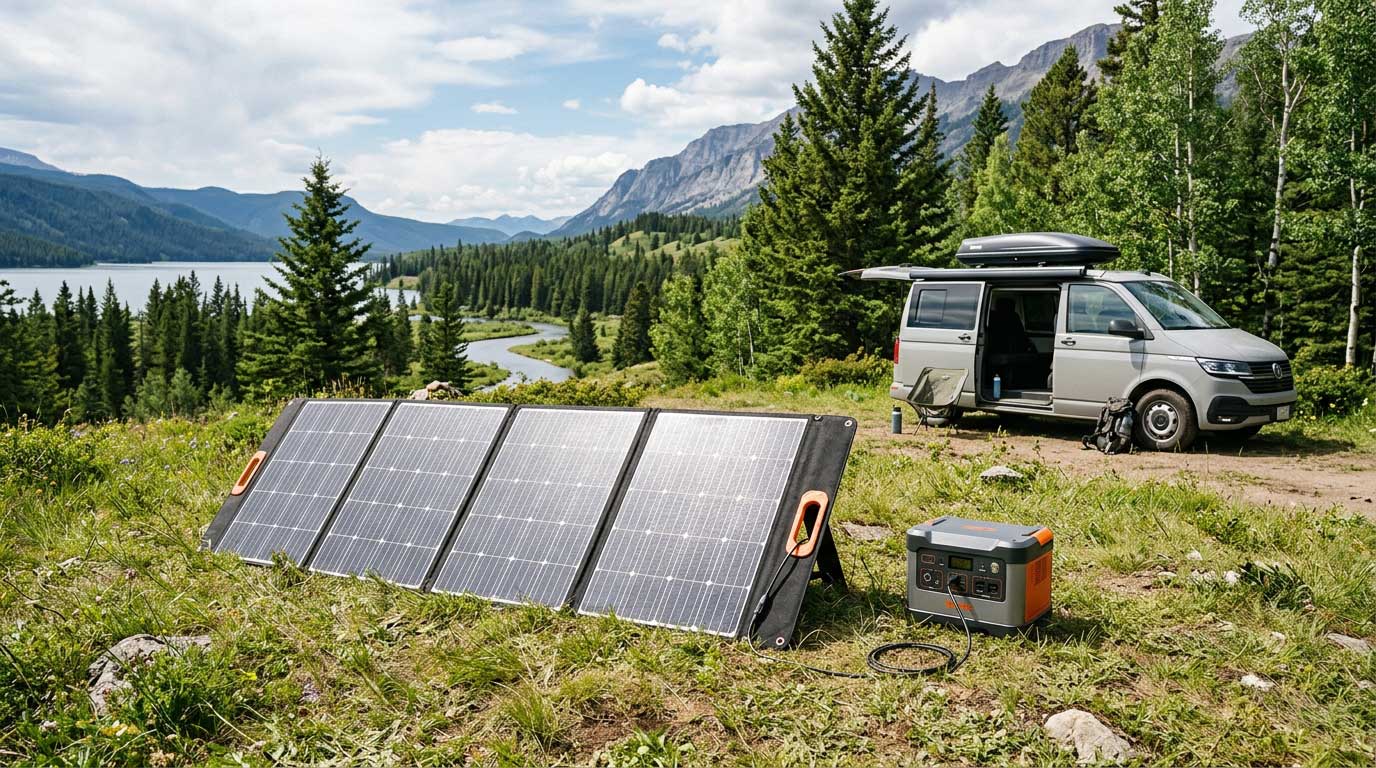
A 120 watt foldable solar panel is most useful when portability matters more than maximizing total daily generation. It can supplement a battery system without requiring a permanent roof installation, and it can be moved when the sun changes position.
Camping and Portable Power Stations
For weekend camping, a folding panel can recharge a compatible power station during daylight. Stored energy can then support phones, headlamps, cameras, small fans, and other low-power electronics after sunset.
A useful planning method is to add up the watt-hours consumed by your devices rather than simply counting how many devices you own.
For example, a hypothetical campsite load might include:
| Device | Example daily energy use |
|---|---|
| Phone charging | 20 Wh |
| LED camping lights | 30 Wh |
| Camera battery charging | 25 Wh |
| Small USB fan | 60 Wh |
| Total | 135 Wh |
These are illustrative estimates; actual consumption depends on device specifications and usage time. A panel producing 384Wh of usable energy under the earlier example could cover this 135Wh load on a suitable day, leaving energy available for battery storage. Cloudy weather, shading, and additional loads change the outcome.
RVs and Camper Vans
An RV solar setup can use a folding panel to supplement a house battery without occupying roof space. This is particularly helpful when the roof is already crowded with vents, antennas, air-conditioning equipment, or existing solar modules.
Set the panel on a stable, sunny patch near the vehicle, route cables away from walking paths, and protect connectors from standing water. Secure the panel against wind and keep it clear of vehicle movement.
A folding panel is generally a supplemental charging option, not a substitute for a properly sized RV electrical system when the load includes a refrigerator, induction cooker, air conditioner, or other high-demand appliance.
Boating and Remote Outdoor Activities
Portable solar can help maintain small electronics and compatible battery systems during stationary use at a campsite, dock, or sheltered outdoor location. However, marine environments create additional requirements.
Salt spray, moisture, vibration, and accidental impacts can damage equipment that is not designed for those conditions. Do not assume a folding panel is suitable for permanent deck installation or direct exposure to seawater unless the manufacturer explicitly confirms the intended use.
For hiking, a 120W panel may also be too large or heavy for someone carrying all equipment on foot. Check the folded dimensions, total carry weight, support structure, and cable arrangement before selecting a model for backpacking.
What to Check Before Buying a 120W Folding Solar Panel
The wattage is only one part of the specification. Two panels rated at 120W can differ considerably in folded size, weight, cell construction, connectors, and compatibility with battery systems.
Key Specifications to Compare
| Specification | What to verify |
|---|---|
| Rated power | Confirm the nominal maximum output is 120W. |
| Operating voltage and current | Check the manufacturer’s Vmp and Imp values. |
| Open-circuit voltage | Ensure Voc stays within the controller’s maximum input voltage, including relevant cold-weather considerations. |
| Short-circuit current | Verify Isc against the controller’s permitted input current. |
| Folded dimensions | Confirm that the panel fits your storage compartment or vehicle. |
| Weight | Include the panel, support legs, cables, and carrying case. |
| Cell technology | Compare the actual cell type specified for each model. |
| Connectors | Confirm plug type, polarity, and adapter requirements. |
| Weather resistance | Check the stated protection rating and operating limitations. |
| Warranty | Review the written warranty and exclusions. |
These values must come from the actual model’s datasheet. Bright Solar’s specific 120W folding panel specifications should be confirmed with the product team before publishing numerical voltage, weight, efficiency, dimensions, or warranty claims.
A related detail deserves attention: maximum power voltage (Vmp) is not the same as open-circuit voltage (Voc). The controller operates with a connected load, while Voc describes the panel’s voltage when no current is being drawn. Confusing these values can lead to an unsuitable controller selection.
Monocrystalline Cells, Folding Construction, and Durability
Cell technology affects conversion performance, while the complete panel construction determines portability and practical durability. The U.S. Department of Energy identifies temperature, reflection, and the properties of photovoltaic cells as factors that influence solar conversion efficiency.
For a folding panel, also inspect the hinges or flexible joining sections, fabric or protective covering, support legs, cable strain relief, and storage case. These components experience repeated handling that a permanently mounted module may not.View Flexible Solar Panel for RV
Ask the supplier whether the panel is intended for occasional camping, frequent transport, marine use, or extended outdoor exposure. Those are different operating requirements, and one construction should not automatically be assumed to suit all four.
How to Set Up a 120W Folding Solar Panel
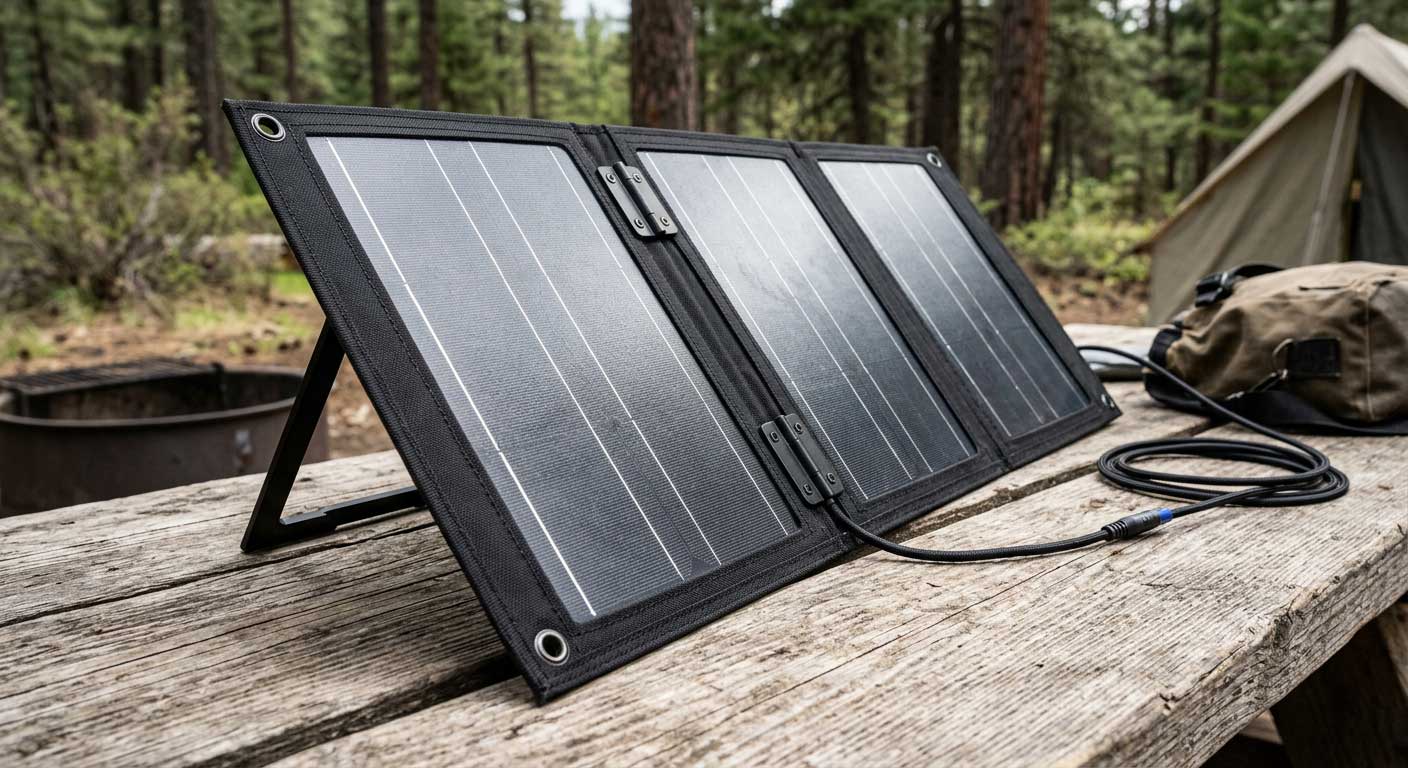
A good setup starts with the receiving equipment, not the sunlight. Before connecting cables, confirm the panel’s electrical ratings and the controller or power station’s solar input requirements.
Step 1 — Choose an Unshaded Location
Place the unfolded panel where it receives direct sunlight for as much of the day as practical. Look for shadows from trees, awnings, roof racks, or the vehicle itself.
Even a small shadow crossing part of the active surface can affect output, depending on the panel’s electrical design. Recheck the position as the sun moves rather than assuming a location that is bright at 9 a.m. will remain ideal at noon.
Step 2 — Position the Panel Toward the Sun
Use the built-in stand if supplied, and adjust the panel’s angle as practical. Avoid unstable rocks, steep slopes, and locations where wind could overturn the panel.
Solar resource changes with location, season, time of day, and the angle at which sunlight reaches the surface. These are established factors described by the U.S. Department of Energy’s Solar Radiation Basics.
Step 3 — Check Electrical Compatibility and Connect
Read the power station or controller manual. Follow its prescribed connection sequence, using compatible cables and connectors. Some controllers require the battery to be connected before the solar input; others may have different instructions.
Do not improvise connections based solely on the panel’s advertised wattage. If building a battery-based system, verify polarity, permitted voltage, current limits, and any required overcurrent protection.
Step 4 — Monitor Charging Performance
After connection, check the controller or power station display. Record the input watts, charging status, and accumulated energy over a few hours.
If the display shows less power than expected, first check shading, panel angle, loose connectors, battery charge limits, and the receiving device’s input ceiling. Low readings do not automatically mean the panel is defective.
Step 5 — Disconnect and Store Carefully
Follow the equipment manufacturer’s shutdown sequence. Allow the panel to cool if necessary, disconnect it safely, and remove dirt with a method approved for its surface.
Fold the panel without pinching cables or forcing the hinges. Store it dry and protect the cells and connectors from abrasion. Never fold a panel that the manufacturer requires to remain rigid, and never walk on a folding panel unless it is explicitly designed and rated for that purpose.
A Practical Energy-Planning Example for a Weekend Trip
Imagine a camper traveling for two nights with a 500Wh portable power station. The planned loads total 135Wh per day, or 270Wh over the weekend. This is an illustrative planning case, not a reported Bright Solar customer installation.
If the 120W panel delivers 384Wh of usable energy on a sunny day under the earlier assumptions, it could replenish more energy than the listed devices consume that day. But if the campsite is shaded and usable charging falls substantially, the balance changes. The traveler should therefore arrive with a charged battery and treat solar generation as a variable resource.
This example highlights an important selection principle: size the system around daily energy consumption, then account for weather and storage. Choosing a panel based only on its maximum wattage can produce unrealistic expectations.
For B2B buyers sourcing portable solar products, Bright Solar can help evaluate application requirements, product configurations, and customization possibilities. Confirm the available 120W model specifications, minimum order quantities, packaging options, and OEM/ODM terms directly with the manufacturer rather than assuming every configuration is available.
FAQ About a 120W Folding Solar Panel
How much electricity does a 120W folding solar panel produce per day?
Theoretical production is 360Wh with three equivalent peak sun hours or 600Wh with five. Actual output depends on sunlight, orientation, shading, temperature, and system losses.
Can a 120W folding solar panel charge a portable power station?
Yes, if the power station supports the panel’s voltage, current, connector, and solar input requirements. Check the manufacturer’s compatibility guidance before connecting the equipment.
Is a 120 watt foldable solar panel suitable for RV use?
Yes. It can supplement an RV battery or portable power station, particularly when roof space is limited. It is generally better suited to modest loads than continuous high-power appliances.
Can a 120W folding solar panel charge a 12V battery?
It can charge a compatible 12V battery through a suitable charge controller. Confirm the battery chemistry, charging profile, panel voltage, and controller specifications before use.
Does a 120W folding solar panel produce 120W all day?
No. The 120W rating represents nominal peak power under specified test conditions. Actual output changes throughout the day with sunlight intensity, panel temperature, orientation, and shading.
Is a folding solar panel waterproof?
Not necessarily. Weather resistance varies by model and component. Check the published protection rating and restrictions for the panel, connectors, junction box, and controller before exposing the system to rain.
What should I check before buying a 120W folding solar panel in bulk?
Confirm rated power, electrical parameters, folded dimensions, weight, cell technology, connector options, durability, warranty, sample availability, and order requirements. B2B buyers should also verify customization capabilities and request the applicable product datasheet.
Conclusion — Is a 120W Folding Solar Panel Right for You?
A 120w folding solar panel is a practical choice for portable charging, weekend camping, RV trips, and modest off-grid energy needs. Its real value depends on how much electricity your devices consume, how much sunlight you receive, and whether your battery or power station is electrically compatible.
Before selecting a model, compare verified specifications, estimate daily energy demand, and consider how the panel will be transported and stored. For product sourcing and customized portable solar solutions, contact Bright Solar to discuss your application and confirm available configurations.
Related recommendations
-

150 Watt Flexible Solar Panel: Lightweight Solar Power Solution for RV and Off-Grid Applications
135Discover the 150 watt flexible solar panel from Bright Solar for RV, marine, and off-grid applications. Learn efficiency, installation, output, and real-world uses.
View details -
500 watt flexible solar panel: High Power Flexible Solar Solution for RV, Marine and Off-Grid Applications
266Discover how a 500 watt flexible solar panel delivers high power output with lightweight design, durability, and versatile installation options for RVs, marine, and off-grid applications.
View details -
CIGS Flexible Solar Panels: Technology, Benefits and Applications
229CIGS flexible solar panels use thin-film photovoltaic technology on flexible substrates, supporting selected lightweight, curved, mobile, marine, RV, and off...
View details -
Best flexible solar panels for RV: A Complete Guide for Mobile Solar Power
269Discover the best flexible solar panels for RV use with expert selection tips, real installation experience, performance data, and Bright Solar insights.
View details