Flexible 12 Volt Solar Panels: A Practical Guide to RV, Marine and Off-Grid Power
Flexible 12 volt solar panels are designed for solar applications where a lightweight, low-profile module is useful, including selected RVs, campervans, boats, and off-grid systems. Choosing the right panel requires checking its actual voltage specifications, power rating, mounting limits, charge controller compatibility, and battery requirements.
The phrase “12 volt” can be confusing: it often describes the battery system a panel is intended to support, not the panel’s exact operating voltage. Understanding that distinction helps prevent mismatched components and disappointing system performance.
This guide explains how flexible 12V solar systems work, how to select and install suitable panels, and what to consider when planning a real project. It also outlines practical product-selection points for B2B buyers working with Bright Solar.
What Are Flexible 12 Volt Solar Panels?
Flexible 12 volt solar panels are photovoltaic modules with a thin, lightweight construction that can accommodate limited bending when the product is specifically designed for it. They are often considered for mobile applications where conventional Rigid Solar Panels and mounting frames may be difficult to accommodate.
These modules convert sunlight into direct-current (DC) electricity. Their output can be used to charge a compatible battery through suitable power-control equipment or supply other compatible DC loads.
However, a flexible panel is not automatically a complete 12V power system. The panel, controller, battery, wiring, and connected equipment must all be compatible.
Why “12 Volt” Does Not Necessarily Mean 12V Output
In solar product descriptions, “12V panel” commonly refers to the nominal battery-system category. The panel’s actual operating voltage may be higher than 12 volts so that it can charge a battery through an appropriate controller.
For this reason, buyers should not select a module based only on its product name.
Check the datasheet for:
- Vmp: Voltage at maximum power.
- Imp: Current at maximum power.
- Voc: Open-circuit voltage.
- Isc: Short-circuit current.
- Pmax: Rated maximum power.
These values help determine whether the module can work with the intended charge controller and battery configuration.
A 12V battery also does not remain at exactly 12 volts throughout charging and discharging. Its voltage changes with battery chemistry, state of charge, load, and charging conditions. The system must be designed around the battery manufacturer’s requirements rather than a nominal label alone.
How Flexible Solar Panels Generate Electricity
Flexible modules use photovoltaic cells to convert sunlight into electricity. The U.S. Department of Energy explains that photovoltaic technology uses semiconductor materials to generate electrical current when exposed to light. The cells are assembled into modules that provide useful electrical output.
The exact construction varies by product, but a flexible module may include:
- Photovoltaic cells.
- Protective encapsulation.
- A front surface designed to admit sunlight.
- A supporting back layer.
- Electrical connections and output cables.
Cell technology, protective materials, module efficiency, and mechanical limits are product-specific. A buyer should confirm these details from the actual manufacturer’s documentation.
Benefits of Flexible 12 Volt Solar Panels
Lightweight Construction for RVs and Campervans
Weight is an important consideration for recreational vehicles. Solar panels are only part of the total installation load; mounting materials, wiring, controllers, batteries, and other equipment add to it.
A lightweight flexible module may help reduce the weight associated with the panel portion of a project. It can also be useful where the roof profile or available mounting space makes a framed module difficult to fit.
Before choosing one, compare the complete installed system weight and confirm that the roof can support the proposed arrangement.
Low-Profile Installation on Suitable Surfaces
Some flexible modules can conform to gently curved surfaces within their specified bending limits. This can be useful on selected campervan roofs, boat surfaces, and other applications where the mounting area is not perfectly flat.
Flexibility has limits, though.
A panel should not be folded, twisted, sharply bent, or forced against a surface that exceeds its permitted curvature. Mechanical stress can damage cells, connections, or protective layers even when the damage is not immediately visible.
Options for Space-Constrained Projects
RV and marine roofs often have vents, hatches, antennas, and other equipment that interrupt the usable area.
A low-profile panel may provide another way to use an appropriate section of the surface. The practical benefit depends on the dimensions and shape of the module, shading, mounting requirements, and the surrounding equipment.
Field-planning insight: Measure the usable area after marking every obstruction and maintenance-access zone. Measuring the roof’s outside dimensions alone can overstate how much solar capacity can realistically be installed.
Adaptability for B2B Solar Applications
For distributors, vehicle converters, marine suppliers, and system integrators, module selection often involves more than choosing a standard wattage.
Project specifications may include:
- Panel dimensions and available roof area.
- Cell technology and electrical characteristics.
- Permitted bending and mounting conditions.
- Cable and connector configuration.
- Environmental exposure.
- Documentation and quality requirements.
- OEM or ODM customization needs.
Bright Solar supplies flexible solar panel solutions for B2B applications. Buyers should confirm current product availability, customization scope, and technical specifications directly with the manufacturer.

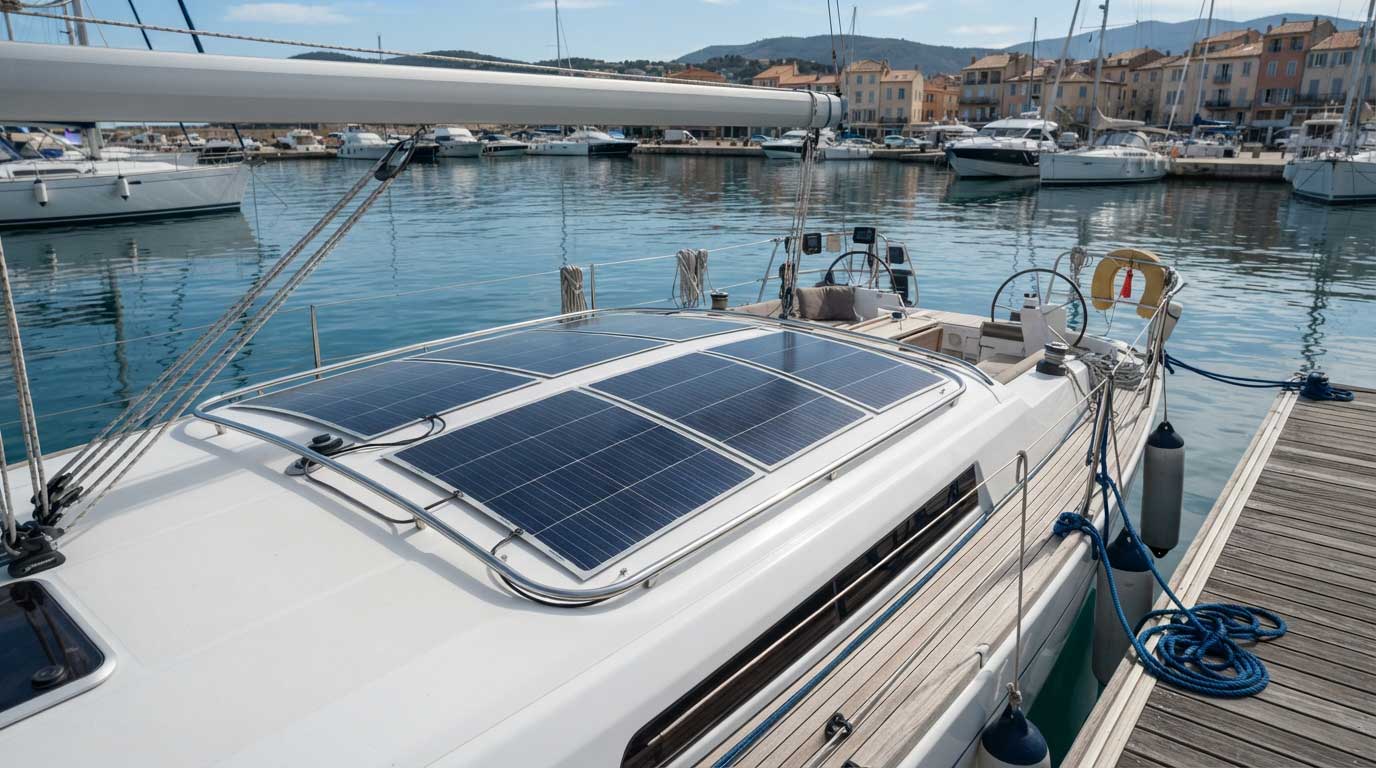
Flexible 12 Volt Solar Panels for Boats and Marine Use
Marine applications can benefit from low-profile solar modules when available mounting space is limited. However, boats expose equipment to conditions that should be considered before selecting a panel.
Potential environmental factors include:
- Salt spray and moisture.
- Vibration and movement.
- Direct sunlight and elevated temperatures.
- Limited airflow around low-profile installations.
- Foot traffic or impact in certain areas.
- Cable routing near moving or exposed equipment.
A flexible panel should only be used in a marine application when its product documentation supports the intended environment. Do not assume that all flexible modules are salt-water resistant, walkable, or suitable for permanent outdoor marine exposure.
Marine Installation Checks
Before installation, confirm the panel’s environmental specifications and mounting instructions. Check whether the surface is suitable for the selected mounting method, whether water can drain properly, and whether cables and connectors can be protected from exposure.
For a boat with a 12V battery system, verify that the panel and charge controller are compatible with the battery’s charging requirements. The nominal battery voltage alone is not enough to determine the correct module.
How to Size a 12V Solar Panel System
Sizing should begin with the equipment that needs power, not with the panel wattage.
List each load, its power consumption, and the expected operating time. Then estimate daily energy use.
Basic calculation:
Daily energy consumption (Wh) = appliance power (W) × operating time (hours)
For several appliances, calculate each load separately and add the results.
Illustrative 12V System Calculation
Imagine a campervan with the following estimated daily loads:
| Equipment | Assumed power | Assumed daily use | Estimated energy |
|---|---|---|---|
| LED lighting | 10W | 4 hours | 40Wh |
| Device charging | 15W | 3 hours | 45Wh |
| Ventilation fan | 20W | 5 hours | 100Wh |
| Other small DC loads | 25W | 2 hours | 50Wh |
| Total | 235Wh/day |
These are hypothetical planning figures, not measured consumption data or a recommended configuration for every campervan.
If a 100W panel were to operate at its rated output for an equivalent five hours, the simple estimate would be:
100W × 5 hours = 500Wh.
That figure is before system losses and assumes five equivalent full-power hours. Real production varies with sunlight, temperature, shading, orientation, and installation conditions.
The National Renewable Energy Laboratory’s PVWatts model includes loss categories such as soiling, shading, wiring, connections, mismatch, and availability. Its default assumptions are modeling inputs, not guaranteed losses for an individual mobile system.
This example suggests why a load calculation is useful: it provides a starting point for deciding whether a proposed array might meet the energy requirement. It does not replace a location-specific production estimate or battery and controller design.
Battery and Charge Controller Compatibility
A solar charge controller regulates the energy delivered from the panel array to the battery. Its type and ratings must match the panel configuration and battery requirements.
Before purchasing components, check:
- The battery chemistry and manufacturer’s charging limits.
- The controller’s supported battery voltages.
- Maximum PV input voltage.
- Maximum PV input current or power, as applicable.
- The array’s Vmp, Voc, Imp, and Isc.
- Any temperature-related voltage increase that affects the controller’s limits.
A nominal 12V battery system may use a solar panel whose operating voltage is higher than 12V. This is one reason to check the datasheet rather than relying on the product name.
Installation Steps for Flexible 12 Volt Solar Panels
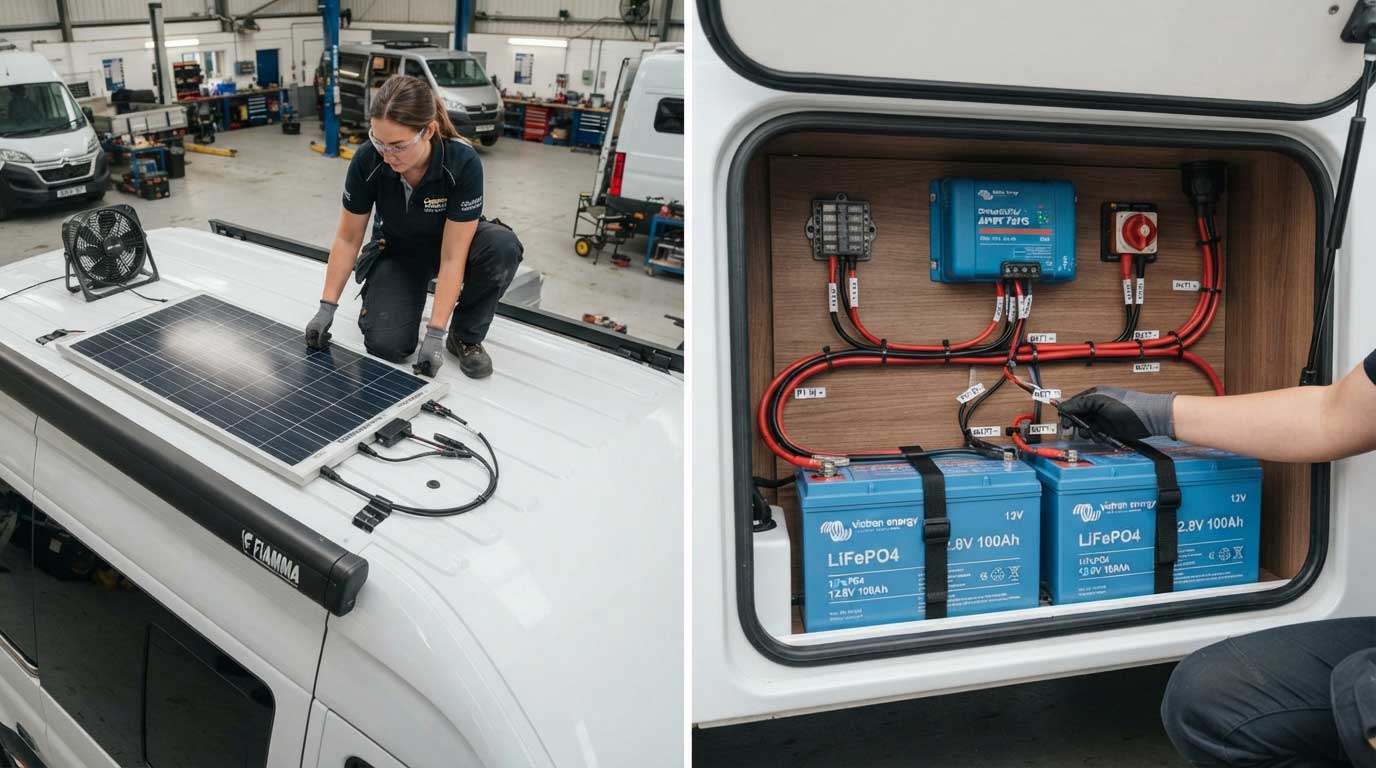
Installation details vary by module and mounting surface. Follow the manufacturer’s instructions and use a qualified installer when required.
Step 1 — Inspect and Measure
Inspect the roof or mounting surface for damage, loose coatings, obstructions, and unsuitable areas. Measure the usable area and check the panel’s dimensions and bending limits.
Step 2 — Confirm the Mounting Method
Use only a mounting method approved for the panel and compatible with the surface material. Confirm adhesive compatibility or mechanical fixing requirements before installation.
Do not force the panel to fit a curve outside its specified limits.
Step 3 — Plan Cable Routing
Choose a route that protects cables from abrasion, heat, water exposure, and moving components. Keep connectors accessible for inspection and ensure the installation does not compromise the vehicle or vessel’s weatherproofing.
Step 4 — Connect and Verify
Check polarity and electrical ratings before connecting the panel to the controller. Confirm that the array voltage and current remain within the controller’s limits and that the battery settings match its manufacturer’s requirements.
After installation, inspect the mounting, wiring, connectors, and controller readings. Record the configuration and baseline measurements for future maintenance.
Common Mistakes When Buying Flexible 12 Volt Solar Panels
Selecting by Nominal Voltage Alone
A “12V” label does not provide enough information to confirm compatibility. Compare the panel’s electrical specifications with the controller and battery requirements.
Assuming Flexible Means Foldable
Flexible modules have mechanical limits. Bending, folding, or twisting a panel beyond its approved range can damage the cells or connections.
Ignoring Heat and Shading
Higher cell temperatures can reduce photovoltaic voltage and performance. Shading and other system losses can also affect energy production. The U.S. Department of Energy identifies temperature as an important factor in PV performance, while NREL’s modeling guidance includes shading and soiling among its system-loss categories.
Forgetting the Rest of the System
A panel alone does not provide a complete battery-charging solution. Include the controller, battery, wiring, protection, and any inverter required by the loads.
FAQ About Flexible 12 volt solar panels
Are flexible 12 volt solar panels suitable for RVs?
Yes. They can be suitable for selected RVs and campervans when the panel’s dimensions, permitted curvature, mounting requirements, and electrical characteristics match the installation. Check roof condition, shading, and ventilation before choosing a module.
Does a 12V solar panel produce exactly 12 volts?
Not necessarily. “12V” commonly identifies the nominal battery-system category. The panel’s actual operating voltage and open-circuit voltage are specified separately in its datasheet.
Can I connect a flexible solar panel directly to a 12V battery?
A panel should not be connected directly to a battery unless the system and product instructions explicitly allow that arrangement. A compatible charge controller is commonly used to regulate charging and protect the battery according to its requirements.
How much energy can a 100W flexible solar panel generate?
There is no universal daily output. For illustration, 100W operating at rated power for five equivalent full-power hours represents 500Wh before losses. Actual generation depends on sunlight, temperature, shading, orientation, and system design.
Can flexible 12V solar panels be connected in series or parallel?
They can be connected in series or parallel when the modules and system components are compatible. Series connections increase voltage; parallel connections increase current. Check controller limits, module ratings, and the manufacturer’s wiring guidance before connecting panels.
Are flexible 12V solar panels suitable for boats?
Some are suitable for selected marine applications, but suitability depends on the product’s environmental ratings, mounting method, surface conditions, and electrical design. Salt-water resistance, walkability, and waterproofing should never be assumed without product documentation.
What should B2B buyers check before ordering?
Review rated power, Vmp, Imp, Voc, Isc, dimensions, weight, cell technology, bending limits, connectors, mounting instructions, and environmental ratings. For OEM or ODM requirements, confirm available customization, order quantities, quality documentation, and production specifications directly with the manufacturer.
Choosing Flexible 12 Volt Solar Panels From Bright Solar
For RV, marine, and off-grid projects, the selection process should start with the installation surface and the electrical system. A panel’s nominal voltage or rated wattage cannot establish suitability on its own.
Bright Solar provides flexible solar panel solutions for B2B applications. Distributors, vehicle converters, marine suppliers, and system integrators should prepare the following information when evaluating a project:
- Intended application and operating environment.
- Available installation dimensions and surface curvature.
- Required rated power and electrical configuration.
- Battery type and charge-controller requirements.
- Mounting method and environmental exposure.
- Customization, documentation, and order requirements.
Confirm the product’s current specifications and available configurations with Bright Solar before finalizing a design or placing an order.
Flexible 12 volt solar panels can be a practical option for suitable mobile and off-grid installations when their mechanical limits, electrical ratings, and mounting conditions are respected. Careful system planning helps buyers assess whether a particular module fits the real requirements of the project.
Related recommendations
-

Disadvantages of Flexible Solar Panels: What to Know Before Buying
177Flexible solar panels can have limitations in heat management, physical protection, bending, installation, repair, cost, and service life. Product-specific c...
View details -
Solar Panel Foldable 100W: Output, Uses and Buying Guide
46A 100W foldable solar panel provides portable electricity for camping, RV travel, and small off-grid needs. Its actual energy output depends on sunlight, ori...
View details -
12 Volt Solar Panels for Reliable Off-Grid and Mobile Power
218Discover how 12 volt solar panels power RVs, boats, cabins, and off-grid systems. Learn sizing, performance, installation tips, and expert insights from Bright Solar.
View details -
Best Semi Flexible Solar Panel: How to Choose the Right One
180The best semi-flexible solar panel matches the surface curvature, power needs, weight, electrical ratings, and installation environment.
View details