100W Flexible Solar Panel – RV & Off-Grid
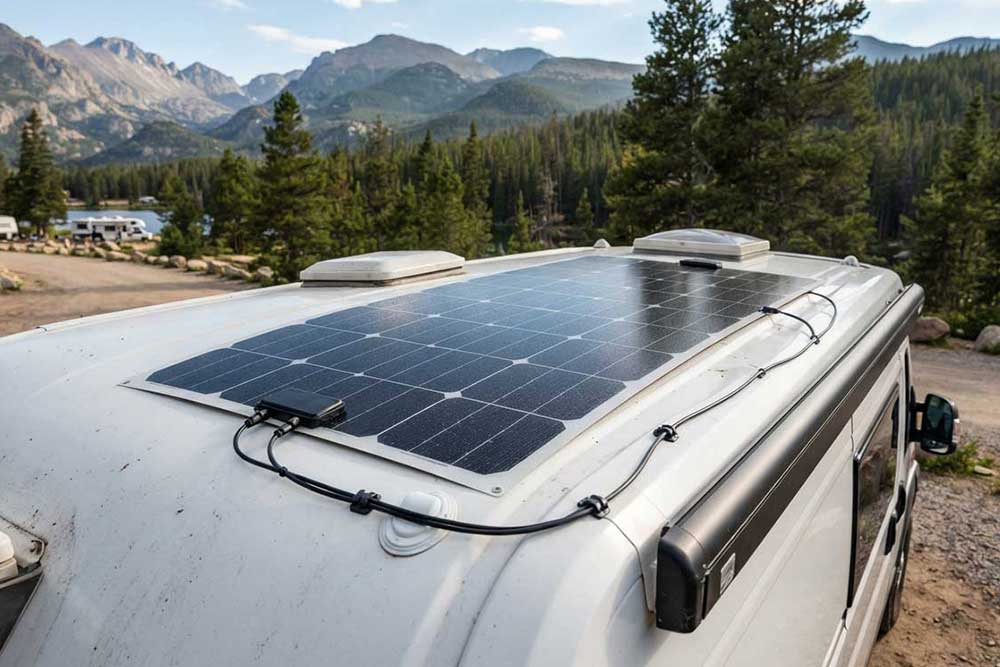
Bright Solar’s 100W flexible solar panel is designed for applications where low weight, flexible installation, and efficient use of available surface area matter. The L Series 100W model, BS100-FT-M(E), delivers 100W nominal peak power, uses 166 × 166 mm monocrystalline cells, weighs about 1.8 kg, and is only 2.8 mm thick. Its flexible polymer-based construction is suited to RV roofs, camper vans, marine applications, and off-grid systems where conventional rigid panels may be difficult to install.
100W Flexible Solar Panel Specifications
The following specifications are based on Bright Solar’s published L Series product data. The 100W L Series model is BS100-FT-M(E). Bright Solar also lists a 100W SunPower-cell version, BS100-FT-S(E), with different dimensions and electrical characteristics, so buyers should confirm the exact model before ordering.
| Specification | BS100-FT-M(E) |
|---|---|
| Rated Power | 100W |
| Maximum Power Voltage (Vmp) | 20V |
| Maximum Power Current (Imp) | 5.00A |
| Open Circuit Voltage (Voc) | 25V |
| Short Circuit Current (Isc) | 5.32A |
| Solar Cell Type | 166 × 166 mm Mono |
| Module Efficiency | 22.5%–25.8% |
| Dimensions | 1072 × 532 × 2.8 mm |
| Weight | 1.8 kg |
| Maximum Bending Radius | Not publicly specified |
| Operating Temperature | Not publicly specified |
| Connector | Optional MC4 connectors or 2-core cable |
| IP Rating | Not publicly specified |
| Maximum System Voltage | 150–300 VDC |
| Power Tolerance | 0 to +3% |
| Warranty | Contact Bright Solar |
Bright Solar states that the L Series supports customized sizes and optional PV cable configurations. Because the L Series contains multiple 100W configurations, the electrical values, dimensions, and construction should be confirmed against the final model quotation before production.
Key Features of the 100W Flexible Solar Panel
100W Power Output
A 100W rating means the module has a nominal peak power of 100 watts under its specified test conditions. For a small solar installation, this provides a practical amount of generation capacity without requiring the roof or mounting area of a larger module.
A single 100W panel can be used as part of a small 12V-class off-grid system or combined with additional modules when more power is required. Bright Solar’s L Series can be configured in series or parallel according to the voltage and power requirements of the system.
The actual electrical output will depend on sunlight, module temperature, shading, orientation, system wiring, and the charge controller or other connected equipment.
Flexible and Lightweight Design
The BS100-FT-M(E) weighs approximately 1.8 kg and measures only 2.8 mm thick. This is useful for mobile applications where roof weight and installation space are important considerations.
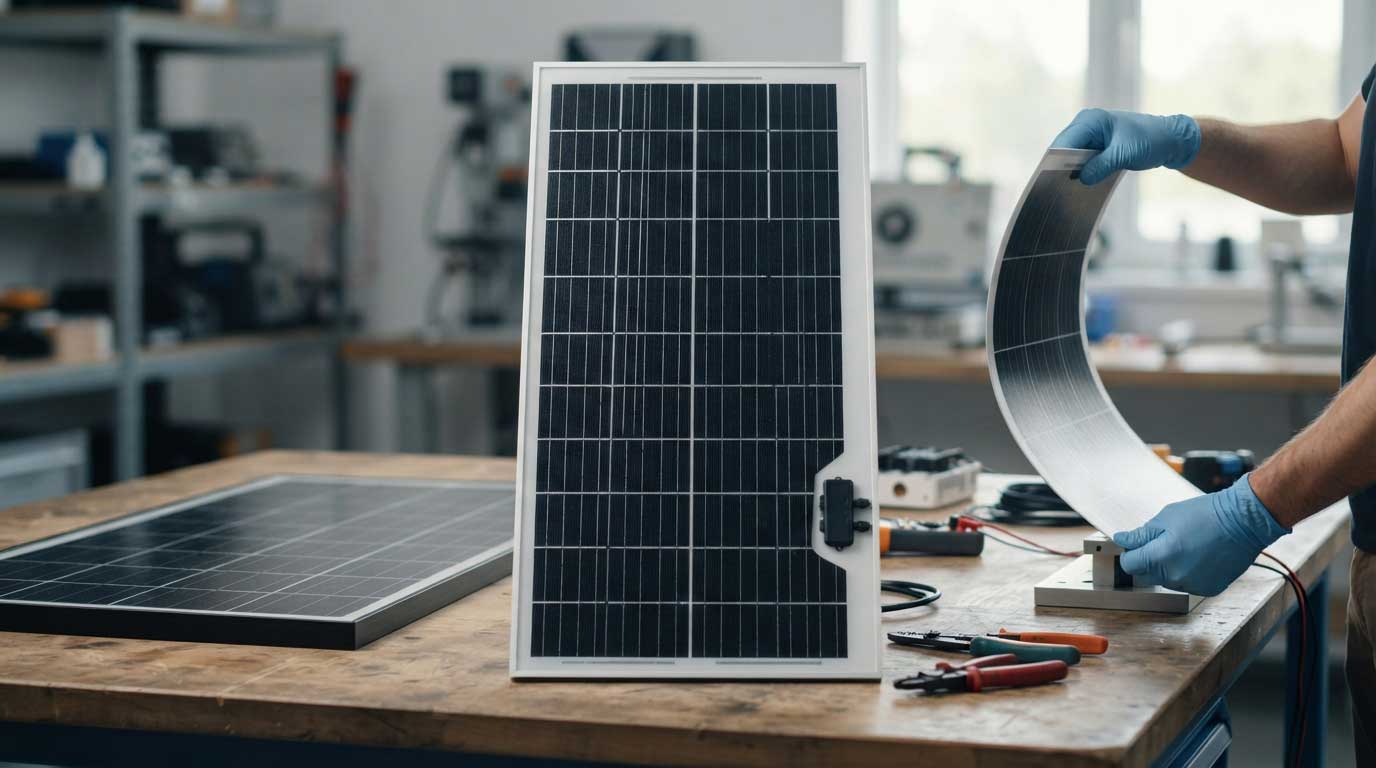
Bright Solar states that the L Series uses polymer substrates and can provide flexibility of up to 30%. The construction is intended to accommodate curved, uneven, or irregular mounting surfaces while reducing the need for bulky mounting hardware.
The lightweight structure is particularly relevant to RVs, camper vans, boats, and other mobile installations. Instead of treating flexibility as a replacement for every rigid panel, it is better understood as an installation advantage when the available surface is curved, weight-sensitive, or difficult to access.
Easy to Install
The L Series is designed for relatively simple installation. Bright Solar states that the panels can typically be installed without drilling by using industrial adhesive or VHB tape, depending on the application and installation requirements.
A typical installation involves:
- Choosing a clean, suitable mounting surface.
- Positioning the panel to maximize sunlight exposure.
- Following the selected adhesive or mounting method correctly.
- Routing and securing the PV cables.
- Connecting the panel to the appropriate charge controller.
- Checking voltage and system operation before normal use.
The mounting method should always match the surface material, environmental conditions, expected vibration, and manufacturer’s installation recommendations.
Durable for Outdoor Applications
The L Series uses a multi-layer composite structure with reinforced encapsulation. Bright Solar describes the construction as resistant to mechanical stress, shock, vibration, rain, dust, UV exposure, and changing outdoor conditions.
The product page also describes anti-soil ETFE surface treatment and corrosion-resistant materials. Its reinforced composite construction is intended to reduce mechanical stress on the cells during movement and vibration.
For RV applications, this matters because the panel may experience road vibration, chassis movement, and repeated changes in outdoor conditions. Bright Solar states that the L Series has passed shock and vibration tests and uses a crack-resistant structure designed to reduce cell-cracking risks.
The published product information does not specify an IP rating for the complete 100W BS100-FT-M(E) module, so an IP67 or IP68 claim should not be assigned to this product without confirming the exact configuration and test documentation.
How Does a 100W Flexible Solar Panel Work?
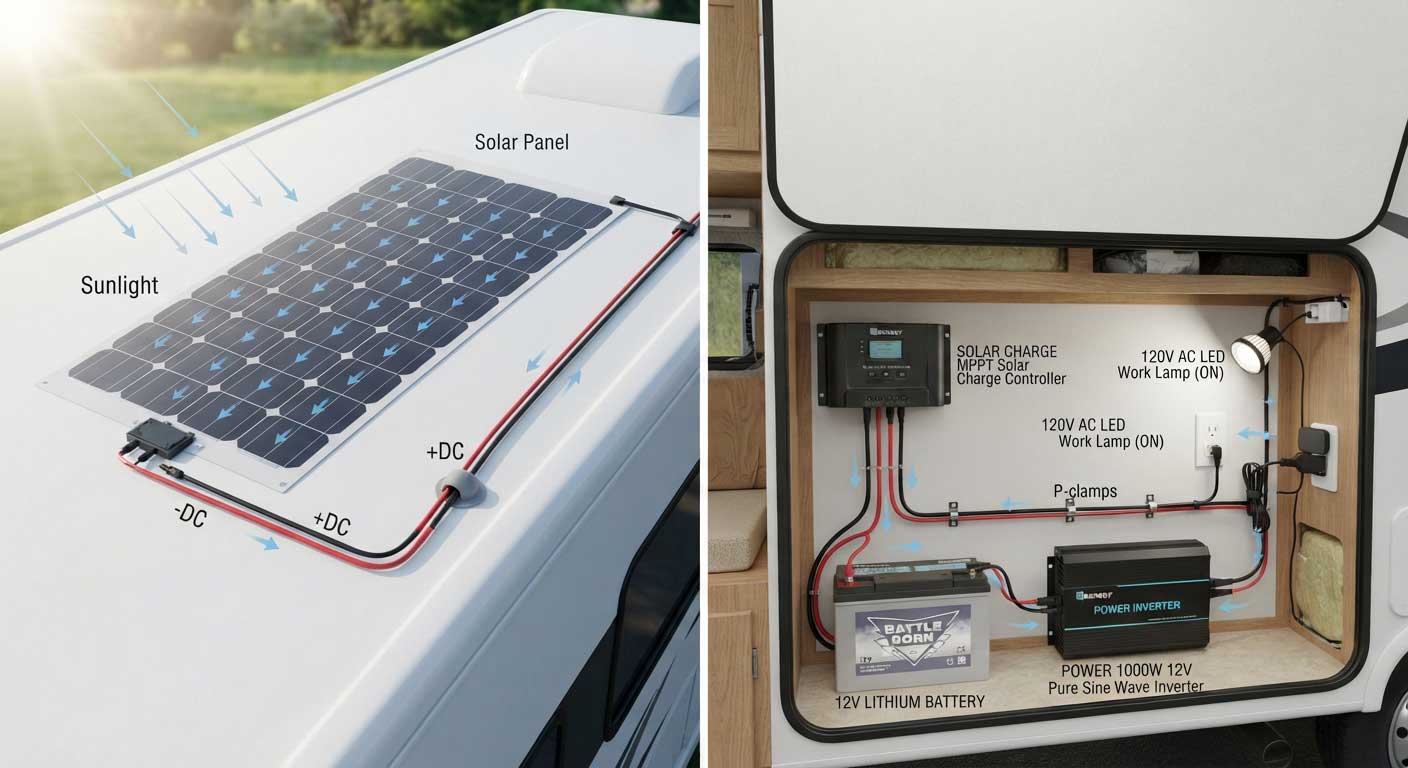
A 100W flexible solar panel converts sunlight into DC electricity through photovoltaic cells. In a typical off-grid installation, the energy path is:
Sunlight → Solar Cells → DC Electricity → Charge Controller → Battery / Inverter
The 100W rating represents the module’s nominal peak power under standard test conditions; it does not mean the panel will continuously produce 100W outdoors. Solar irradiance, temperature, shading, orientation, and electrical losses all affect actual output.
NREL’s PVWatts model accounts for irradiance and operating cell temperature when estimating PV output, while the U.S. Department of Energy explains that higher temperatures generally reduce photovoltaic voltage and therefore affect power production.
This is why a flexible photovoltaic panel should be evaluated as part of the complete solar system rather than by its nameplate wattage alone.
Applications of 100W Flexible Solar Panel
A 100W flexible solar panel is most useful when the installation requires moderate power capacity together with low weight or adaptable mounting.
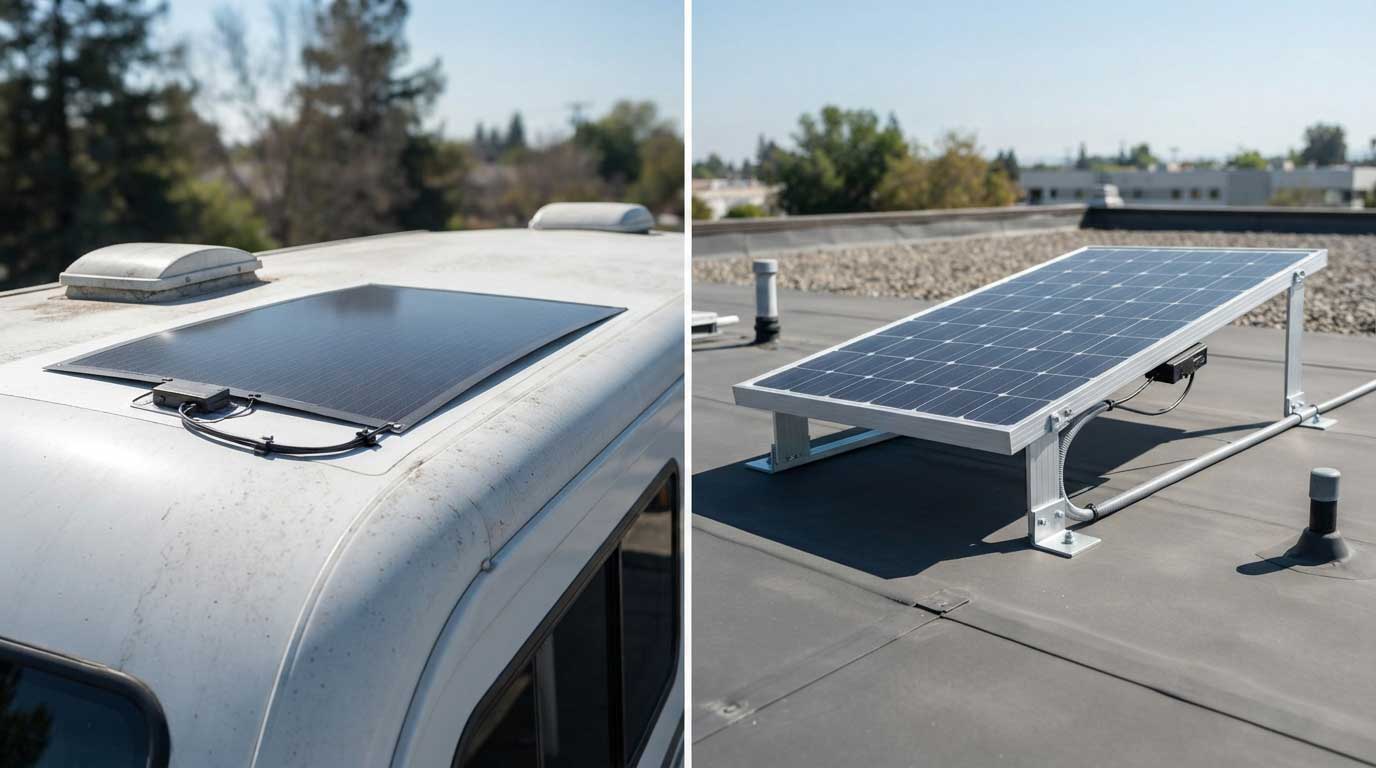
RV and Camper
100W flexible solar panel for RV
The L Series is particularly suited to RVs and camper vans because its 1.8 kg weight and 2.8 mm thickness reduce roof loading. Its flexible structure can also accommodate curved or irregular roof areas.

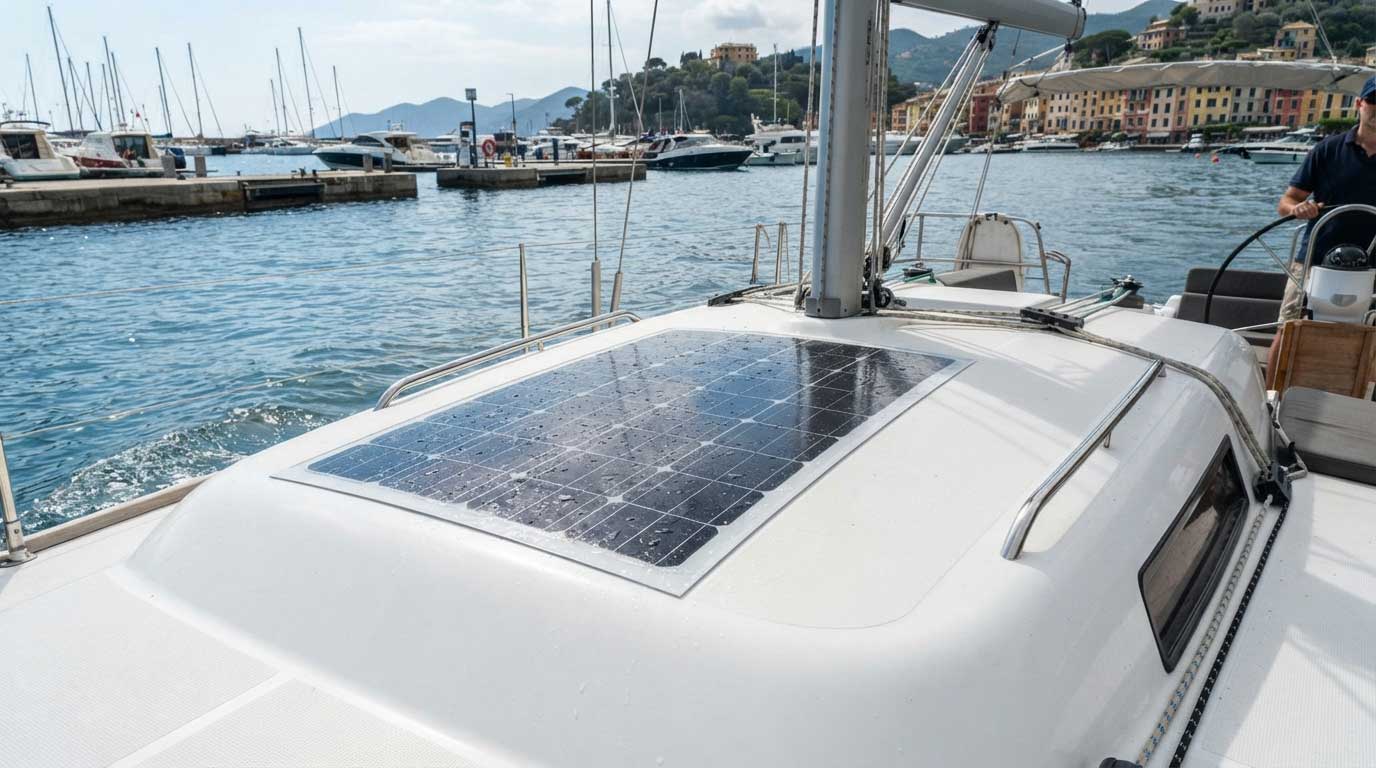
Marine and Boat
100W flexible solar panel for boat
A flexible panel can make better use of limited deck or cabin-top space where a framed rigid module may be difficult to position. For marine projects, the exact product construction and environmental requirements should be confirmed before installation.
Off-Grid Solar Systems
100W flexible solar panel for off-grid
A 100W module can serve as a building block in a small off-grid system. Multiple panels can be connected to increase system capacity, provided the voltage, current, charge controller, battery, and wiring are properly matched.
Camping and Outdoor Power
100W flexible solar panel for camping
A 100W panel can support small outdoor power systems where portability and easy handling matter. It can be paired with a suitable battery or portable power system to store energy for use when sunlight is unavailable.
Remote and Mobile Applications
The lightweight construction can also be useful for remote monitoring equipment, mobile workspaces, temporary power installations, and other applications where mounting weight or surface geometry limits the use of conventional framed modules.
100W Flexible Solar Panel vs. Rigid Solar Panel
Neither panel type is universally better. The appropriate choice depends on the installation surface, weight restrictions, mounting method, environmental conditions, and system design.
| Feature | 100W Flexible Solar Panel | 100W Rigid Solar Panel |
|---|---|---|
| Flexibility | Designed for curved and irregular surfaces | Generally designed for flat mounting |
| Weight | Typically lower for flexible constructions | Usually heavier because of glass and frame construction |
| Installation | Can use adhesive-based installation depending on product | Commonly uses brackets, rails, or other mounting hardware |
| Mounting Surface | Suitable for some curved, uneven, or irregular surfaces | Best suited to stable, flat mounting structures |
| Portability | Easier to handle where low weight is important | More rigid and less convenient for irregular mobile installations |
| Typical Applications | RVs, camper vans, boats, off-grid and mobile systems | Residential roofs, ground mounts, fixed solar installations |
A Flexible Solar Panel is generally more suitable when weight, installation space, or curved surfaces are important. A Rigid Solar Panel is often the more practical choice for fixed installations with suitable mounting structures. The decision should be based on the actual installation rather than assuming one construction is always superior.
How Much Power Can a 100W Flexible Solar Panel Produce?
A 100W flexible solar panel has a nominal peak output of 100 watts under standard test conditions. In real outdoor use, instantaneous output can be lower because sunlight intensity, temperature, shading, orientation, and system losses change throughout the day.
For example, the BS100-FT-M(E) has a published Vmp of 20V and Imp of 5.00A:
20V × 5.00A = 100W
This calculation explains the relationship between the panel’s rated voltage, current, and nominal peak power.
However, 100W should not be interpreted as 100W of continuous daily output. The U.S. Department of Energy notes that PV performance is affected by factors including temperature, while NREL’s PVWatts methodology calculates DC output using incident irradiance and cell temperature.
For this reason, 100W flexible solar panel output should be evaluated using the complete installation conditions rather than the 100W nameplate figure alone.
How to Install a 100W Flexible Solar Panel
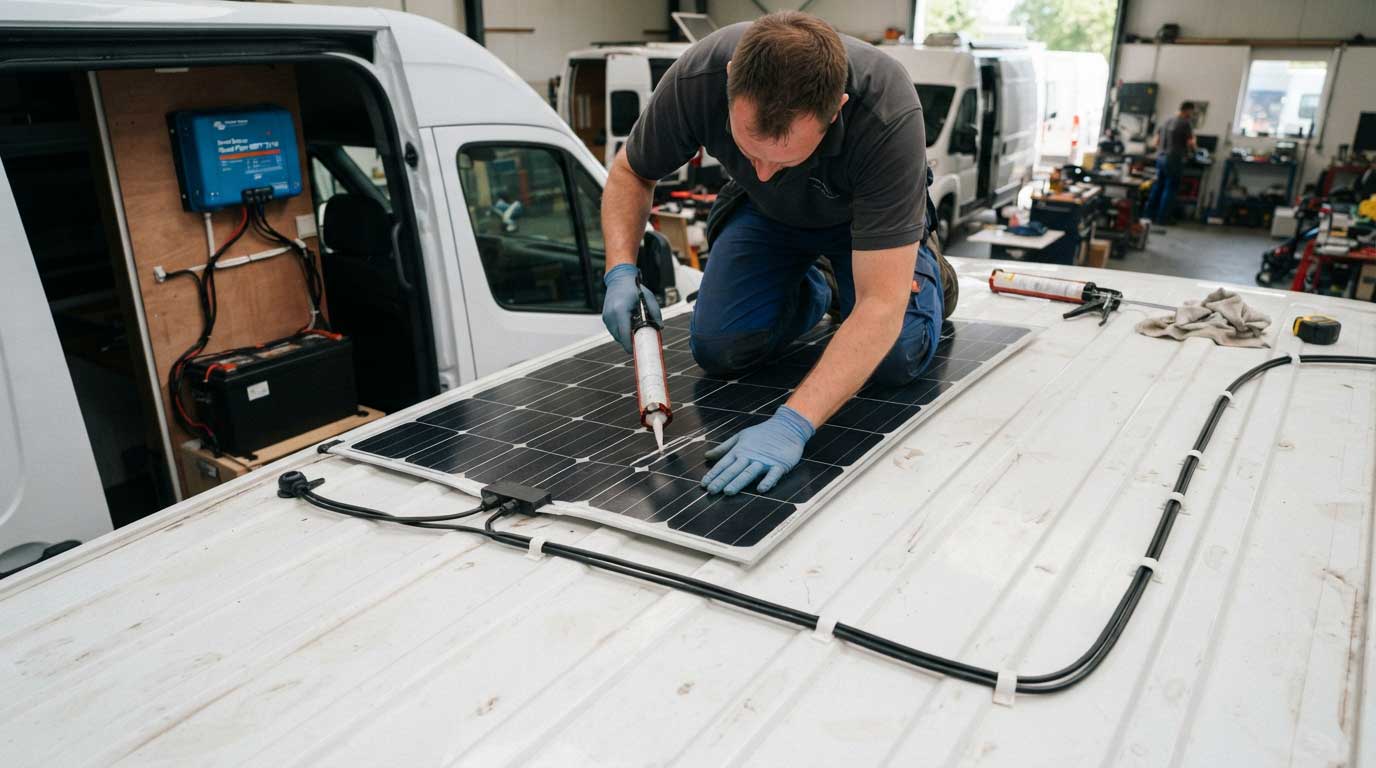
Installation should follow the exact mounting instructions for the selected Bright Solar configuration and the requirements of the installation surface.
1. Choose a Suitable Surface
Select a structurally suitable surface with sufficient exposure to sunlight. Remove dirt, oil, dust, and other contaminants before applying an adhesive-based mounting method.
2. Position the Panel
Place the panel where it can receive as much unobstructed sunlight as practical. Avoid locations where vents, roof equipment, rails, or other objects create persistent shading.
3. Secure the Panel
For the L Series, Bright Solar states that installation can typically be completed without drilling by using industrial adhesives or VHB tape. The adhesive system should be selected according to the mounting surface and environmental conditions.
Do not exceed the product’s specified flexibility. A maximum bending radius should not be assumed from the general statement that the L Series can bend up to 30%; the exact mechanical installation limit should be confirmed for the selected model.
4. Connect the Cables
Use the specified PV cable and connector configuration. Bright Solar lists optional MC4 connectors and cable configurations for the L Series.
Check polarity before connecting the panel to the rest of the system.
5. Connect the Charge Controller
Connect the panel to a compatible solar charge controller before connecting the controller to the battery according to the controller manufacturer’s installation procedure.
For a 12V-class battery system, the controller must be selected based on the panel’s voltage/current characteristics and the battery chemistry and charging requirements.
6. Check System Output
After installation, check the panel voltage, polarity, charge-controller status, and battery charging behavior. If the measured output is significantly lower than expected, inspect shading, cable connections, surface temperature, orientation, and other system losses before assuming the panel is defective.
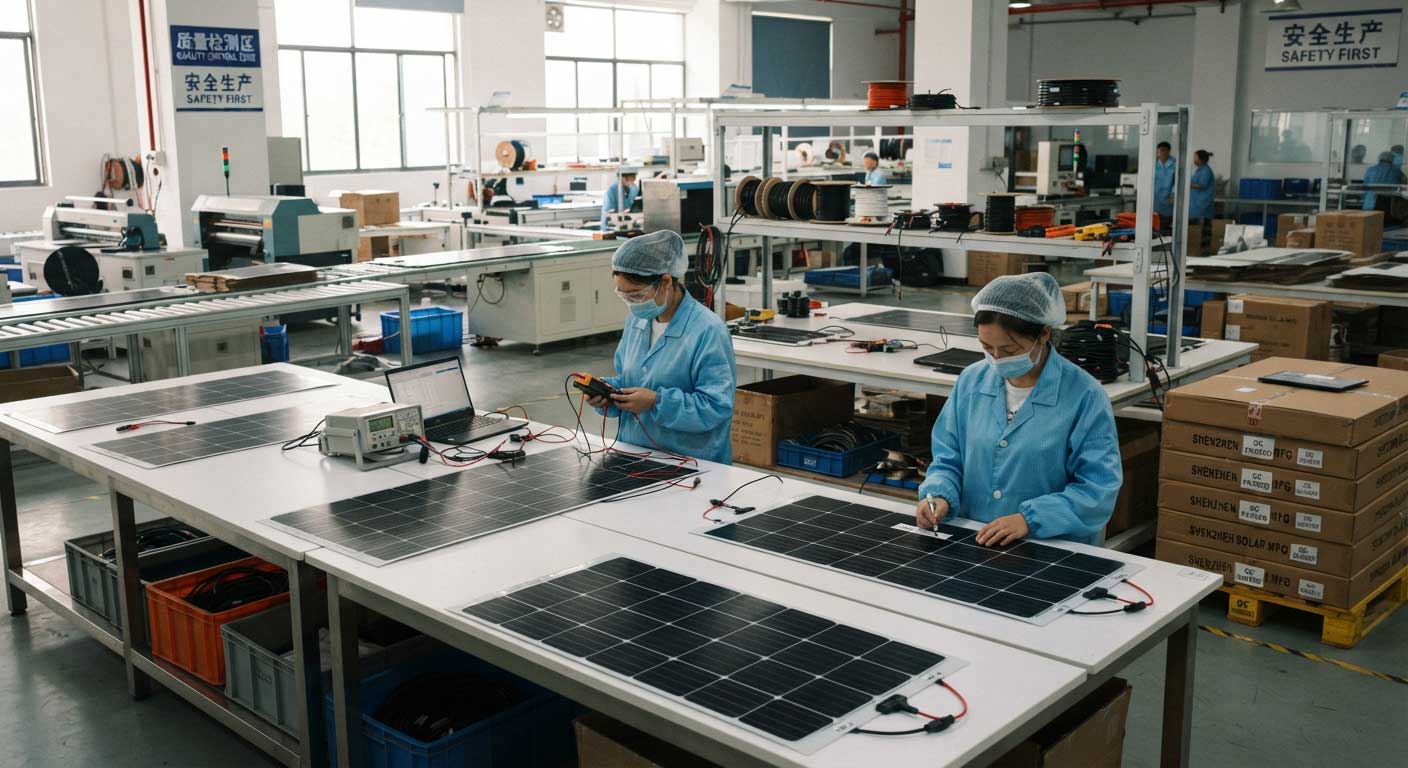
Why Choose Bright Solar 100W Flexible Solar Panel?
Bright Solar approaches the 100W flexible panel as part of a broader flexible and off-grid solar product range rather than as a one-size-fits-all module.
The L Series provides several capabilities relevant to OEM buyers, installers, and system integrators:
- Product quality: The L Series uses multi-layer composite encapsulation, polymer substrates, and reinforced construction.
- Manufacturing capability: Bright Solar offers multiple flexible panel power levels and configurations.
- Quality control: Published product data includes electrical characteristics, dimensions, weight, efficiency, power tolerance, and system voltage information.
- Customization: Bright Solar states that custom sizes are supported.
- OEM/ODM support: Customization capabilities can be discussed according to the required project specification.
- Bulk orders: Buyers can discuss production quantities and project requirements directly with Bright Solar.
- Cable and connector options: The L Series lists optional PV cable and MC4 connector configurations.
- Technical support: Product selection should be based on the intended application, electrical system, mounting surface, and environmental requirements.
Rather than describing one flexible solar panel as the best choice for every project, Bright Solar can help buyers match the panel construction and electrical configuration to the actual application.
100W Flexible Solar Panel for OEM & Wholesale
For distributors, system integrators, RV manufacturers, marine equipment suppliers, and other B2B buyers, the 100W flexible panel can be specified according to the requirements of the final system.
Bright Solar’s L Series product page confirms support for custom sizes and optional cable/connector configurations.
Potential OEM and wholesale requirements include:
- Custom panel dimensions
- Electrical specification adjustments
- Cable configuration
- Connector configuration
- Product color
- Logo requirements
- Packaging requirements
- Sample orders
- Bulk production
- Project-specific technical requirements
MOQ, custom branding conditions, lead time, packaging options, and other commercial terms should be confirmed with Bright Solar for the specific order rather than presented as fixed standard terms.
FAQ About 100W flexible solar panel
What is a 100W flexible solar panel?
A 100W flexible solar panel is a photovoltaic module with a nominal peak power rating of 100 watts and a flexible construction designed for applications where conventional rigid panels may be difficult to install. Bright Solar’s BS100-FT-M(E) is a 100W L Series model.
How much power does a 100W flexible solar panel produce?
It is rated for 100W of peak power under specified test conditions. Actual outdoor output varies with solar irradiance, temperature, shading, orientation, and system losses, so 100W should not be treated as continuous real-world output.
Can a 100W flexible solar panel charge a 12V battery?
Yes, a suitable 100W flexible panel can be used in a 12V-class battery system when paired with a compatible solar charge controller. The controller, battery type, wiring, and panel electrical characteristics must be correctly matched.
Can a 100W flexible solar panel be used on an RV?
Yes. Bright Solar’s L Series is specifically designed for RV and mobile off-grid applications. The BS100-FT-M(E) weighs about 1.8 kg and is 2.8 mm thick, while its flexible construction can accommodate some curved or irregular surfaces.
Can a flexible solar panel be installed on a curved surface?
Yes, when the selected panel is designed for curved installation and the surface remains within its specified mechanical limits. Bright Solar states that the L Series can provide flexibility of up to 30%. This should not be interpreted as a specific bending radius; the mechanical limit for the exact installation should be confirmed before mounting.
How do you install a flexible solar panel?
The Bright Solar L Series can typically be installed without drilling by using industrial adhesive or VHB tape, depending on the installation. The surface should be clean and suitable, the panel positioned for good sunlight exposure, and the cables connected to a compatible charge controller.
How long does a flexible solar panel last?
Service life depends on cell technology, encapsulation, temperature, mechanical stress, installation quality, and outdoor exposure. Bright Solar’s L Series uses reinforced composite encapsulation and a crack-resistant structure designed to withstand mechanical stress, shock, and vibration. A specific service-life figure should not be assumed unless it is provided in the product documentation.
What is the difference between a flexible and rigid solar panel?
Flexible solar panels prioritize low weight and installation adaptability, making them useful for curved or mobile applications. Rigid panels generally provide a more conventional framed construction suited to fixed mounting. Neither type is universally better; the correct choice depends on the installation and system requirements.
Conclusion
A 100W flexible solar panel is a practical option when a solar system needs moderate power capacity without the weight and rigid mounting requirements of a conventional framed module. Bright Solar’s BS100-FT-M(E) combines 100W nominal peak power with a 1.8 kg, 2.8 mm-thick flexible construction, making it suitable for RVs, camper vans, marine applications, and small off-grid systems where installation flexibility matters.
For OEM and wholesale projects, the more important question is not simply whether 100W is enough, but whether the panel’s electrical characteristics, dimensions, mounting method, materials, and environmental requirements match the final application. Bright Solar’s flexible panel range and customization capability allow specifications to be discussed according to the project rather than relying on a generic panel configuration.
Related recommendations
-

100W Flexible Solar Panels: Lightweight Solar Power for RV, Marine and Off-Grid Applications
282100W flexible solar panels deliver lightweight and portable solar power for RVs, boats, camping, and off-grid systems. Explore Bright Solar solutions and applications.
View details -
Tiny Home Solar Panels: Complete Guide to Solar Power Systems
175Tiny home solar panels provide clean, reliable power. Learn sizing, costs, installation tips, batteries, and flexible solar solutions from Bright Solar today.
View details -
450w Solar Panels: Output, Size and Applications
245450w solar panels deliver high power in limited space. Compare output, efficiency, dimensions, wiring and applications for RV, home and off-grid solar systems.
View details -
flexible solar panel 100w: Lightweight Solar Solution for RV, Marine and Off-Grid Applications
240Discover flexible solar panel 100w solutions from Bright Solar with lightweight design, durable materials, and reliable solar power for RV, marine, camping, and off-grid use.
View details