1000 Watt Solar Panel Kit: Complete Sizing and Setup Guide
A 1000 watt solar panel kit can provide substantial off-grid power for an RV, cabin, workshop, or backup system, but the 1,000W panel rating is only the starting point. Battery capacity, sunlight, MPPT sizing, wiring, inverter losses, and installation conditions determine how much energy you actually get.
A thousand watts sounds like a complete system.
It isn’t.
The first time you lay out ten 100W panels—or two, three, or four larger modules—the number looks reassuring. But once the roof has vents, an air conditioner, a skylight, or a satellite antenna, the neat 1,000W plan on paper can become difficult to install.
I approach a 1000 watt solar panel kit as a system, not a pile of panels.
The panels produce DC electricity. The charge controller manages that energy going into the battery. The battery determines how much energy can be stored for later. An inverter, if required, converts DC to AC for conventional household equipment.
The U.S. Department of Energy describes PV system design in terms of energy actually harvested, rather than simply module nameplate power, because heat, dirt, shade, solar resource, and other conditions affect real production.
That distinction is important for anyone buying a 1000W kit.
What Is a 1000 Watt Solar Panel Kit?
A 1000 watt solar panel kit is a photovoltaic system with approximately 1,000 watts of total rated PV capacity.
It might be configured as:
- 10 × 100W panels
- 5 × 200W panels
- 4 × 250W panels
- 2 × 500W panels
- Another combination totaling approximately 1,000W
The number of panels is not what defines the system.
The combined rated power does.
A basic 1,000W array can theoretically produce:
1,000W × 1 hour = 1,000Wh
or:
1 kWh
during one hour at its rated output.
But don’t use that equation to promise 1 kWh every hour.
PV module ratings are measured under Standard Test Conditions (STC), including 1,000 W/m² irradiance and 25°C cell temperature. Actual outdoor conditions are different, and the U.S. Department of Energy notes that real sunlight is often below 1,000 W/m² while module temperatures are typically above 25°C.
That is why a 1,000W array does not normally deliver 1,000W continuously from sunrise to sunset.
How Much Power Does a 1000 Watt Solar Panel Kit Produce?
The most useful number is daily energy, measured in watt-hours (Wh) or kilowatt-hours (kWh).
A simple planning formula is:
Daily energy ≈ Solar array power × peak sun hours × system derating
For example, if a 1,000W array receives an equivalent of 5 peak sun hours:
1,000W × 5h = 5,000Wh
That is:
5 kWh/day before system losses and environmental effects.
If a planning assumption uses an illustrative 80% overall factor:
5,000Wh × 0.80 = 4,000Wh/day
So the planning estimate becomes roughly 4 kWh/day.
That 80% figure should be treated as a design assumption, not a universal guaranteed efficiency. Real performance depends on location, temperature, shading, orientation, dirt, wiring, controller/inverter efficiency, and other factors.
The DOE’s Federal Energy Management Program emphasizes comparing actual PV production with modeled production and identifies solar resource, temperature, system losses, and module degradation as factors affecting output.
This is also why I prefer saying:
“A 1,000W array can potentially harvest several kWh per day under favorable conditions.”
rather than:
“A 1,000W system produces exactly 5 kWh every day.”
The second statement is too confident for real solar.
How Many Solar Panels Do You Need for 1000 Watts?
It depends on the wattage of each module.
| Panel Rating | Panels Needed | Total PV |
|---|---|---|
| 100W | 10 | 1,000W |
| 150W | 7 | 1,050W |
| 200W | 5 | 1,000W |
| 250W | 4 | 1,000W |
| 300W | 4 | 1,200W |
| 400W | 3 | 1,200W |
| 500W | 2 | 1,000W |
There is no requirement that a system must contain exactly ten 100W panels.
In fact, fewer larger panels can make installation easier when roof space is available.
For an RV, though, physical dimensions can change the answer.
Five 200W panels might fit around roof equipment more conveniently than two 500W modules, even though the nominal array power is the same.
This is where panel dimensions per watt become useful.
Choosing Panels for a 1000 Watt Solar Panel Kit
I would compare these specifications before looking at the product’s marketing headline:
- Rated power
- Module efficiency
- Voc
- Vmp
- Isc
- Imp
- Temperature coefficient
- Dimensions
- Weight
- Maximum system voltage
- Connector type
- Construction
- Warranty
For an RV or mobile installation, add:
- Roof curvature
- Available mounting area
- Roof loading
- Cable-entry location
- Roof vents
- Air conditioner shadow
- Antenna location
- Maintenance access
A panel with slightly higher efficiency can be useful when roof area is scarce.
The DOE explains that PV conversion efficiency is the percentage of incoming solar energy converted into usable electricity and notes that temperature has a significant effect on PV performance, with higher temperatures causing a much larger decrease in voltage than the increase in current.
That matters on a dark RV roof in midsummer.
The roof may feel hot enough to fry an egg. The panel doesn’t suddenly become a better generator because the sun is stronger.
1000 Watt Solar Panel Kit for RVs
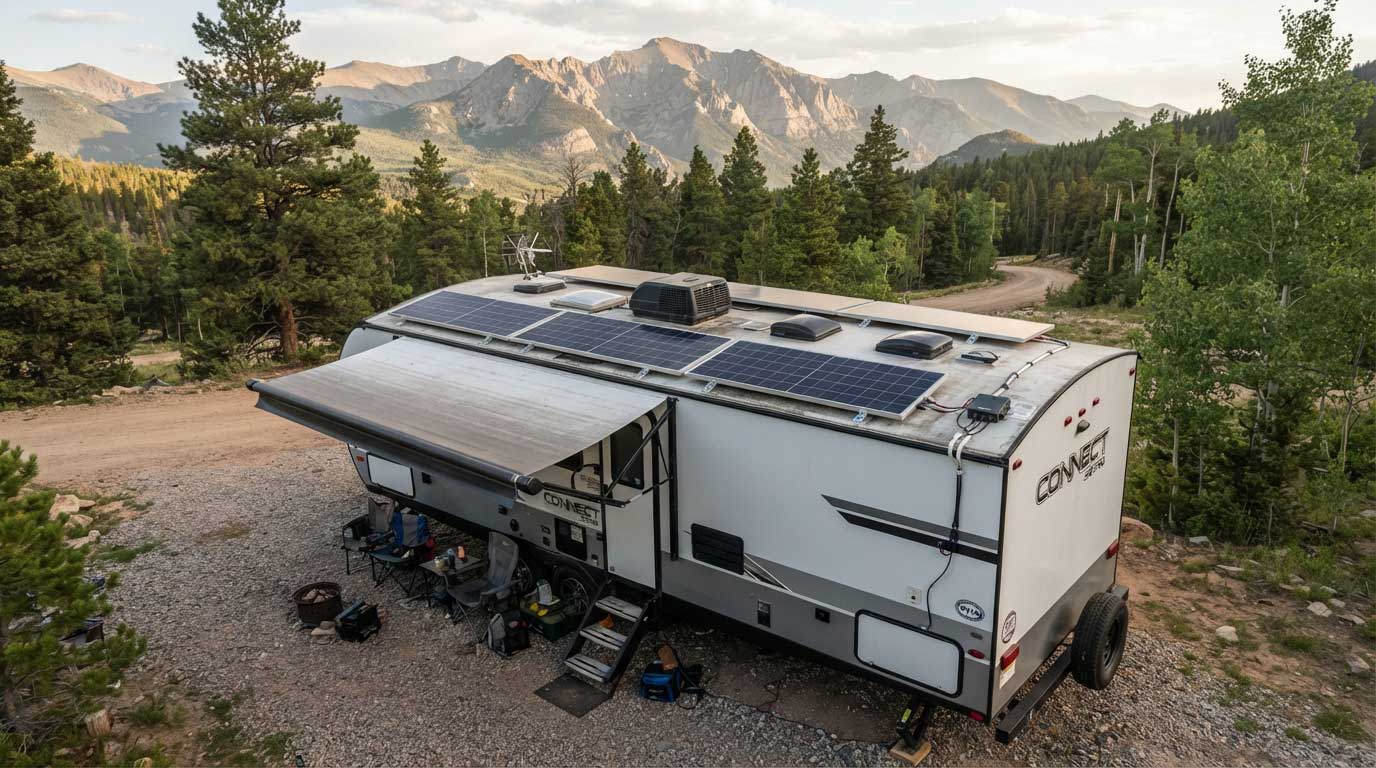
A 1,000W array is a substantial RV solar system.
It can support loads such as:
- Refrigerator
- LED lighting
- Ventilation fans
- Water pump
- Laptops
- Phones and tablets
- Internet equipment
- Small kitchen appliances
- Other moderate DC and AC loads
Whether it can run an air conditioner for extended periods is a completely different question.
Air conditioning has a high energy demand and is highly dependent on runtime, climate, insulation, inverter efficiency, and battery capacity.
For RV applications, I would first calculate the owner’s daily Wh consumption.
For example:
| RV Load | Example Daily Consumption |
|---|---|
| Refrigerator | 500Wh |
| LED lighting | 80Wh |
| Water pump | 60Wh |
| Laptop | 150Wh |
| Phones/tablets | 80Wh |
| Fans | 150Wh |
| Router/other electronics | 180Wh |
| Total | 1,200Wh/day |
This is an illustrative load profile, not a guaranteed consumption figure.
If the RV uses about 1.2kWh per day, a 1,000W array has considerably more potential energy capacity than the daily load under good solar conditions.
But that does not mean the owner should automatically buy a tiny battery.
Solar generation happens during the day.
The refrigerator still wants electricity at midnight.
What Battery Size Goes With a 1000W Solar System?
The battery should be sized from the energy you want to store, not simply from the solar array wattage.
Common battery capacities for this class of system might include:
- 12V 100Ah
- 12V 200Ah
- 12V 300Ah
- 24V 100Ah
- 24V 200Ah
- Larger banks for heavy off-grid use
A nominal 12V × 200Ah battery contains:
12 × 200 = 2,400Wh
or about:
2.4kWh nominal energy
But usable energy depends on battery chemistry and the manufacturer’s recommended depth of discharge.
A lithium iron phosphate battery is often used in modern off-grid and RV systems because it can provide a relatively high usable-energy fraction, but the battery manufacturer’s charging limits still need to be respected.
A 1,000W array can also produce substantial charging current into a 12V battery system.
Using a simplified conversion:
1,000W ÷ 12V ≈ 83A
The actual controller output is not simply 83A because battery voltage, conversion efficiency, operating conditions, and controller limits matter.
This is one reason a 24V battery architecture becomes attractive as system size grows.
At 24V:
1,000W ÷ 24V ≈ 42A
The current is roughly half under the same simplified calculation.
That can influence controller selection, conductor sizing, and system architecture.
MPPT Charge Controller for a 1000W Solar Panel Kit
The charge controller is one of the components I would not undersize casually.
Victron’s RV sizing guidance identifies wattage, Voc, and Isc as key solar-panel specifications and explains that series wiring increases voltage while parallel wiring increases current. It also recommends selecting the controller based on PV voltage, array current, and battery voltage.
For a 1,000W array, the controller might need to handle substantially different output currents depending on whether the battery bank is 12V or 24V.
A rough planning calculation:
1,000W ÷ 12V = 83.3A
1,000W ÷ 24V = 41.7A
This does not mean you should simply purchase an 83A or 42A controller.
The controller manufacturer’s charging-current rating, permitted PV power, battery charging voltage, temperature behavior, and installation conditions all matter.
And there is another critical number:
PV input voltage.
Series vs Parallel Wiring for a 1000W Solar Panel Kit
Suppose five identical 200W panels have:
- Vmp = 20V
- Imp = 10A
- Voc = 24V
Five in series would theoretically produce:
100V Vmp
with approximately:
10A current
Five in parallel would theoretically produce:
20V Vmp
with approximately:
50A current
Both arrays have approximately:
1,000W nominal power
But the controller sees very different voltage and current.
For an RV or off-grid installation using an MPPT controller, a higher-voltage series configuration can be attractive because the controller can convert PV voltage down to the battery voltage.
Victron specifically notes that series wiring raises voltage while keeping current approximately the same, and that this can work well with MPPT controllers.
However, there is a trap.
Never calculate series strings from wattage alone
If five panels each have a 24V Voc:
24V × 5 = 120V Voc
That’s already beyond a 100V controller’s nominal maximum.
And that is before considering cold temperatures.
Victron’s installation documentation explicitly warns that the number of panels in series must be calculated using both Voc and the temperature coefficient, because Voc increases when temperatures fall below 25°C.
This is one of the calculations I would do before the first panel is mounted.
Not afterward.
1000W Solar System Wiring Example
For a 1,000W system using four 250W modules, one possible configuration is 2S2P.
That means:
String 1: Panel 1 → Panel 2
String 2: Panel 3 → Panel 4
Then the two strings are connected in parallel.
Assume each panel has:
- Vmp = 25V
- Imp = 10A
- Voc = 30V
Each two-panel series string becomes approximately:
50V Vmp
and:
30V × 2 = 60V Voc
The two strings in parallel then produce approximately:
50V Vmp
and:
20A Imp
Total:
50V × 20A = 1,000W
This is an illustrative electrical example.
The actual string design must use the exact panel datasheet and controller limits.
How Much Roof Space Does a 1000W Solar Kit Need?
Roof area can become the limiting factor.
If each 200W flexible panel occupies approximately 1.5 m², five panels would require roughly:
7.5 m²
before accounting for spacing, roof equipment, cable routing, and installation clearances.
The exact dimensions vary significantly by manufacturer.
For an RV, the usable area can be much smaller than the total roof footprint.
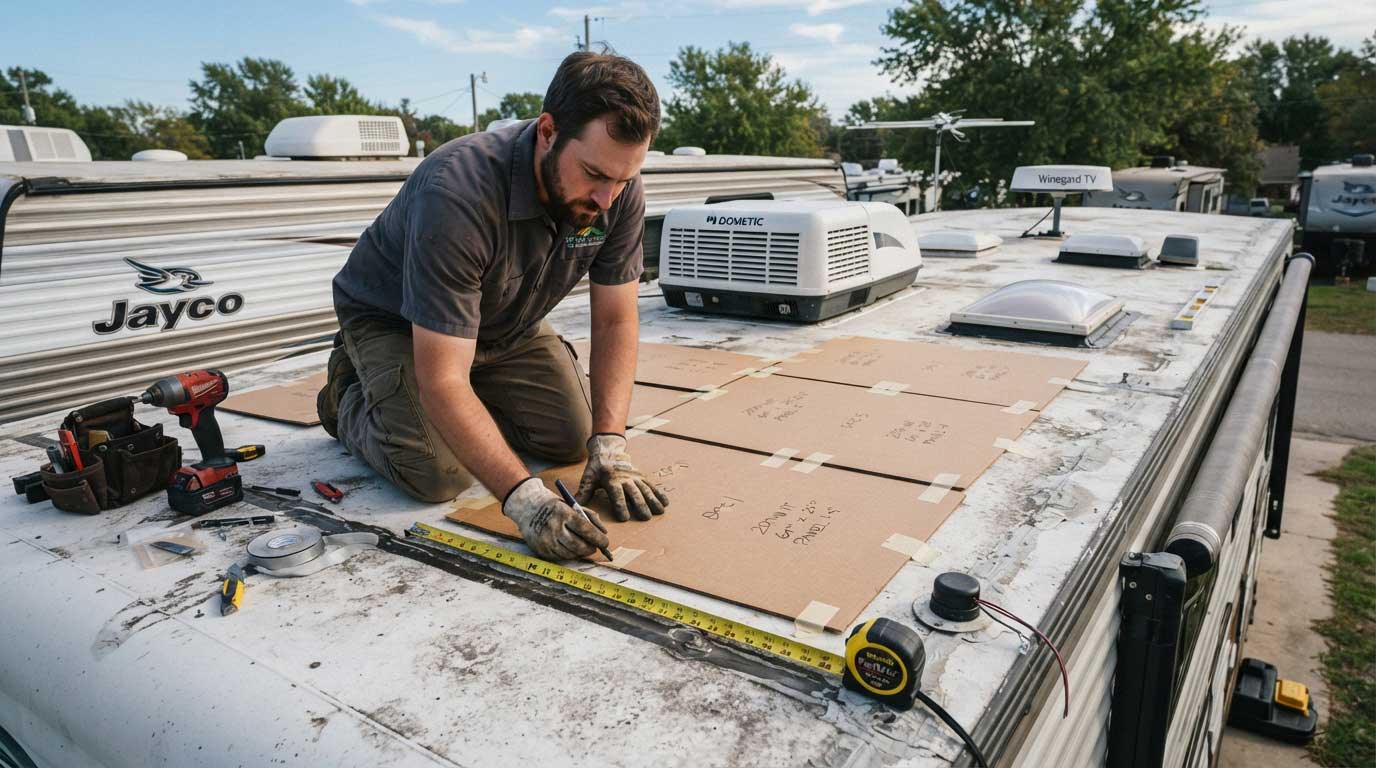
Before ordering the kit, I recommend using a simple cardboard layout.
Cut rectangles representing each panel.
Place them on the roof.
Mark:
- AC unit
- Vent
- Skylight
- Antenna
- Roof rack
- Cable entry
- Walking/maintenance area
Then move the rectangles around.
This takes perhaps 15 minutes.
It can prevent an expensive installation mistake.
Can a 1000 Watt Solar Panel Kit Run a House?
A 1,000W solar array can power selected household loads, but it is generally better described as a small PV system rather than a whole-home solar system.
During strong sunlight, a 1,000W array can theoretically deliver 1,000W of DC power under rated conditions.
That could cover loads such as:
- LED lighting
- Refrigerator
- Internet router
- Television
- Laptop
- Small electronics
A conventional electric oven, central air conditioner, electric water heater, or large heat pump can require considerably more power.
Battery storage changes the picture.
An inverter also changes it.
For example, a 1,000W PV array does not mean you automatically have a 5,000W AC output system. The inverter has its own continuous and surge ratings.
The system must be designed around the largest simultaneous load, not just daily energy consumption.
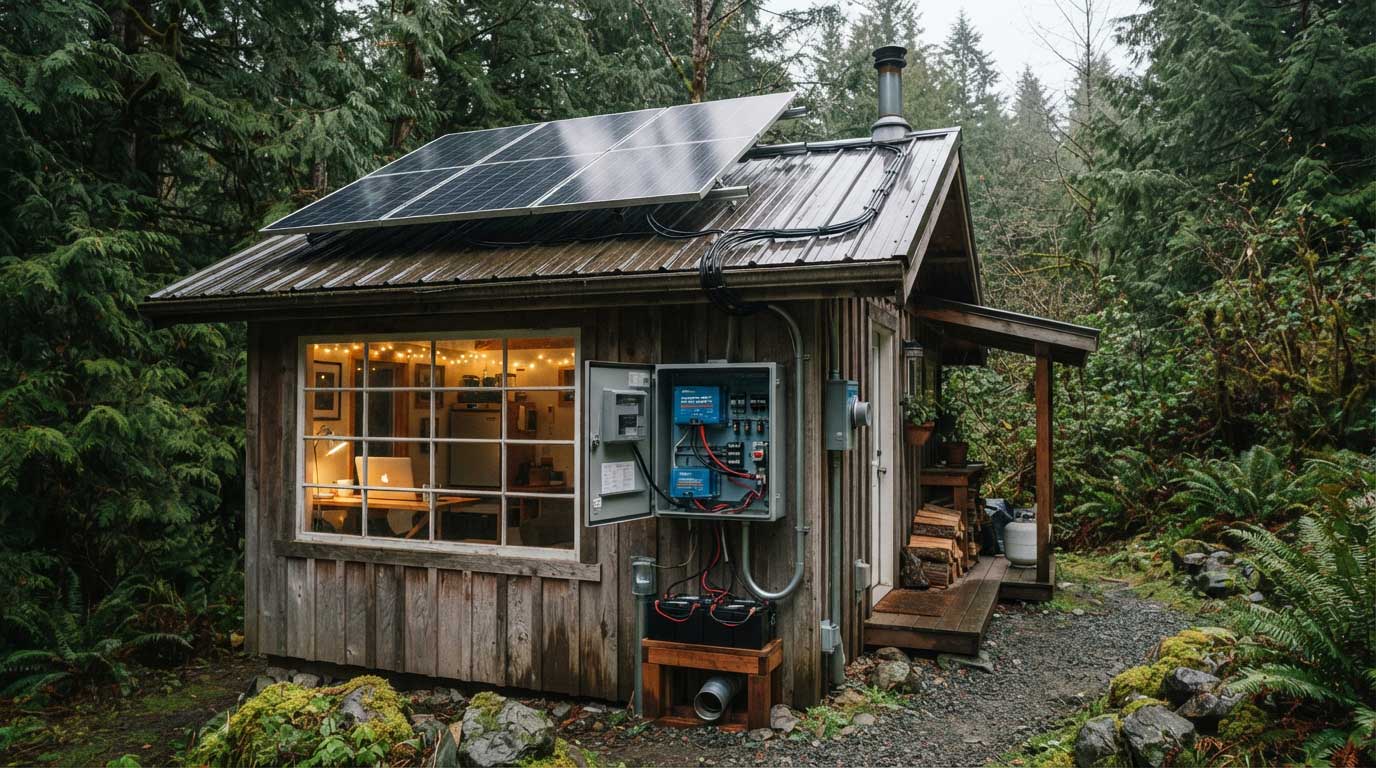
1000 Watt Off Grid Solar System: Example
Consider a small weekend cabin with no utility connection.
Daily estimated loads:
| Load | Daily Energy |
|---|---|
| Refrigerator | 600Wh |
| LED lighting | 100Wh |
| Wi-Fi/router | 120Wh |
| Laptop | 200Wh |
| Water pump | 150Wh |
| Small electronics | 150Wh |
| Total | 1,320Wh/day |
The owner wants roughly 1.3kWh/day.
A 1,000W array with five equivalent peak-sun-hours gives:
1,000 × 5 = 5,000Wh theoretical daily solar input
A real system will produce less than that idealized calculation because outdoor conditions and system losses reduce energy harvest.
DOE’s PV performance guidance specifically distinguishes STC ratings from field conditions and identifies temperature, solar resource, system losses, and module aging as factors affecting actual output.
For this cabin, 1,000W could therefore provide a reasonable solar-generation margin during favorable periods.
But winter is a different design problem.
A system designed around summer production should not automatically be assumed to provide the same daily energy in December.
Temperature and Real-World Solar Production
Solar modules do not perform at their nameplate rating all day.
Temperature is particularly important.
The DOE explains that solar cells generally perform better at lower temperatures and that increasing temperature causes a much larger reduction in voltage than the corresponding increase in current.
There is an interesting contradiction here:
Hot sunlight feels powerful, but hot PV modules lose voltage.
This matters for energy production and system design.
Cold weather matters for another reason.
As module temperature decreases, Voc rises.
That can make a series string that looks safe on a warm spreadsheet exceed the charge controller’s maximum PV input voltage during cold conditions.
For this reason, when I review a proposed 1000W kit, I check both:
Hot operating performance
and
cold-weather maximum Voc
They solve different problems.
Installation Steps for a 1000 Watt Solar Panel Kit
Step 1: Calculate daily energy consumption
List every important load and estimate Wh/day.
Do not start by buying panels.
Step 2: Inspect the installation surface
For an RV, check the actual usable roof area.
For a cabin, inspect roof orientation, shading, mounting structure, and cable-entry location.
Step 3: Choose panel wattage and physical dimensions
Select a configuration that reaches approximately 1,000W without creating unnecessary installation complications.
Step 4: Design the series/parallel configuration
Calculate Vmp, Voc, Imp, and Isc for the complete array.
Step 5: Check cold-weather Voc
Use the module manufacturer’s temperature coefficient and the lowest relevant design temperature.
Step 6: Select the MPPT controller
Check:
- Maximum PV voltage
- MPPT operating range
- Maximum charging current
- Recommended PV power
- Battery voltage
Step 7: Size the battery
Base storage on the energy required during periods without solar production.
Step 8: Size cables and protection
Account for current, cable length, voltage drop, environmental conditions, disconnects, fuses, and applicable electrical requirements.
Victron’s RV guidance lists PV isolators, appropriately sized cables, DC fuses, fuse holders, distribution components, and mounting hardware among the supporting equipment required for a properly designed system.
Step 9: Commission the system
Before normal operation:
- Check polarity
- Measure string voltage
- Verify controller settings
- Confirm battery voltage
- Check cable connections
- Monitor initial charging behavior
Common Mistakes With 1000 Watt Solar Kits
Mistake 1: Assuming 1,000W means 1,000W continuously
It doesn’t.
The 1,000W rating is a module/array nameplate capacity under defined test conditions.
Mistake 2: Buying panels before measuring the roof
This is especially common with RVs.
A panel can have an excellent specification and still be the wrong physical size.
Mistake 3: Ignoring Voc
A series string can produce dangerous or equipment-damaging voltage if the controller limit is exceeded.
Mistake 4: Using only nominal battery voltage for calculations
A “12V battery” does not operate at exactly 12.000V throughout its charging cycle.
Controller design should follow actual manufacturer specifications.
Mistake 5: Forgetting shading
A small shadow from an RV roof vent can have an outsized effect on a particular string configuration.
Mistake 6: Undersizing the inverter
The inverter must handle the intended AC loads, including startup/surge requirements where applicable.
Mistake 7: Treating flexible panels as installation-free
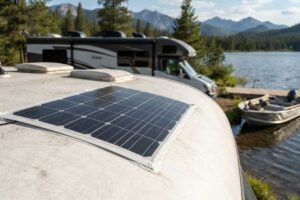
Flexible panels can simplify certain RV installations, but roof preparation, heat, cable routing, adhesive compatibility, and mechanical conditions still matter.
Is a 1000 Watt Solar Panel Kit Worth It?
For the right application, yes.
A 1,000W array is large enough to be useful without becoming a major commercial-scale installation. That makes it a practical size for many RVs, vans, cabins, workshops, sheds, and small off-grid systems.
The value becomes particularly strong when the system is designed around actual energy use.
For an RV owner using roughly 1–2kWh per day, a 1,000W array can provide substantial generation potential during good solar conditions.
For a cabin with 4–6kWh/day of consumption, it may become a supplemental system rather than the entire energy source.
For a workshop running high-power tools continuously, 1,000W may be insufficient.
The number on the panel doesn’t answer that question.
The load profile does.
FAQ: 1000 Watt Solar Panel Kit
How much electricity can a 1000 watt solar panel kit produce?
A 1,000W array can theoretically produce 1,000Wh during one hour at its rated output. Daily production depends on solar resource, temperature, shading, orientation, system losses, and operating conditions. For example, five equivalent peak-sun-hours gives 5kWh of theoretical solar input before losses.
How many panels do I need for a 1000 watt solar system?
The number depends on panel wattage. Five 200W panels, four 250W panels, ten 100W panels, or two 500W panels can each provide approximately 1,000W of nominal PV capacity.
What size battery do I need for a 1000W solar panel kit?
Battery size depends on daily energy use and how long you need power without solar. A 12V 200Ah battery has approximately 2.4kWh of nominal energy, while a 24V 100Ah battery also has approximately 2.4kWh nominal energy. Usable energy depends on battery chemistry and manufacturer specifications.
Can a 1000W solar panel kit run an RV?
Yes. A 1,000W RV solar array can support many moderate electrical loads, including refrigeration, lighting, fans, electronics, and water pumps. Whether it can support high-power appliances such as air conditioning depends on the appliance load, operating time, battery capacity, inverter size, and solar conditions.
Should 1000W solar panels be wired in series or parallel?
Either configuration can work. Series wiring increases voltage and keeps current approximately unchanged, while parallel wiring increases current and maintains similar voltage. The correct choice depends on panel specifications, shading, cable length, MPPT voltage range, and maximum controller input voltage.
What size MPPT controller do I need for 1000W solar?
The controller should be selected from the array’s voltage and current characteristics and the battery voltage, not from wattage alone. For example, 1,000W divided by a nominal 12V gives about 83A as a simplified current figure, while at 24V it is about 42A. Actual controller sizing must follow the manufacturer’s PV and charging limits.
Can flexible solar panels be used in a 1000 watt solar panel kit?
Yes. Flexible modules can be used where low weight, low profile, or roof curvature makes them practical. They are especially relevant to RVs, camper vans, boats, and other mobile applications. Installation surface, thermal conditions, cable routing, and manufacturer specifications should be checked before permanent installation.
Bright Solar’s Practical Approach to a 1000W System
When I review a 1,000W design, I don’t start by asking:
“Which 1,000W kit has the highest rating?”
I start with the roof.
Then the loads.
Then the battery.
Then the controller.
Only after that do the panels get their final configuration.
This order prevents a surprisingly common problem: buying a collection of components that individually look excellent but do not fit together electrically or physically.
For flexible RV applications, weight and roof coverage can be decisive. For stationary off-grid systems, mounting, ventilation, shading, and long-term maintenance often deserve more attention.
And I always leave room for the weather to disagree with the spreadsheet.
A 1,000W nameplate is useful. It gives us a common reference point.
It is not a promise of 1,000W every afternoon.
The U.S. Department of Energy’s PV performance research makes the same broader point: actual energy yield depends on environmental conditions and system characteristics, while PV modules also experience gradual degradation over their operating life. DOE cites approximately 0.5% annual module degradation as a typical planning figure in its PV performance guidance.
That is the mindset I recommend when selecting a 1000 watt solar panel kit for Bright Solar applications.
Build around the actual installation.
Not the number on the box.
Related recommendations
-

Flexible Solar Panels vs Rigid: Which Solar Panel Type Performs Better?
327Compare flexible solar panels vs rigid systems for RVs, boats, mobile homes, and off-grid power. Discover costs, durability, efficiency, and real-world performance.
View details -
10 Watt Flexible Solar Panel: Uses, Output and Installation Guide
171A 10 watt flexible solar panel is designed for low-power applications such as sensors, small lights, GPS devices, battery maintenance, and small RV or marine...
View details -
Solar Panels Wired in Series: Wiring, Voltage, and Safety Guide
282Solar panels wired in series increase voltage while current stays nearly unchanged. Safe string design requires checking Voc, temperature effects, MPPT volta...
View details -
Foldable Camping Solar Panels: How to Choose and Use Them
29Foldable camping solar panels provide portable electricity for outdoor activities, RV travel, and off-grid charging. Their performance depends on sunlight, e...
View details