100 Watt Folding Solar Panel: Output, Uses and Setup Guide
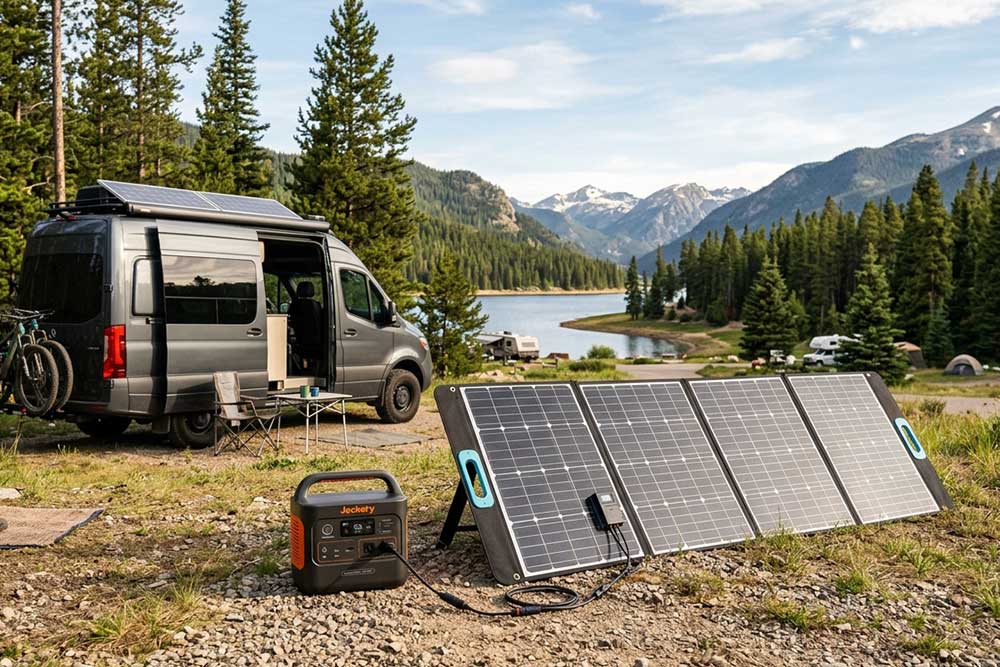
A 100 watt folding solar panel provides portable electricity for camping, RV travel, and small off-grid systems. Its actual output depends on sunlight, panel angle, temperature, shading, and the connected power station or battery.
Unlike a permanently mounted solar panel, a folding model can be unfolded in a sunny spot, repositioned as the sun moves, and packed away when the trip ends. For campers, van owners, and outdoor enthusiasts, that flexibility can be more useful than a higher-rated panel that cannot be positioned properly.
Bright Solar helps B2B buyers evaluate solar panel configurations for portable power applications, including outdoor equipment, mobile systems, and customized solar solutions. When selecting a 100W folding panel, the important questions are not limited to rated wattage: usable daily energy, charging compatibility, portability, and the way the panel will be used all matter.
What Can a 100 Watt Folding Solar Panel Actually Power?
A 100W rating describes the panel’s nominal power under specified test conditions. It does not mean the panel produces 100 watts continuously throughout the day.
The U.S. Department of Energy explains that solar photovoltaic output depends on sunlight and system conditions. Standard Test Conditions (STC) commonly use an irradiance of 1,000 W/m² and a cell temperature of 25°C. Real outdoor conditions rarely remain identical to these laboratory conditions.
Source: U.S. Department of Energy, Solar Photovoltaic Technology Basics.
For practical planning, consider a simple estimate:
- Panel rating: 100W
- Equivalent peak sun hours: 4 hours
- Estimated energy before system losses: 100W × 4 hours = 400Wh
That gives a theoretical daily yield of 0.4kWh before losses from temperature, orientation, wiring, charge conversion, and battery charging. Actual production may be lower or higher depending on the location and weather.
| Application | Typical suitability | Important consideration |
|---|---|---|
| Phones and USB devices | Suitable with a compatible output or power station | Charging speed changes with sunlight |
| LED camping lights | Suitable | Check total watt-hours used overnight |
| Camera batteries | Suitable through a compatible charger | Verify the charger’s input requirements |
| Small portable power stations | Often suitable | Check the station’s solar input limits |
| RV auxiliary batteries | Suitable with a compatible charge controller | Match the panel, controller, and battery |
| Refrigerators and high-demand appliances | Limited as a standalone source | Calculate daily energy consumption first |
A 100W panel is best understood as a way to replenish a battery or supply modest loads when sunlight is available. It is not a guaranteed 100W household outlet.
Why Choose a 100W Folding Solar Panel for Camping?
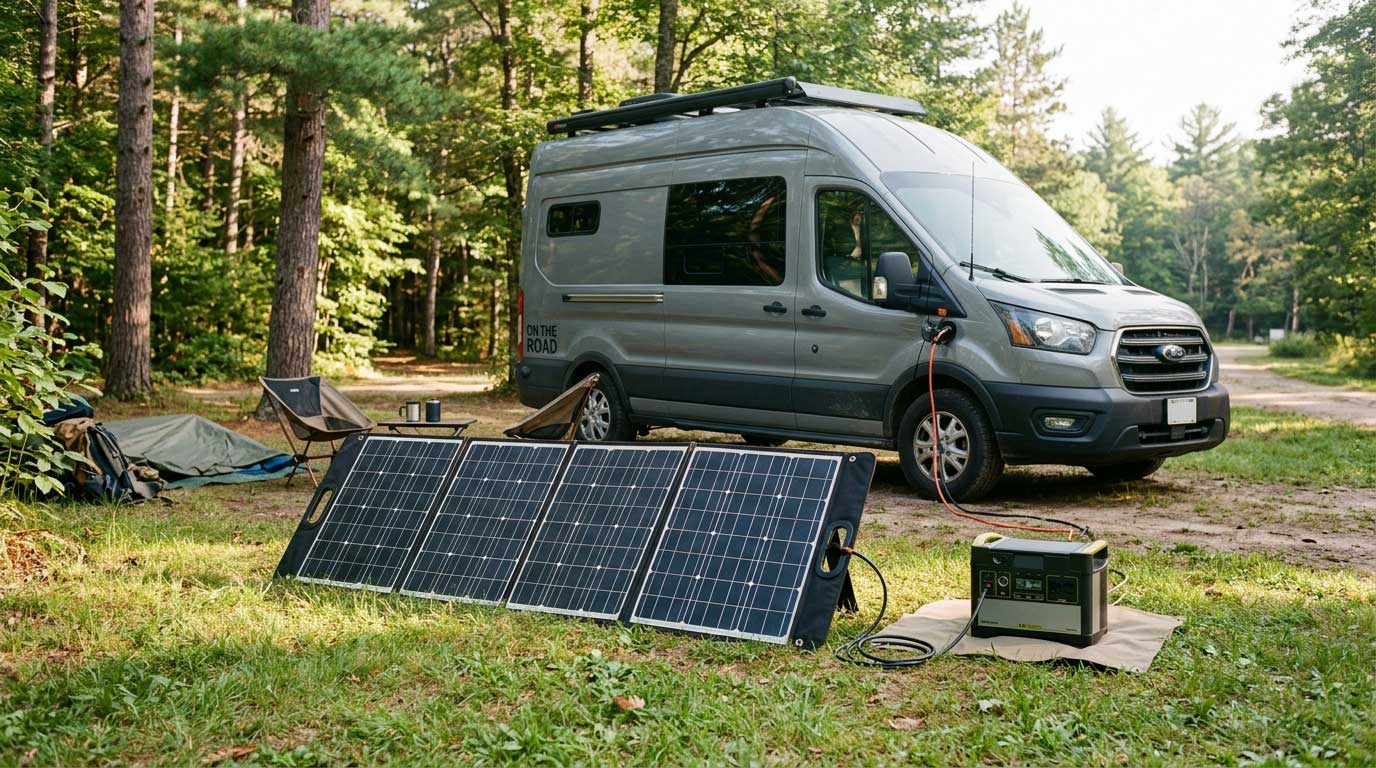
The main benefit of a folding solar panel is freedom of placement. You can leave the vehicle parked in the shade while putting the panel in a sunnier location, provided the cable can reach safely. That small difference can matter on wooded campsites, where moving the entire vehicle just to improve solar exposure is impractical.
A folding panel also packs away when rain starts or when you need to move camp. This makes it attractive to weekend campers, van travelers, hikers who use vehicle-supported campsites, and emergency-preparedness users.
However, folding panels are not automatically more powerful or more efficient than rigid panels of the same rated wattage. Their advantage is convenience, portability, and flexible positioning.
Five Practical Benefits
- Portable setup: Unfold the panel when charging is needed and pack it away afterward.
- Adjustable positioning: Change the direction and tilt as sunlight shifts.
- Temporary installation: Avoid permanent roof modifications when using compatible ground-based equipment.
- Multiple outdoor uses: Support camping electronics, cameras, lights, and suitable portable power stations.
- Storage convenience: Fold the panel for transport, following the manufacturer’s folding and packing instructions.
One limitation deserves attention: folding panels need a stable place to stand. A gust of wind can move an unsupported panel or tip over its kickstands. On exposed beaches, mountain campsites, or open desert ground, secure the panel according to its instructions and avoid placing it where people can trip over cables.
How Much Power Does a 100 Watt Folding Solar Panel Generate?
The right way to estimate output is to start with sunlight exposure rather than assume the panel will deliver its rated power for eight or ten hours.
The National Renewable Energy Laboratory’s PVWatts Calculator estimates photovoltaic energy production using location, solar resource, equipment assumptions, orientation, and system losses. Its modeling framework is useful for understanding why a nameplate rating alone cannot predict actual energy production. Small portable systems still require attention to local weather, shading, panel angle, and electrical losses.
For an illustrative 100W portable panel, the calculation below uses assumed peak sun hours. These are examples for planning, not measured Bright Solar product results or a location-specific forecast.
| Equivalent peak sun hours | Energy before system losses |
|---|---|
| 2 hours | 200Wh |
| 3 hours | 300Wh |
| 4 hours | 400Wh |
| 5 hours | 500Wh |
| 6 hours | 600Wh |
For example, four equivalent peak sun hours produce a theoretical estimate of 400Wh. The energy reaching a battery will usually be lower after conversion and charging losses.
Peak sun hours represent accumulated solar energy expressed as equivalent hours at an irradiance of 1,000W/m². They do not mean the sun stays at peak intensity for that entire period.
A Realistic Camping Energy Budget
Consider a hypothetical camper using the panel to recharge a phone, run LED lights, and top up a camera battery.
| Device | Assumed daily consumption |
|---|---|
| Smartphone charging | 15Wh |
| LED camping lights | 20Wh |
| Camera battery charging | 25Wh |
| Total | 60Wh |
These are illustrative energy estimates, not universal device specifications. Actual consumption varies by model, usage, and charging efficiency.
A theoretical 400Wh solar yield would exceed this example’s 60Wh daily demand. Even after system losses, the panel could have enough energy available on a suitably sunny day. But the surplus should not be treated as guaranteed: cloudy weather, tree cover, short winter days, and poor orientation can reduce production substantially.
If the same camper adds an electric cooler, laptop, or other continuous load, the energy budget changes quickly. Check each device’s wattage and operating hours before deciding whether 100W is sufficient.
Why Actual Output Can Be Lower Than 100W
Several factors explain the difference between rated power and field performance.
- Shading: Trees, vehicle awnings, and even partial obstructions can reduce output.
- Panel angle: A panel facing away from the sun receives less direct sunlight.
- Temperature: Solar cells operate differently as their temperature changes; hotter conditions can reduce the output of many crystalline-silicon modules.
- Surface condition: Dust, pollen, dried mud, and other debris can obstruct sunlight.
- Electrical conversion: Charge controllers, cables, connectors, and battery charging introduce losses.
- Weather and season: Cloud cover and changing day length affect the energy available.
The U.S. Department of Energy’s technical overview of photovoltaic performance explains that solar cells convert light into electricity and that modules are assembled from interconnected cells. For more detailed performance modeling, consult NREL PVWatts and its published system-loss assumptions.
A useful field habit is to check the power station’s input display after unfolding the panel. If the reading is unexpectedly low, first inspect the sunlight, orientation, connections, and charging limits before assuming the panel is defective.
How to Set Up a 100 Watt Folding Solar Panel
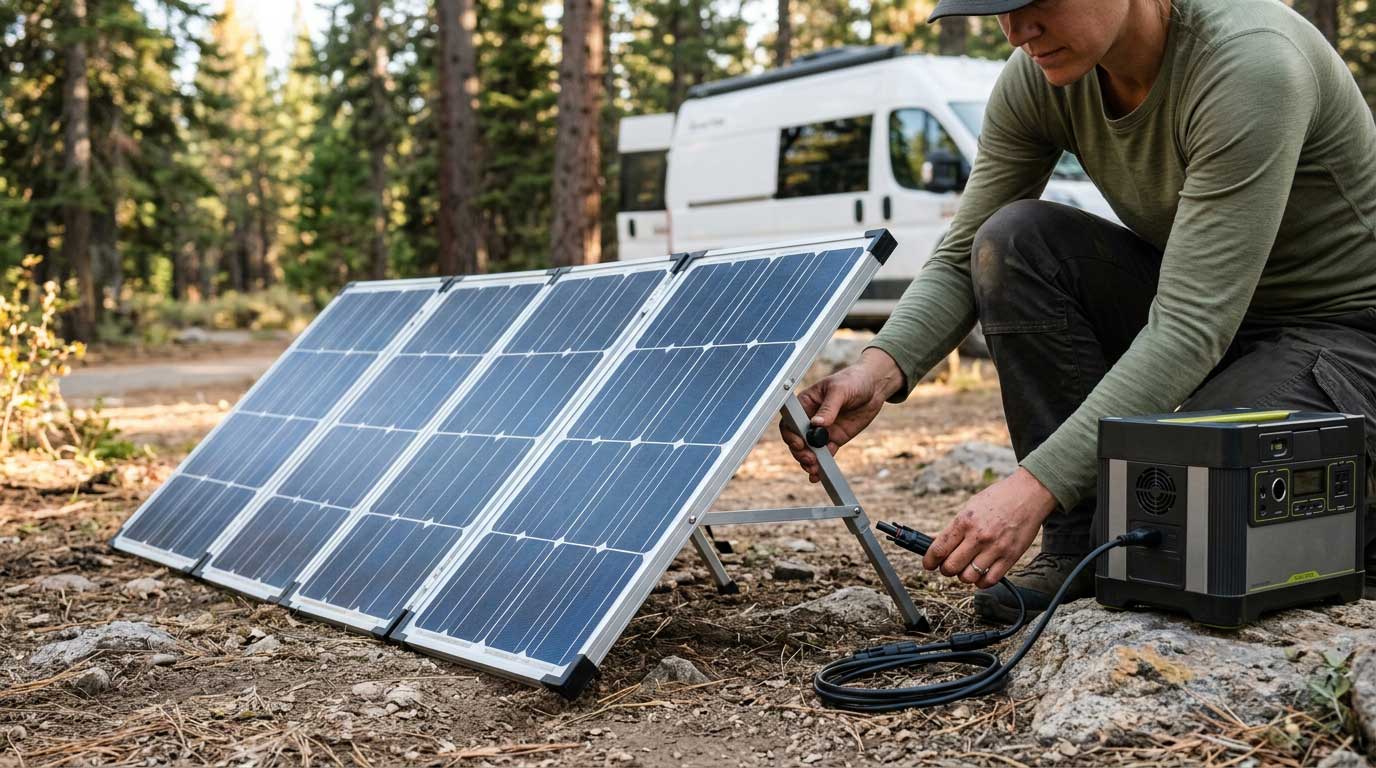
Step 1 — Check the Equipment
Before opening the panel, identify the equipment you intend to charge.
Check the panel’s rated power, voltage, current, connector type, and operating limits. Then compare those details with the solar input specifications of the power station or the requirements of the battery charge controller.
A 100W rating alone does not establish electrical compatibility. Two panels with the same nominal wattage can have different voltage and current characteristics.
If the panel is intended for a battery system, confirm that the charge controller is suitable for the battery chemistry and voltage. Do not connect a panel directly to a battery unless the equipment manufacturer explicitly specifies that arrangement as safe.
Step 2 — Unfold and Position the Panel
Open the panel on a reasonably flat surface. Extend the built-in supports according to the manufacturer’s instructions, then aim the panel toward the strongest available sunlight.
In the Northern Hemisphere, a south-facing orientation is often a useful starting point, but the best direction changes with the season, location, and time of day. The goal is to expose the panel to unobstructed sunlight, not to follow a compass direction blindly.
Look for small shadows across the photovoltaic surface. A nearby tree branch or the edge of an awning may seem insignificant, yet it can interfere with output. Recheck the panel when the sun moves.
Step 3 — Connect the Charging Equipment
Follow the exact connection sequence specified by the panel, charge controller, or power station manufacturer. Some portable power stations support direct solar input; others require a particular adapter or connector.
Before connecting, verify:
- The solar input voltage is within the receiving device’s permitted range.
- The panel’s connector and polarity match the intended input.
- The power station’s maximum solar input current and wattage will not be exceeded.
- Any required charge controller is installed in the correct position.
- Outdoor connectors are kept dry and protected as specified by the manufacturer.
Do not assume that a connector fitting physically means the electrical connection is correct.
Step 4 — Check the Input Reading
Once connected, check the power station or controller display, if available. The measured input will fluctuate as clouds move and the sun changes position.
If charging is not detected, disconnect the system according to the equipment instructions and check for loose connectors, incompatible adapters, excessive shading, or input limits. Do not open electrical components or improvise wiring to force a connection.
Step 5 — Pack Away Carefully
When charging is complete, follow the manufacturer’s shutdown and disconnection procedure. Allow the panel to cool if necessary, clean it only with approved materials, and fold it along its designed hinges or sections.
Keep cables and connectors from being trapped between panel sections. Store the unit dry and avoid putting heavy objects on top of it.
Choosing a 100 Watt Folding Solar Panel for an RV or Off-Grid System
A folding solar panel for RV use should be selected according to the complete charging system, not wattage alone. Connector compatibility, portability, operating conditions, and daily energy demand all affect whether a panel will work for a particular trip.
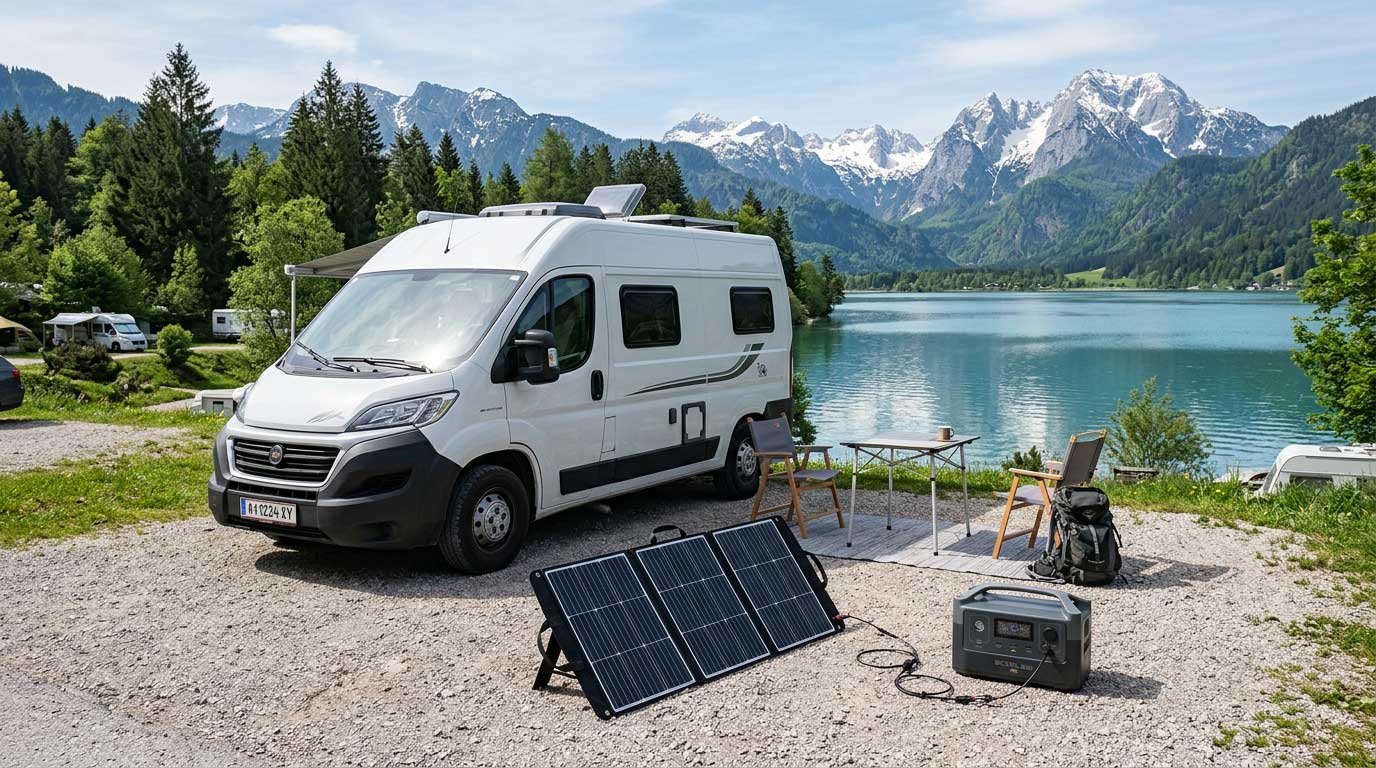
Portable Power Station or RV Battery?
These are two different use cases, and the connection requirements are not interchangeable.
Portable power station: This is often the simpler option for casual camping. The station integrates a battery and charging electronics, and some models accept solar input directly. You still need to verify the permitted solar voltage, current, wattage, and connector.
RV battery: A 100W panel can contribute energy to an RV battery when paired with a compatible charge controller and correctly configured wiring. Battery chemistry, system voltage, charging limits, and the expected daily load must be considered.
A 12V battery does not mean every nominally 12V panel can be connected directly to it. The charging voltage and control requirements need to match the system design.
What to Check Before Buying
| Selection factor | What to verify |
|---|---|
| Rated power | Whether 100W meets your expected daily energy budget |
| Folded dimensions | Whether the panel fits your storage space |
| Weight | Whether it is practical to carry between the vehicle and a sunny location |
| Solar output specifications | Whether voltage and current match the receiving equipment |
| Connectors | Whether the required cable or adapter is supported |
| Weather protection | Whether the panel and connectors are suitable for the intended outdoor conditions |
| Support structure | Whether the panel can stand securely on the ground |
| Warranty and service | What the manufacturer actually covers |
For businesses sourcing panels for a product line, outdoor power kit, or private-label solution, additional considerations include repeatable specifications, connector options, packaging, documentation, and consistency across production batches.
Bright Solar supports B2B solar panel requirements, including customized configurations and OEM/ODM discussions. Buyers evaluating a portable solar product should confirm the intended application and required electrical specifications before requesting a quotation. A folding design and a semi-flexible panel are not automatically the same product category; their construction, handling requirements, and intended mounting methods may differ.
Common Mistakes That Reduce Solar Charging Performance
Small setup errors can have a noticeable effect on the amount of energy collected during a short camping trip.
- Leaving the panel behind the vehicle: The vehicle may cast a shadow across part of the panel. Move the panel into clear sunlight when practical.
- Treating rated watts as daily energy: A 100W panel does not automatically generate 800Wh over an eight-hour day. Actual sunlight intensity varies.
- Ignoring power station limits: A panel can be rated at 100W and still be incompatible with a particular solar input.
- Using unsuitable extension cables: Excessive cable resistance can cause voltage drop. Follow the equipment manufacturer’s cable recommendations.
- Leaving the panel unsecured: Wind can tip over a panel and damage its support structure or cables.
- Assuming water resistance means waterproof connections: Protect connectors and charging equipment according to their specified ratings and instructions.
One useful troubleshooting method is to compare the input reading at different panel positions under similar sunlight. If repositioning the panel noticeably increases input, orientation or shading was probably contributing to the lower reading. This is a practical diagnostic approach, not proof that every low-output problem has the same cause.
FAQ About a 100 Watt Folding Solar Panel
How much electricity does a 100 watt folding solar panel produce per day?
A 100W panel theoretically produces 400Wh with four equivalent peak sun hours before system losses. Actual daily energy depends on sunlight, orientation, shading, temperature, and charging efficiency.
Can a 100 watt folding solar panel charge a portable power station?
Yes, if the power station supports the panel’s voltage, current, connector, and solar input requirements. Check the manufacturer’s specifications before connecting the equipment.
Can a 100 watt folding solar panel run a refrigerator?
It may contribute to running a small, efficient refrigerator through a suitable battery system, but it cannot guarantee continuous operation. Calculate the refrigerator’s daily energy use and account for nighttime demand and cloudy weather.
Is a 100 watt folding solar panel suitable for camping?
Yes. It can support small electronics, LED lights, camera batteries, and compatible power stations. Suitability depends on your energy needs and the amount of usable sunlight at the campsite.
Does a 100 watt folding solar panel work on cloudy days?
Yes, photovoltaic panels can generate electricity in diffuse light, but output generally decreases when cloud cover reduces the sunlight reaching the cells. Do not rely on rated power as a cloudy-day production estimate.
Can I connect a 100 watt folding solar panel directly to a 12V battery?
Not unless the equipment manufacturer explicitly permits that connection. A suitable charge controller is generally needed to regulate charging and protect the battery from improper charging conditions.
Is a folding solar panel better than a rigid solar panel?
Neither is universally better. Folding panels prioritize portability and temporary placement, while Rigid Solar Panels are commonly chosen for permanent installations. The right option depends on available space, mounting requirements, durability, and how often the system needs to move.
Technical References and Editorial Notes
The following authoritative resources support the energy calculations and photovoltaic performance explanations in this guide.
1. U.S. Department of Energy — Solar Photovoltaic Technology Basics: Explains how photovoltaic cells convert sunlight into electricity and how cells are assembled into modules. https://www.energy.gov/cmei/systems/solar-photovoltaic-technology-basics
2. National Renewable Energy Laboratory — PVWatts Calculator: Estimates solar energy production using location-specific solar resources, system configuration, and loss assumptions. https://pvwatts.nrel.gov/
3. National Renewable Energy Laboratory — PVWatts V8 Documentation: Describes the modeling inputs and updates used to estimate photovoltaic system output. https://developer.nlr.gov/docs/solar/pvwatts/v8/
Editorial expertise: This article is prepared for outdoor solar users, RV owners, portable power buyers, and B2B solar product purchasers. Energy calculations are illustrative estimates rather than claims of measured Bright Solar product performance. Actual product specifications should be verified against the applicable manufacturer’s datasheet.
Related recommendations
-

Solar Panel for Electric Fence: How to Choose the Right System
255Learn how to choose a solar panel for electric fence systems, size the battery and panel correctly, reduce downtime, and keep remote livestock fencing reliable.
View details -
Enphase Expands Mini Inverter Deployment in Southern California
338Enphase expands Mini inverter deployment in Southern California, with more homes adopting IQ8 Microinverters and IQ Batteries to prepare for summer outages. Local installers from Anaheim to Riverside share how sunlight-only backup and flexible sys...
View details -
Foldable Camping Solar Panels: How to Choose and Use Them
32Foldable camping solar panels provide portable electricity for outdoor activities, RV travel, and off-grid charging. Their performance depends on sunlight, e...
View details -
Flexible Film Solar Panels: Technology, Applications and Buying Guide
152Flexible film solar panels use lightweight photovoltaic structures on flexible substrates for curved, weight-sensitive, mobile, marine, and specialty surfaces.
View details