what direction do solar panels face?
what direction do solar panels face depends on location, but in the Northern Hemisphere, fixed solar panels generally perform best when facing true south. East- or west-facing roofs can still produce substantial energy, so shading, roof pitch, and household electricity use must also be considered.
What Is the Best Direction for Solar Panels?
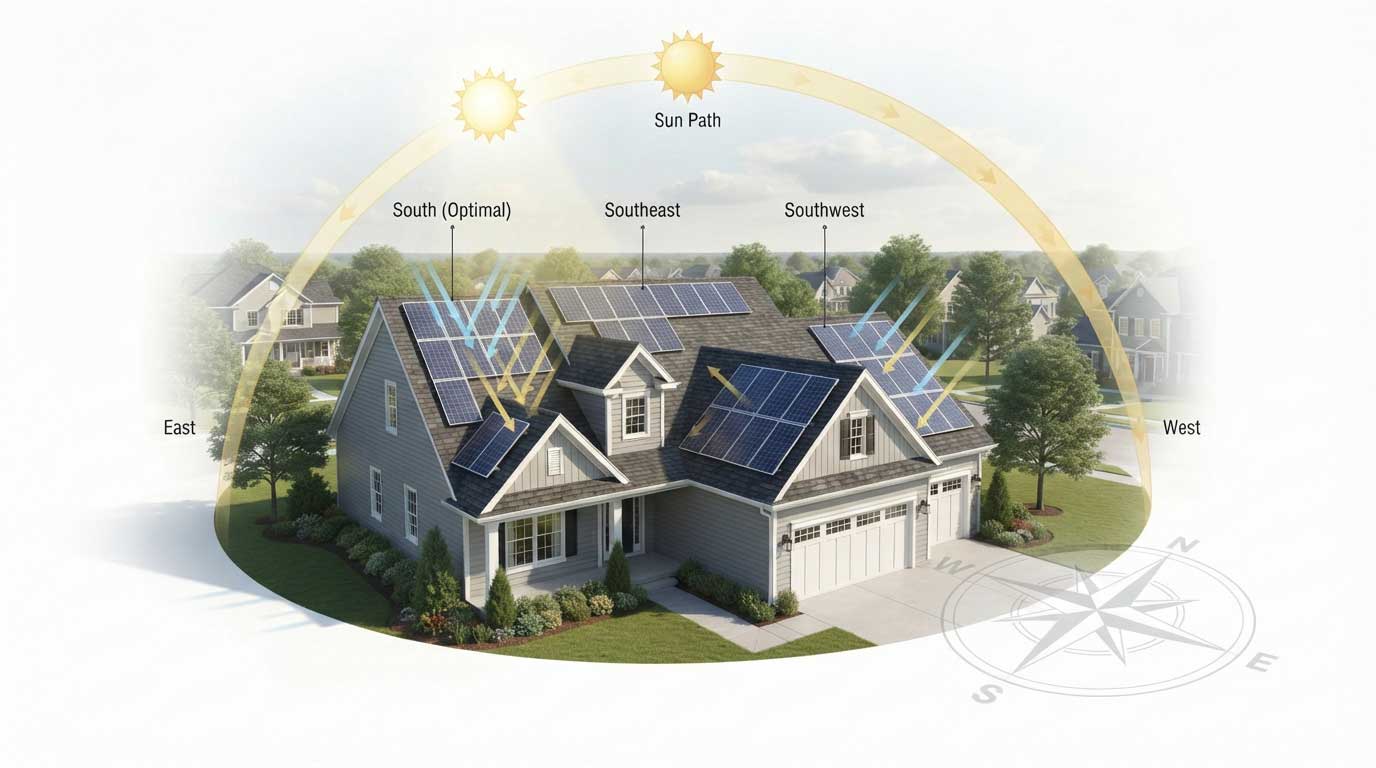
For homes in the Northern Hemisphere, true south is normally the best direction for fixed solar panels because the sun follows a generally southern path across the sky.
The U.S. Department of Energy recommends south-facing modules for maximizing annual energy production and notes that the ideal fixed-panel tilt is generally related to local latitude.
Data source: https://www.energy.gov/cmei/systems/solar-photovoltaic-system-design-basics
In technical terms, solar orientation is measured using azimuth:
| Direction | Azimuth |
|---|---|
| North | 0° / 360° |
| East | 90° |
| South | 180° |
| West | 270° |
| Southeast | 135° |
| Southwest | 225° |
NREL uses 180° as the typical azimuth for systems north of the equator.
One detail that gets overlooked in homeowner conversations: installers should distinguish true south from magnetic south when determining array orientation. Compass readings can be affected by magnetic declination.
Do Solar Panels Have to Face South?
No.
A south-facing roof is ideal in many Northern Hemisphere locations, but it is not a requirement for a productive solar installation.
The DOE states that solar panels can perform well on roofs oriented anywhere from southeast to southwest, particularly when roof slopes are moderate. Its current homeowner guidance identifies 15°–40° as a typical favorable roof-slope range for south-facing installations.
NREL provides a useful real-world example from Boulder, Colorado. Its analysis found orientation losses of about 4% for a panel facing 45° east of south and about 10% facing 45° west of south under the conditions studied. NREL also stresses that the effect varies by location.
That is why I would not reject a house simply because its roof isn’t perfectly south-facing.
On actual projects, a clean southeast roof with no shade can be a better installation site than a theoretically perfect south roof interrupted by a chimney, parapet, or neighboring tree.
Are East-Facing Solar Panels Good?
Yes. East-facing solar panels can work well, particularly when the home’s electricity consumption is higher in the morning.
An east-facing array receives stronger sunlight earlier in the day. That can shift the production curve forward compared with a south-facing array.
For a homeowner who leaves for work early, runs appliances in the morning, or charges equipment before midday, this production profile may have practical value.
The question is no longer simply:
“Which direction produces the most electricity?”
It can also be:
“When does the home need the electricity?”
That distinction becomes even more important when electricity rates vary throughout the day or when a battery is included.
Are West-Facing Solar Panels Good?
West-facing solar panels can also be a strong option.
They generally produce more of their daily electricity later in the afternoon, when many households return home, cooking begins, air conditioning remains active, and other loads increase.
The DOE specifically notes that southeast- and southwest-facing roofs can work well for solar.
For some homes, accepting a modest reduction in annual production in exchange for later-day generation can make more sense than forcing every panel onto a south-facing roof.
This is one of the more useful insights from designing around the load profile, rather than treating panel orientation as an isolated number.
Does Roof Direction Matter More Than Shading?
Not always.
A shaded south-facing roof can perform worse than an unshaded roof with a less-than-perfect orientation.
NREL recommends identifying an unshaded installation area, particularly during the approximate 9 a.m. to 3 p.m. peak-sun period. It identifies trees, nearby buildings, chimneys, and other roof structures as potential sources of shading.
What Is the Best Angle for Solar Panels?
Direction and tilt work together.
The DOE says that, for maximum annual energy output, fixed modules in the Northern Hemisphere are generally oriented toward south and tilted at an angle related to local latitude.
But the “perfect” angle is rarely the only consideration on a real roof.
For example:
- A low roof pitch may favor flush mounting.
- A steep roof may make additional racking unnecessary.
- Snow-prone areas may benefit from steeper mounting.
- High-wind areas require structural considerations.
- Aesthetic restrictions may limit tilt.
- Roof geometry may matter more than a theoretical optimum.
DOE’s current installation guidance notes that a 15°–40° south-facing tilt can provide strong production across the continental United States, while steeper angles may improve snow and hail shedding but increase wind loading.
So I would not change a structurally sound roof just to chase a few degrees of theoretical tilt optimization.
What Direction Should Solar Panels Face in the Southern Hemisphere?
The rule reverses.
In the Southern Hemisphere, fixed solar panels generally face true north to maximize annual solar exposure.
NREL’s solar modeling documentation describes the typical azimuth as 180° for locations north of the equator and 0° for locations south of the equator.
The basic principle is simple: fixed panels generally face toward the equator.
Does Solar Panel Direction Affect Energy Production?
Yes.
NREL’s residential PV modeling shows that actual capacity factors vary significantly with location and system configuration, including whether an array faces south or west. Its modeled U.S. residential PV capacity factors range from 12.7% to 19.6% across resource categories.
Those numbers are not orientation-only losses—they incorporate broader solar-resource and system conditions. That distinction matters.
For a specific property, NREL’s PVWatts Calculator accepts system size, tilt, azimuth, module type, losses, inverter efficiency, and other inputs to estimate annual and hourly PV production.
For Bright Solar system planning, this kind of site-specific modeling is much more useful than telling every homeowner that “south is always best.”
How Should You Choose Solar Panel Direction?
Before finalizing the array layout, check:
- Roof azimuth
- Roof pitch
- Annual shading
- Nearby trees
- Chimneys and vents
- Adjacent buildings
- Local latitude
- Household electricity profile
- Utility rate structure
- Battery storage plans
- Available roof area
- Structural condition
A Practical Example
Imagine two roof sections:
Roof A: South-facing, but shaded by a large tree from 11 a.m. to 2 p.m.
Roof B: Southwest-facing, completely clear from morning through late afternoon.
I would not automatically choose Roof A.
Solar production is affected by several variables simultaneously. The best installation is often the one that gives the array the strongest combination of orientation, usable area, and unobstructed sunlight.
That is what matters when moving from a satellite image to an actual installation plan.
FAQ About what direction do solar panels face?
What direction do solar panels face in the United States?
In most of the United States, fixed solar panels perform best when oriented toward true south, although southeast and southwest orientations can also work well.
Can solar panels face east?
Yes. East-facing panels can be productive and may be useful when morning electricity consumption is important.
Can solar panels face west?
Yes. West-facing arrays can provide more afternoon electricity and may align well with homes that have significant late-day loads.
Are north-facing solar panels useless?
No. North-facing panels can still generate electricity, but in the Northern Hemisphere they are generally less favorable for maximizing annual production.
What is the best angle for solar panels?
The ideal fixed tilt depends on latitude, season, roof design, and project objectives. A tilt near local latitude is a useful starting point, but the actual roof and site conditions should determine the final design.
Does shading matter more than direction?
It can. A well-oriented but heavily shaded roof may be less productive than a slightly less favorable orientation with unobstructed sunlight.
Should I move panels to face south if my roof faces west?
Not necessarily. A west-facing roof can still be an effective solar location. Compare expected production, roof area, shading, installation cost, and household demand before adding tilt structures or choosing a more complicated mounting arrangement.
Conclusion
what direction do solar panels face is usually answered with true south in the Northern Hemisphere and true north in the Southern Hemisphere, but that is the starting point—not the entire design.
At Bright Solar, orientation should be evaluated together with roof pitch, shading, local solar resource, electricity demand, and battery strategy. A slightly off-south array with excellent sunlight can make more practical sense than a perfectly oriented array with poor site conditions.
The prev: how to integrate solar panels?The next: what is a solar panel made of?
Related recommendations
-

how durable are flexible solar panels?
315How durable are flexible solar panels? Learn their real lifespan, heat resistance, weather performance, and what causes early failure in RV and marine use.
View details -
what is a solar panel made of?
245what is a solar panel made of? Explore the silicon cells, glass, aluminum frame, encapsulants, backsheet, copper, and other materials inside modern PV modules.
View details -
How to Compare Marine Flexible Solar Panels?
280Learn how to compare marine flexible solar panels beyond wattage. Discover real-world insights on durability, ETFE materials, saltwater resistance, and lifespan before buying.
View details -
How to Clean Solar Light Panels?
262Learn how to clean solar light panels properly, remove dirt from garden solar lights, improve charging performance, and extend solar lighting lifespan.
View details