Custom Shape Flexible Solar Panels: Design, Applications and Buying Guide
Custom shape flexible solar panels are made to fit installation areas where standard rectangular modules leave unused space or cannot follow the available surface. By tailoring a panel’s dimensions and outline to a project, buyers can make better use of curved RV roofs, yacht surfaces, and specialized off-grid equipment—provided the design respects electrical, mechanical, and installation limits.
What Are Custom Shape Flexible Solar Panels?
Custom shape flexible solar panels are photovoltaic modules designed with project-specific dimensions or outlines rather than only standard rectangular formats. Depending on the manufacturer’s capabilities, a custom design may adjust the module’s length, width, aspect ratio, or edge profile to better suit the mounting area.
They are particularly relevant when the available surface is:
- Curved or irregularly shaped.
- Interrupted by hatches, vents, rails, or other fittings.
- Too narrow or short for standard modules.
- Part of a vehicle, vessel, or product with a distinctive exterior design.
- Limited by weight, height, or visual requirements.
A custom outline does not automatically mean the panel can bend in every direction or fit every curved surface. Flexibility, allowable bending radius, cell layout, and installation method are product-specific. Those details must be confirmed before finalizing a drawing or placing an order.
Custom Shape vs. Standard Flexible Solar Panels
| Feature | Standard flexible panel | Custom shape flexible panel |
|---|---|---|
| Dimensions | Selected from available standard sizes | Specified around project requirements, subject to manufacturing limits |
| Outline | Usually rectangular | May use a tailored outline if supported by the manufacturer |
| Design process | Typically choose from existing products | Usually requires drawings, measurements, and technical review |
| Lead time | May be available from existing stock | Depends on design approval, production, and order quantity |
| Best suited for | Common roof and deck layouts | Installations where standard dimensions create fit or space problems |
For a straightforward rectangular roof, a standard module may be easier to source and replace. Customization becomes more useful when the geometry itself is the problem—not simply when a buyer wants a different-looking panel.
Where Custom Shape Flexible Solar Panels Are Used
The application determines which design details matter most. A panel for an RV roof, for example, may need to work around vents and air-conditioning equipment. A marine installation may place greater emphasis on moisture exposure, surface preparation, and the suitability of the module for the intended deck or cabin location.
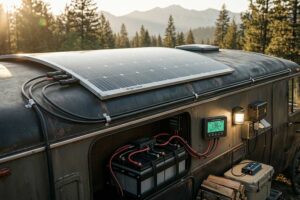
RVs, Campervans and Motorhomes
RVs and campervans often have limited usable roof space. Roof vents, skylights, air conditioners, antennae, and raised sections can break up an otherwise large surface. A custom module layout may help use the available area without placing a panel over an obstruction.
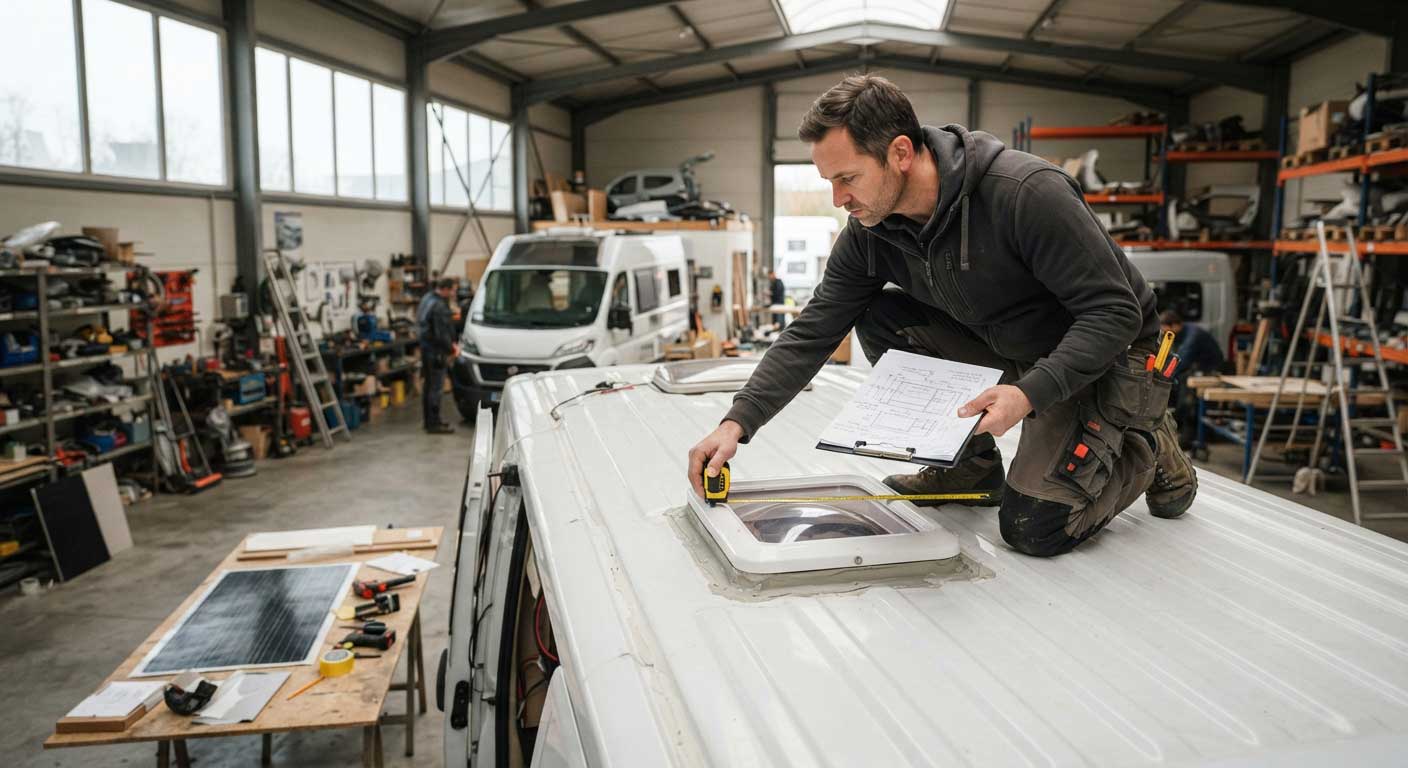
Before requesting a custom shape, measure the usable roof rather than the roof’s overall length and width. Include clearance around accessories and consider where cables can enter the vehicle. A panel that fits the outline on paper can still be impractical if its connector ends up beneath a vent or where the cable cannot be routed safely.

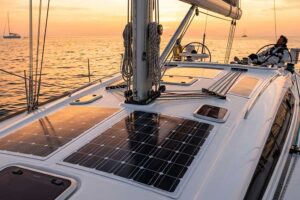
Yachts and Other Marine Applications
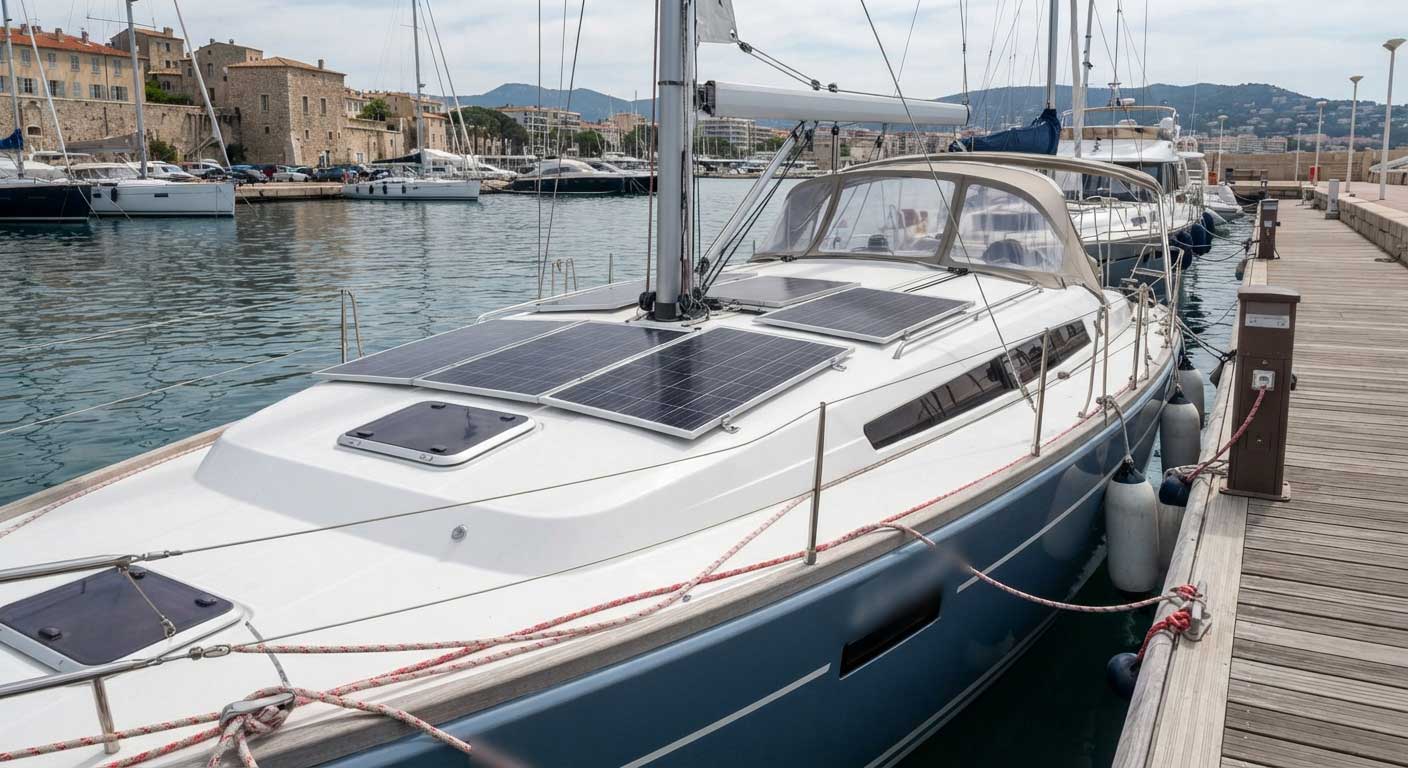
On boats, the available surface may include curved cabin tops, narrow hardtops, or deck areas interrupted by rails and hardware. A custom layout can help coordinate panel placement with these features, but the design must account for the actual marine environment.
Important checks include:
- Whether the selected module is suitable for the intended marine location.
- Exposure to saltwater, spray, moisture, and temperature changes.
- The surface material and the manufacturer’s approved attachment method.
- Whether people will walk on or near the installation.
- Cable routing, strain relief, and protection from abrasion.
A flexible module should not be described as walkable unless the specific product is designed and rated for that use. Similarly, a custom shape does not establish waterproofing or marine suitability on its own.
Specialty Equipment and Off-Grid Projects
Custom dimensions can also be useful for certain mobile equipment, compact shelters, monitoring stations, and off-grid enclosures. These projects often have a fixed surface area and a specific energy requirement, so both the mechanical fit and the electrical output need to be considered.
For B2B buyers, the important question is not only whether a panel can be manufactured in a requested shape. It is whether the resulting module can meet the project’s power, environmental, wiring, and installation requirements.
What Can Be Customized?
Customization is a set of related decisions. A change to the outline can affect cell placement, usable active area, electrical output, cable position, and how the module is supported. It should therefore be reviewed as a complete design rather than treated as a simple trimming request.
Shape and Dimensions
Depending on the manufacturing process, a custom project may consider:
- Non-standard length and width.
- Narrow or elongated rectangular formats.
- Rounded or angled corners.
- Selected curved or irregular outlines.
- Cable exits positioned to suit the installation.
- Layouts designed around specific obstructions.
Not every shape is feasible for every cell technology or production line. A drawing that looks straightforward in CAD may leave too little room for cell interconnections, edge sealing, or a practical cable exit. Shape feasibility needs to be confirmed by the manufacturer.
Research on custom-shaped photovoltaic modules also demonstrates that design freedom depends on the underlying technology and manufacturing method. For example, a study of printed organic photovoltaic modules explains that electrode materials and processing methods impose constraints on cell dimensions and layout. That finding should not be treated as a direct specification for crystalline-silicon Flexible Solar Panels, but it illustrates why “any shape” is not a safe assumption.
Electrical Configuration
A custom module must work with the system it is intended to power. Buyers should establish the electrical requirements before agreeing on the physical design.
| Electrical item | Why it matters |
|---|---|
| Rated power (W) | Sets the target output under specified test conditions |
| Voltage at maximum power (Vmp) | Helps determine compatibility with the charge controller or power system |
| Current at maximum power (Imp) | Affects wiring, connectors, and controller sizing |
| Open-circuit voltage (Voc) | Important when checking the system’s maximum voltage limit, particularly in cold conditions |
| Short-circuit current (Isc) | Relevant to electrical protection and system design |
| Series/parallel arrangement | Determines array voltage and current |
| Connector and cable position | Affects installation, routing, and service access |
Rated power is not a guarantee of the energy a panel will produce every day. The National Renewable Energy Laboratory’s System Advisor Model uses reference conditions of 1,000 W/m² irradiance and 25°C for module data, while actual operating conditions vary. Buyers should distinguish laboratory ratings from expected field energy.
Materials and Construction
The front surface, encapsulation, backing structure, cell technology, and junction box all influence a module’s suitability for a particular project. Material selection should follow the application and environmental exposure—not appearance alone.
For example, Bright Solar’s L Series uses monocrystalline PERC cells and a DuPont ETFE surface, and is specified with a maximum flexibility of 30%. Its H Series is designed for marine and yacht applications, with double ETFE construction and a walkable design. These are product-family details, not universal properties of all flexible modules; confirm the relevant specification for the exact model and installation.
Mounting and Cable Layout
A panel can match the available outline and still be difficult to install. Confirm:
- The exact surface where the panel will be attached.
- Whether the surface is flat, curved in one direction, or curved in multiple directions.
- The approved bending limit and direction, if applicable.
- The attachment method and surface preparation requirements.
- Cable-exit location, connector clearance, and routing.
- Access for inspection, cleaning, and future replacement.
Flexible does not mean foldable. A module designed to sit on a gently curved surface should not be repeatedly folded or flexed unless the manufacturer explicitly approves that use.
How to Order Custom Shape Flexible Solar Panels
A clear technical brief reduces avoidable revisions. It also helps a supplier identify early whether the request is a standard customization, a new module design, or a project that needs further engineering review.
Step 1 — Measure the Installation Area
Measure the usable area, not the outside dimensions of the roof, deck, or equipment casing.
Record:
- Maximum length and width.
- Obstructions and required clearances.
- Curvature direction and approximate radius, where relevant.
- Surface material and texture.
- Available cable-routing paths.
- Areas that must remain accessible.
A dimensioned drawing is useful. Photographs with measurements marked on them can reveal practical details that a drawing may omit, such as raised seams, fittings, and nearby shadows.
Step 2 — Define the Electrical Target
State the intended system voltage, controller or inverter type, target power, and any maximum voltage or current limits. If the panel will charge a battery, provide the battery-system details and the controller model where possible.
Avoid specifying only “a 150W panel” and leaving the rest open. The same nominal power can be achieved through different voltage and current configurations, and not every configuration suits every controller.
Step 3 — Submit the Shape Drawing
Send a dimensioned outline in a commonly usable format such as PDF, DXF, or another format the supplier accepts. Mark:
- Overall dimensions.
- Corner radii and angled edges.
- Any cutouts or excluded zones.
- Cable-exit position.
- Front and back orientation.
- The side that faces the sun.
If the project uses a three-dimensional curved surface, include photographs or a 3D model as well. A two-dimensional outline alone cannot fully describe compound curvature.
Step 4 — Review the Design Before Sampling
Ask the supplier to confirm the proposed outline, cell layout, rated electrical values, construction materials, bending limits, cable arrangement, and installation method. Clarify which specifications are guaranteed and which remain provisional until testing.
Do not approve a sample solely because it fits the drawing. Check whether it can be installed as intended and whether the electrical output and connectors match the system design.
Step 5 — Test the Sample in the Intended Setting
A practical sample review should include:
- A fit check on the actual mounting surface or a representative mock-up.
- Inspection of edges, corners, cable exits, and attachment points.
- Verification of the supplied electrical data and connectors.
- Confirmation that the installation does not exceed the approved bend limits.
- Review of the supplier’s relevant test reports and documentation.
The appropriate environmental and qualification tests depend on the module construction and application. Buyers should request evidence relevant to their project rather than assuming that one general certification covers every custom configuration.
Custom Shape Flexible Solar Panels — Illustrative Project Example
Consider a hypothetical campervan conversion in France. The owner has a roof area interrupted by a skylight and wants to install solar without covering the opening. A standard rectangular module may leave an awkward strip of unused space, so the installer considers a custom layout.
The following figures are illustrative planning assumptions, not Bright Solar product specifications, a performance guarantee, or a quotation.
| Project item | Illustrative requirement |
|---|---|
| Application | Campervan roof |
| Main constraint | Skylight and roof fittings interrupt the usable area |
| Design input | Dimensioned roof drawing and photographs |
| Electrical target | A project-defined charging requirement, to be confirmed with the system designer |
| Customization under review | Module outline, dimensions, and cable-exit position |
| Before approval | Confirm cell layout, rated output, bend limits, attachment method, and controller compatibility |
The key design decision is to work from the roof’s usable envelope. The installer should not assume that a panel can simply be cut around the skylight after production; cutting a finished module could damage its cells, interconnections, or protective layers unless the product is specifically designed for that process.
The supplier and installer would review a proposed layout, confirm the electrical specification, and assess a sample against the actual roof. Only after those checks should the project proceed to a production order.
How to Evaluate a Custom Solar Panel Supplier
A supplier’s ability to discuss shape customization is only one part of the evaluation. B2B buyers should also establish how design changes are controlled and what documentation accompanies the finished product.
Questions to ask include:
- Can the supplier review a dimensioned drawing before quoting?
- Which outline features are feasible for the requested cell and module construction?
- Will a change in shape affect rated power, voltage, or current?
- What are the minimum order quantity and sample lead time?
- Are tooling, sample, and engineering charges itemized?
- Which tests and reports are available for the proposed construction?
- How are approved drawings and specifications controlled between sample and production?
- What warranty terms apply to the exact model and intended installation?
For OEM projects, also agree on labeling, packaging, connector standards, manuals, and responsibility for system-level compliance. A panel’s documentation does not automatically certify the complete product or installation in which it will be used.
Bright Solar Customization Considerations
Bright Solar supplies flexible and semi-flexible solar panel products for applications including RVs, marine projects, and off-grid systems. Its product families have different construction features, so buyers should identify the intended application before selecting a base model for customization discussions.
L Series
The L Series uses monocrystalline PERC cells and a DuPont ETFE surface. Bright Solar specifies a maximum flexibility of 30% for the series. Buyers should confirm how that specification applies to the particular panel and installation rather than interpreting it as permission for repeated folding or unrestricted bending.
H Series
The H Series is intended for marine and yacht applications and features double ETFE construction. Bright Solar describes the series as walkable and specifies an IP67 junction box. The exact model, installation location, and conditions of use should still be checked against its product documentation.
What to Include in a Bright Solar Inquiry
For a custom shape flexible solar panels inquiry, provide:
- Application and installation location.
- Required dimensions and a drawing of the desired outline.
- Photos of the mounting surface and any obstructions.
- Target rated power and system voltage.
- Controller, battery, or inverter information, where applicable.
- Preferred cable-exit position and connector type.
- Expected environmental exposure and mounting method.
- Estimated order quantity and target schedule.
These details give the technical team a starting point for determining what can be reviewed and which specifications need to be confirmed before sampling.
FAQ About Custom shape flexible solar panels
Can flexible solar panels be made in custom shapes?
Custom outlines may be possible, depending on the manufacturer’s equipment, cell layout, materials, and production process. Submit a dimensioned drawing so the supplier can assess feasibility. Do not assume every shape, cutout, or corner treatment can be produced.
Can custom shape flexible solar panels fit a curved roof?
They may be suitable for some curved surfaces, but the allowable curvature depends on the specific module construction. Confirm the permitted bending radius, bend direction, and installation method before mounting the panel. Flexible modules are not automatically designed for repeated folding.
Does changing the shape affect solar panel power?
It can. The outline may change the available active area and cell arrangement, which can affect rated power, voltage, and current. Request a revised datasheet or approved electrical specification for the proposed design instead of relying on the rating of a similar-looking standard panel.
What information should I send when requesting a custom panel?
Provide the application, dimensioned drawing, photographs, electrical target, system voltage, controller details, cable-exit preference, mounting surface, environmental conditions, and estimated quantity. These inputs help the supplier review both the physical design and electrical compatibility.
Are custom flexible solar panels suitable for boats?
Some flexible solar modules are designed for marine applications, but suitability depends on the specific product and where it will be installed. Review moisture and salt exposure, attachment requirements, cable routing, and any walkability claims against the manufacturer’s documentation.
Can I cut a flexible solar panel to create a custom outline?
Do not cut a finished panel unless the manufacturer explicitly states that the product is designed for that process and provides instructions. Cutting can damage photovoltaic cells, conductors, and protective layers. Custom geometry should normally be reviewed and approved as part of the module design.
How do I request a quote from Bright Solar?
Send Bright Solar the application details, dimensions or drawing, photographs, target electrical values, cable requirements, environmental conditions, and expected quantity. The requested design and order details will determine what can be reviewed and what further technical information is needed.
Conclusion
Custom shape flexible solar panels can help address installation spaces that standard modules do not use efficiently. The most useful starting point is a measured installation area, followed by an agreed electrical target and a review of the panel’s construction and mounting limits. Drawings, photographs, and sample checks help reduce uncertainty before production.
For RV, marine, and OEM projects, customization should be treated as a coordinated mechanical and electrical design process—not simply a request for a different outline. Contact Bright Solar with your project requirements to discuss the available options for custom shape flexible solar panels.
Related recommendations
-

Solar Panel for 12V Battery: How to Choose the Right Size, Power, and Setup
199Discover how to choose the best solar panel for 12V battery charging. Learn sizing, real-world performance, battery protection, and off-grid energy tips from Bright Solar.
View details -
Solar Panels for Camping Trailers: Complete Guide
262Solar panels for camping trailers typically range from 200–800W, while larger off-grid systems may require 1,000W or more. The correct system depends on dail...
View details -
solar panel golf cart roof Solutions from Bright Solar
315Bright Solar’s solar panel golf cart roof keeps golf cart batteries topped up while driving, reducing downtime and electricity use. Ideal for eco-conscious courses with solar charging options.
View details -
Flexible Solar Panels for Boats: A Smarter Way to Power Life on the Water
307Discover how flexible solar panels for boats deliver lightweight, reliable marine power for yachts, sailboats, and off-grid cruising with Bright Solar.
View details