Solar Panel Electric Fence: A Practical Guide for Reliable Off-Grid Protection
A solar panel electric fence provides dependable off-grid power for livestock control, wildlife exclusion, and property security. When properly sized with the correct solar panel, battery, and energizer, a solar-powered fence can operate continuously for years with minimal maintenance while reducing dependence on grid electricity.
Several years ago, I was standing beside a cattle pasture in western Texas when a ranch owner pointed toward nearly two miles of fencing stretching across open land.
His problem wasn’t the fence itself.
The fence worked.
The problem was power.
Every time a battery discharged unexpectedly, livestock found weak spots. Repairing fences wasn’t expensive. Chasing escaped cattle across hundreds of acres was.
That project became one of the clearest examples of why solar-powered fencing has become increasingly common across farms, ranches, vineyards, wildlife reserves, and remote properties.
The conversation wasn’t about solar panels.
It was about reliability.
Solar happened to be the most practical way to achieve it.
At Bright Solar, we have worked with solar applications ranging from residential systems and RV installations to marine projects, agricultural power systems, and remote infrastructure. Solar fencing occupies a unique category because the power requirements are relatively small, but reliability requirements are extremely high.
An electric fence that fails during a critical period can create consequences far beyond the cost of the equipment itself.
Why Solar Panel Electric Fence Systems Continue Growing in Popularity
Electric fencing has existed for decades.
What has changed is the power source.
Historically, many remote fences relied on:
- Disposable batteries
- Grid electricity
- Vehicle-charged battery systems
- Portable generators
Each option presented limitations.
Remote locations increased maintenance requirements.
Battery replacement created recurring costs.
Grid extension was often prohibitively expensive.
Solar power solved many of these challenges.
According to the U.S. Department of Agriculture (USDA), fencing remains one of the most important infrastructure investments for livestock management and grazing operations.
Source:
https://www.usda.gov
The introduction of affordable solar technology made reliable fence electrification practical even in locations where utility service was unavailable.
Today, solar-powered fence systems can be found protecting:
- Cattle operations
- Horse farms
- Sheep pastures
- Goat grazing areas
- Wildlife conservation zones
- Agricultural crops
- Solar farms
- Industrial properties
The technology is simple.
The benefits are substantial.
Understanding How a Solar Panel Electric Fence Works
Many first-time buyers assume the solar panel powers the fence directly.
That is not actually how most systems operate.
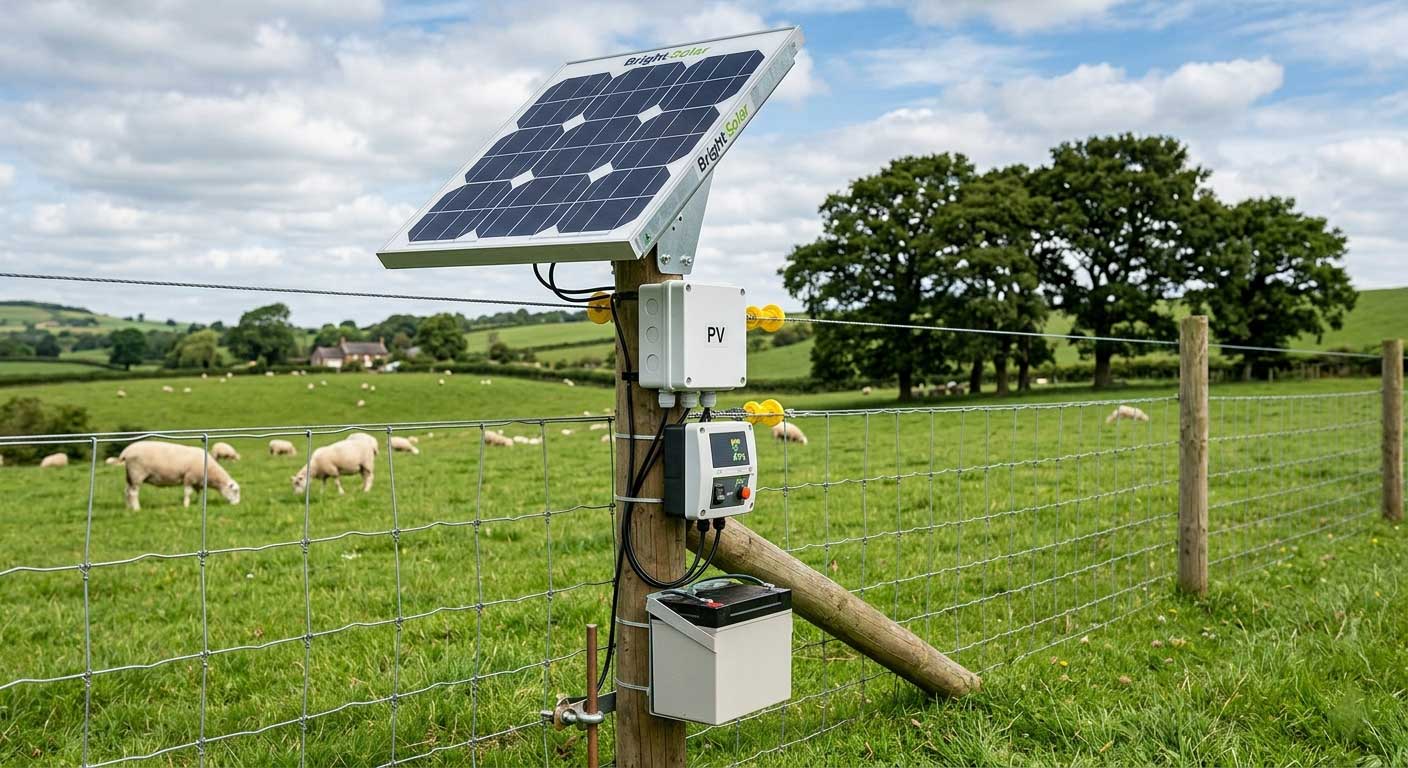
A typical solar fence system consists of four primary components:
| Component | Function |
|---|---|
| Solar Panel | Generates electricity |
| Battery | Stores energy |
| Charge Controller | Regulates charging |
| Fence Energizer | Produces electric pulses |
The solar panel charges the battery.
The battery powers the energizer.
The energizer delivers controlled electrical pulses through the fence wire.
This design provides a critical advantage.
The fence continues operating overnight and during periods of poor weather.
Without battery storage, reliability would decline significantly.
Why Battery Capacity Matters More Than Many Buyers Realize
One mistake I frequently encounter involves oversizing the solar panel while undersizing the battery.
The result looks good on paper.
It performs poorly in the field.
A fence may receive abundant sunlight for most of the week.
Then several cloudy days arrive.
The solar panel isn’t the problem.
Energy storage becomes the limiting factor.
Experienced installers often evaluate battery autonomy before evaluating solar production.
In practical terms:
A properly designed fence should continue operating even when weather conditions are temporarily unfavorable.
The battery acts as the system’s insurance policy.
Determining the Right Solar Panel Size
Fence energizers vary dramatically.
A small horse paddock requires far less energy than a large cattle operation spanning hundreds of acres.
Sizing depends on:
- Fence length
- Number of conductors
- Vegetation contact
- Animal type
- Energizer output
- Local solar conditions
General reference ranges often look like this:
| Fence Application | Common Solar Panel Range |
|---|---|
| Small Paddock | 10W–20W |
| Medium Farm Fence | 20W–50W |
| Large Livestock Fence | 50W–100W |
| Extensive Perimeter Fence | 100W+ |
Actual requirements vary significantly.
A system designed for Arizona conditions may not be appropriate for northern climates with reduced winter sunlight.
According to the National Renewable Energy Laboratory (NREL), solar resource levels differ substantially across North America.
Source:
https://www.nrel.gov
This is why location-specific design remains important.
Livestock Applications: Different Animals, Different Requirements
Not all electric fences operate under identical conditions.
The behavior of the animals matters.
A lot.
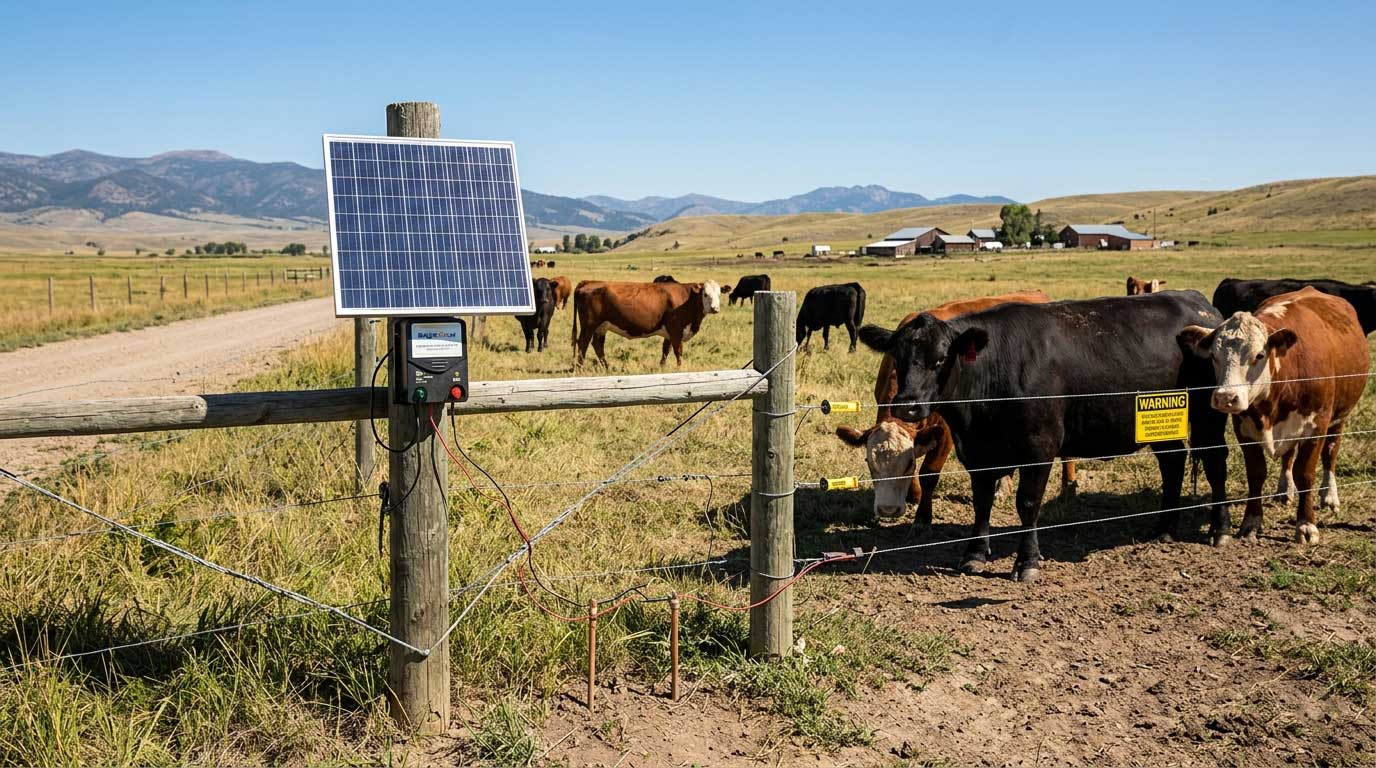
Cattle Fencing
Cattle generally respect properly energized fencing after initial training.
Power requirements are often moderate.
Fence maintenance becomes more important than increasing voltage.
Horse Fencing
Horse installations often prioritize visibility as much as electrification.
Tape conductors and highly visible fence materials are frequently used.
Consistent energizer performance remains critical.
Sheep and Goat Fencing
These animals create different challenges.
Particularly goats.
Goats possess an almost professional talent for testing weak points.
Solar systems protecting goat enclosures often require careful vegetation management and consistent voltage delivery.
Many fence failures blamed on equipment are actually vegetation problems.
Solar Electric Fence Performance During Winter
This topic generates more concern than almost any other.
“Will the fence still work in winter?”
The answer is yes—if the system is designed correctly.
Winter performance depends on:
- Battery capacity
- Flexible Solar panel sizing
- Snow accumulation
- Sun angle
- Fence load
- Geographic location
A properly engineered system accounts for the worst months rather than the best months.
This distinction is important.
Anyone can design a fence that works in July.
The real test occurs in December or January.
During a project review in Montana, we evaluated a fence system that performed perfectly for eight months of the year.
Then winter arrived.
Production dropped.
Battery reserves became inadequate.
The solution wasn’t complicated.
Additional solar capacity and increased battery storage resolved the issue.
The lesson remained valuable.
Systems should be designed around the most challenging conditions, not average conditions.
The Hidden Problem: Vegetation Contact
When fence owners experience voltage loss, they often blame the energizer.
Sometimes the energizer is innocent.
Vegetation is frequently the real culprit.
Grass, weeds, brush, and branches touching fence wires create energy leakage.
The effect accumulates gradually.
Performance declines.
Battery consumption increases.
Voltage drops.
Eventually, the fence appears ineffective.
Regular vegetation management often improves fence performance more than equipment upgrades.
This reality is rarely mentioned in product advertisements but becomes obvious during long-term operation.
Real Ranch Case Study: Reducing Maintenance Across 400 Acres
One project involved approximately 400 acres of grazing land in the southwestern United States.
The original system relied on manually recharged batteries.
Maintenance consumed significant labor time.
The ranch team routinely transported batteries for charging and replacement.
After transitioning to a solar-powered fence system:
- Manual charging trips were eliminated
- Fence uptime improved
- Labor requirements decreased
- Battery replacement frequency declined
The financial savings were meaningful.
The operational convenience was even more valuable.
For remote agricultural operations, reducing service visits often produces greater benefits than reducing electricity costs.
Common Mistakes When Buying a Solar Panel Electric Fence
After reviewing numerous installations, several recurring mistakes appear repeatedly:
Mistake #1
Choosing equipment based solely on fence length.
Fence load matters more than distance alone.
Mistake #2
Ignoring battery capacity.
Storage often determines reliability.
Mistake #3
Underestimating vegetation growth.
Even powerful systems struggle when conductors remain in constant contact with weeds.
Mistake #4
Designing for average weather instead of worst-case weather.
Reliable systems are engineered around difficult conditions.
Mistake #5
Purchasing oversized energizers without evaluating actual requirements.
More power does not always create better results.
What Actually Costs More: The Fence or The Problem It Prevents?
When people ask about the return on investment of a solar panel electric fence, they usually expect a discussion about equipment pricing.
That’s rarely where the real money goes.
A rancher in Oklahoma once told me something I still remember:
“The fence wasn’t expensive. Finding 30 cattle at 2 a.m. was.”
That comment sums up the economics better than any spreadsheet.
Most agricultural operators don’t install electric fencing because they enjoy buying fencing equipment. They install it because livestock escaping, wildlife entering, or perimeter failures become much more expensive than prevention.
A solar-powered fence removes one common point of failure: power availability.
No trenching.
No monthly electricity bill.
No driving miles into remote fields to swap batteries every few days.
Over several years, those savings accumulate quietly.
And unlike many farm investments, the benefits start immediately.
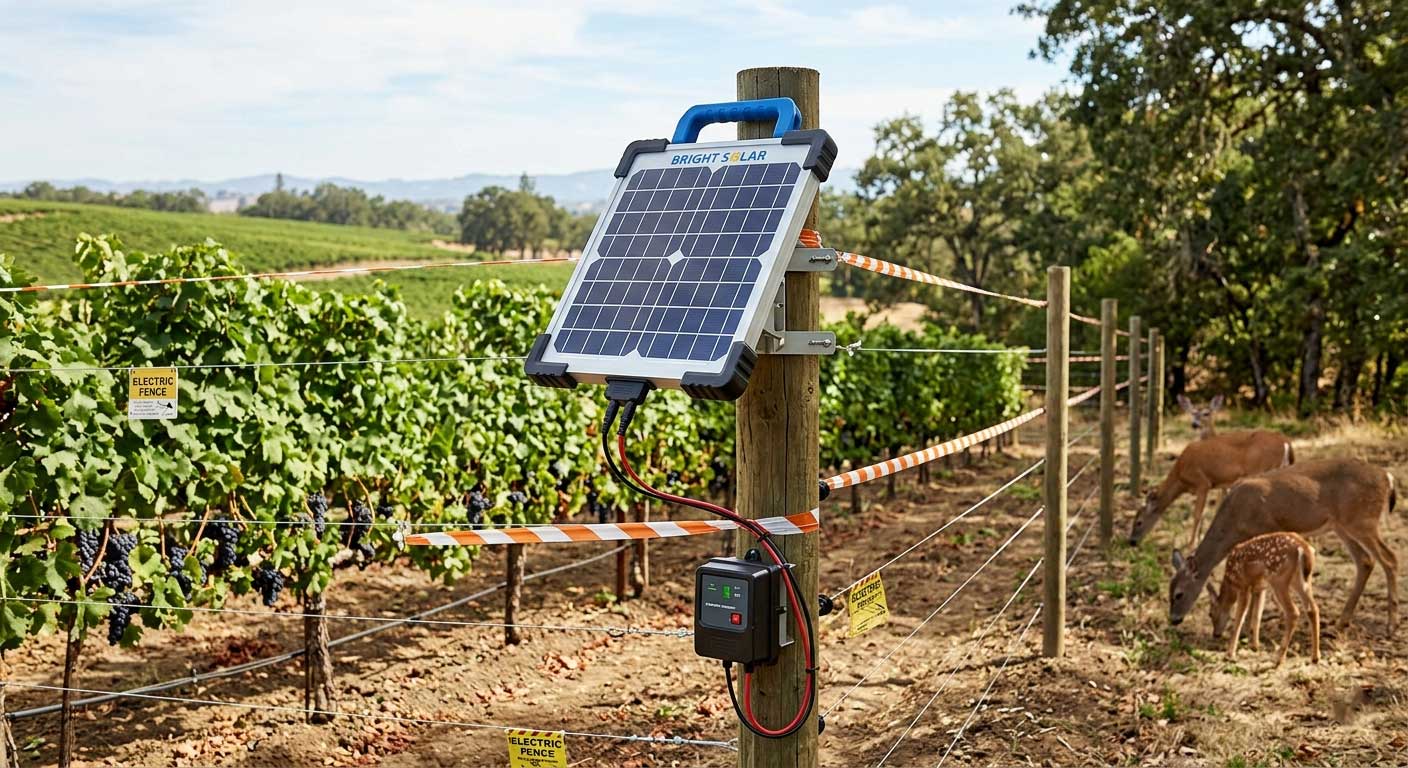
The Wildlife Problem Most New Landowners Underestimate
I occasionally visit properties where owners believe fencing is mainly about livestock.
Then the deer arrive.
Or wild hogs.
Or raccoons.
Or elk.
The conversation changes quickly.
The USDA has documented billions of dollars in agricultural losses associated with wildlife damage across the United States.
Source:
https://www.aphis.usda.gov
The interesting part is that many wildlife issues don’t require massive fencing systems.
They require consistent fencing systems.
A fence that operates at 7,000 volts every day is far more effective than one that occasionally reaches 10,000 volts but spends part of the week underpowered because the battery wasn’t charged.
Consistency beats peak performance.
That lesson appears repeatedly across agricultural infrastructure.
A Mistake I See Repeated Every Year
Most system failures are not caused by solar panels.
That surprises many buyers.
Panels usually perform exactly as expected.
The issue often starts with sizing assumptions.
Someone calculates energy consumption during summer.
Everything looks perfect.
Then December arrives.
The sun sits lower in the sky.
Cloud cover increases.
Days become shorter.
Battery reserves shrink.
Suddenly the fence that worked flawlessly for eight months becomes unreliable.
The problem wasn’t winter.
The problem was designing for July.
Good fence systems are sized around January.
That approach costs slightly more at installation and dramatically less afterward.
Why Grounding Determines Fence Performance More Than Panel Size
I’ve watched people spend hours comparing solar panel specifications.
Then install a grounding system in ten minutes.
Unfortunately, electricity doesn’t care about marketing brochures.
A fence energizer can be excellent.
A solar panel can be oversized.
The battery can be brand new.
Poor grounding can still make the entire system perform badly.
In dry regions such as Texas, Arizona, and parts of Australia, grounding frequently becomes the limiting factor.
One installation review involved replacing nearly every electrical component before anyone tested the grounding rods.
The original equipment wasn’t defective.
The grounding system was.
The replacement parts solved nothing.
The grounding upgrade solved everything.
That’s not an unusual story.
The Shift Toward Smarter Fence Systems
Five years ago, most owners checked fences manually.
Today, many larger operations are moving toward remote monitoring.
The technology isn’t complicated.
Sensors track:
- Fence voltage
- Battery status
- Solar charging performance
- Energizer activity
If voltage drops unexpectedly, the owner receives an alert before livestock discover the problem.
Large grazing operations have embraced these systems because labor costs continue rising.
Driving around hundreds of acres simply to verify fence performance is becoming harder to justify.
The fence itself hasn’t changed much.
The information surrounding it has.
Maintenance: Less About Electronics, More About Grass
If someone asked me to predict the biggest threat to a fence next month, I probably wouldn’t choose the battery.
I’d choose weeds.
Grass is surprisingly effective at stealing energy.
Especially after rain.
A fence line that looked clean in April can become a different environment by June.
That’s why experienced operators walk fence lines periodically even when the electrical equipment appears healthy.
Many voltage issues disappear after thirty minutes with a trimmer.
The solution is often botanical rather than electrical.
What I Would Choose for My Own Property
If I were designing a solar panel electric fence today for a medium-sized agricultural property, I would prioritize four things:
- A quality energizer from a proven manufacturer.
- More battery capacity than the minimum calculation requires.
- A conservative solar panel size.
- An oversized grounding system.
Notice what isn’t first.
The solar panel.
Most long-term reliability issues originate elsewhere.
Panels tend to be the easiest component to get right.
System balance is harder.
And balance is what separates a fence that operates for years from one that becomes a monthly maintenance project.
FAQ About Solar Panel Electric Fence
Can a solar panel electric fence run all year?
Yes. Properly sized systems with adequate battery storage are designed for year-round operation, including winter periods with reduced sunlight.
How many solar panels are needed for an electric fence?
Most installations require only one appropriately sized panel. The actual size depends on energizer consumption, battery capacity, and local solar resources.
Do solar fences work during cloudy weather?
Yes. Stored battery energy allows operation when sunlight is temporarily unavailable.
What voltage should an electric fence have?
Requirements vary by application, but livestock fences commonly operate between 2,000 and 8,000 volts depending on species and fence design.
How long does a solar fence battery last?
Lead-acid batteries typically last 3–5 years, while quality lithium batteries may last considerably longer under proper operating conditions.
Final Thoughts From the Field
After spending years around agricultural solar projects, one observation keeps resurfacing.
Owners rarely call to discuss a fence that works.
They call when it stops working.
The best solar panel electric fence installations are usually the least noticeable. Months pass. Sometimes years. The fence energizer pulses quietly, livestock stay where they belong, wildlife stays outside the perimeter, and nobody thinks about the system at all.
That’s the real benchmark.
Not the wattage of the solar panel.
Not the size of the battery.
Not the specifications printed on a brochure.
Reliability.
When a solar panel electric fence consistently performs in difficult weather, across changing seasons, and in remote locations where power isn’t available, it stops being a piece of equipment and becomes part of the property’s infrastructure. That’s ultimately what most operators are looking for.
Related recommendations
-

Car Roof Solar Panel: How It Works and What to Know
226Explore car roof solar panel options for EVs and conventional vehicles. Learn sizing, energy output, flexible PV, installation, shading, safety, and real-world limits.
View details -
Best Semi Flexible Solar Panel: How to Choose the Right One
118The best semi-flexible solar panel matches the surface curvature, power needs, weight, electrical ratings, and installation environment.
View details -
12 Volt Solar Panels for Reliable Off-Grid and Mobile Power
156Discover how 12 volt solar panels power RVs, boats, cabins, and off-grid systems. Learn sizing, performance, installation tips, and expert insights from Bright Solar.
View details -
Solar Panel Series vs Parallel: Which Wiring Setup Works Better?
237Compare solar panel series vs parallel wiring for RVs, boats, and off-grid systems. Learn efficiency, shading, voltage, and real installation tips.
View details