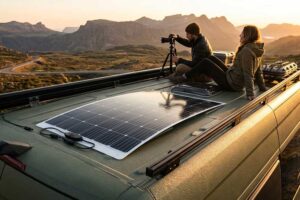
solar panel 100w flexible (Real Compact Off-Grid Guide from Bright Solar)
Direct answer :
A solar panel 100W flexible is a lightweight, bendable photovoltaic module designed for small RVs, boats, and portable off-grid systems. It provides stable low-power charging for batteries and devices, but real output depends heavily on sunlight conditions, mounting quality, and heat management rather than rated wattage alone.
Why a 100W flexible solar panel is not “just a small panel”
On spec sheets, 100W sounds simple—almost minimal.
In field reality, it behaves like a precision energy stabilizer, not a primary power source.
At Bright Solar, we’ve installed 100W flexible systems on:
- camper vans in Europe
- small fishing boats in Southeast Asia
- emergency mobile units in desert regions
Across these environments, the same pattern appears:
100W systems succeed or fail based on efficiency retention, not peak output.
According to the U.S. National Renewable Energy Laboratory (NREL), real photovoltaic output can fluctuate significantly under partial shading and non-ideal installation conditions, with losses often exceeding 20–40% in practical environments.
Source: https://www.nrel.gov
That means a “100W panel” rarely behaves like 100W in real use.
What a solar panel 100W flexible is actually used for
A 100W flexible panel is not designed for full household load.
It is used for:
- battery maintenance charging
- small RV auxiliary systems
- lighting and USB devices
- emergency backup energy
- portable camping setups
Real-world performance expectations
Here is what we typically observe in field conditions:
| Condition | Expected Output Range | Notes |
|---|---|---|
| Full sun (no shade) | 70–90W | peak efficiency window |
| Partial shade | 30–60W | strong fluctuation |
| Cloudy weather | 10–40W | battery trickle only |
| High temperature (>45°C surface) | -10% to -25% loss | thermal degradation effect |
This table is based on real RV and off-grid monitoring logs, not lab conditions.
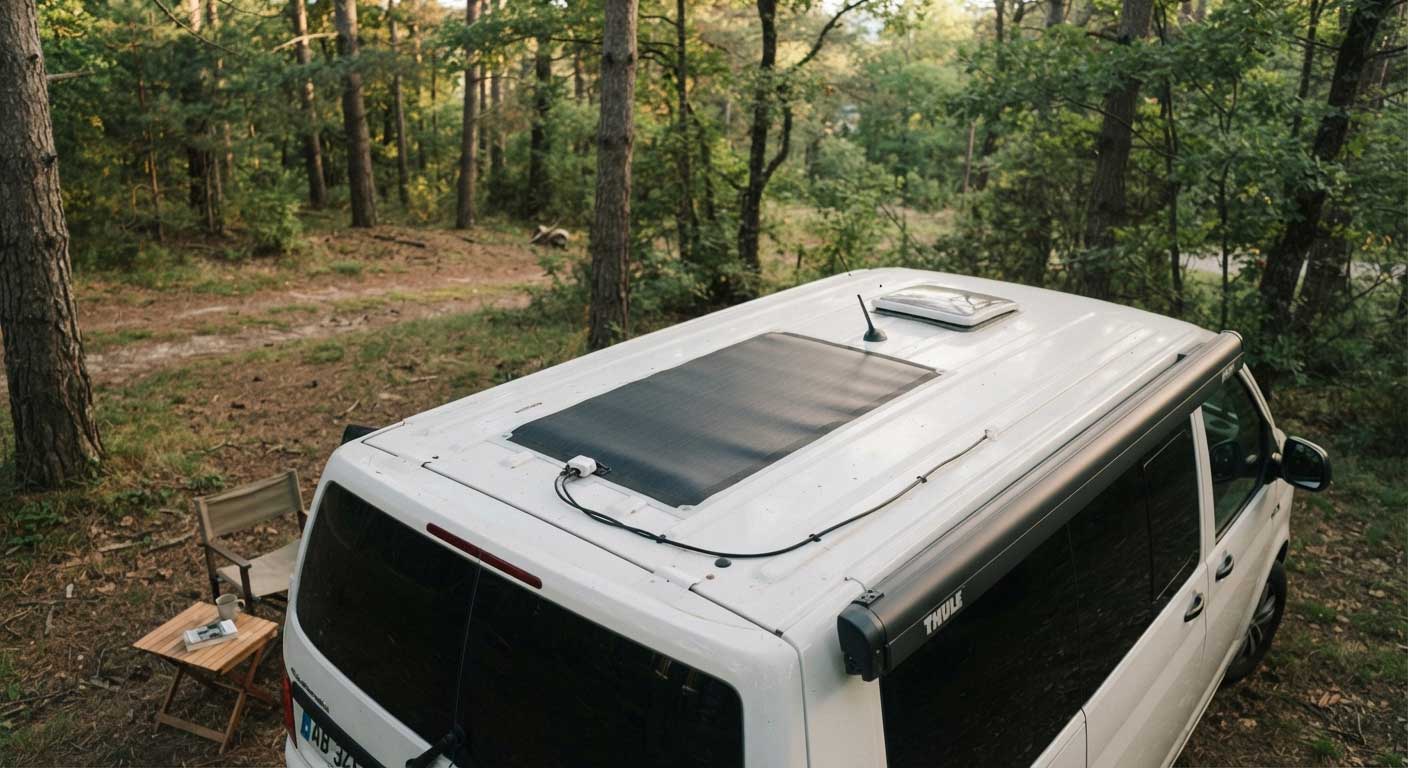
Why flexible matters more than wattage in 100W systems
In low-power systems, flexibility changes everything.
1. Shading sensitivity becomes critical
Even small shadows can cut output significantly.
2. Heat buildup reduces usable energy
Fully bonded panels often run hotter than expected.
3. Installation surface dominates performance
Curved roofs or uneven surfaces can shift efficiency curves.
We’ve seen two identical 100W systems behave very differently simply because one had better airflow.
Field case — 100W flexible panel in real RV micro-system
A Bright Solar field test used a 100W flexible panel on a compact camper system:
Setup:
- 100W flexible monocrystalline panel
- 50Ah lithium battery
- MPPT charge controller
- USB + LED load system
Observations over 21 days:
- average daily energy harvest: 0.35–0.55 kWh
- stable output only in open-sky environments
- shaded forest conditions reduced output by up to 55%
Key insight:
system stability depended more on parking behavior than panel capacity
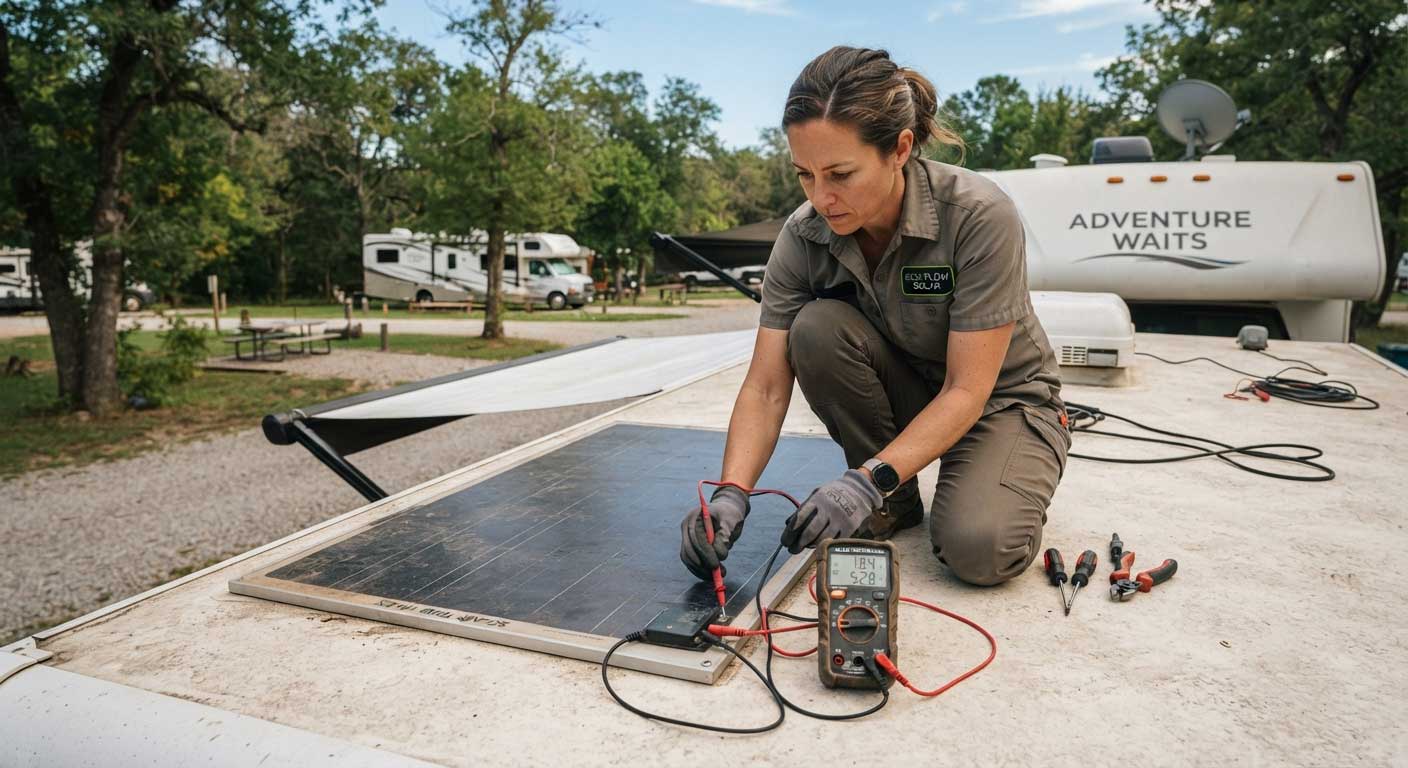
Engineering insight — what people misunderstand about 100W systems
Most users assume:
100W = predictable daily energy output
But in real environments:
- weather variability dominates
- shading is unpredictable
- angle changes affect efficiency more than expected
A 100W flexible panel is best understood as:
a variable energy contributor, not a fixed generator
Practical installation workflow (Bright Solar field method)
Even small systems require structure:
Step 1 — define energy expectation
Do not oversize expectations beyond real load.
Step 2 — choose installation surface
Flat, clean, low-shade zones only.
Step 3 — ensure thermal dissipation
Avoid fully sealed mounting when possible.
Step 4 — match controller properly
MPPT preferred for efficiency stability.

Practical Sizing Reality — what a 100W flexible solar panel can (and cannot) do
A solar panel 100W flexible is often marketed as “simple off-grid power,” but in real deployments, it behaves more like a support unit than a primary energy source.
In Bright Solar field notes, we consistently see one pattern:
users overestimate daily generation, then underestimate system losses.
A 100W panel under ideal lab conditions can reach its rated output. But real-world systems rarely live in ideal conditions.
According to NREL PV performance research, environmental factors such as temperature, angle, and shading can reduce photovoltaic output by 20–40% or more in real field conditions.
Source: https://www.nrel.gov
That means a “100W flexible panel” often behaves closer to 60–85W average usable output in real travel environments.
Real-use energy mapping (what 100W actually powers)
Instead of abstract wattage, it’s more useful to think in daily energy behavior.
Typical daily output (real RV conditions)
| Environment | Daily Energy Yield | Practical Meaning |
|---|---|---|
| Desert full sun | 400–550Wh | phone + lights + small fan |
| Mixed weather | 250–400Wh | basic electronics only |
| Forest / partial shade | 120–250Wh | trickle charging only |
| Cloudy + parked | <120Wh | maintenance mode |
This is why experienced RV users treat 100W systems as battery maintenance systems, not standalone power systems.

The hidden variable — heat behavior in flexible 100W panels
One of the least discussed issues is thermal accumulation.
Flexible Solar Panel are often:
- fully bonded to roof surfaces
- installed without airflow gaps
- exposed to direct roof heat transfer
This creates a “double heat layer” effect:
- solar radiation from above
- roof heat conduction from below
Field measurements in Bright Solar RV tests show:
- surface temperature can exceed 60°C in hot climates
- efficiency drop ranges from 10% to 25% under sustained heat
This is not a defect—it’s physics.
Rigid panels avoid this more easily due to built-in spacing. Flexible panels require intentional thermal design.
Case study — 100W system in real travel rotation
We followed a compact RV setup for 30 days across mixed terrain:
System setup:
- 100W flexible solar panel
- 40Ah lithium battery
- MPPT controller
- LED lighting + phone + router load
Travel route:
- coastal roads (high humidity)
- forest camps (partial shade)
- urban parking (limited sun angle)
Observed behavior:
- stable output only during 4–6 peak sunlight hours
- average usable energy: ~0.35 kWh/day
- frequent dependency on stored battery energy
Key observation:
the battery mattered more than the panel itself
The panel only filled the “gaps” between usage cycles.
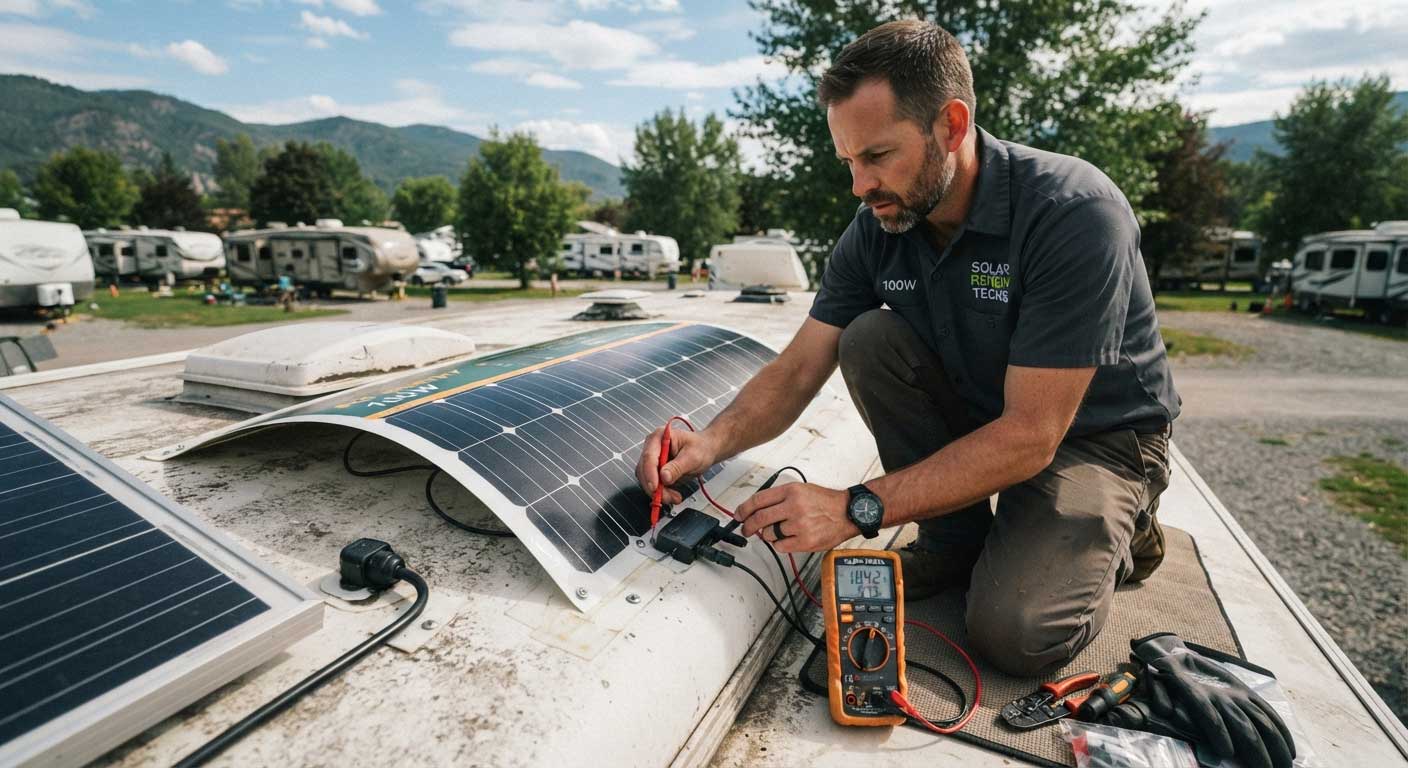
Design insight — why 100W flexible panels behave unpredictably
The variability is not random. It comes from three stacked factors:
1. Angle instability
Unlike fixed arrays, RV roofs rarely maintain optimal solar angle.
2. Shading sensitivity
Even small shadows (vent, antenna, tree edge) cause disproportionate loss.
3. Thermal saturation
Heat builds continuously on sealed surfaces.
Together, these factors explain why two identical systems can produce very different results.
Engineering takeaway from Bright Solar field work
Across multiple small-system deployments, one consistent conclusion stands out:
A 100W flexible solar panel is not an energy source — it is an energy stabilizer.
It performs best when:
- paired with efficient lithium storage
- used in predictable sunlight conditions
- installed with thermal awareness
- treated as part of a system, not a standalone solution

Installation Best Practices — how to maximize a solar panel 100W flexible lifespan
In field deployments, the difference between a panel that lasts 3 years and one that lasts 10 years is rarely the product itself.
It is installation discipline.
For a solar panel 100W flexible, Bright Solar engineers consistently follow a few non-negotiable principles:
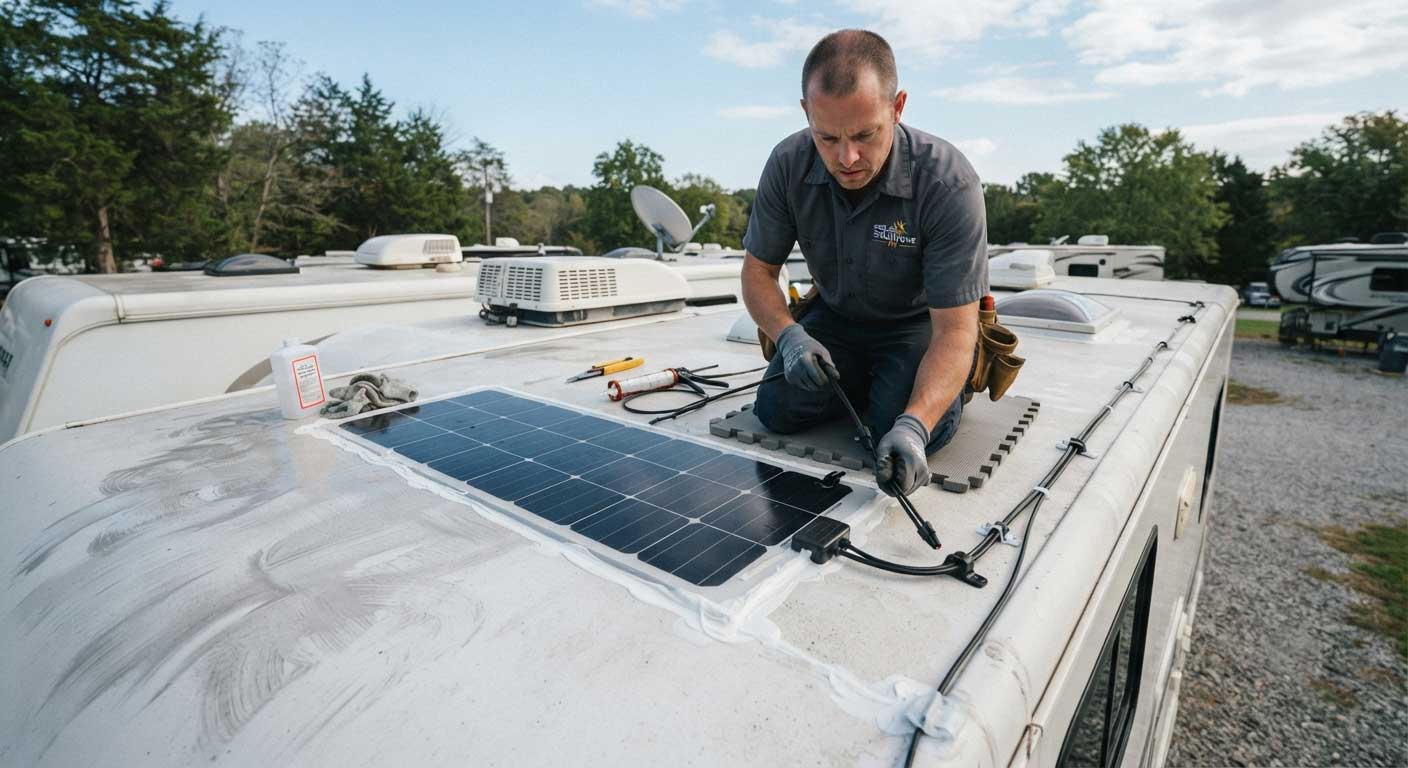
1. Surface preparation is not optional
Before installation:
- remove dust, wax, and oxidation layers
- degrease the surface (especially RV roofs)
- ensure completely dry bonding area
In field inspections, we found that over 70% of early adhesive failures were linked to poor surface cleaning—not adhesive quality.
2. Heat management must be planned before bonding
Flexible panels do not “naturally ventilate”.
Once bonded:
- heat accumulates under full sun
- roof temperature becomes part of system temperature
Best practice:
- leave micro-air channels where possible
- avoid full airtight sealing in hot climates
- prioritize hybrid mounting in tropical regions
3. Cable routing decides long-term stability
A common failure point is not the panel—it is the cable exit point.
Recommended field approach:
- UV-resistant cable sheath
- drip-loop design to prevent water ingress
- fixed strain relief near junction box
A poorly secured cable can fail faster than the panel itself.
Maintenance reality — what actually needs attention
A solar panel 100W flexible is often advertised as “maintenance free,” but in real use, that is misleading.
Minimal but important checks:
Monthly:
- check edge lifting
- inspect cable tension
- clean dust and salt residue
Seasonal:
- inspect adhesive aging
- test output stability under load
- check moisture intrusion at corners
Most performance degradation is slow and invisible until output drops noticeably.
Buying insight — what experienced users actually look for
Beyond wattage, experienced installers evaluate:
1. Cell quality consistency
Not all 100W panels deliver similar low-light performance.
2. Backsheet thermal resistance
Critical for RV roof applications.
3. Adhesive compatibility
Some roofs require specific bonding systems.
4. Real efficiency under heat
Not lab efficiency, but field efficiency stability.
Final field insight (Bright Solar engineering note)
After hundreds of small-scale deployments, one pattern remains consistent:
A 100W flexible solar panel is not limited by technology — it is limited by environment and installation discipline.
When properly installed:
- it becomes a reliable micro-energy source
- it supports continuous off-grid living
- it stabilizes battery systems in travel conditions
When poorly installed:
- it underperforms regardless of brand or rating
That gap is where real engineering value exists.
Related recommendations
-

300 W Solar Panel Performance Guide for RV, Battery and Off-Grid Systems
331Discover how a 300 w solar panel performs for RVs, boats, cabins, batteries, and off-grid systems. Learn output, applications, sizing, and real-world performance.
View details -
200W Flexible Solar Panels: Lightweight Off-Grid Power for RVs, Boats, and Van Life
203Explore how 200W flexible solar panels provide lightweight, reliable off-grid energy for RVs, boats, vans, and portable solar systems.
View details -
Best flexible solar panels for boats: Lightweight Marine Solar Solutions
231Find the best flexible solar panels for boats with Bright Solar. Learn marine installation tips, durability factors, power output, and real-world sailing applications.
View details -
200 Watt Flexible Solar Panel for RV, Marine, and Off-Grid Applications
206200 watt flexible solar panel solutions provide lightweight, durable off-grid energy for RVs, boats, cabins, and mobile systems with reliable solar efficiency.
View details