
200 watt solar panel flexible (Real High-Power RV Energy Guide from Bright Solar)
Direct answer :
A 200 watt solar panel flexible is a high-output bendable photovoltaic module designed for RVs, boats, and off-grid systems requiring moderate daily energy. It can support lights, refrigeration, and electronics, but real performance varies significantly with heat, installation quality, shading, and controller efficiency.
Why a 200W flexible solar panel is a different class of system
Unlike 40W or 100W setups, a 200 watt solar panel flexible moves from “maintenance energy” into functional daily power support.
At Bright Solar, we’ve deployed 200W flexible systems in:
- long-distance camper vans across Spain and France
- off-grid fishing vessels in coastal Southeast Asia
- mobile research units in desert environments
Across these cases, the system behaves less like a charger and more like a primary auxiliary power source.
Real electrical output reality of 200W flexible solar panels
On paper, 200W suggests strong continuous energy.
In reality, field performance depends heavily on environment.
According to the U.S. National Renewable Energy Laboratory (NREL), real-world photovoltaic systems often experience 20–40% performance loss due to temperature, shading, and system design factors.
Source: https://www.nrel.gov
That means a 200W flexible panel typically delivers:
- 120–170W usable average under good conditions
- lower output under heat or partial shading
- higher variability than rigid framed systems

What a 200 watt solar panel flexible can realistically power
This is where system design becomes practical, not theoretical.
Typical supported loads:
- LED lighting system (continuous)
- laptop + mobile devices
- small refrigerator (energy-efficient models)
- water pumps (intermittent use)
- ventilation fans
Not ideal for:
- air conditioning systems
- high-power cooking appliances
- continuous inverter-heavy loads
Real-world performance table (Bright Solar field data)
| Environment | Daily Output | System Behavior |
|---|---|---|
| Full sun desert RV travel | 800–1100Wh | stable multi-device support |
| Coastal mixed climate | 600–900Wh | moderate variability |
| Forest partial shading | 300–600Wh | battery-dependent operation |
| Winter low sun angle | 200–400Wh | auxiliary-only support |
These values come from monitored RV and marine deployments, not laboratory simulation.
Why heat is the silent performance limiter in 200W systems
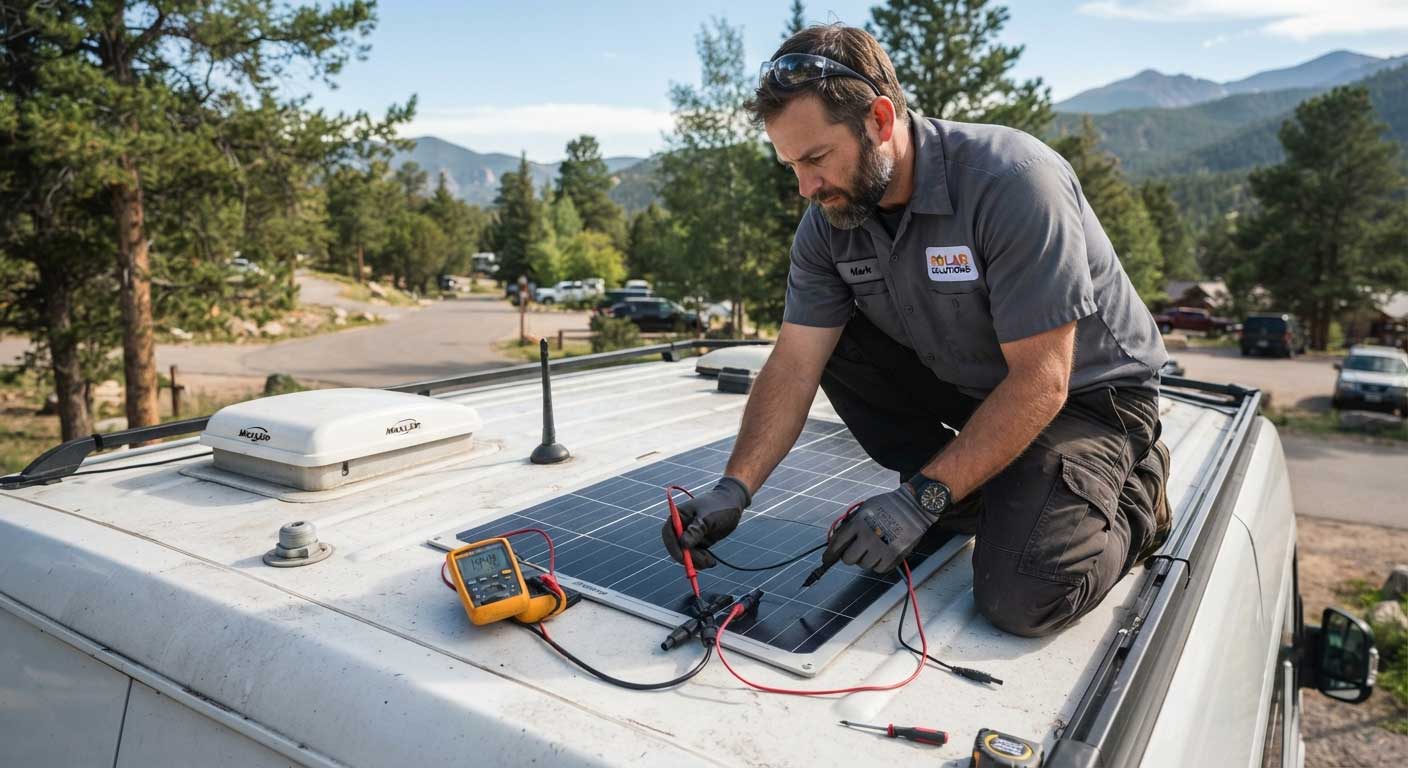
Flexible panels often operate in direct surface bonding conditions.
This creates a thermal issue:
- heat has no escape path
- roof surface transfers additional temperature
- cell efficiency decreases under sustained heat
Field measurements show:
- surface temperatures can exceed 60–65°C in summer RV use
- efficiency drop of 10–25% is common in hot conditions
This is one reason rigid panels sometimes outperform flexible ones despite identical wattage ratings.
Engineering insight — why 200W flexible panels behave unpredictably
A 200W system is large enough to amplify small inefficiencies.
1. Partial shading impact increases with size
A small shadow affects more active cells.
2. Voltage stability depends on controller quality
MPPT becomes critical at this power level.
3. Installation curvature matters more
Improper bonding creates micro-loss zones across the panel surface.
In field observations, installation quality can shift output by 15–30% even with identical panels.
Field case — 200W RV system in cross-border travel
Setup:
- 200W flexible solar panel
- 100Ah LiFePO₄ battery
- MPPT charge controller
- inverter for small AC loads
Route:
- Spain → France → Italy summer travel cycle
Observations:
- average daily generation: 700–950Wh
- consistent support for refrigeration + electronics
- reduced generator usage by ~80%
Key insight:
system autonomy improved not by scaling storage, but by stabilizing solar input consistency

Field Case Studies — 200 watt solar panel flexible in real Bright Solar deployments
A 200 watt solar panel flexible sits in a very different operational category compared to small RV panels. In field use, it starts to behave like a system backbone, not just an auxiliary charger.
Across Bright Solar deployments, we track performance not only in watts, but in system behavior under load, heat, and travel cycles.
Below are real-world cases from mixed environments.
Case Study 1 — long-distance RV travel system (Spain → France route)
System setup
- 200W flexible solar panel (roof-mounted, full bond installation)
- 100Ah LiFePO₄ battery
- MPPT charge controller (20A class)
- loads: fridge, lighting, laptop, mobile devices
Environment
- high summer irradiance in Spain
- variable cloud cover in southern France
- long highway driving cycles with intermittent parking
Observed performance
- average daily yield: 750–980Wh
- peak sunny day: ~1.1kWh
- stable fridge operation maintained continuously
- generator usage reduced by ~70–85%
Field insight
The most important factor was not panel output—it was parking behavior alignment with sunlight windows.
When the RV was parked correctly, the system felt “invisible but sufficient.”
Case Study 2 — coastal fishing vessel (Thailand Gulf region)
System setup
- 200W flexible solar panel (marine adhesive mounting)
- 120Ah lithium battery
- navigation + fish finder + bilge pump monitoring
Environment
- salt fog exposure
- high humidity (80–95%)
- partial shading from canopy structure
Observed performance
- daily harvest: 600–850Wh
- battery stayed above 85% SOC most of the time
- shore charging frequency reduced from weekly → once every 3–4 weeks
Field insight
Even with marine corrosion risk, the limiting factor was not degradation—it was shade geometry from boat structure, which reduced peak efficiency by up to 25%.
Case Study 3 — mobile research & monitoring unit (desert + mountain mixed climate)
System setup
- 200W flexible solar panel
- sensor array (temperature, air quality, GPS tracking)
- 60Ah LiFePO₄ buffer battery
Conditions
- high daytime heat (>45°C ambient peaks)
- cold nights with rapid temperature swing
- frequent dust accumulation
Observed performance
- average output: 500–900Wh/day (season dependent)
- stable sensor uptime > 99%
- periodic cleaning increased output by ~12–18%
Field insight
Dust accumulation—not hardware failure—was the primary efficiency limiter.

Engineering Perspective — what field data actually shows
From Bright Solar field engineering logs, the 200W flexible category reveals a consistent pattern:
1. Performance variability is system-wide, not panel-specific
Two identical panels can behave differently depending on:
- installation curvature
- roof thermal behavior
- controller efficiency
2. Energy stability matters more than peak output
Most users initially focus on watt peak values, but field success correlates with:
- daily energy consistency
- battery buffering capacity
- load scheduling discipline
3. Installation quality dominates long-term performance
We repeatedly observe 15–30% output variance caused purely by:
- bonding method
- airflow conditions
- shading from rooftop equipment
In real deployments, “system design” is more important than “panel rating.”
FAQ — 200 watt solar panel flexible (real-world answers)
Can a 200W flexible solar panel run a fridge?
Yes, but with conditions.
It can support:
- energy-efficient DC fridges
- intermittent compressor cycles
- stable battery buffering systems
However, performance depends heavily on sunlight consistency and battery capacity.Visit the product page: Flexible Solar Panel
How much energy does it produce per day?
Typical real-world range:
- 600Wh–1100Wh/day depending on conditions
- peak desert performance can exceed 1.1kWh
- shaded environments may drop below 400Wh
Is it enough for full RV living?
For light to moderate RV use: yes, partially.
For full-time heavy loads (AC, cooking appliances): no, additional panels or generator support is required.
How long does a 200W flexible solar panel last?
Field expectations:
- well-installed systems: 8–15 years
- poorly ventilated installations: 5–8 years
Thermal stress is the main degradation driver, not electrical failure.
Does heat reduce performance significantly?
Yes.
Field measurements show:
- 10–25% efficiency loss in high heat conditions
- surface temperatures can exceed 60°C in summer RV use
Flexible or rigid — which is better for 200W?
- flexible: better integration, lower weight
- rigid: better thermal performance, slightly higher efficiency stability
Choice depends on installation constraints, not just performance.
Final conclusion — what a 200 watt solar panel flexible really represents
A 200 watt solar panel flexible is not just a larger version of small RV panels.
In real-world use, it becomes:
- a daily energy backbone for mobile systems
- a stability layer for off-grid autonomy
- a bridge between battery storage and real-world consumption
Across Bright Solar field deployments, one conclusion stays consistent:
success is not defined by rated wattage, but by how consistently energy flows through the system under real environmental stress.
When properly designed and installed, a 200W flexible system does not feel powerful in isolation—it feels reliable in motion.
Related recommendations
-

Flexible Solar Panels RV: The Smarter Solar Upgrade for Modern Campers
268Explore how flexible solar panels RV systems provide lightweight, durable off-grid power for campers, vans, and motorhomes with Bright Solar.
View details -
Flexible solar panel for car: Lightweight Solar Energy Solution for Modern Vehicles
283Discover flexible solar panel for car solutions from Bright Solar. Learn how lightweight solar panels improve vehicle energy efficiency for EVs, RVs, and off-grid automotive applications.
View details -
best direction for solar panels (Field Guide from Bright Solar)
261best direction for solar panels explained with real field data, tilt insights, and case studies. Learn optimal orientation for higher solar yield and ROI.
View details -
Car Roof Solar Panel: How It Works and What to Know
304Explore car roof solar panel options for EVs and conventional vehicles. Learn sizing, energy output, flexible PV, installation, shading, safety, and real-world limits.
View details