Lightweight Folding Solar Panels: How to Choose the Right Portable Power System
Lightweight folding solar panels provide portable electricity for camping, RV travel, hiking, and off-grid use without the bulk of conventional rigid modules. The right choice balances panel weight, rated wattage, folded dimensions, and compatibility with your devices or power station.
For people who travel frequently, a solar panel is useful only if it is practical to carry, quick to set up, and capable of collecting enough energy for the equipment they actually use. A panel that looks compact in a product photo may still be awkward to store in a small camper. A higher-wattage model may generate more power in favorable sunlight but weigh too much for someone carrying equipment on foot.
Bright Solar provides flexible solar panel solutions for B2B customers developing products for RVs, outdoor power, and selected marine applications. When comparing lightweight folding solar panels with flexible solar modules, buyers should consider not just portability but also the intended installation method, electrical requirements, and operating environment.
What Are Lightweight Folding Solar Panels?
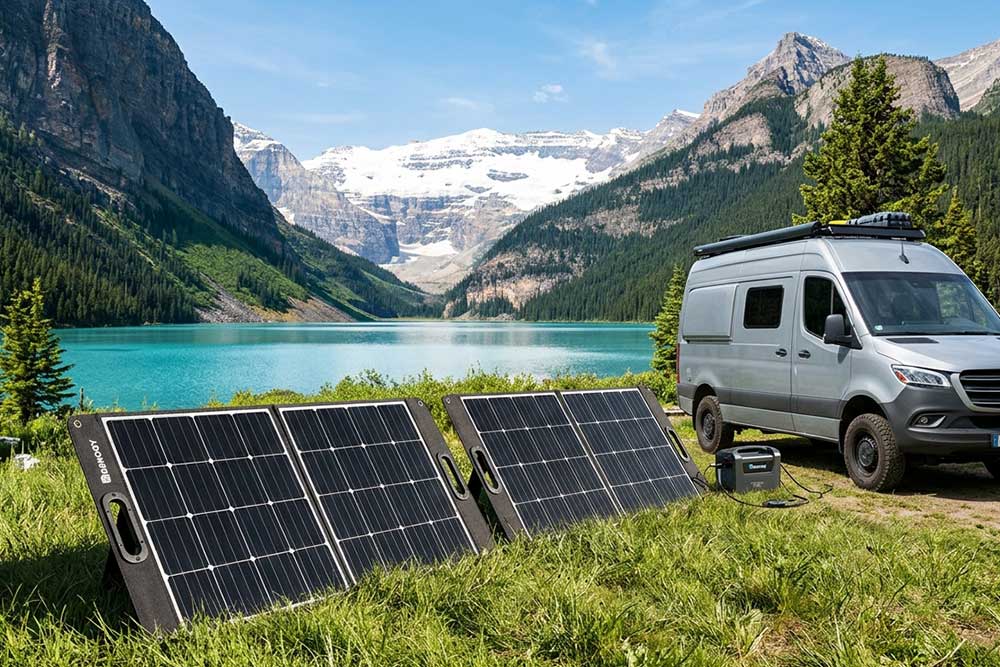
Lightweight folding solar panels are portable photovoltaic panels designed to collapse into a smaller package for transport and storage. Most use multiple solar sections connected by hinges or flexible fabric, with support legs or a carrying case to simplify setup outdoors.
When unfolded, the sections capture sunlight and convert it into direct-current electricity. Depending on the model, the output can charge compatible USB devices, feed a portable power station, or connect to a suitable battery system through the required charge controller.
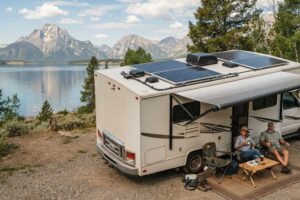
Their main advantage is mobility. Instead of permanently attaching a panel to a vehicle roof, users can take it out when needed, position it in sunlight, and pack it away before driving.
Common applications include:
- Camping and hiking: charging phones, GPS devices, cameras, and small battery packs.
- RV travel: supplementing the energy supply of a compatible portable power station.
- Boating: providing temporary charging where the product is appropriate for the marine environment.
- Emergency preparedness: supplying supplemental electricity when conventional power is unavailable.
- Outdoor work: supporting small electronic devices at remote locations.
One distinction matters before buying. Lightweight folding solar panels are not necessarily the same as lightweight flexible solar panels. Folding products generally use hinged sections that open and close; flexible modules are designed to bend within specified limits and may be integrated into suitable curved surfaces. They solve different installation problems.
Why Lightweight Folding Solar Panels Matter for Portable Power
Weight is not a minor specification when equipment has to be carried repeatedly. It affects whether a panel can be packed into a hiking bag, lifted into an RV storage compartment, or moved around a campsite to follow the sun.
Easier Transport and Storage
A folding design reduces the area occupied during transport. This can be especially useful when an RV already contains bedding, cooking equipment, water containers, and other travel essentials.
However, compare the complete packed system, not just the solar panel itself. Carrying cases, extension cables, stands, adapters, and controllers can add noticeable weight and bulk.
More Freedom to Position the Panel
A portable panel can be moved away from a vehicle parked under a tree or repositioned when a shadow crosses the campsite. This flexibility can improve energy collection without requiring permanent roof installation.
The trade-off is that someone must set up and reposition the panel. A fixed installation may be more convenient for travelers who want solar power available whenever the vehicle is parked.
A Practical Alternative to Permanently Mounted Panels
Lightweight folding solar panels are particularly useful when a vehicle cannot accommodate a permanent installation or when users want to take the same equipment on different trips.
They also make it easier to keep the solar collection area separate from the battery and the equipment being charged. That arrangement allows users to place the panel in sunlight while keeping a power station in a shaded, ventilated location within the manufacturer’s operating limits.
How Much Power Can Lightweight Folding Solar Panels Generate?
The panel’s rated wattage indicates its nominal power under specified test conditions. It does not mean the panel will deliver that power continuously throughout a camping day.
According to the U.S. Department of Energy, photovoltaic cells convert sunlight into electricity, and module performance depends on factors including solar irradiance, temperature, and system design. Outdoor output therefore varies with weather, orientation, shading, and electrical losses.
Source: U.S. Department of Energy — Solar Photovoltaic Technology Basics.
Typical Wattage and Suitable Applications
The following table provides illustrative wattage categories for planning. These are general examples, not verified specifications for a particular Bright Solar product or a guarantee of market availability.
| Rated power | Possible applications | What to consider |
|---|---|---|
| 20–40W | Phones, GPS devices, small electronics | Limited energy for multiple devices or poor weather |
| 50–80W | Cameras, tablets, battery packs | Connector compatibility and available sunlight |
| 100–120W | Camping systems and compatible power stations | Packed size, weight, and input voltage |
| 160–200W or more | Larger power stations and greater energy demand | More deployment space and potentially more weight |
A 100W panel may be a useful compromise for vehicle-based camping, but it is not automatically the best choice for hiking. Someone carrying every item in a backpack may prefer a smaller panel even if it collects less energy.
Estimate Daily Energy Before Buying
Use this basic planning formula:
Estimated daily energy (Wh) = rated power (W) × peak sun hours × system derating factor
For example, assume a 100W panel receives four equivalent peak sun hours, with an illustrative system derating factor of 0.75.
100W × 4 hours × 0.75 = 300Wh per day
The 0.75 factor is an assumption for this example, not a measured efficiency rating or a universal industry standard. Actual energy may be lower when clouds, partial shade, poor orientation, or conversion losses reduce performance.
For location-specific estimates, use the National Renewable Energy Laboratory’s PVWatts Calculator.
Source: NREL PVWatts Calculator.
The important distinction is between watts and watt-hours. Watts describe power at a given moment; watt-hours describe energy accumulated over time. That difference is essential when matching a panel to a battery or estimating whether a day’s sunlight can cover a device’s energy consumption.
How to Choose Lightweight Folding Solar Panels
The lightest panel is not always the best purchase. A useful comparison starts with the load you need to power and works backward to the panel, battery, connectors, and available storage space.
1. Check the Weight of the Complete Kit
Manufacturers may list the weight of the panel without its carrying case or accessories. Ask for both the panel-only weight and the total packed weight.
For backpacking, every additional item competes with food, water, clothing, and safety equipment. For RV travel, a slightly heavier panel may be acceptable if it provides more output and can be stored easily.
2. Compare Folded and Unfolded Dimensions
Folded dimensions tell you whether the panel fits into a backpack, cabinet, or vehicle compartment. Unfolded dimensions tell you how much space it needs to collect sunlight.
Measure the actual storage area before purchasing. In a small camper, a panel that is only a few centimeters too wide can become inconvenient to pack, even if its rated power is suitable.
3. Match Wattage to Daily Energy Demand
Make a short list of the devices you expect to charge. Record their battery capacities or energy consumption, then estimate how frequently they will be used.
A phone and a camera battery require a different setup from a portable refrigerator or a collection of high-power appliances. Larger loads may require a higher-wattage panel, a battery with adequate capacity, and an inverter if the equipment uses AC electricity.
4. Verify Electrical Compatibility
Before connecting a panel to a power station, check the following specifications:
- Maximum permitted solar input voltage.
- Panel open-circuit voltage (Voc).
- Operating voltage and maximum input power.
- Connector type and polarity.
- Whether a charge controller or specific adapter is required.
Do not connect panels based on connector shape alone. A plug that fits does not establish electrical compatibility.
5. Inspect Construction and Weather Protection
Look at the hinges, stitching, support legs, cable strain relief, and connector covers. These components experience repeated handling, folding, transport, and exposure to outdoor conditions.
An IP rating can help assess protection against dust and water, but it must apply to the relevant product or component. Do not assume the entire kit can withstand heavy rain because one connector or junction box has a stated protection rating.
Lightweight Folding Solar Panels for Camping and RV Travel
Camping and RV use often demand a different balance between portability and energy production. A hiker may prioritize minimum weight, while an RV traveler can usually accommodate a larger panel and battery in exchange for more charging capacity.
Camping: Keep the Setup Simple
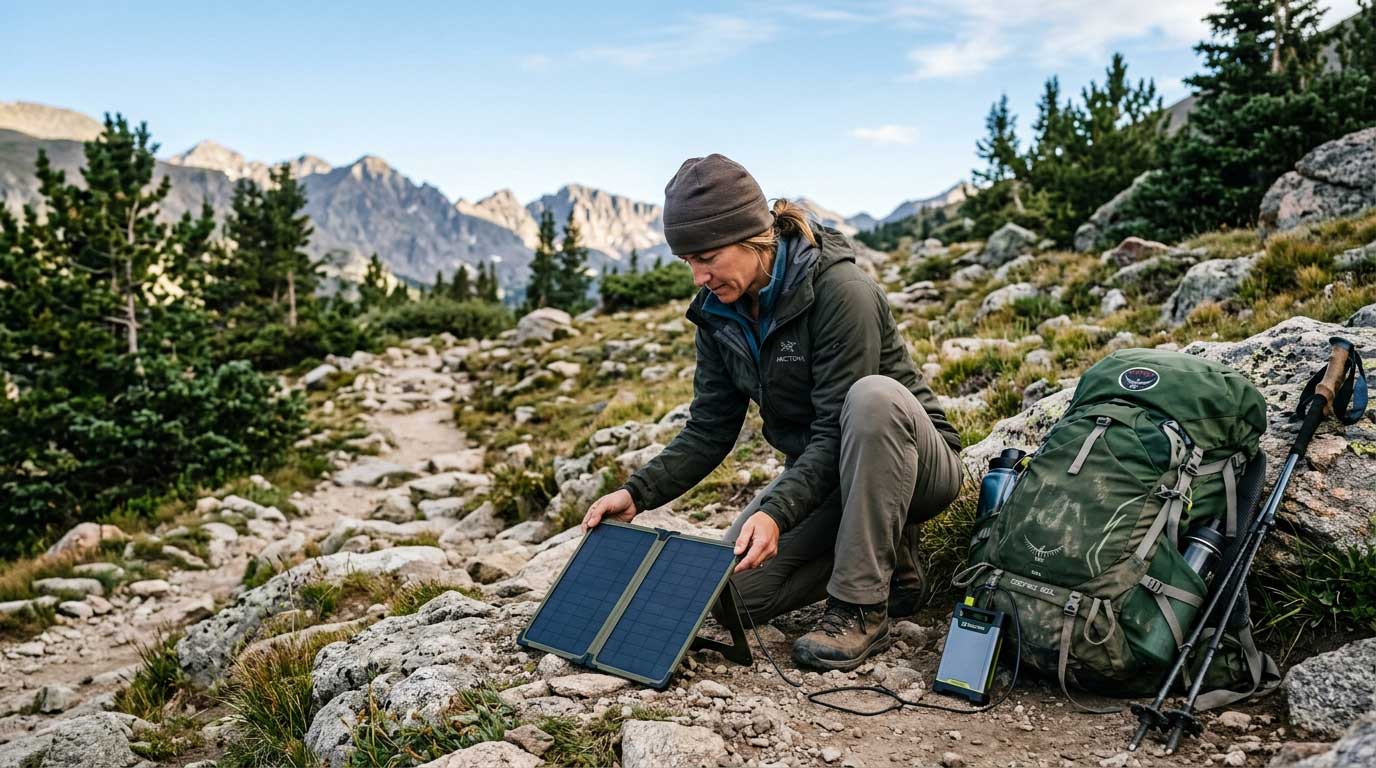
For a weekend tent trip, the primary loads may be a phone, a headlamp, a GPS device, and a camera. A compact panel connected to a compatible power bank can be convenient because the battery stores energy while the panel is exposed to sunlight.
Avoid leaving the panel in an exposed location where people might step on it or where wind can overturn it. At a crowded campsite, place cables where they will not become a trip hazard.
RV Travel: Balance Portability With Daily Consumption
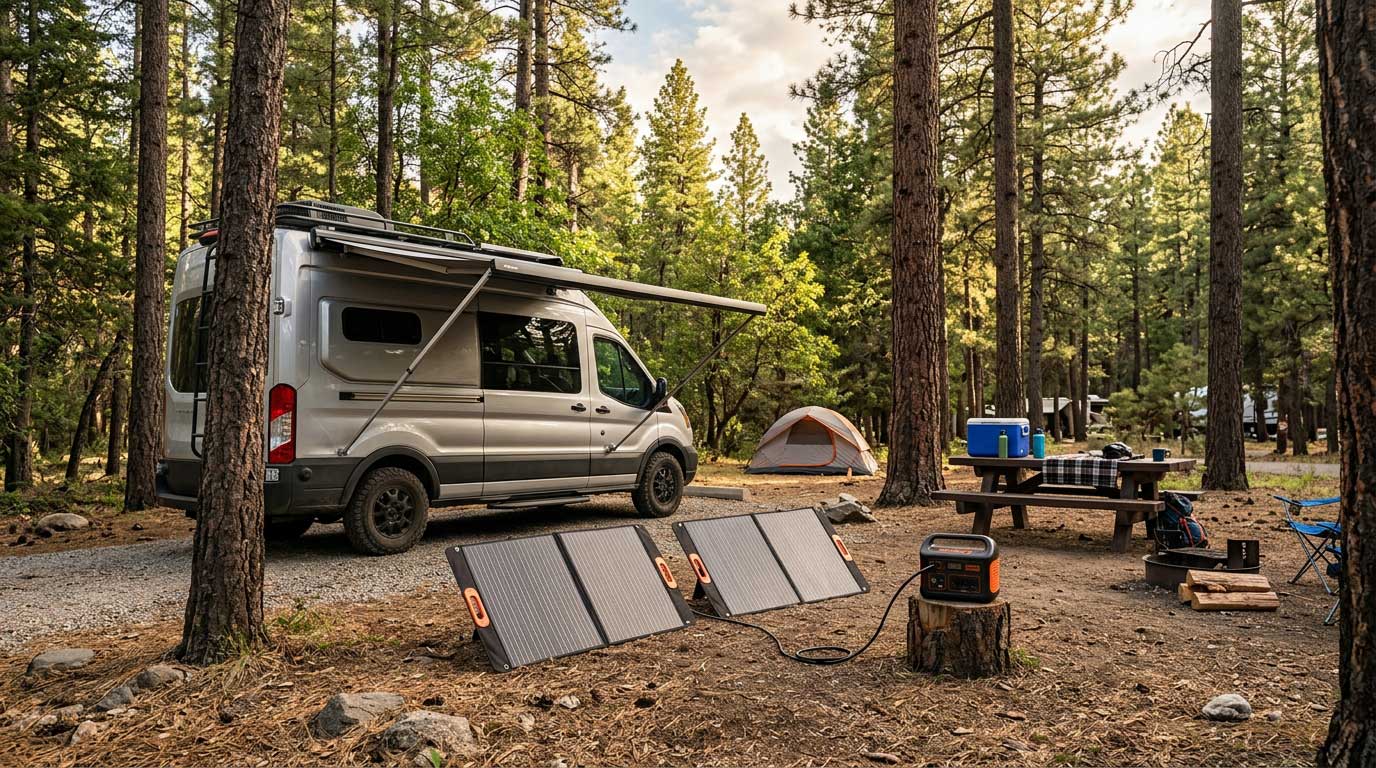
An RV traveler may need to charge several devices and supplement a larger battery system. In that case, a folding panel with a compatible power station can be deployed outside the vehicle while the battery remains in an appropriate shaded and ventilated position.
Consider the complete energy system rather than the panel alone. A larger panel will not solve an overnight energy shortage if the battery is too small, and a large battery cannot replenish itself quickly when the panel receives limited sunlight.
A Realistic Planning Example
Consider a hypothetical two-day RV trip using a 100W folding panel. The traveler estimates four peak sun hours per day and uses the same illustrative 0.75 derating factor.
| Calculation | Result |
|---|---|
| Rated panel power | 100W |
| Assumed peak sun hours per day | 4 |
| Estimated daily energy | 300Wh |
| Estimated energy over two similar days | 600Wh |
This estimate assumes similar sunlight on both days and does not represent measured customer performance. If the second day is cloudy or the panel is shaded by trees, actual production may be considerably lower.
A practical field record should include the time of day, weather, panel position, and the power station’s accumulated energy reading. Comparing these measurements across several trips gives the owner a better basis for deciding whether to carry a larger panel or reduce energy consumption.
Lightweight Folding Solar Panels vs. Flexible Solar Panels
Both product types serve mobile solar applications, but their construction and installation methods differ.
| Feature | Lightweight folding solar panels | Flexible solar panels |
|---|---|---|
| Main design | Multiple sections that fold for transport | Thin module designed to bend within specified limits |
| Typical use | Temporary outdoor charging | Suitable integrated or surface-mounted applications |
| Setup | Usually unfolded and positioned for sunlight | Depends on mounting design and installation |
| Storage | Folds into a compact package | May be rolled or handled only if the manufacturer permits it |
| Best selection criteria | Packed weight, folded size, output, connectors | Bend limits, dimensions, mounting, electrical specifications |
A flexible panel should not be treated as a folding panel simply because it bends. Repeated folding can damage a module that was designed for limited curvature rather than articulated movement. Similarly, a folding panel should not be permanently mounted on a curved roof unless the manufacturer explicitly approves that application.
Where Bright Solar Fits
Bright Solar specializes in flexible solar panel solutions for business customers, including RV and camper applications, outdoor power, and selected marine uses.
Its L Series offers lightweight, thin solar modules with a stated maximum bending capacity of up to 30%. The actual installation must follow the relevant model’s permitted curvature and mounting requirements; the percentage should not be interpreted as a universal bending radius or a guarantee of unlimited repeated flexing.
For B2B buyers, the decision often begins with the finished product:
- A retailer sourcing a portable charging kit may prioritize folded dimensions, carrying weight, and ready-to-use output connections.
- An RV equipment manufacturer may prioritize module dimensions, mounting constraints, and electrical integration.
- A marine equipment supplier may need to assess the intended environment, surface materials, salt-water exposure, and the documented protection of the complete system.
Bright Solar’s flexible modules may be worth evaluating when the project requires a lightweight solar component rather than a complete folding charger. Confirm the exact product configuration and specifications before making a design or procurement decision.
Common Mistakes to Avoid When Buying Lightweight Folding Solar Panels
Some problems appear only after the first trip, when the panel must fit into a crowded vehicle or produce enough energy in less-than-ideal weather.
- Comparing panel weight without accessories: Check the packed weight of the complete kit.
- Buying by wattage alone: Compare output with your daily energy needs and the receiving equipment’s input limits.
- Ignoring folded dimensions: Measure the actual storage space available in a backpack, vehicle, or RV cabinet.
- Assuming cloudy-day output will be sufficient: Solar production varies with available sunlight; plan for lower-output conditions.
- Overlooking connector requirements: Confirm voltage, polarity, connector type, and controller compatibility.
- Confusing water resistance with full waterproofing: Check the rating and instructions for the complete product.
- Choosing a panel unsuitable for the installation: Folding and flexible modules have different structural requirements.
One useful purchasing habit is to compare two or three candidate products against the same checklist. Record packed weight, rated wattage, folded dimensions, connector type, and warranty terms. That makes the trade-offs clearer than relying on a single headline specification.
FAQ About Lightweight Folding Solar Panels
What are the lightest folding solar panels used for?
Lightweight folding solar panels are useful for charging phones, cameras, GPS devices, battery packs, and compatible portable power stations. Their main advantage is portability, making them suitable for hiking, camping, road trips, and temporary off-grid power.
Are lightweight folding solar panels worth buying for camping?
Yes, if your energy requirements match the panel’s output and you have access to adequate sunlight. They are convenient for charging small electronics and replenishing compatible battery stations. For frequent overnight use or larger loads, consider battery capacity and realistic daily energy production before choosing a panel.
How much power can a lightweight folding solar panel produce?
Output depends on rated wattage, sunlight, temperature, shading, orientation, and system losses. For example, a 100W panel with four equivalent peak sun hours and an assumed 0.75 derating factor produces an estimated 300Wh per day. This is a planning example, not a guaranteed result.
Can lightweight folding solar panels charge a portable power station?
Yes, provided the panel’s voltage, power rating, connector, and other electrical characteristics are compatible with the power station. Check its maximum solar input voltage and supported operating range before connecting the panel.
Are folding solar panels better than flexible solar panels?
They suit different needs. Folding panels are designed for portable deployment and compact storage, while flexible panels are intended for applications where a thin module may need to conform to an approved curved surface. Selection depends on mounting, transport, durability, and electrical requirements.
Do lightweight folding solar panels work in cloudy weather?
They can still generate electricity in cloudy conditions, but output generally falls as available sunlight decreases. Partial shade and dense cloud cover may significantly reduce production. For important equipment, maintain a suitable battery reserve rather than depending on a specific daily solar yield.
How should lightweight folding solar panels be maintained?
Follow the manufacturer’s cleaning and storage instructions. Keep the active surface free from dirt, inspect cables and connectors for wear, protect the panel from sharp impacts, and fold it only along its intended hinges. Dry the product before storage when required, and avoid exceeding its stated operating and weather-protection limits.
Technical References and Editorial Information
The technical principles and calculation methods in this article are supported by the following public resources:
- U.S. Department of Energy — Solar Photovoltaic Technology Basics: Explains photovoltaic electricity generation and the fundamentals of solar module operation. Read the DOE guide.
- National Renewable Energy Laboratory — PVWatts Calculator: Estimates photovoltaic system energy production using location and system parameters. Use the PVWatts Calculator.
- U.S. Department of Energy — Solar Photovoltaic Performance and Efficiency Basics: Explains factors that influence solar conversion performance. Read the performance guide.
Editorial note: Prepared for Bright Solar by its solar-content team. The article combines established photovoltaic principles with explicitly labeled illustrative calculations and practical selection considerations. The numerical camping examples are estimates, not claimed customer test results. Confirm product-specific wattage, weight, dimensions, electrical limits, and warranty details using the relevant manufacturer’s datasheet.
Related recommendations
-

Solar Power for RV Air Conditioner: Complete Guide
245Solar power for RV air conditioner systems can provide off-grid cooling. Learn solar panel sizing, battery capacity, inverter requirements, installation tips, costs, and practical RV applications.
View details -
12V Folding Solar Panels: Output, Battery Charging and Uses
1712V folding solar panels provide portable solar power for camping, RVs, and compatible off-grid battery systems. Their actual energy output depends on panel ...
View details -
flexible solar panels for rv (Real Field Engineering Guide from Bright Solar)
139flexible solar panels for rv explained with real installation cases, durability insights, RV roof design tips, and off-grid performance data for travelers.
View details -
Solar Panel for 12V Battery: How to Choose the Right Size, Power, and Setup
199Discover how to choose the best solar panel for 12V battery charging. Learn sizing, real-world performance, battery protection, and off-grid energy tips from Bright Solar.
View details