how to use a portable solar panel?
how to use a portable solar panel is straightforward: place the panel in unobstructed sunlight, connect it to a compatible portable power station or charge controller, verify the voltage and polarity, then monitor the charging process. The panel should match the electrical limits of the device being charged.
A portable solar panel is most useful when the power source needs to move with you—an RV campsite, boat deck, remote work site, garden shed, or weekend camping setup. In practice, the panel is only one part of the system. NREL identifies the PV module, charge controller, battery, mounting, and inverter as the main components in an off-grid solar setup.
What Do You Need to Use a Portable Solar Panel?
The simplest setup depends on what you want to charge.
| Use case | Basic connection | Extra equipment |
|---|---|---|
| Portable power station | Solar panel → power station | Correct solar charging cable |
| 12V battery | Solar panel → charge controller → battery | Fuse, suitable cables |
| RV battery bank | Solar panel → controller → battery | RV-compatible connectors |
| AC appliances | Solar panel → battery/power station → inverter | Inverter if AC output is required |
| Small DC devices | Panel → compatible controller/device | Depends on device input |
A common mistake is treating the panel like a wall outlet. A portable solar panel produces variable DC electricity. It does not automatically provide stable household AC power.
NREL‘s off-grid system documentation describes the charge controller as the component that regulates how PV electricity charges a battery, while an inverter converts DC electricity into AC electricity for appliances.
For a portable power station, the controller is often already built into the unit. Some manufacturers specifically state that their portable power stations have built-in charge controllers, so adding another controller can be unnecessary or inappropriate.
Check the Electrical Specifications First
Before connecting anything, compare:
- Solar panel Voc
- Solar panel operating voltage
- Solar panel maximum current
- Power station or controller maximum PV voltage
- Maximum PV input wattage
- Battery system voltage
- Connector type and polarity
This is where a few minutes with the specification sheet can prevent an expensive mistake.
For example, a portable panel may be advertised as “100W,” but that number alone does not tell you whether it is compatible with a particular power station. The input voltage range matters just as much.
How to Set Up a Portable Solar Panel Outdoors
Start with the panel folded or covered while making the electrical connections when the equipment manufacturer recommends doing so. Once the connections have been checked, open the panel toward the sun.
For battery-based systems using a separate charge controller, the connection order specified by the controller manufacturer matters. Renogy, for example, instructs users to connect the battery to the controller first and then connect the solar panel, while noting that certain prewired portable products are exceptions.
Then:
- Put the panel where nearby trees, vehicle roofs, tents, or equipment will not shade the active surface.
- Aim the panel toward the strongest available sunlight.
- Keep cables away from vehicle tires, walking paths, and standing water.
- Connect the panel to the correct solar input.
- Check the power station or controller display.
- Watch the charging value for several minutes rather than judging performance from the first reading.
The last point is easily overlooked. Cloud movement can make the displayed wattage jump around. NREL notes that solar output depends on conditions including orientation, tilt, and shading rather than remaining at the panel’s rated value continuously.
Where to Place a Portable Solar Panel
A good field position is often more important than simply moving the panel into “sunlight.”
Try to avoid:
- Partial shade across even part of the panel
- Low-angle sunlight blocked by trees
- Hot surfaces that restrict airflow around the panel
- Loose cables pulling against connectors
- Locations where people may step on the panel
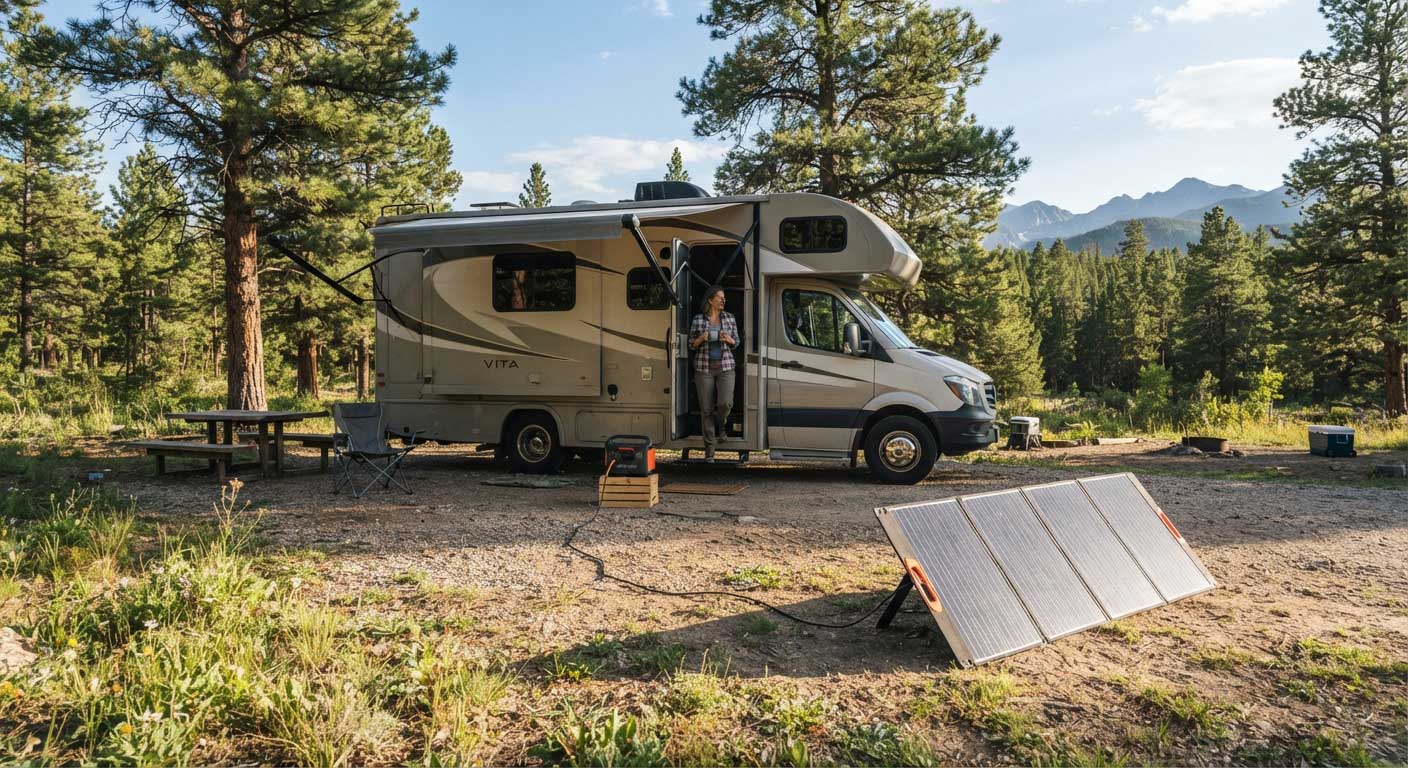
On an RV trip, for example, moving a portable panel several metres away from the vehicle can sometimes give it a much cleaner view of the sky than leaving it beside the RV in partial shade.
How to Connect a Portable Solar Panel to a Battery
If the panel is charging a conventional battery rather than a power station, use a compatible solar charge controller between the panel and battery.
The basic arrangement is:
Portable Solar Panel → Charge Controller → Battery → Inverter or DC Loads
The controller regulates the solar input before it reaches the battery. NREL describes this as a core function of an off-grid PV system.
For example, a 100W panel on a nominal 12V system should not simply be connected directly to a 12V battery unless the equipment is specifically designed for that connection. A properly matched controller manages charging voltage and current.
MPPT controllers can also be useful when panel voltage is significantly higher than battery charging voltage. Current technical guidance from Renogy describes MPPT controllers as DC converters that can accept higher PV voltage and convert it to the voltage required by the battery; the manufacturer reports typical MPPT efficiency above 90%, depending on operating conditions.
Cable length deserves attention too. Longer cable runs increase voltage drop, so a portable panel positioned far from an RV or battery should use appropriately sized cable rather than simply adding a very long extension.
How to Use a Portable Solar Panel for Camping or RVs
For camping, keep the system simple.
A practical arrangement is:
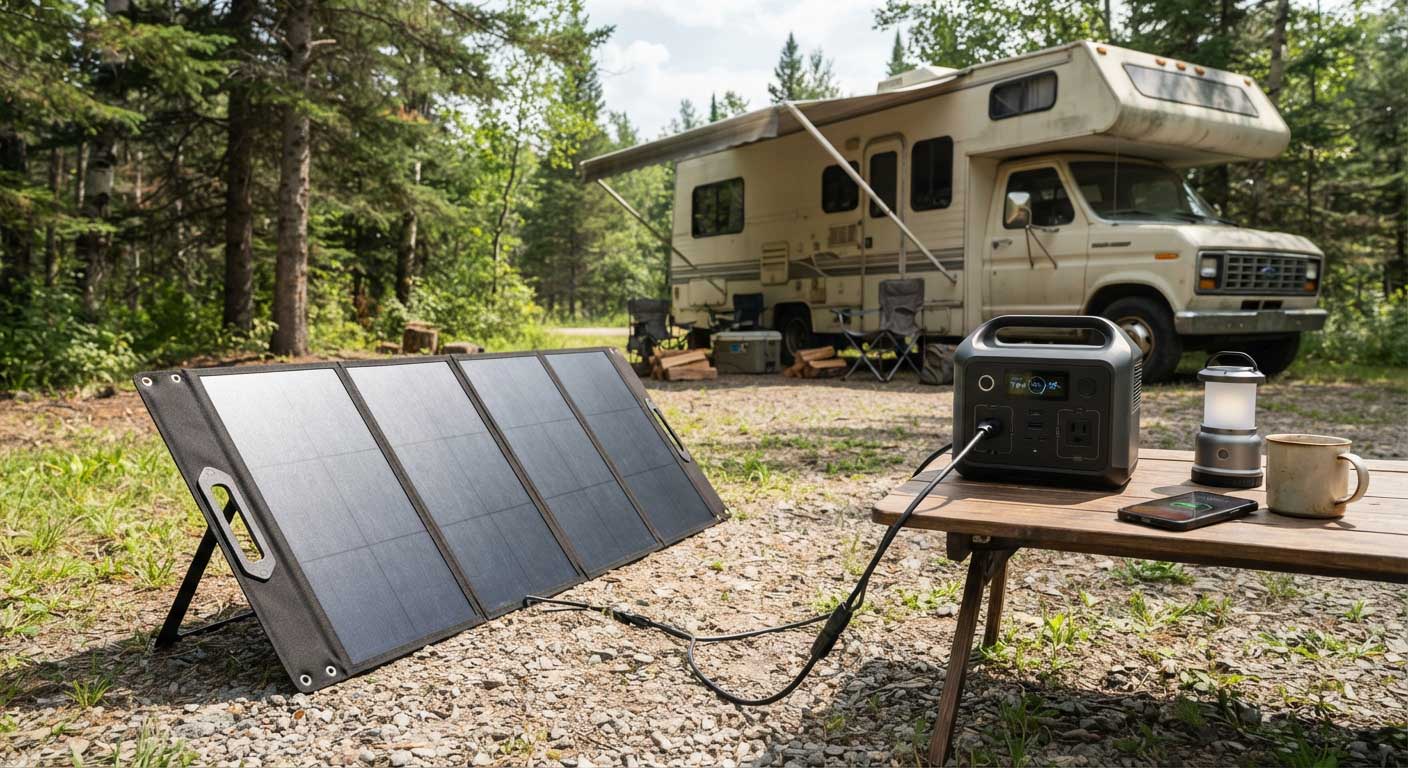
Panel → Portable Power Station → USB/DC/AC Loads
This works well for phones, cameras, laptops, lights, communication equipment, and other modest electrical loads when the power station accepts the panel’s voltage and wattage range.
For an RV battery system, the arrangement is usually:
Panel → Solar Charge Controller → RV Battery → RV Loads
Do not assume that an RV’s existing solar connector is automatically compatible. Connector type, controller arrangement, voltage limits, and wiring configuration all need to be checked. Renogy’s compatibility guidance, for example, distinguishes between different RV ports and controller configurations.
Bright Solar‘s practical approach to portable solar applications is to start with the actual electrical requirements rather than choosing a panel solely by wattage. A 100W panel, 200W panel, or larger portable array should be matched to the storage system and the expected daily load.
Quick Field Check Before Leaving the Panel
Before walking away from the setup, check:
- Is the panel receiving direct sunlight?
- Is the charging indicator active?
- Is the input voltage within the device’s permitted range?
- Are positive and negative connections correct?
- Are connectors fully seated?
- Is the cable protected from foot traffic and vehicle movement?
- Is the battery or power station actually accepting charge?
That final display check is surprisingly useful. A panel can be sitting in bright sunlight while the connected equipment is receiving little or no energy because of an incompatible input range, a loose connector, shading, or a controller limitation.
Common Mistakes When Using Portable Solar Panels
A few problems appear repeatedly in real installations:
- Buying by wattage alone: 200W does not automatically mean compatible with every 200W-rated system.
- Ignoring Voc: The panel’s open-circuit voltage must remain within the controller or power station’s permitted PV input.
- Leaving partial shade: A seemingly small shadow can affect actual output.
- Using unsuitable connectors: Mechanical fit does not always mean electrical compatibility.
- Skipping the controller: Conventional battery charging normally requires appropriate charge regulation.
- Expecting rated wattage all day: Panel ratings are based on defined test conditions, not guaranteed continuous production.
- Using excessive cable length: Longer runs can increase voltage drop.
FAQ About How to Use a Portable Solar Panel
Can I connect a portable solar panel directly to a power station?
Yes, if the power station specifically accepts solar/PV input and the panel’s voltage, current, wattage, and connector are within its specifications. Many portable power stations have a charge controller built in.
Can I connect a portable solar panel directly to a 12V battery?
For a conventional 12V battery system, use a properly matched solar charge controller unless the panel and battery system are specifically designed for direct charging.
Does a portable solar panel work on cloudy days?
Yes. Solar modules can still produce electricity under diffuse light, but output will generally be lower than under strong direct sunlight. Actual production varies with weather, orientation, shading, and system conditions.
Can I use a portable solar panel to run a laptop?
Yes, but the practical setup depends on the laptop’s power requirements. A compatible power station or battery-and-inverter system is usually needed unless the laptop can accept the panel’s regulated DC output directly.
How long does a portable solar panel take to charge a power station?
There is no single charging time. Panel wattage, available sunlight, power-station input limits, battery capacity, temperature, shading, and conversion losses all affect the result.
Should I use MPPT or PWM with a portable solar panel?
Either can be appropriate. The correct choice depends on the panel voltage, battery voltage, controller limits, and system size. MPPT controllers can be advantageous when the PV voltage is substantially higher than the battery voltage.
Can I leave a portable solar panel outside all day?
Only when the panel and its electrical components are rated for the outdoor conditions involved. Protect connectors, cables, controllers, and power stations from water exposure beyond their specified ratings, excessive heat, physical damage, and vehicle movement.
Conclusion
Knowing how to use a portable solar panel comes down to matching the panel to the device receiving its electricity, placing it where sunlight is not unnecessarily blocked, and checking the electrical limits before connecting it. For portable power stations, the setup can be remarkably simple. For batteries and RV systems, a correctly sized charge controller and properly matched wiring become more important.
For Bright Solar, the useful question is not simply “How many watts is the panel?” It is whether the panel’s voltage, current, physical format, installation environment, and intended load fit the complete portable solar system.
The prev: how to set up a portable solar panel system?The next: how to use portable solar panels?
Related recommendations
-

How Much Do Residential Solar Panels Cost?
93How much do residential solar panels cost? Explore real 2026 solar panel prices, installation factors, system sizes, and expert insights from Bright Solar.
View details -
how much to have solar panels installed?
117Find out how much to have solar panels installed, including average costs, installation factors, incentives, and expert tips to reduce your solar investment with Bright Solar.
View details -
How to Wire Solar Panels in Series?
238How to wire solar panels in series correctly? Learn step-by-step wiring methods, voltage calculations, safety tips, and real-world installation insights from Bright Solar.
View details -
what does solar panels do?
185what does solar panels do? Learn how solar panels convert sunlight into electricity, reduce energy costs, support renewable power, and create a cleaner future.
View details