how to set up a portable solar panel system?
To set up a portable solar panel system, place the panel in unobstructed sunlight, connect it to a correctly sized charge controller or compatible power station, then connect the battery and loads according to the equipment instructions. Check voltage, polarity, connectors, and cable condition before switching the system on.
What do you need for a portable solar panel system?
A portable setup is usually much smaller than a permanent PV installation, but the electrical path is basically the same: solar generation, regulation, storage, and usable power.
A typical off-grid portable system may include:
- Portable solar panels
- Solar charge controller
- Battery or portable power station
- DC cables and compatible connectors
- Fuse or overcurrent protection where required
- Inverter for AC appliances, if needed
- Stable support or stand
The U.S. Department of Energy explains that a complete PV system involves more than the module itself, including power electronics, wiring, mounting and, when energy is stored, batteries.
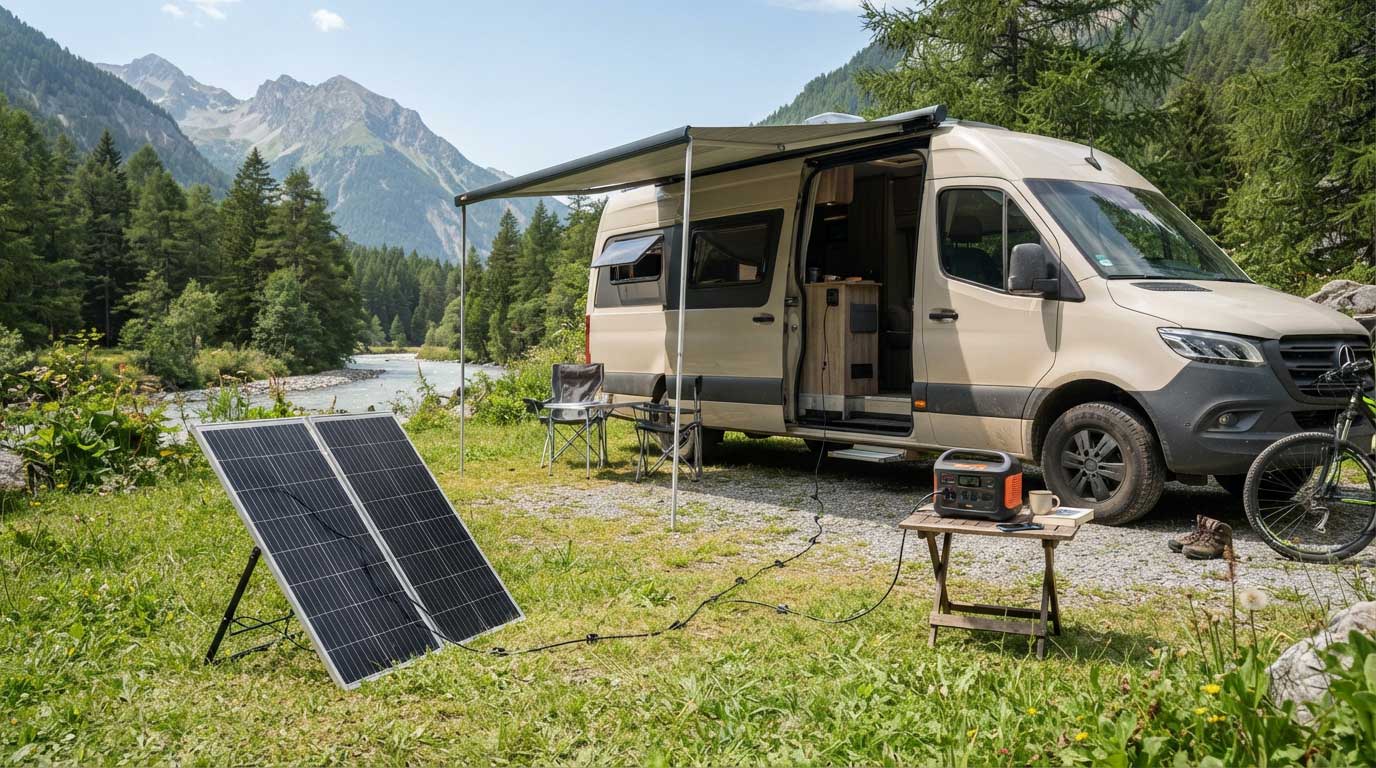
For a simple camping setup, a portable solar panel → power station connection may be all that is needed because the power station already contains the battery, charge-control electronics and inverter. For a custom 12V system, those components normally need to be selected separately.
How should you position the portable solar panel?
Put the panel where it receives direct sunlight for the longest practical period. A few feet can make a surprising difference when a tree, RV roof edge, awning or vehicle casts a shadow across part of the module.
The DOE notes that solar output depends on factors including sunlight reaching the panel, orientation and shading.
For field use, check these points before connecting anything:
- Face the panel toward the strongest available sunlight.
- Keep leaves, bags, branches and camping equipment off the panel.
- Avoid partial shade when possible.
- Keep connectors away from standing water.
- Secure the panel against wind and accidental movement.
- Do not place heavy objects on a Flexible Solar Panels.
A portable system also benefits from being easy to reposition. On an RV trip, moving a panel from the shaded side of the vehicle to an open patch of ground can matter more than trying to make a complicated mounting arrangement.
Why panel orientation matters
Solar cells respond to available light, so the panel does not produce its rated output simply because it is outdoors. Clouds, haze, dirt and shadows can reduce available solar energy; the DOE specifically identifies these conditions as factors affecting solar production.
Practical field check: before connecting the load, look at the panel surface rather than only the sky. Bright sunlight with a shadow crossing one section of the panel is not equivalent to unobstructed exposure.
How do you connect the panel to the battery?
For a system using a separate battery, the normal arrangement is:
Portable solar panel → charge controller → battery → DC load/inverter
The charge controller regulates charging current and voltage rather than allowing the panel to connect directly to the battery without appropriate control. DOE technical guidance describes charge controllers as devices that regulate PV charging to prevent battery overcharging.
Before making the connection:
- Confirm the battery voltage matches the controller.
- Check the controller’s maximum PV voltage and current.
- Verify positive and negative polarity.
- Inspect connectors for damage or moisture.
- Follow the controller manufacturer’s connection sequence.
- Add required fuses or disconnects according to the system design.
Incorrect polarity is not a minor wiring mistake. Victron’s installation documentation, for example, warns that reverse battery polarity can damage equipment and recommends confirming polarity with a multimeter before connection.
Can you connect a portable solar panel directly to a power station?
Yes, if the panel’s electrical specifications are within the power station’s solar-input limits and the connector is compatible.
Check the power station manual for:
| Specification | What to check |
|---|---|
| Solar input voltage | Panel Voc must remain within the allowed range |
| Solar input current | Panel Isc/Imp must not exceed the input limit |
| Solar input power | Stay within the rated charging range |
| Connector | Use the specified compatible connector |
| Polarity | Confirm positive and negative terminals |
Do not assume that a higher-wattage panel will charge faster simply because its rated wattage is higher. The power station’s input ceiling still applies.
How do you set up a portable solar panel system safely?
Once the electrical connections are correct, the physical setup becomes just as important. Portable equipment gets moved, folded, packed and unpacked repeatedly. That is where loose connectors, pinched cables and unstable panels tend to appear.
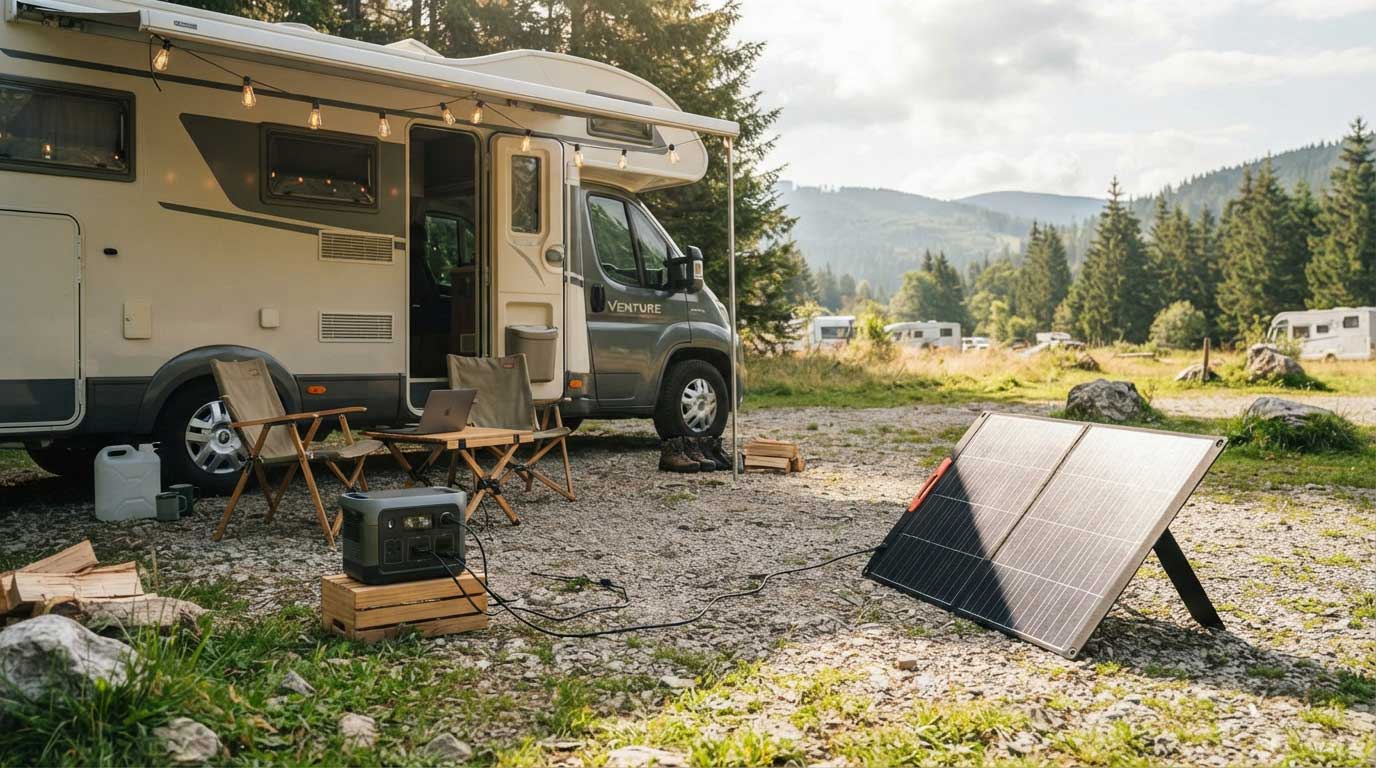
For RV and camping applications, keep the setup simple:
- Place the panel on a stable surface or suitable stand.
- Route cables where people will not step on them.
- Keep connectors off wet ground where practical.
- Leave enough cable slack for repositioning.
- Protect cables from sharp edges and vehicle doors.
- Keep the battery and power electronics ventilated according to manufacturer instructions.
- Do not operate damaged cables, connectors or panels.
The National Renewable Energy Laboratory (NREL) recommends following module manufacturers’ instructions for transportation, storage, mounting, grounding and electrical connections. Its PV installation guidance also emphasizes selecting mounting arrangements according to site conditions, including wind exposure.
That matters more with portable panels than it first appears. A panel that looks perfectly stable at 8 a.m. may be sitting differently after several hours of wind, people walking around the campsite, or a cable being pulled accidentally.
What should you check before turning the system on?
A short inspection can prevent an avoidable equipment problem.
Before startup, check:
- Panel connectors are fully seated.
- Cable insulation has no cuts or crushed sections.
- Positive and negative polarity are correct.
- Solar input voltage is within the controller or power station range.
- Battery voltage is compatible with the charge controller.
- The panel is not partially covered.
- The inverter’s continuous and surge ratings suit the intended AC load.
For a new installation, using a multimeter to verify polarity and voltage is useful. It is also worth checking the manufacturer’s maximum input voltage rather than calculating from the panel’s nominal “12V” or “24V” label alone.
How much power can a portable solar panel system produce?
Rated panel wattage is a laboratory rating, not a promise of constant real-world output.
For example, a 100W portable solar panel is rated to produce 100 watts under its specified test conditions. Actual production changes with sunlight, temperature, orientation, shading, wiring, controller behavior and the connected equipment.
The National Renewable Energy Laboratory’s PVWatts tool uses factors such as solar resource, system losses, orientation and other design conditions when estimating PV energy production.
A useful way to think about a portable system is:
Panel power × usable sunlight × system conditions = actual energy available
So a 100W panel does not necessarily deliver 100W continuously throughout a camping day.
For an RV user, that distinction is important. A refrigerator, fan, lights, phone chargers and inverter can create a changing load while solar generation changes at the same time. The battery acts as the buffer between those two sides.
How should you choose the battery and inverter?
Battery capacity should be based on the energy your loads actually require, rather than choosing a battery simply because it is commonly paired with a particular panel.
For example, if your equipment consumes 600Wh over a day, a 100W panel may need substantial sunlight exposure and suitable conditions to replenish that energy. If you also want to operate AC appliances through an inverter, account for conversion losses and the inverter’s own consumption.
Portable solar panel system sizing example
| Component | Example role |
|---|---|
| 100W solar panel | Produces DC solar power |
| Charge controller | Regulates battery charging |
| 12V battery | Stores generated energy |
| DC loads | Use stored solar energy directly |
| Inverter | Converts DC to AC when required |
The important point is that these components must work as a system. A large battery does not make a small solar array produce more energy, while a high-wattage panel cannot automatically overcome an undersized solar input on a power station.
For Bright solar portable applications, this system-level approach is particularly relevant for RVs, boats, camping equipment and off-grid power where weight, available surface area and easy repositioning all affect the practical design.
What are common mistakes when setting up a portable solar panel?
Several problems are surprisingly ordinary.
Using the wrong input range. A panel can have a suitable wattage but still exceed a power station’s maximum solar voltage.
Leaving the panel partly shaded. A convenient location beside the RV may not be the productive one.
Running cables across walkways. A perfectly good electrical connection can become a physical hazard when someone trips over it.
Ignoring wind. Portable does not mean immune to weather. NREL notes that PV mounting systems need to account for site-specific forces, including wind-related uplift.
Connecting damaged equipment. Repeated folding, transport and outdoor exposure can put stress on connectors and cable jackets.
Using the inverter for every appliance. If a device can operate directly from an appropriate DC supply, unnecessary DC-to-AC conversion may add losses.
FAQ About Setting Up a Portable Solar Panel System
Can I set up a portable solar panel system without an electrician?
For a simple plug-and-play solar panel and power station combination, users can generally follow the manufacturer’s instructions. Custom battery, controller, inverter and distribution systems require greater electrical knowledge and appropriate protection.
Can I leave a portable solar panel outside all day?
Only when the panel is designed for the intended outdoor conditions and is positioned securely. Check the manufacturer’s environmental and weather specifications, and bring equipment in when severe weather is expected.
Should I connect the battery or solar panel first?
Follow the specific charge-controller manufacturer’s required connection sequence. Do not assume every controller uses the same procedure.
Can a portable solar panel charge an RV battery?
Yes. The panel can charge an RV battery through a properly sized solar charge controller, provided the panel, controller and battery are electrically compatible.
Can I use a portable solar panel on cloudy days?
Yes, solar panels can still produce electricity under cloudy conditions, but output is generally lower because less solar radiation reaches the cells.
Do I need an inverter?
Only if you need AC power from a DC battery system. DC appliances can often avoid the additional conversion stage, while AC appliances require an appropriately rated inverter.
How do I know whether my portable solar setup is working?
Check the charge controller or power station display for solar input, charging power and battery status. Comparing readings at different times of day can also reveal whether shading or panel positioning is affecting production.
Conclusion
A reliable portable system is not simply a solar panel placed in the sun. Panel orientation, input limits, battery compatibility, cable routing, physical stability and the actual electrical load all matter once the equipment is being used outdoors.
For RV trips, camping and mobile off-grid applications, keeping the system straightforward usually makes daily use easier. Check the specifications before connecting, inspect the equipment after transport, and reposition the panel when the sunlight changes.
When these details are handled correctly, how to set up a portable solar panel system becomes a practical process rather than a complicated installation project.
The prev: how to secure portable solar panels?The next: how to use a portable solar panel?
Related recommendations
-

How Much Energy Can a Solar Panel Generate?
160Discover how much energy can a solar panel generate in real conditions. Learn actual daily output, weather impacts, and expert insights from Bright Solar.
View details -
how to mount flexible solar panels on van?
249Learn how to mount flexible solar panels on van roofs safely and efficiently. Discover real installation methods, adhesive tips, airflow advice, and expert RV solar insights from Bright Solar.
View details -
how long do solar panels last on a roof?
116Learn how long do solar panels last on a roof with real lifespan data, degradation rates, and field insights from Bright solar engineers across global installations.
View details -
How Often Do Solar Panels Need to Be Replaced?
208How often do solar panels need to be replaced? Learn solar panel lifespan, replacement signs, warranty details, and expert maintenance tips from Bright Solar.
View details