how to use portable solar panels?
how to use portable solar panels is simple when the panel, power station or battery, and controller are electrically compatible. Place the panels in unobstructed sunlight, connect them with correct polarity, check voltage limits, then monitor charging rather than relying on rated wattage alone.
Portable solar panels look simple in the field, but the useful part is in the details. A panel rated at 100W or 200W does not automatically deliver that output throughout the day. Sun angle, shade, temperature, cable losses, and the receiving device all affect what actually reaches the battery.
The U.S. Department of Energy explains that PV modules produce DC electricity, while batteries store energy and inverters convert DC to AC for conventional appliances.
What Do You Need to Use Portable Solar Panels?
A basic portable solar setup normally contains:
| Component | Main purpose |
|---|---|
| Portable solar panel | Converts sunlight into DC electricity |
| Solar charge controller | Regulates charging for a battery |
| Portable power station | Stores energy and provides usable outputs |
| Battery | Stores solar energy for later use |
| Inverter | Converts DC electricity to AC |
| Solar cables | Carry power between components |
For a power station, the controller is often integrated into the unit. For a conventional 12V or 24V battery system, an external charge controller is normally required.
This distinction matters. The DOE describes a PV module as only one part of a complete PV system; storage, power conversion, and other electrical equipment determine how that generated electricity can actually be used.
Check These Specifications Before Connecting
Before plugging anything together, compare:
- Panel Voc
- Panel operating voltage
- Panel maximum current
- Maximum PV input voltage
- Maximum PV input power
- Battery voltage
- Connector and polarity
- Charge controller specifications
For example, one current portable-solar manual specifies that the panel’s operating voltage must exceed the power station’s minimum DC input voltage, while its open-circuit voltage must remain below the station’s maximum DC input voltage.
That is more useful than simply saying “this is a 200W panel.”
How to Set Up Portable Solar Panels Outdoors
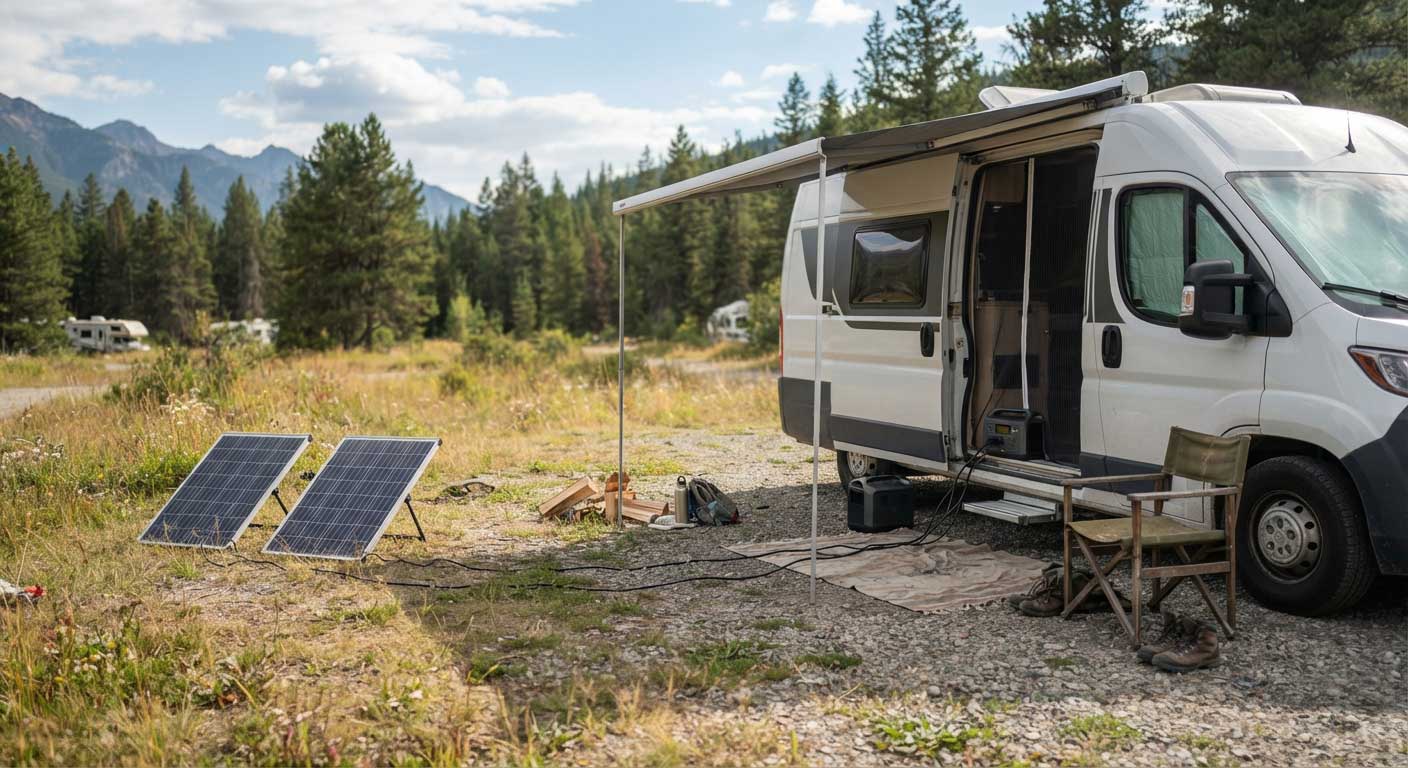
Put the panels somewhere with a clear view of the sky. On an RV trip, this may mean moving the portable panel away from the vehicle rather than leaving it directly beside a shaded campsite.
A practical setup looks like this:
Portable Solar Panels → Power Station → DC/USB/AC Loads
For a battery-based system:
Portable Solar Panels → Charge Controller → Battery → Loads/Inverter
The first arrangement is convenient for camping and temporary power. The second gives more control over an RV or off-grid battery system.
The DOE notes that mounting orientation and tilt influence annual solar energy production, while batteries allow stored solar electricity to be used when sunlight is unavailable.
Position the Panels for Real-World Sunlight
Do not judge the location by how bright it looks.
Check for:
- Tree shadows moving across the panel
- RV awnings blocking part of the surface
- Buildings or tents creating afternoon shade
- Dirt, leaves, or dust on the panel
- Loose cables exposed to foot or vehicle traffic
- A panel sitting at an awkward angle to the available sun
A narrow strip of shade can be surprisingly disruptive. In actual outdoor use, I pay more attention to the panel’s view of the sky than to whether the campsite itself feels sunny.
How to Connect Portable Solar Panels to a Battery
When using a separate battery and charge controller, the wiring order should follow the controller manufacturer’s instructions.
For many conventional systems, the sequence is:
- Keep the solar panel covered or out of direct sunlight while wiring.
- Connect the battery to the charge controller.
- Confirm positive and negative polarity.
- Connect the portable solar panel to the controller.
- Check the controller display for charging status.
- Confirm that voltage and current remain within the equipment limits.
Renogy’s current installation guidance recommends connecting the battery to the charge controller first and then connecting the solar panel. It also warns that incorrect polarity can damage equipment.
This is one of those small installation habits that matters more than it appears.
Cable length also deserves attention. As cable runs become longer, voltage drop becomes more relevant, so cable size should be selected according to current and distance rather than convenience alone. Controller manufacturers commonly specify allowable wire gauges and emphasize considering cable length.
Using Portable Solar Panels With an RV
For an RV, there are two common approaches.
| RV setup | Typical arrangement |
|---|---|
| Portable power station | Panels → Power station |
| Battery charging | Panels → Controller → RV battery |
| AC appliance use | Panels → Battery/Power Station → Inverter |
| DC appliance use | Panels → Battery/Controller → DC loads |
Do not assume an RV’s existing solar connector accepts every portable panel. The connector may physically fit while the electrical specifications do not.
For example, current charge-controller specifications can vary considerably: one 12V controller may accept up to 520W of PV input, while another 12V model may have a much lower maximum.
How Much Power Can Portable Solar Panels Produce?
A panel’s nameplate rating is not a promise of continuous output.
A 100W panel is rated under defined test conditions. Actual output changes with sunlight intensity, temperature, orientation, shading, wiring, and the input limits of the connected device.
The DOE notes that PV systems produce electricity from sunlight through photovoltaic cells, while the energy available to a complete system depends on the equipment used to convert, store, and deliver that electricity.
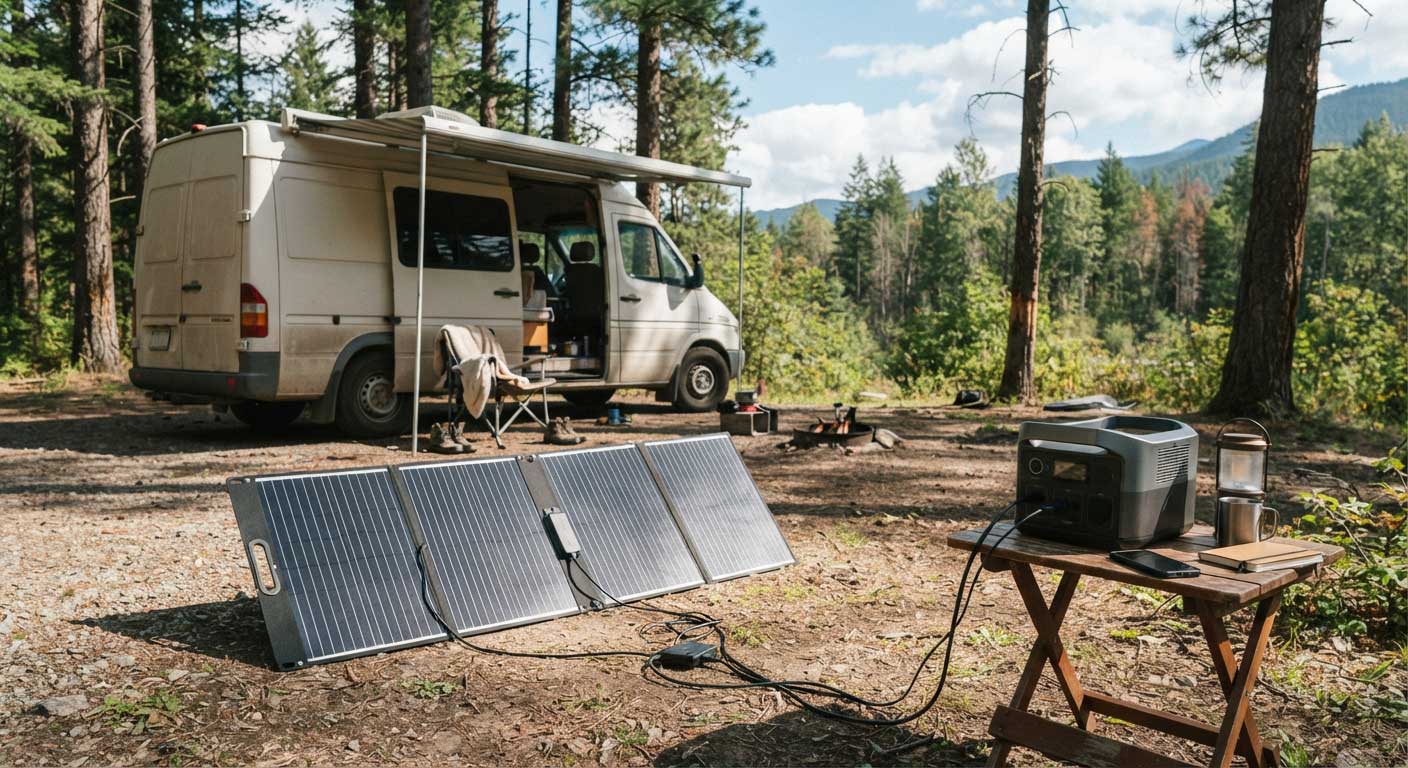
For a simple field check, look at the power station’s live solar input rather than assuming the panel is producing its full rated wattage.
If the display shows 62W from a 100W panel, that does not automatically indicate a faulty panel. The sun may be lower, clouds may have moved across the site, the panel may be warm, or the power station may be limiting input.
That is why I recommend recording the actual input value at several points during the day when evaluating a portable setup. One reading at 10:00 a.m. tells very little.
Common Mistakes When Using Portable Solar Panels
- Choosing by wattage only: Check voltage and current limits too.
- Ignoring Voc: Excessive open-circuit voltage can exceed the receiving equipment’s PV limit.
- Leaving partial shade: Trees, awnings, and nearby equipment can reduce output.
- Reversing polarity: Match positive and negative terminals carefully.
- Skipping the controller: Conventional battery systems generally require suitable charge regulation.
- Using excessively long cables: Voltage drop can reduce usable charging power.
- Expecting constant rated output: Solar conditions change throughout the day.
FAQ About How to Use Portable Solar Panels
Can I connect portable solar panels directly to a power station?
Yes, provided the panel’s voltage, current, wattage, and connector are compatible with the power station’s solar input. Many power stations integrate the required charging electronics.
Can portable solar panels charge a 12V battery?
Yes. For a conventional 12V battery, use a compatible solar charge controller unless the specific panel and battery system are designed for direct charging.
Can portable solar panels work on cloudy days?
Yes. PV panels can generate electricity under diffuse sunlight, although output generally falls as available solar irradiance decreases.
Can I use portable solar panels for an RV?
Yes. They can charge an RV battery through a compatible charge controller or charge a portable power station that supplies the RV’s loads.
Should the battery be connected before the solar panel?
For many separate charge controllers, yes. Renogy’s current guidance specifically recommends connecting the battery first and the solar panel afterward, although product-specific instructions should always take priority.
Do portable solar panels need an inverter?
Only when you need AC electricity. An inverter converts the panel or battery system’s DC electricity into AC electricity for compatible appliances.
Can I leave portable solar panels outside all day?
Only when the panel and every exposed electrical component are rated for the actual outdoor conditions. Protect connectors, cables, controllers, and power stations according to their specified environmental ratings.
Conclusion
The practical answer to how to use portable solar panels is to treat the panel as one component of a complete power system. Check the electrical specifications first, place the panel where sunlight is least obstructed, use the correct controller or power station, and watch actual charging data instead of relying only on the panel’s headline wattage.
Bright Solar approaches portable solar applications from the same practical starting point: panel power, voltage, installation environment, storage, and the intended load need to work together.
The prev: how to use a portable solar panel?The next: how to use portable solar panels at home?
Related recommendations
-

How to Transfer Solar Energy to Electricity?
128How to transfer solar energy to electricity explained with photovoltaic technology, energy conversion steps, system components, and expert solar insights.
View details -
How to Mount Flexible Solar Panel?
275Learn how to mount flexible solar panel systems safely on RVs, vans, boats, and curved roofs. Expert installation tips, mistakes to avoid, and real-world mounting advice from Bright Solar.
View details -
How Much a Solar Panel Can Generate Electricity?
186How much a solar panel can generate electricity depends on wattage, sunlight, and location. Learn real output estimates and expert solar insights from Bright Solar.
View details -
Do Solar Panels Add Value to Your House?
81Solar panels can add value to a house, but the effect is not guaranteed. Ownership, system condition, documented performance, local electricity prices, and b...
View details