how to secure portable solar panels?
Direct Answer :
To secure portable solar panels, use a weather-resistant security cable through a suitable structural point, attach it to a fixed anchor, and keep the panel stable against wind and accidental movement. When the RV or campsite is unattended, store the panel inside whenever practical and never rely on the electrical cable as security.
Start With the Panel’s Structure
Portable solar panels are designed to be moved, folded, carried, and deployed. That makes security different from a permanently mounted rooftop array.
The first question is not “Which lock should I buy?” It is where can the panel safely accept a security connection?
A lock or cable should connect to a structural part of the panel or its purpose-designed frame. Avoid drilling through the active module, squeezing a cable around delicate junction-box wiring, or putting concentrated pressure on a flexible panel.
NREL installation guidance emphasizes following the manufacturer’s instructions for module mounting, including the specified mounting locations and appropriate attachment hardware. It also notes that mounting and clamping methods affect the loads a module can withstand.
For a Bright Solar portable panel, check the product documentation before adding any permanent hardware.
What to Check Before Adding a Lock
- Panel frame or designated mounting points
- Module dimensions and weight
- Flexible-panel bending limitations
- Cable and junction-box location
- Existing eyelets or mounting holes
- Manufacturer-approved attachment method
- Weather exposure around the security hardware
A useful field test is surprisingly simple: hold the panel as you would during normal transport and look at where your hand naturally wants to grip it. That is often exactly where you shouldn’t attach a rigid security device if it interferes with carrying or folding.
Use a Separate Security Cable
The solar cable carries electricity. The security cable protects the equipment.
Keep those jobs separate.
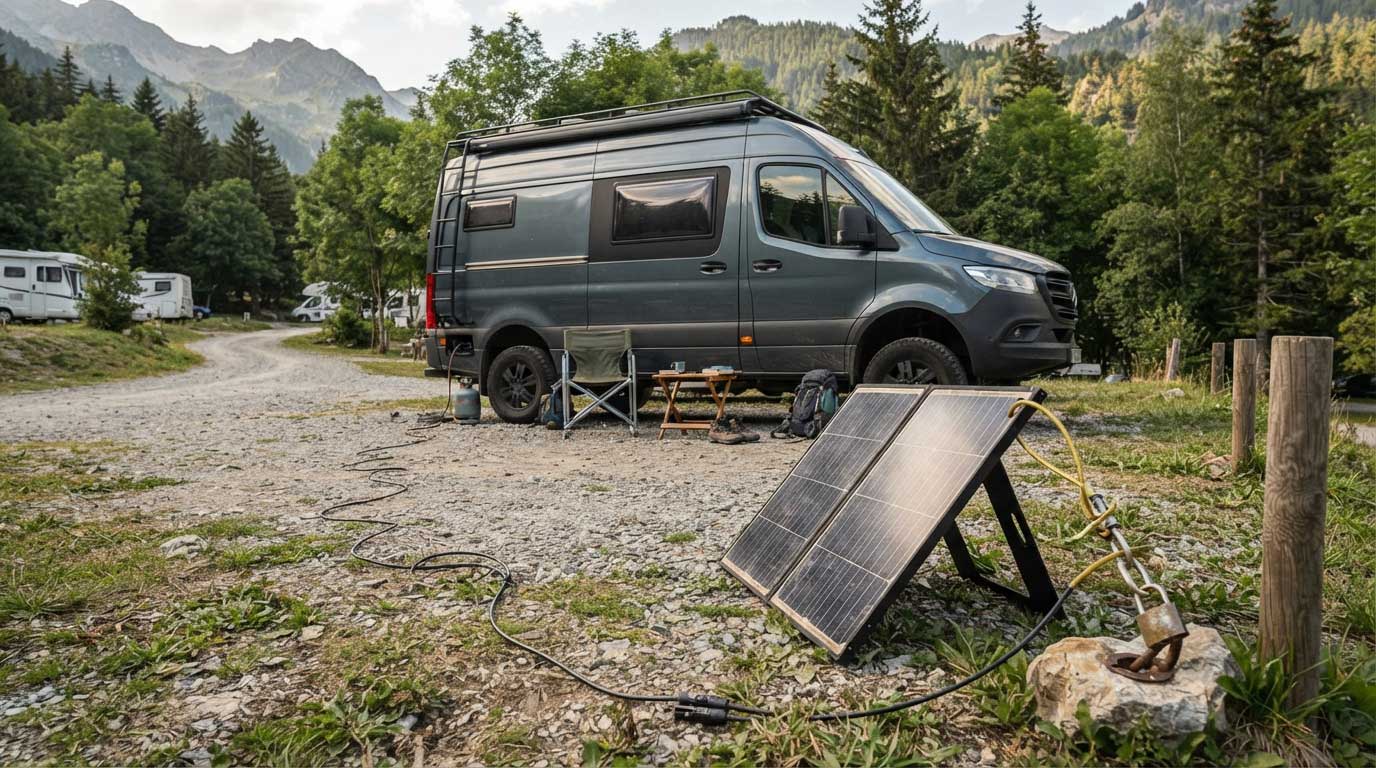
A coated steel cable with a suitable padlock or compact locking mechanism is a practical solution for temporary outdoor installations. Pass the security cable through a structurally appropriate point and then connect it to something that cannot simply be lifted, carried, or pulled away with the panel.
| Security method | Main purpose | Suitable situation |
|---|---|---|
| Coated steel cable | Slows unauthorized removal | RV campsite |
| Locking hardware | Prevents quick disconnection | Short-term outdoor use |
| Fixed anchor | Prevents carry-away theft | Established campsite |
| Storage inside RV | Removes outdoor exposure | Overnight/unattended |
| Identification label | Establishes ownership | Recovery support |
| Tracker | Helps locate equipment | Higher-value equipment |
Do not treat a cable lock as theft-proof. It is one layer.
The U.S. National Park Service specifically advises campers to protect valuables, and some NPS campgrounds warn visitors not to leave valuables unattended. Mount Rainier National Park, for example, tells campers to prevent thefts and protect valuables.
That is directly relevant to portable solar equipment because the panel may sit outside the RV for several hours while generating power.
The Anchor Is More Important Than the Lock
A strong cable attached to a weak object is still a weak security arrangement.
A folding camping table is not a useful anchor. Neither is a lightweight chair, plastic storage box, or anything else that can be picked up together with the solar panel.
At a managed campground, use an approved fixed structure only where the campground rules permit it. Do not attach equipment to trees, signs, utility infrastructure, or other park property without permission.
The National Park Service recommends checking campground rules and speaking with rangers or hosts about current regulations and conditions.
For an RV owner, the most convenient solution may be creating a dedicated security point as part of the portable mounting system itself.
That can be as simple as a properly designed metal eyelet integrated into a support frame.
Protect the Panel From Wind as Well as Theft
Security is not only about somebody walking away with the panel.
Wind can move a lightweight portable panel or stand, especially when the panel is tilted upward and exposed like a small sail. NREL guidance notes that PV modules and mounting systems need to account for site-specific wind loading, and that attachment and clamping affect the loads a module can withstand.
That becomes important with portable installations because the support structure is often temporary.
Before leaving a panel outside:
- Check that every stand joint is locked.
- Keep the center of gravity within the base.
- Use wide, stable feet.
- Secure the frame where permitted.
- Avoid unnecessary height.
- Check the weather forecast.
- Pack the panel away when conditions become unsuitable.
Do not add heavy improvised weights directly onto a flexible module. Secure the stand or support structure according to the equipment design.
Don’t Put Security Hardware on the Solar Surface
A common DIY mistake is drilling directly into the panel because it appears to be the fastest way to attach a cable.
Don’t.
A photovoltaic module is an electrical product, not a piece of sheet metal. Drilling, puncturing, crushing, or clamping the wrong area can damage internal components or compromise weather protection.
NREL specifically recommends following manufacturer requirements for transportation, storage, mounting, grounding, and connection of PV modules.
For flexible solar panels, the concern is even more practical. A rigid metal cable attachment can create a localized stress point while the rest of the panel flexes.
The better arrangement is:
Panel structural point → security cable → fixed anchor
rather than:
Panel surface → drilled hole → improvised lock
Secure Portable Solar Panels When the RV Is Unattended
The most effective theft-prevention step is also the least complicated: take the panel with you.
If you are leaving the campsite for several hours, disconnect the portable panel, fold it if designed to fold, and store it inside the locked RV.
This removes the target instead of trying to make it harder to steal.
The National Park Service recommends protecting valuables at campsites and specifically warns visitors at some locations about property theft. At Golden Gate National Recreation Area and nearby NPS sites, law-enforcement personnel responded to more than 3,969 cases involving larceny from vehicles between 2015 and September 2021. That statistic concerns vehicle-property theft, not portable solar panels, so it should not be interpreted as a solar-panel theft rate.
The broader lesson is practical: unattended valuable equipment deserves its own security plan.
A Simple RV Security Routine
Before leaving:
- Disconnect the solar panel.
- Coil the electrical cable.
- Remove the security cable.
- Fold the panel if applicable.
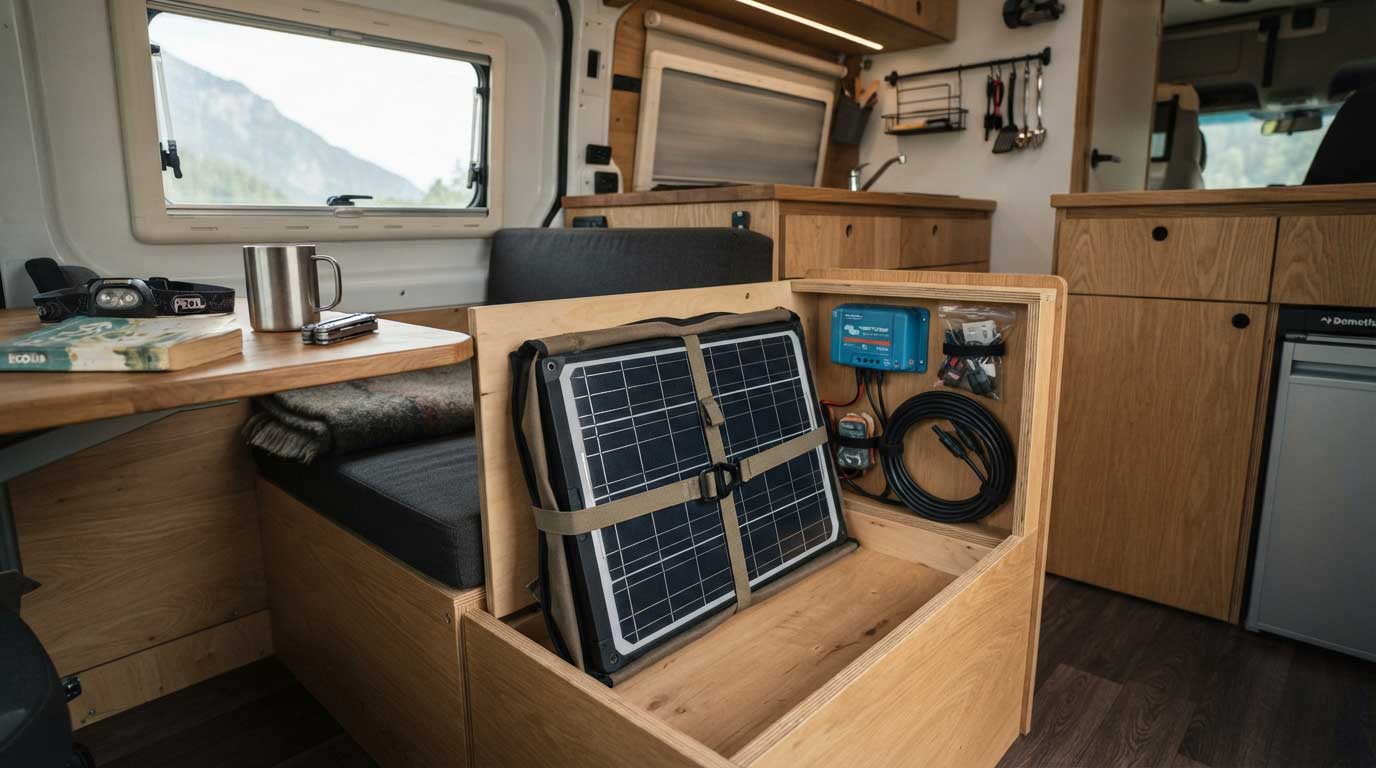
- Store the panel inside the RV.
- Keep the charge controller and connectors out of sight.
- Lock the RV.
It takes a few minutes.
That is often easier than trying to build an outdoor security system capable of resisting every possible theft attempt.
Add Identification for Recovery
Security hardware is about prevention. Identification is about recovery.
Record the:
- Panel model
- Serial number, if provided
- Purchase invoice
- Product photographs
- Distinctive marks
- Controller model
- Approximate purchase date
A discreet ownership mark can also help distinguish your equipment from another camper’s visually similar panel.
The National Park Service recommends identifying camping equipment before trips and testing equipment before departure.
For a portable solar setup, photographing the panel, connectors, controller, and any distinctive scratches or labels takes only a few minutes.
Keep those photographs somewhere other than the RV.
Compare the Main Portable Solar Security Options
| Approach | Security benefit | Limitation |
|---|---|---|
| Security cable | Makes quick removal harder | Not theft-proof |
| Fixed anchor | Prevents simple carry-away | Must be legitimate and strong |
| Secure mounting frame | Adds physical resistance | Reduces portability |
| Indoor RV storage | Removes outdoor target | Requires storage space |
| Identification | Supports ownership verification | Does not physically prevent theft |
| GPS/Bluetooth tracker | May support recovery | Does not stop removal |
| Electrical cable | Carries solar power | Should not be used as a security device |
For frequent RV travelers, a layered approach usually makes more sense than relying on a single lock.
The panel can remain portable during the day, use a dedicated security cable when temporarily unattended, and go inside the RV overnight.
FAQ About how to secure portable solar panels?
What is the best way to secure portable solar panels?
Use a suitable security cable through a manufacturer-approved or structurally appropriate attachment point and connect it to a secure fixed anchor. Store the panel inside the RV when it will be unattended for an extended period.
Can I lock a portable solar panel to my RV?
Yes, provided the attachment point is structurally suitable and does not damage the panel, frame, junction box, or wiring. Follow the manufacturer’s mounting requirements before adding hardware.
Can I use the solar cable as a security cable?
No. The solar cable is designed for electrical power transmission, not theft resistance. Use separate security hardware so the electrical connectors are not subjected to unnecessary mechanical loads.
How do I secure a portable solar panel at a campsite?
Use a security cable attached to a suitable structural point and a legitimate fixed anchor where campground rules permit it. Keep the panel stable against wind and avoid creating trip hazards around the campsite.
Should I leave portable solar panels outside overnight?
If theft or severe weather is a concern, storing them inside the RV is the simplest option. If they remain outside, use appropriate physical security and check weather and campground conditions.
Can I drill a hole into a portable solar panel to install a lock?
Do not drill or puncture the module unless the manufacturer specifically provides for that method. Improper modification can damage the module and compromise its electrical or weather-resistant construction.
Does a tracker prevent portable solar panel theft?
No. A tracker can potentially assist with recovery, but it does not physically prevent someone from removing the panel. It should be treated as an additional layer rather than a replacement for physical security.
Conclusion
Knowing how to secure portable solar panels is mainly about separating three jobs: the panel produces power, the mounting system keeps it stable, and the security hardware makes unauthorized removal more difficult.
For Bright Solar portable solar applications, protect the panel at its structural attachment points, use a separate security cable, keep the system stable in outdoor conditions, and store it inside the RV when it will be left unattended. The goal is not to make a portable panel permanently immovable—it is to preserve its portability without leaving valuable equipment unnecessarily exposed.
Related recommendations
-

How Much Is One Solar Panel Cost?
176How much is one solar panel cost? Learn solar panel prices, wattage factors, technology differences, and expert buying advice from Bright Solar.
View details -
how solar panel produce electricity?
163Solar panels use the photovoltaic effect to convert sunlight into DC electricity, which an inverter can convert into AC power for buildings, batteries, or th...
View details -
What Direction Should Solar Panels Face?
149Discover what direction should solar panels face for maximum energy output. Learn the best orientation, optimal angle, and installation tips from Bright Solar.
View details -
How Many kWh Does a Solar Panel Generate?
160How many kWh does a solar panel generate explained with real output data, factors affecting production, and expert solar insights from Bright Solar.
View details