how to connect solar panel to portable power station?
To connect a solar panel to a portable power station, plug the panel into the station’s dedicated solar/DC input using a compatible cable or adapter. Before connecting, verify the panel’s Voc, operating current, connector polarity, and the power station’s allowable solar voltage, current, and wattage.
What You Need Before Connecting
The basic setup is straightforward:
- Compatible solar panel
- Portable power station with solar/DC input
- Correct solar charging cable or connector
- Multimeter for checking unfamiliar wiring
- Stable outdoor location with unobstructed sunlight
The important part is not the plug itself. It is the electrical match behind the plug.
A portable power station normally contains its own charging electronics, including a solar charge controller or MPPT-based charging circuit. Therefore, a conventional setup does not require an additional external RV-style charge controller between the panel and power station unless the manufacturer’s instructions specifically call for one.
For example, BLUETTI lists an MPPT controller and battery-management system as part of the electronics in one of its portable power stations, while its published specifications identify the permitted solar-input voltage and maximum solar power.
Check Solar Input Specifications First
This is where many connection mistakes happen.
Do not choose a panel only because its wattage looks appropriate. Check these four values on both products:
| Solar panel | Portable power station |
|---|---|
| Voc | Maximum solar input voltage |
| Vmp | Operating voltage range |
| Imp | Maximum solar input current |
| Rated power | Maximum solar input power |
The open-circuit voltage (Voc) deserves particular attention. A panel whose voltage exceeds the power station’s permitted input range can prevent charging and, depending on the equipment, potentially cause damage.
Jackery’s current compatibility guidance specifically tells users to verify both solar-panel Voc and Imp against the power station’s DC input limits.
The limits are not universal. A current Jackery Explorer 500 V2, for example, accepts 16–60V solar input, with a 10.5A current limit and 200W maximum solar input. Its Explorer 1500 specification uses a different 12–30V range and different current limits.
That difference is exactly why “I have a 200W panel” is not enough information to confirm compatibility.
How to Connect Solar Panel to Portable Power Station
Step 1 — Put the Panel in Position
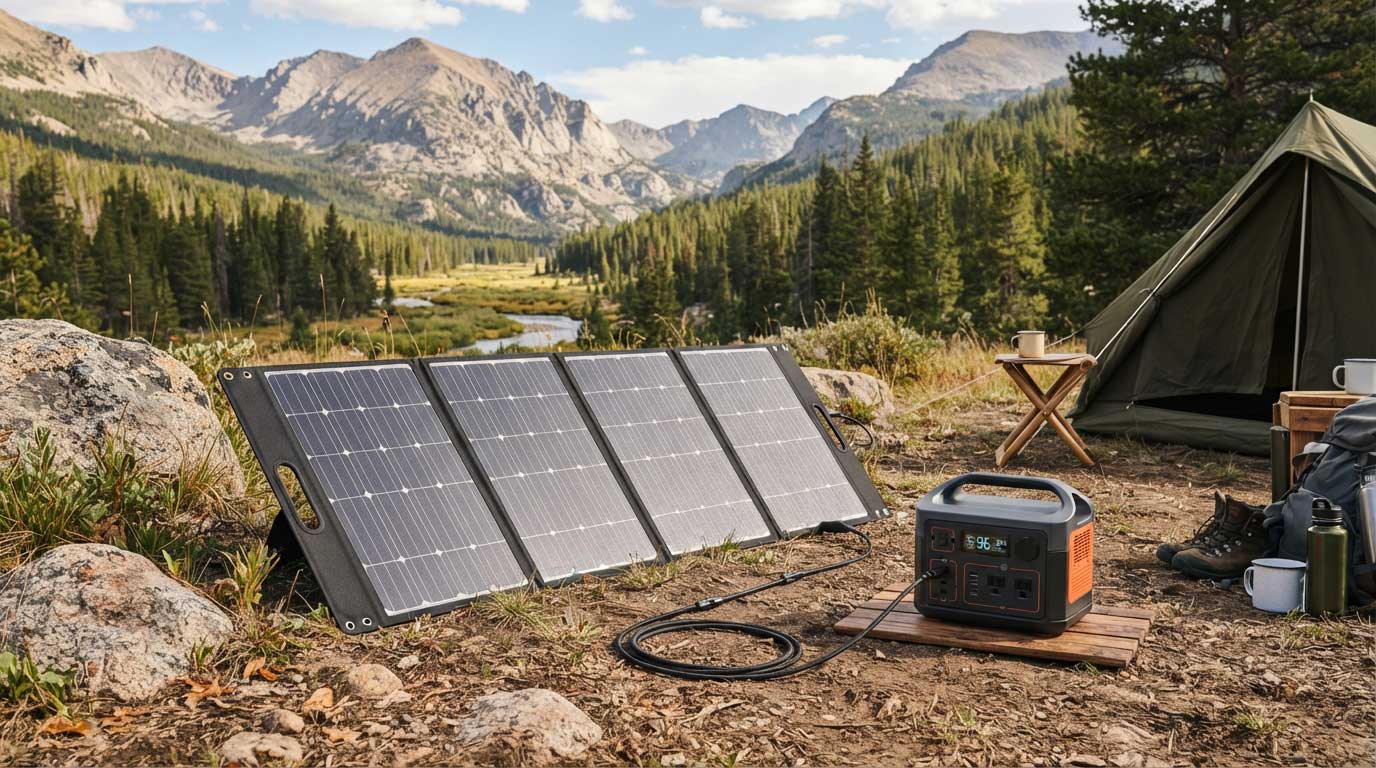
Place the panel outdoors where the entire surface receives direct sunlight. Fully unfold Portable Solar Panels and remove shadows from trees, vehicle roofs, awnings, or equipment.
Jackery’s current guidance recommends direct sunlight and keeping the entire panel surface unobstructed because partial shading can substantially reduce generation.
Step 2 — Check the Connector
Use the connector specified for the power station’s solar input.
Connector standards vary between models. Jackery currently lists DC7909 and DC8020 connections across different power-station families, while some newer models use an adapter to connect third-party panels.
Do not force a connector that physically looks close enough. A mechanical fit does not prove electrical compatibility.
Step 3 — Connect the Panel
With the panel positioned and the cable confirmed, connect the solar panel to the dedicated solar/DC input.
The normal arrangement is:
Solar Panel → Solar Cable/Adapter → Solar Input → Portable Power Station
The station should then display an input wattage or charging indicator when sufficient solar energy is available.
Step 4 — Watch the First Charging Session
Do not walk away immediately after plugging it in.
Check the display for solar input watts, voltage, or charging status. If the reading is zero, inspect the connector, polarity, sunlight, cable, and input limits before assuming the panel is defective.
Why Rated Solar Wattage Is Not the Same as Actual Input
A 200W panel does not guarantee 200W entering the power station.
Photovoltaic module ratings are commonly based on Standard Test Conditions: 1,000 W/m² irradiance and a 25°C cell temperature, with a defined reference spectrum.
Outdoor conditions rarely remain at those laboratory conditions. Panel angle, clouds, temperature, shading, cable losses, and the power station’s own input limit all affect the number displayed on the screen.
This is why a correctly matched 200W panel may show considerably less than 200W during ordinary camping conditions.
Common Connection Problems
The Power Station Does Not Show Solar Input
Check the panel’s position first. Then check connector compatibility and whether the panel’s Voc falls inside the station’s permitted voltage range.
The Input Wattage Is Very Low
Look for partial shade. Even a small obstruction across part of a portable panel can affect its output. Then check panel orientation and cable connections.
The Station Stops Charging
The power station may have reached a battery-management or input-control condition. Check the manufacturer’s operating limits rather than repeatedly reconnecting the panel.
FAQ About how to connect solar panel to portable power station?
Can I connect any solar panel to a portable power station?
No. The panel’s voltage, current, wattage, connector, and polarity must be compatible with the station’s solar input.
Do I need a solar charge controller?
Usually not as a separate device when the portable power station already has its own integrated solar charging electronics. Confirm this in the specific product manual.
Can I use a higher-wattage solar panel?
Only when the power station permits it. The station may limit incoming power, while excessive voltage can create a compatibility problem. Always check the manufacturer’s maximum input specifications.
Can I connect two solar panels?
Sometimes. Whether panels can be connected in series or parallel depends on the power station’s voltage and current limits and the electrical characteristics of the panels.
Can a flexible solar panel charge a portable power station?
Yes, if its electrical output and connector are compatible with the station’s solar input. Flexible construction does not automatically make a panel compatible.
Why does my solar panel produce less power than its rated wattage?
Rated output is measured under standardized test conditions. Real outdoor output changes with irradiance, temperature, orientation, shading, and system limitations.
Conclusion
The practical answer to how to connect solar panel to portable power station is simple: use the correct solar input cable, but verify the electrical specifications before making the connection. In field installations, Voc is the number that deserves the closest attention, followed by current, maximum input wattage, connector compatibility, and sunlight conditions.
For Bright Solar customers using portable or Flexible Solar Panels, the panel should be selected around the power station’s actual DC input window rather than choosing wattage alone. That approach avoids a common mistake: buying a panel that looks powerful on paper but does not operate comfortably within the power station’s permitted input range.
Related recommendations
-

What Are Solar Panels Made Out Of?
156Solar panels combine silicon cells with protective, encapsulating, structural, and electrical materials to generate and protect solar power.
View details -
How Many kWh Does a Solar Panel Produce?
189How many kWh does a solar panel produce? Learn the real daily and yearly output of different solar panels, key influencing factors, and expert insights from Bright Solar.
View details -
How to attach flexible solar panel to RV roof?
281Learn how to attach flexible solar panel to RV roof safely and securely. Discover real installation methods, adhesive tips, wiring advice, and RV solar insights.
View details -
how many kilowatts does a solar panel generate?
31A solar panel’s rated power typically ranges from about 0.3–0.7 kW, while actual energy production varies with site and operating conditions.
View details