how to connect two portable solar panels together?
To connect two portable solar panels together, wire them in parallel when you need to increase current while keeping voltage similar, or in series when the power station or controller accepts the higher voltage. Always compare each panel’s Voc, Vmp, Isc, Imp, wattage, and the controller or power station’s input limits first.
Can Two Portable Solar Panels Be Connected Together?
Yes. Two compatible portable solar panels can usually be combined in parallel or series, but the correct method depends on the electrical limits of the equipment receiving the solar power.
The difference is significant:
| Connection | Voltage | Current | Typical reason |
|---|---|---|---|
| Parallel | Stays approximately the same | Increases | More current at similar voltage |
| Series | Increases | Stays approximately the same | Higher operating voltage |
| Series-parallel | Both can increase | Both can increase | Larger matched arrays |
For two identical 100W panels, for example, a parallel connection theoretically creates a 200W array while retaining approximately the voltage characteristics of one panel. In series, the voltage rises while the current remains approximately that of one panel. Renogy demonstrates both configurations using two 100W panels and MC4 branch connectors.
That simple distinction is useful in the field. The mistake is treating “200W total” as the only specification that matters.
Check the Panel and Power-Input Specifications
Before connecting anything, write down these numbers from both portable panels:
- Voc: open-circuit voltage
- Vmp: voltage at maximum power
- Isc: short-circuit current
- Imp: current at maximum power
- Rated power: maximum rated output
Then check the equipment receiving the combined array:
- Maximum PV input voltage
- Maximum PV input current
- Maximum solar input wattage
- Recommended connection configuration
- Connector type and polarity
This is particularly important with portable power stations. A power station may accept a certain number of watts but have a separate voltage or current ceiling.
For example, two panels that add up to 240W may still be unsuitable if their combined series voltage exceeds the power station’s maximum PV voltage. Conversely, a parallel connection can keep voltage within range while pushing current beyond the station’s input-current limit.
The receiving device sets the boundary—not the combined panel wattage.
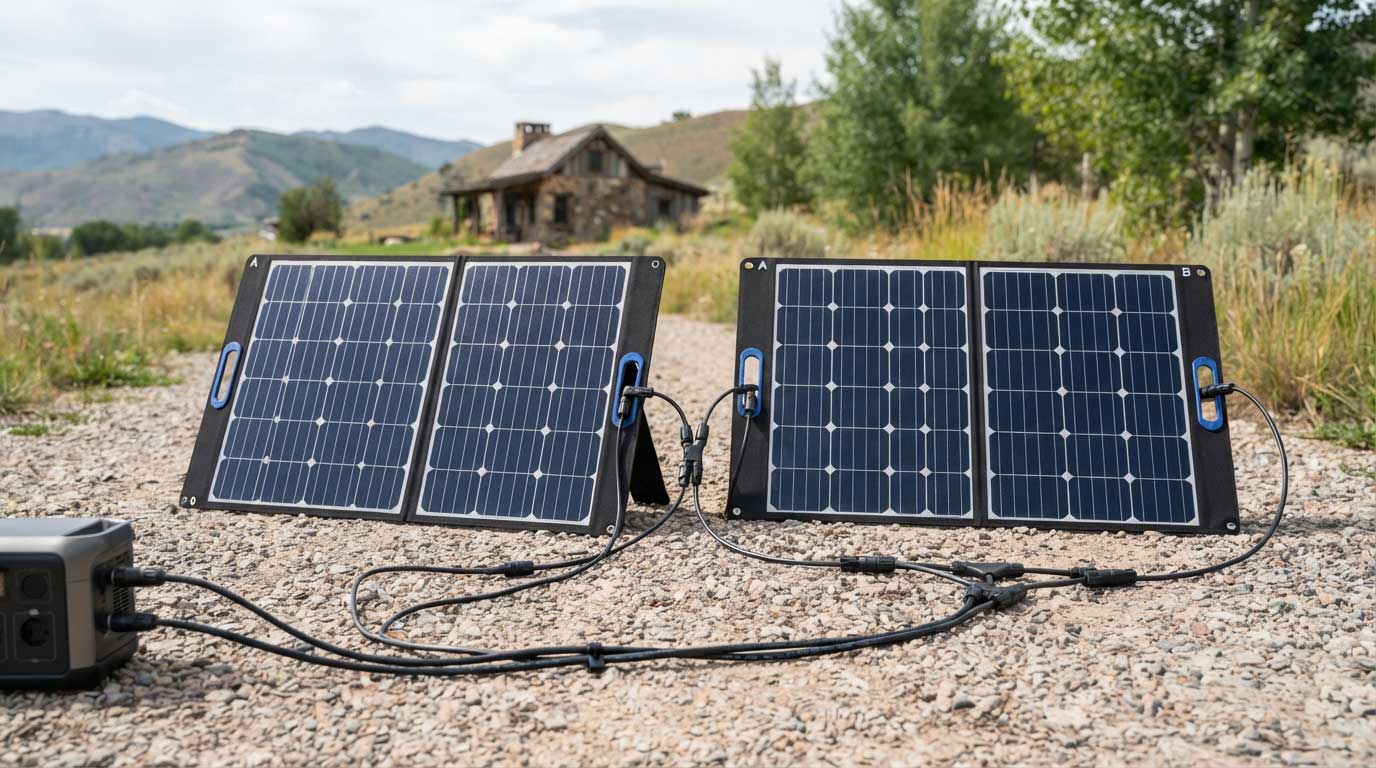
How to Connect Two Portable Solar Panels in Parallel
Parallel wiring is often chosen when the receiving equipment needs roughly the same voltage as a single panel but can accept additional current.
For two matching panels, the basic arrangement is:
Panel 1 positive + Panel 2 positive → positive output
Panel 1 negative + Panel 2 negative → negative output
MC4 branch connectors are commonly used for this arrangement. Renogy’s documented example connects the positive leads together and the negative leads together before routing the combined output toward the charging equipment.
When Parallel Makes Sense
Parallel connection can be useful when:
- The power station has a relatively low PV voltage limit.
- The controller accepts the combined current.
- Both panels have similar electrical specifications.
- You want to retain approximately the voltage of one panel.
- The panels may experience slightly different sunlight conditions.
There is a practical advantage for portable systems: if one panel is partially shaded while another remains in direct sun, the two panels do not necessarily experience identical operating conditions. That makes physical panel placement just as important as the wiring configuration.
How to Connect Two Portable Solar Panels in Series
Series wiring connects the positive lead of one panel to the negative lead of the other:
Panel 1 negative → output negative
Panel 1 positive → Panel 2 negative
Panel 2 positive → output positive
The important electrical effect is that the panel voltages add. Renogy’s two-panel example describes two 100W panels connected in series as producing a higher-voltage configuration compared with the parallel arrangement.
Before using series wiring, calculate the combined Voc, not merely the combined Vmp.
A simplified check is:
Array Voc ≈ Panel 1 Voc + Panel 2 Voc
The actual cold-weather design voltage requires additional attention because PV voltage changes with temperature. For a professional installation, use the module temperature coefficient and the equipment’s maximum PV voltage rather than relying on a nominal “12V” or “24V” label.
Do Both Portable Solar Panels Need to Match?
They should ideally be closely matched.
Using two panels with substantially different voltage and current characteristics can make array behavior harder to predict and may reduce the benefit of combining them.
For a straightforward portable setup, use panels with:
- Similar rated wattage
- Similar Vmp
- Similar Voc
- Similar Imp
- Similar Isc
- Similar cell technology where practical
- The same intended operating voltage
This does not mean every portable array must use identical modules. It means that matching panels makes the electrical design much easier to verify.
At Bright Solar, this is one reason panel specifications should be reviewed as a complete electrical set rather than selecting a module based only on its headline wattage.
Why Two 100W Panels May Not Deliver 200W
A combined 200W rating does not mean the power station will continuously display 200W.
PV module ratings are normally established under Standard Test Conditions. NREL identifies STC as 1,000 W/m² irradiance and 25°C cell temperature. NREL also notes that real operating conditions commonly differ from these laboratory conditions, with sunlight intensity and cell temperature affecting actual production.
Outdoor details matter.
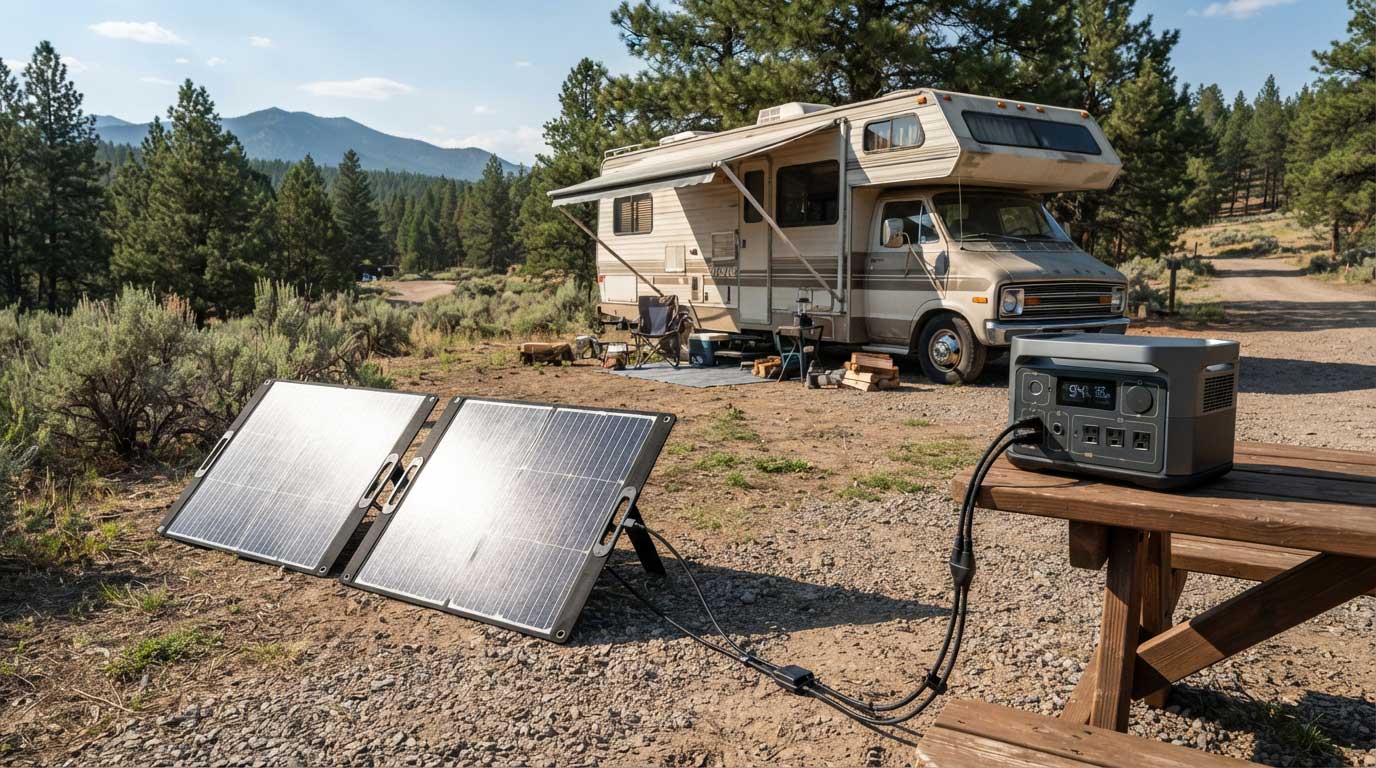
Two panels placed beside an RV may have one panel shaded by an awning while the other remains fully illuminated. A panel lying flat can also receive sunlight at a less favorable angle than one tilted toward the sun.
So if two 100W panels produce 145W at a particular moment, that does not automatically indicate a wiring fault.
Common Mistakes to Avoid
Connecting in Series Without Checking Voc
This is the most important electrical check. Adding two panel voltages can push the array beyond the receiving device’s maximum PV voltage.
Connecting in Parallel Without Checking Current
Parallel wiring increases current. The controller or portable power station must accept the resulting current.
Mixing Very Different Panels
A 100W high-voltage panel and a 100W low-voltage panel are not automatically interchangeable simply because their nameplate wattage is identical.
Assuming the Connector Proves Compatibility
An MC4-style connector indicates a physical connection method, not complete system compatibility. Voltage, current, polarity, and input limits still need to be checked.
FAQ About how to connect two portable solar panels together?
Can I connect two portable solar panels together?
Yes, provided their electrical specifications and the receiving equipment are compatible. They can generally be connected in series or parallel.
Is it better to connect two portable solar panels in series or parallel?
Neither configuration is universally better. Choose according to the receiving device’s permitted PV voltage and current range.
Can I connect two 100W portable solar panels?
Yes, if the controller or power station accepts the resulting voltage, current, and approximately 200W combined rated input.
Can two different portable solar panels be connected together?
They can sometimes be combined, but substantially different electrical characteristics can make the array less predictable. Matching panels is generally simpler.
Does connecting solar panels in parallel increase voltage?
No. Parallel connection primarily increases available current while keeping voltage approximately similar to one panel.
Does connecting solar panels in series increase wattage?
The array’s rated power can increase when additional panels are added, but series wiring specifically increases voltage while current remains approximately that of the individual string.
Can I connect two portable panels directly to a portable power station?
Only if the resulting array stays within the station’s specified solar-input voltage, current, power, and connector requirements. The manufacturer’s manual should be the final reference.
Conclusion
The practical answer to how to connect two portable solar panels together is to choose series or parallel wiring based on the receiving equipment’s limits, then verify Voc, Vmp, current, polarity, and total rated power before connecting the panels.
For portable systems, matching the panels is usually the cleaner engineering choice. A two-panel setup can increase available solar power, but the extra panel only helps when the controller or power station can actually accept the resulting electrical output.
Related recommendations
-

How to Compare Marine Flexible Solar Panels?
220Learn how to compare marine flexible solar panels beyond wattage. Discover real-world insights on durability, ETFE materials, saltwater resistance, and lifespan before buying.
View details -
What Is IRC Certificate for Solar Panels?
95An IRC reference for solar panels concerns residential building-code compliance, not a standalone solar product certification.
View details -
how do you hook up solar panels?
150Learn how do you hook up solar panels safely, including series and parallel wiring, charge controllers, inverters, batteries, and key checks for home solar systems.
View details -
How Hot Do Flexible Solar Panels Get?
205How hot do flexible solar panels get in real-world conditions? Learn operating temperatures, heat impact on efficiency, and expert installation insights from Bright Solar.
View details