how to clean solar panels on roof automatically?
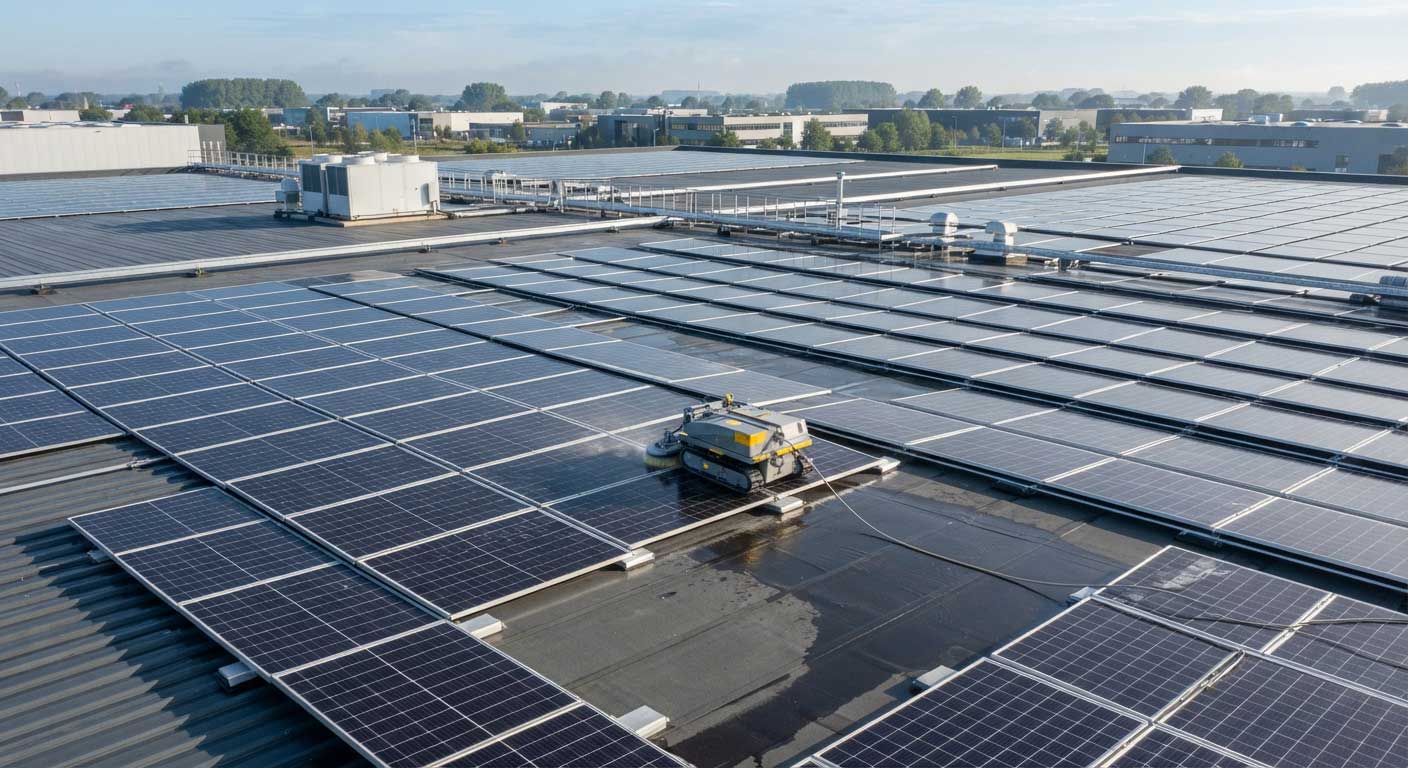
Solar panels on a roof can be cleaned automatically with robotic dry-brush systems, water-fed cleaning equipment, or automated washing devices triggered by a cleaning schedule or soiling sensor. The right approach depends on roof access, panel layout, local dust, pollen, water availability, and whether cleaning gains justify the equipment cost.
Can solar panels on a roof be cleaned automatically?
Yes. Automatic solar panel cleaning is already used in commercial and utility-scale PV systems, particularly where roof access is difficult, soiling is frequent, or manual cleaning is expensive.
The main approaches include:
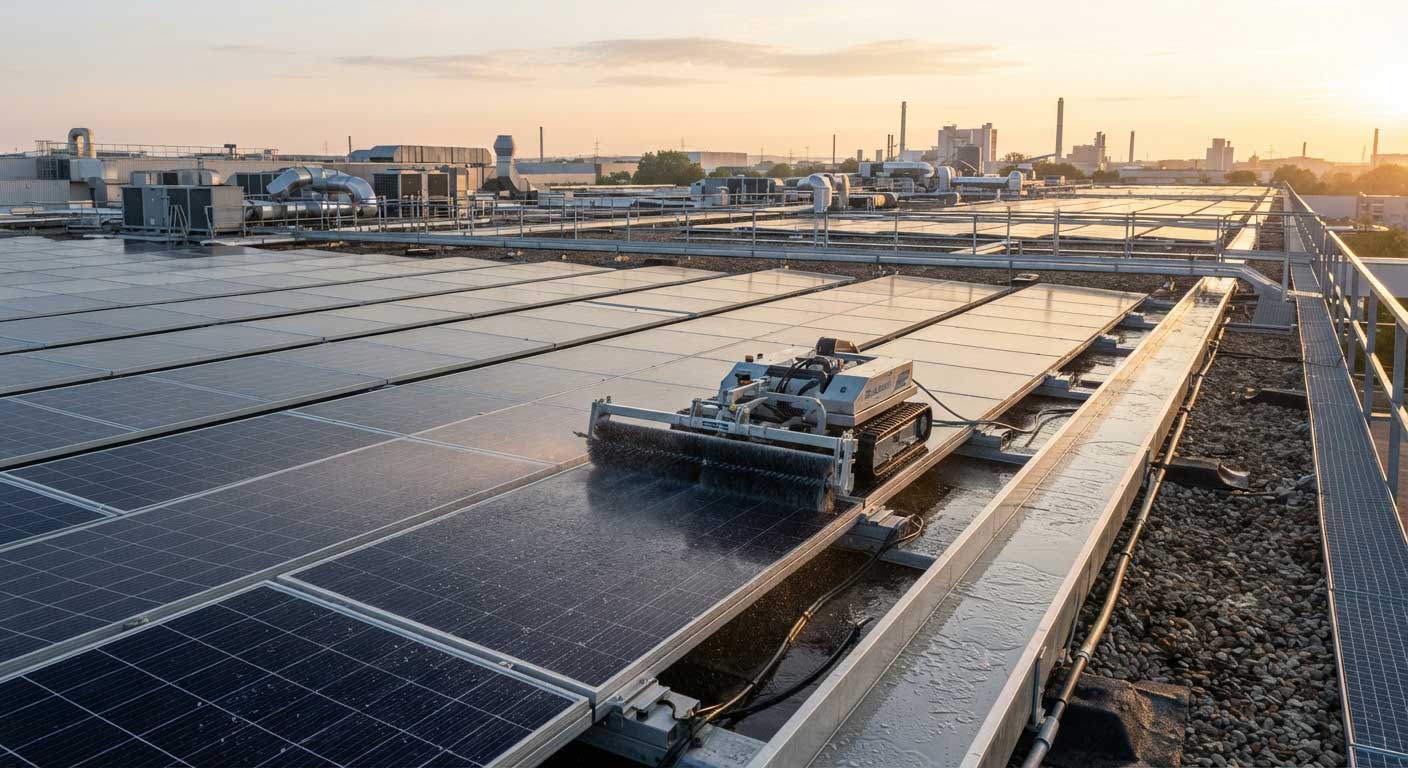
- Robotic dry brushing — a motorized robot travels across the module surface and removes loose dust.
- Automated wet cleaning — brushes, spray bars, or cleaning robots use controlled amounts of water.
- Fixed washing systems — nozzles or sprinkler-style equipment are installed near the array.
- Soiling-based cleaning — sensors estimate the performance loss and activate cleaning when the loss reaches a defined threshold.
NREL identifies robotic dry or wet brush cleaning as one of the approaches being studied for PV soiling mitigation. It also cautions that brush contact, reliability, surface damage, and economics need to be considered rather than assuming automation is automatically better.
That last point matters on rooftops. An automatic cleaner eliminates much of the labor, but it does not eliminate maintenance.
Why would you need automatic solar panel cleaning?
The answer starts with soiling: dust, pollen, soot, bird droppings, leaves, and other deposits that block sunlight from reaching the cells.
NREL’s PV operations and maintenance guidance reports typical annual soiling losses in the range of 4.3% to 7.5%, with many studies around 6% per year. It also reports a commonly observed daily soiling rate of roughly 0.05% of output per day, although actual rates vary substantially by location. Agricultural areas, bird activity, construction, and dust storms can produce much higher rates.
NREL’s research on five utility-scale PV plants in North Carolina found an even more interesting result: pollen reduced performance by as much as 15% during peak pollen season, while mechanical wet-brush cleaning subsequently improved performance by 5% to 11%. Without planned cleaning, researchers estimated annual production losses could be around 10% at those sites.
Rain alone, therefore, is not a reliable automatic cleaning strategy in every environment.
Roof conditions that favor automatic cleaning
Automatic cleaning becomes more attractive when:
- The roof is large or difficult to access.
- Panels are installed in several long rows.
- Dust or pollen accumulates quickly.
- The building is near agriculture, construction, roads, or industrial activity.
- Water access is limited.
- Manual roof access creates safety or labor concerns.
- Energy losses can be measured accurately enough to justify cleaning.
A small residential array with low soiling may not need a permanent robot. A large commercial rooftop with persistent dust can be a completely different calculation.
How does an automatic solar panel cleaning system work?
An automated system normally combines three elements:
Cleaning mechanism + movement/control system + cleaning trigger
The cleaning mechanism may use soft rotating brushes, microfiber contact surfaces, air, water, or a combination. The movement system positions the cleaner across the array. The control system determines when and where cleaning occurs.
A more advanced installation can use soiling measurements rather than a simple calendar.
DOE describes a technology developed with Department of Energy support that compares a dirty reference PV cell with a cell cleaned daily. The difference helps estimate the actual soiling rate and determine when cleaning provides enough energy benefit to justify its cost.
That is a useful concept for rooftop systems: clean because the panels are losing energy, not simply because Tuesday is the first day of the month.
Should automatic solar panel cleaning use water?
Not necessarily.
For dusty environments, dry brushing can be attractive because it avoids water consumption. For pollen, sticky deposits, bird contamination, or cemented dust, wet cleaning may be more effective.
NREL’s research identifies both dry and wet robotic brushing as potential approaches, while emphasizing site-specific performance and durability.
Water quality also matters. NREL’s PV module research recommendations identify deionized water near module temperature as an option for washing when contact cleaning is required.
For rooftop design, consider:
| Cleaning method | Main advantage | Main concern |
|---|---|---|
| Dry robotic brush | Little or no water | Abrasion and brush maintenance |
| Wet robotic brush | Effective on some stubborn deposits | Water supply and drying |
| Fixed spray system | Simple automated coverage | Water use and nozzle maintenance |
| Air cleaning | No water | Limited effectiveness on adhered deposits |
| Manual cleaning | Flexible and inexpensive for small arrays | Labor, access, safety |
A cleaner should never be selected only because it looks “automatic.” Contact pressure, brush material, module surface, frame geometry, cable routing, and roof obstacles all matter.
How often should automatic solar panel cleaning run?
There is no universal cleaning interval.
A better approach is to monitor the site’s soiling rate and energy production.
NREL’s published data shows how widely daily soiling can vary. Typical values around 0.05% per day have been reported, while heavy agricultural activity has produced rates around 0.36% per day, and dust storms have produced reported losses of approximately 1.5% per day in some locations.
That difference is enormous.
For example, if a system is losing only a fraction of a percent over several weeks, frequent automated cleaning may not make economic sense. If a dusty industrial rooftop loses measurable production every day, the calculation changes quickly.
The strongest automatic systems therefore combine cleaning with monitoring rather than treating both as separate maintenance tasks.
What should be considered before installing an automatic rooftop cleaner?
The roof itself becomes part of the cleaning system.
Check:
- Panel row spacing
- Module dimensions
- Roof slope
- Obstacles and rooftop equipment
- Drainage paths
- Cable routing
- Module frames
- Robot travel path
- Wind exposure
- Water availability
- Cleaning access
- Emergency manual access
NREL specifically notes that repeated cleaning can create mechanical concerns, including abrasion and cyclic loading, while robotic cleaning can affect components such as frames and wiring.
That is an important manufacturer-level consideration. A cleaning robot should remove contamination without becoming another source of module wear.
For flexible solar panels, the situation can be more application-specific. A flexible module may be bonded or mounted differently from a conventional framed panel, so an automated cleaner must be compatible with the module’s surface and installation method rather than assuming every robotic system can safely travel across it.
Is automatic solar panel cleaning worth the cost?
It depends on the relationship between energy recovered and cleaning cost.
NREL has emphasized that cleaning should be economically justified because cleaning non-soiled modules wastes money, while failing to clean heavily soiled modules sacrifices energy.
DOE has also highlighted the economics of automated soiling measurement. One DOE-supported system reported that cleaning a PV array can cost around $2 per kilowatt per year, illustrating why cleaning frequency needs to be optimized rather than maximized.
A simple decision framework is:
Expected value of recovered electricity > cleaning system + water + maintenance + replacement costs
For a small roof, manual or occasional professional cleaning may remain the sensible choice.
For a large commercial roof, automation can make more sense when access is difficult and measurable soiling losses recur throughout the year.
FAQ about automatic solar panel cleaning
Can solar panels on a roof clean themselves automatically?
Yes. Robotic brushes, automated washing systems, and sensor-controlled cleaning equipment can remove accumulated dirt with limited manual intervention.
Do rainstorms automatically clean solar panels?
Not reliably. NREL found that rainfall did not fully remove pollen from PV panels at five North Carolina solar plants, and performance losses reached up to 15% during peak pollen season.
Are solar panel cleaning robots safe for PV modules?
They can be, but the cleaning system must be compatible with the module surface and installation. Brush pressure, abrasive particles, repeated contact, frame design, and wiring must all be considered.
How often should an automatic solar panel cleaner run?
It should ideally be based on local soiling conditions and measured performance rather than a universal weekly or monthly schedule. NREL reports large differences in daily soiling rates between agricultural, desert, and dust-storm environments.
Do automatic solar panel cleaners need water?
No. Some robotic systems use dry brushes. Wet systems use water when the type of contamination requires it.
Can automatic cleaning improve solar panel output?
Yes, when soiling is materially reducing production. NREL reported 5%–11% performance improvements after mechanical wet-brush cleaning at the North Carolina sites studied.
Is automatic cleaning necessary for every rooftop solar system?
No. The economic case depends on array size, soiling rate, roof accessibility, local labor costs, water availability, and the value of recovered electricity.
Final answer
The practical answer to how to clean solar panels on roof automatically is to match the cleaning technology to the actual soiling problem. Robotic dry brushes suit some dusty roofs, wet systems can handle harder deposits, and sensor-based controls can prevent unnecessary cleaning. The strongest design is not the one that cleans most often—it is the one that protects energy yield without creating unnecessary maintenance or module wear.
The prev: how to clean a solar light panel?The next: how solar panels create electricity?
Related recommendations
-

How Do You Install Solar Panels?
142Solar panels are installed by assessing the site, planning the array, mounting the modules, connecting wiring and system equipment, then completing testing, ...
View details -
how to connect solar panel to portable power station?
264Connect a solar panel to a portable power station through its solar/DC input after verifying voltage, current, wattage, polarity, and connector compatibility.
View details -
How Many KW Does a Solar Panel Produce?
178How many kw does a solar panel produce? Learn real solar panel output, watt-to-kW conversion, energy production factors, and expert insights from Bright Solar.
View details -
How to Clean Solar Panels?
218Learn how to clean solar panels safely using expert methods, real maintenance experience, and proven cleaning techniques to improve solar performance and longevity.
View details