how to clean a solar light panel?
To clean a solar light panel, switch the light off, remove loose dust with a soft dry cloth or brush, then gently wipe the panel with clean water and a soft microfiber cloth. Avoid abrasive cleaners, hard brushes, and high-pressure water, then let the panel dry fully before restoring normal operation.
Why Cleaning a Solar Light Panel Matters
A solar light panel has a simple job: capture sunlight and convert it into electrical energy stored for use after dark. A layer of dust, pollen, bird residue, leaves, or dried mineral deposits reduces the amount of light reaching the photovoltaic surface.
This matters even on a small garden light.
NREL research on five utility-scale solar plants in North Carolina found that pollen-related soiling reduced PV performance by as much as 15% during peak pollen season. Mechanical wet-brush cleaning subsequently improved performance by 5% to 11%. The study also found that rainfall alone did not always restore the panels to their previous performance level.
A solar garden light will not experience exactly the same losses as a large PV array. Its panel is smaller, its charging circuit is different, and the light may operate with only a few hours of useful solar charging. Still, the maintenance principle is the same: keep the light-receiving surface clear.
From a solar-panel manufacturing perspective, one practical mistake appears repeatedly: people clean the visible dirt but overlook the thin film left behind after water evaporates. That residue can be especially noticeable on small panels because it covers a significant portion of the active surface.
How to Clean a Solar Light Panel Step by Step
1. Turn Off the Solar Light
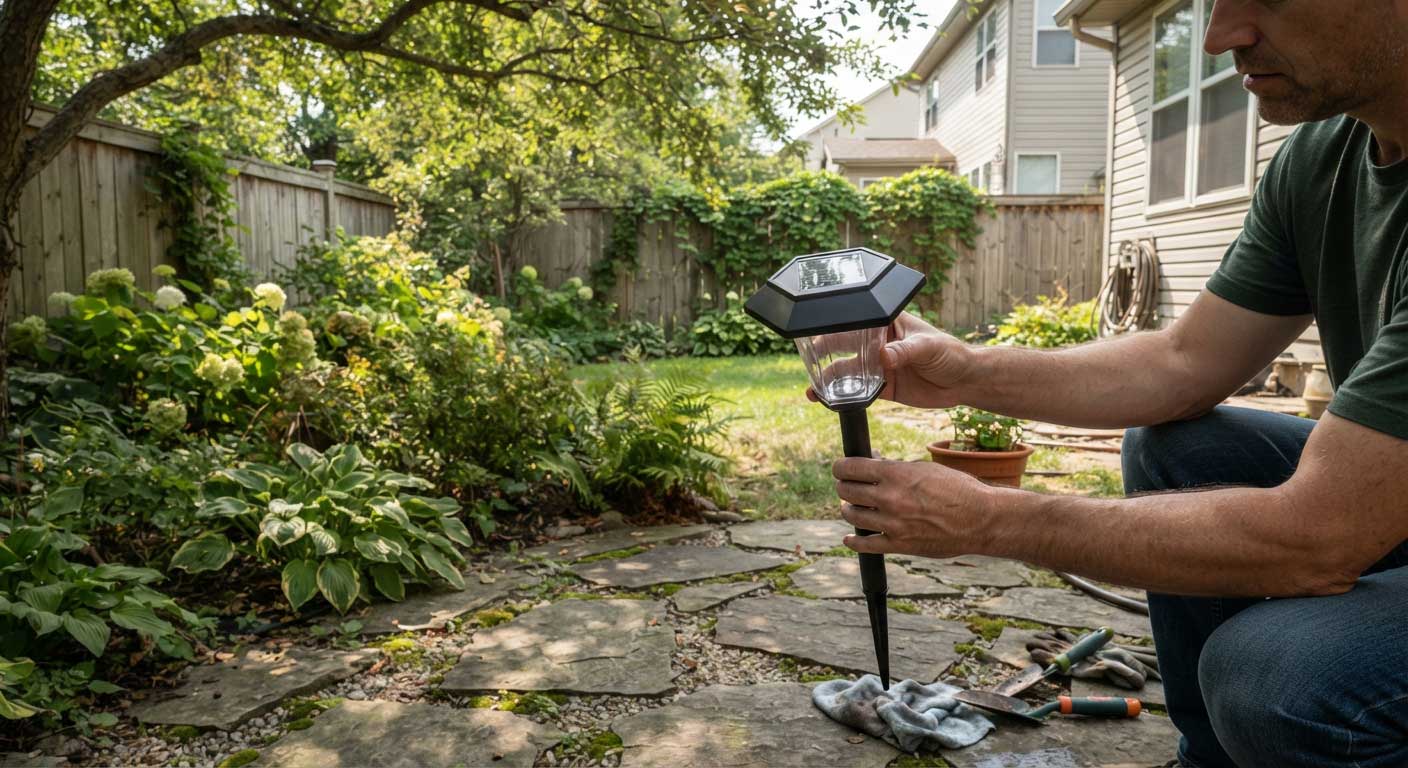
If the light has an ON/OFF switch, turn it off before cleaning. For a removable solar garden light, move it to a stable work surface rather than trying to wipe the panel while it is mounted at height.
You do not normally need complicated equipment for routine cleaning.
Prepare:
- Soft microfiber cloth
- Clean water
- Soft-bristle brush
- Small bowl or spray bottle
- Dry microfiber cloth
Avoid steel wool, abrasive pads, strong solvents, and rough household brushes.
2. Remove Loose Dust First
Brush away loose dust, dried leaves, cobwebs, and other particles before using water.
This small step is easy to skip. It should not be.
Dry grit trapped underneath a wet cloth can act like fine sandpaper when the surface is wiped. For small solar light panels, a clean microfiber cloth is usually sufficient. If the panel has accumulated heavier dust, use a very soft brush first.
3. Wipe the Panel With Clean Water
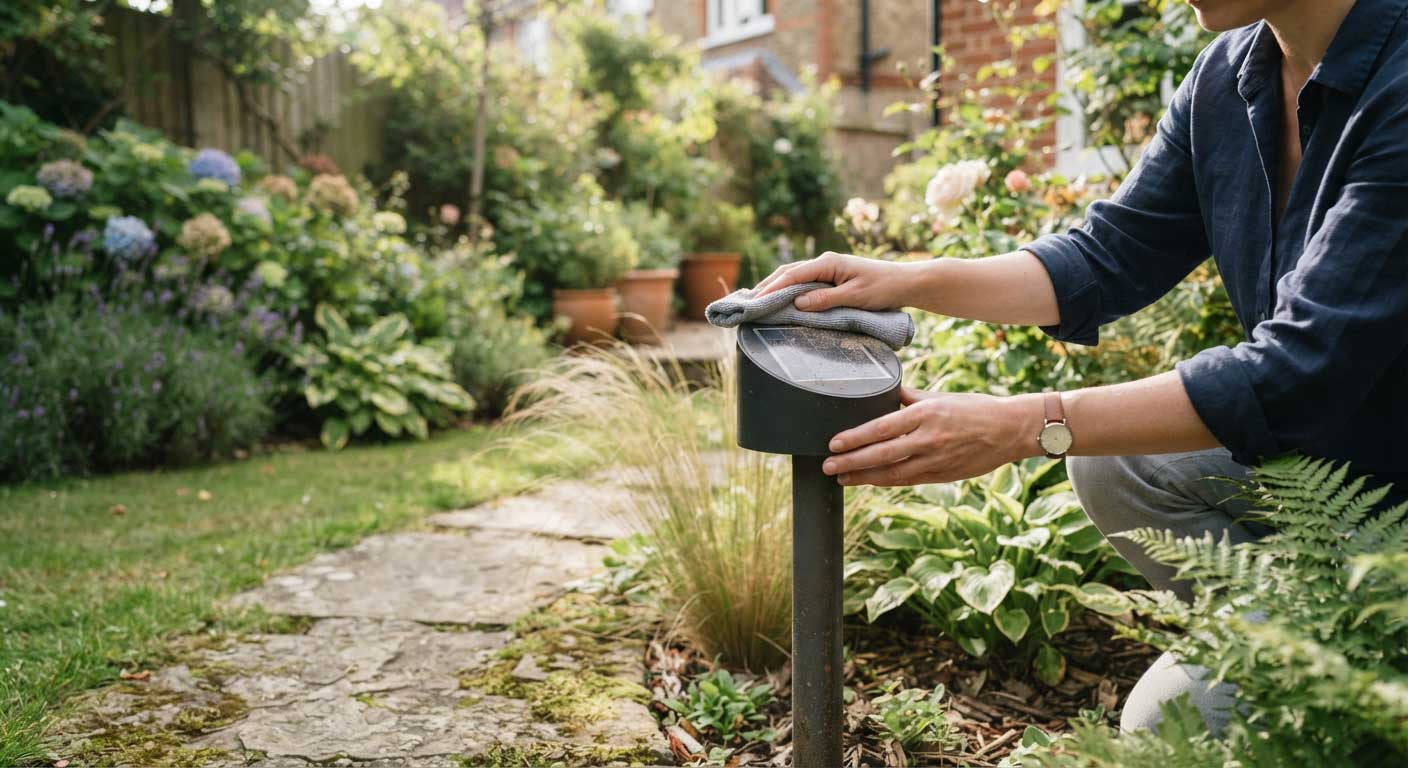
Moisten the microfiber cloth with clean water and gently wipe the photovoltaic surface.
Do not pour large quantities of water directly over the solar light, particularly around the panel edges, switch, housing seams, cable entry, or battery compartment.
For stubborn marks, make several light passes instead of pressing harder.
The U.S. Department of Energy and NREL generally recommend plain water or mild cleaning solutions for PV module maintenance while advising against hard brushes and abrasive materials.
4. Remove Water Spots and Residue
After washing, use a second clean microfiber cloth to remove remaining water.
This is particularly useful in areas with hard water. When droplets evaporate, dissolved minerals can remain on the panel as a cloudy film. The panel may look clean from a distance while still having a thin residue across the surface.
For a solar light installed beside a driveway, patio, pool, or sprinkler, check this area more often because splash water can leave mineral deposits.
How Often Should You Clean a Solar Light Panel?
There is no universal monthly cleaning schedule.
A better approach is to inspect the panel when the light begins operating for noticeably less time at night, or when visible dirt has accumulated.
NREL identifies agricultural dust, construction dust, pollen, bird droppings, diesel soot, and industrial pollution as common sources of PV soiling. Cleaning needs therefore vary considerably by location.
| Location | What to Watch For | Practical Cleaning Approach |
|---|---|---|
| Residential garden | Dust, leaves, pollen | Inspect every 1–2 months |
| Near trees | Pollen, sap, bird residue | Inspect more frequently during pollen season |
| Coastal area | Salt and airborne deposits | Check regularly for surface film |
| Near roads | Road dust and soot | Clean when visible buildup appears |
| Construction area | Fine construction dust | Inspect frequently during active work |
These are maintenance starting points rather than fixed manufacturer intervals. The actual interval should follow the panel condition and the light’s charging performance.
DOE guidance similarly emphasizes regular O&M and monitoring rather than assuming every solar installation needs an identical cleaning schedule.
What Not to Use on a Solar Light Panel
Some cleaning methods are unnecessarily aggressive.
Avoid:
- Abrasive sponges or scouring pads
- Steel wool
- Hard-bristle brushes
- Strong solvents
- Household abrasive powders
- High-pressure water jets
- Scraping dried deposits with metal tools
- Pouring water directly into the light housing
DOE guidance specifically warns that high-pressure hoses can damage PV module surfaces and that unsuitable cleaning equipment can increase the risk of surface damage.
For a compact solar light, there is rarely a reason to use high-pressure equipment. A damp microfiber cloth gives you much better control.
When Cleaning Does Not Fix the Charging Problem
A dirty panel is only one possible reason a solar light becomes dim or stops working.
If cleaning produces little improvement, inspect the surrounding system:
- Is the panel receiving direct sunlight?
- Has a nearby tree grown over the light?
- Is the panel shaded by a wall or garden structure?
- Is the rechargeable battery aging?
- Are the electrical contacts corroded?
- Is the light’s switch in the correct position?
- Has the panel surface become permanently cloudy or damaged?
DOE notes that preventive O&M helps reduce soiling, corrosion, debris accumulation, and other performance problems.
A useful field check is simple: clean the panel during the day, leave the light in an unobstructed sunny location, and compare its nighttime operating time over the following evening. If the result barely changes, the problem may be elsewhere in the system.
FAQ : how to clean a solar light panel?
Can I clean a solar light panel with tap water?
Yes. Clean water is normally suitable for routine cleaning. If your local water leaves heavy mineral spots, finish with a clean microfiber cloth to remove droplets before they evaporate.
Can I use glass cleaner on a solar light panel?
It is better to avoid ordinary glass cleaners unless the solar-light manufacturer specifically approves them. Plain water and a soft cloth are a safer routine choice.
How often should I clean my solar light panel?
Inspect it every one or two months as a starting point, then adjust according to dust, pollen, coastal salt, trees, birds, and local weather. Heavy soiling requires more frequent attention.
Does rain clean solar light panels?
Not always. NREL found that rainfall did not completely remove pollen from utility-scale PV panels, and peak-season performance losses reached as much as 15% at the studied sites.
Can I use a pressure washer to clean a solar panel?
No. High-pressure water is unnecessary for routine cleaning and can increase the risk of damage. DOE guidance specifically recommends avoiding high-pressure hoses for PV module cleaning.
Why is my solar light still dim after cleaning?
Check sunlight exposure, shading, battery condition, electrical contacts, and panel damage. A clean panel cannot compensate for an aging battery or insufficient daytime solar exposure.
Does cleaning improve solar charging?
It can when dirt, pollen, or other deposits are blocking sunlight. NREL’s field study measured a 5%–11% performance improvement after mechanical wet-brush cleaning at five utility-scale sites.
Final Answer
For routine maintenance, the safest approach is simple: remove loose debris, wipe the solar light panel gently with clean water and a soft microfiber cloth, remove water residue, and check for shading or physical damage. Cleaning frequency should follow the actual environment rather than an arbitrary calendar.
For homeowners, installers, and solar-light manufacturers, how to clean a solar light panel ultimately comes down to preserving a clear optical surface without introducing scratches, moisture intrusion, or unnecessary mechanical stress.
Related recommendations
-

How Heavy Are Solar Panels?
252how heavy are solar panels? Learn typical solar panel weights, 400W module examples, roof load considerations, and why flexible panels can be much lighter.
View details -
do solar panels work on cloudy days?
304Discover do solar panels work on cloudy days with real performance data, field-tested output rates, and Bright solar engineering insights from global installations.
View details -
How to Install Flexible Solar Panels on Van?
255Learn how to install flexible solar panels on van roofs safely and efficiently. Real installer tips, wiring advice, mounting methods, and maintenance insights.
View details -
How Solar Panel Works for Generate Electricity?
244How solar panel works for generate electricity explained with PV technology, solar cells, energy conversion steps, and expert insights from Bright Solar.
View details