how often do solar panels need to be cleaned?
how often do solar panels need to be cleaned? Most solar panels should be inspected every few months and cleaned about once or twice a year when dirt, pollen, bird droppings, or industrial deposits visibly affect output. Dry, dusty locations may need monthly or even more frequent cleaning, while clean, rainy sites may need less.
How Often Do Solar Panels Need to Be Cleaned?
There is no universal cleaning calendar for every solar installation.
For a typical residential system in a relatively clean environment, one or two thorough cleanings per year is a reasonable starting point. But that schedule changes quickly when the panels are exposed to agricultural dust, construction activity, heavy pollen, bird droppings, coastal salt, industrial pollution, or long dry periods.
IEA PVPS identifies soiling as one of the most important factors affecting PV energy yield after irradiance. Its research estimates that soiling causes approximately 3–5% of annual PV energy production losses globally, representing several billion euros in economic impact.
So the better question is not simply “What month should I clean?”
It is: How much output am I losing because the module surface is dirty?
That distinction matters when operating larger arrays.
A Practical Solar Panel Cleaning Schedule
| Installation condition | Suggested starting point |
|---|---|
| Clean residential area | Inspect every 3–6 months; clean 1–2 times/year if needed |
| Frequent rain, moderate pollution | Inspect seasonally; clean when deposits remain |
| Agricultural area | Inspect monthly during dusty periods |
| High-pollen location | Inspect during and after pollen season |
| Desert or very dusty climate | Monitor frequently; monthly or more often may be necessary |
| Construction/industrial area | Inspect frequently and clean after heavy dust events |
| Heavy bird activity | Inspect frequently and spot-clean when necessary |
These are starting points, not fixed maintenance requirements. NREL‘s O&M guidance reports typical annual soiling losses around 4.3–7.5%, with many studies near 6%, while daily soiling rates around 0.05% output loss per day have been reported. Under agricultural, bird-heavy, or dust-storm conditions, reported daily losses can be considerably higher.
Does Rain Clean Solar Panels?
Sometimes. Not reliably.
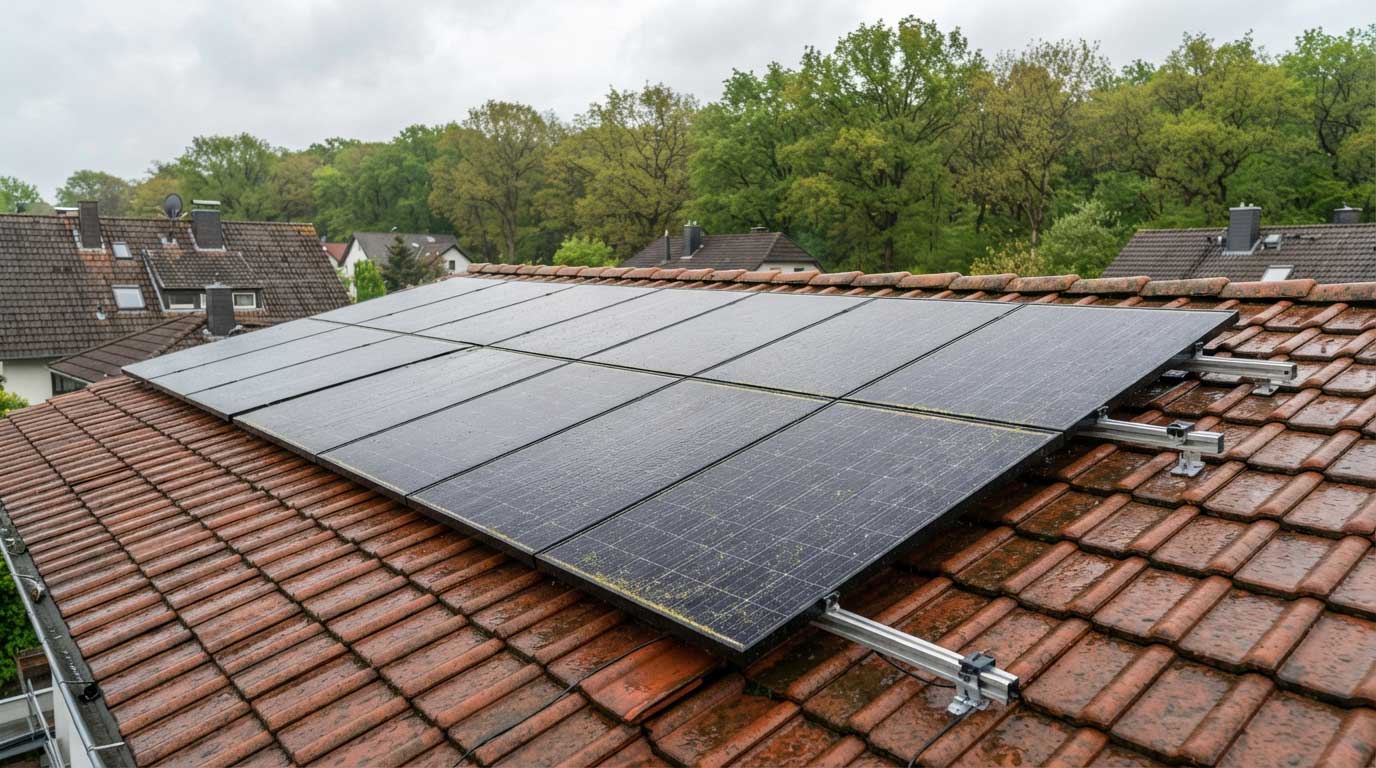
Rain removes loose dust and some surface contamination, but it does not guarantee that a PV module is actually clean. Dust can combine with dew and moisture, dry onto the glass, and become much harder to remove.
NREL researchers studied five utility-scale solar plants in North Carolina and found that rainfall did not completely remove pollen. During peak pollen season, panel performance dropped by as much as 15%, while the research indicated annual production losses could reach approximately 10% without planned cleaning. After mechanical wet-brush cleaning, measured performance improvements ranged from 5% to 11%.
That is a useful reality check.
A homeowner may look at a panel after a storm and see a clean-looking surface from the ground. Fine pollen, bird residue, or a thin film can still remain.
At Bright Solar, this is why I would treat rainfall as a helpful environmental cleaning event—not as proof that scheduled inspection is unnecessary.
What Causes Solar Panels to Get Dirty?
The type of contamination is often more important than the number of months since the last cleaning.
Common sources include:
- Dust and airborne soil
- Pollen
- Bird droppings
- Leaves and organic debris
- Industrial particles
- Agricultural emissions
- Road traffic pollution
- Coastal salt deposits
- Construction dust
- Snow or ice in colder climates
NREL specifically identifies agricultural dust, construction dust, pollen, bird populations, diesel soot, and industrial activity as sources that can require different cleaning strategies.
I find the location around a panel can tell you a lot before you even touch the glass.
A rooftop beside a mature pine tree is different from a rooftop in a new suburban development. A solar array above a barn is different again. The same 400W module can have completely different maintenance requirements simply because the surrounding environment is different.
When Should You Clean Solar Panels?
Do not wait for the panel to look dramatically dirty.
Three practical signals are particularly useful:
1. Visible Contamination
If you can clearly see bird droppings, thick dust bands, pollen, or industrial residue, inspect the affected modules.
Localized contamination deserves attention because a relatively small dirty area can have a larger electrical effect than its visual size suggests, depending on the cell layout and module design.
2. Unexpected Production Decline
Compare recent production with historical performance while accounting for sunlight, temperature, shading, and weather.
NREL has developed approaches for estimating soiling from PV production data, including the Stochastic Rate and Recovery and Combined Degradation and Soiling methods.
For a monitored commercial system, this can be much more useful than simply scheduling a cleaner twice a year.
3. Seasonal Events
Pollen season, harvesting, nearby construction, wildfire smoke, dust storms, and long dry periods can justify an inspection even if the normal maintenance schedule says the next cleaning is months away.
This is where a calendar-only approach falls short.
How Much Energy Can Dirty Solar Panels Lose?
The answer depends heavily on location.
IEA PVPS estimates average global soiling losses at approximately 4–7% in its 2025 fact sheet.
NREL has reported that annual soiling losses in the United States can reach about 7% in some areas, while losses in the Middle East have been reported as high as 50% under severe conditions.
Those numbers should not be interpreted as a promise that cleaning a residential array will recover exactly 7%, 20%, or 50% of its output. They demonstrate how strongly local conditions can change the economics.
For example, if a system normally produces 8,000 kWh annually, a hypothetical 5% soiling loss represents about 400 kWh of energy. Whether cleaning is worthwhile depends on electricity value, labor, access, water, cleaning method, and how quickly the panels become dirty again.
NREL’s research emphasizes this economic balance: cleaning clean modules wastes money, while allowing excessive soiling to continue sacrifices energy production.
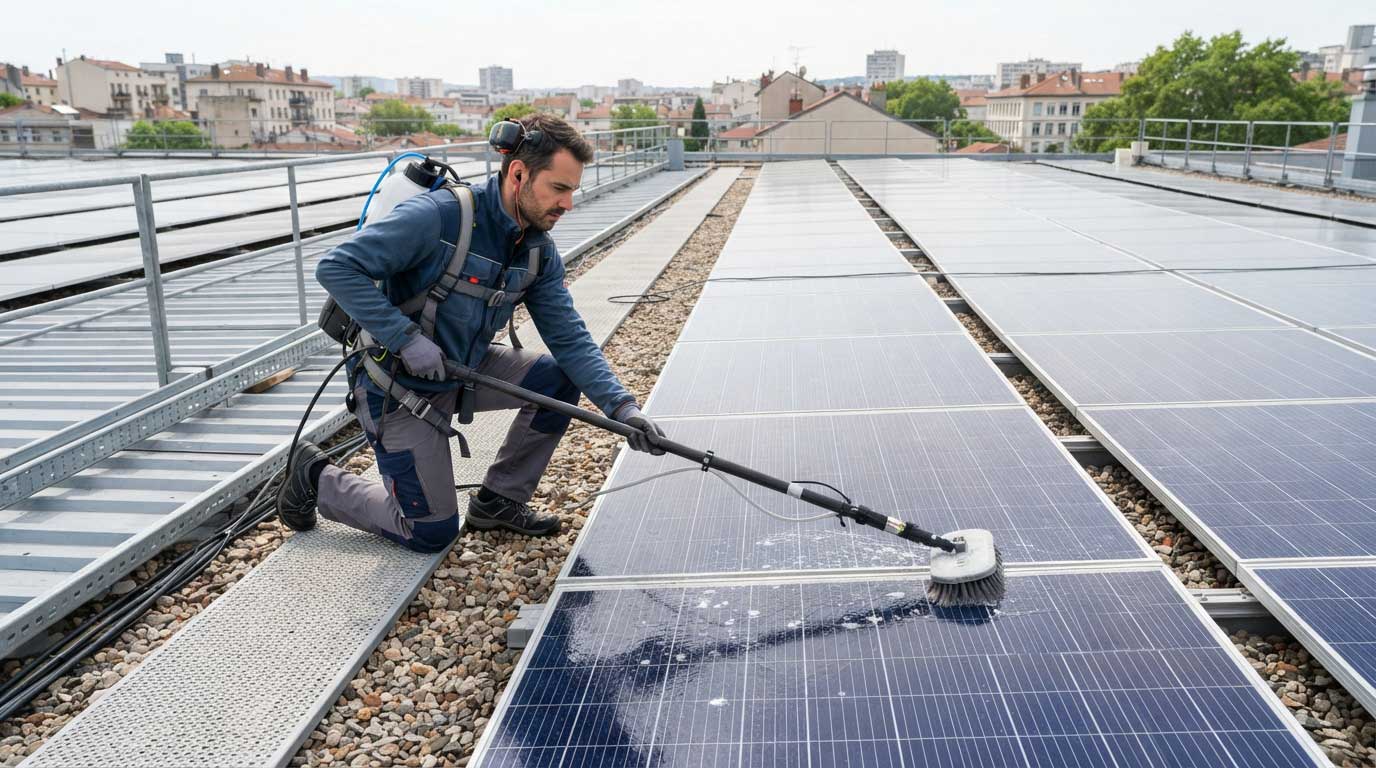
How Should Solar Panels Be Cleaned?
The cleaning method matters almost as much as the schedule.
NREL’s technical guidance recommends deionized water near the module temperature when washing and advises using soft, thin-bristle brushes when contact cleaning is required.
For routine residential or commercial cleaning:
- Inspect the panels first.
- Choose a cool period or low-light condition.
- Remove loose debris gently.
- Use clean, suitable water.
- Use a soft, non-abrasive brush if necessary.
- Avoid aggressive scrubbing.
- Check the surface afterward for residue or streaking.
Avoid treating the glass like a concrete floor. Abrasive pads, harsh chemicals, aggressive pressure washing, and careless walking across modules can create problems that dirt itself never would.
For rooftop systems, personal safety is also more important than recovering a few percentage points of production. If access is difficult or the roof is steep, professional cleaning is the sensible option.
FAQ About Solar Panel Cleaning
How often do solar panels need to be cleaned?
Most systems should be inspected every few months and cleaned roughly once or twice per year when needed. Dusty, agricultural, coastal, or heavily polluted locations may require more frequent cleaning.
Do solar panels need cleaning if it rains regularly?
Yes, they may. Rain can remove loose dirt but may leave pollen, bird residue, and mineral deposits behind. NREL research found that rainfall was insufficient to fully remove pollen from several North Carolina PV plants.
Can dirty solar panels reduce electricity production?
Yes. Soiling blocks or scatters sunlight before it reaches the photovoltaic cells. IEA PVPS estimates global annual energy losses from soiling at roughly 4–7%.
How often should solar panels be cleaned in a desert?
Desert systems generally need much closer monitoring. Monthly cleaning can be appropriate in some locations, while severe dust conditions may justify even more frequent cleaning. IEA PVPS research shows that cleaning frequency should be based on measured soiling and economics rather than a universal calendar.
Is it worth cleaning solar panels every month?
Not necessarily. Monthly cleaning can cost more than the additional electricity recovered in a relatively clean environment. Trigger cleaning when the measured or estimated production loss justifies the maintenance expense.
Can I clean solar panels with tap water?
It depends on the water quality. Hard water can leave mineral deposits after drying. NREL guidance recommends deionized water near the module temperature for washing when appropriate.
What is the best time to clean solar panels?
Cooler, low-light conditions are generally preferable because the module surface is less likely to be hot. Early morning or evening can also make the work more comfortable and reduce rapid drying, but site safety always comes first.
Final Answer
how often do solar panels need to be cleaned depends more on the site than on the calendar. For many residential systems, one or two cleanings per year is a sensible starting point, but dusty, agricultural, pollen-heavy, or industrial locations may require monthly monitoring or triggered cleaning based on actual production losses.
The prev: how much silver in a solar panel?The next: how solar panel produce electricity?
Related recommendations
-

How Much Energy Can a Solar Panel Generate?
212Discover how much energy can a solar panel generate in real conditions. Learn actual daily output, weather impacts, and expert insights from Bright Solar.
View details -
How to Install Flexible Solar Panels to Rubber RV Roof?
225Learn how to install flexible solar panels to rubber RV roof safely and correctly. Discover proven adhesive methods, wiring tips, and real-world installation insights from RV solar experts.
View details -
How Much Does One Solar Panel Cost?
199How much does one solar panel cost? Discover current solar panel prices, what affects costs, and how to choose the right panel for your home with Bright Solar's expert guide.
View details -
How much is it to install a solar panel?
106How much is it to install a solar panel? Learn installation costs, labor factors, system sizing, and real pricing insights from Bright Solar experts.
View details