How Do You Install Solar Panels?
How do you install solar panels? Solar panels are installed by first assessing the roof or mounting site, confirming structural capacity and sunlight exposure, planning the array layout, installing compatible mounting hardware, securing the modules, routing DC wiring, and completing the electrical connection, inspection, and commissioning. Grid-connected systems also require local permitting and utility approval.
What Should You Check Before Installing Solar Panels?
A good installation starts before the first mounting rail goes onto the roof.
First, inspect the installation surface. For a rooftop system, check the roof’s age, condition, construction, available area, drainage, and existing penetrations. NREL notes that PV installation can affect roof warranties and recommends reviewing the roof condition and manufacturer’s requirements before installation.
Sunlight is the next practical issue. Look at the roof in the morning, around midday, and later in the afternoon. A chimney that looks insignificant at 9 a.m. may cast a long shadow across several modules by mid-afternoon.
Before installation, confirm:
- Available roof or ground-mount area
- Roof structure and expected loads
- Solar exposure and shading
- Panel dimensions and electrical specifications
- Mounting-system compatibility
- Inverter or charge-controller requirements
- Cable routing
- Disconnect and protection requirements
- Local building and electrical requirements
- Access for future maintenance
NREL’s solar-ready guidance gives a useful real-world reference: a typical pitched-roof PV system can add roughly 3 lb/ft² of additional load, while ballasted flat-roof systems can be around 4–6 lb/ft², depending on the design. These are representative figures, not a universal structural allowance for every installation.
Roof Condition Matters More Than Panel Placement Alone
It is tempting to start by asking where the panels will fit. Experienced installers usually have another question first: Will the roof remain a reliable mounting surface for the expected life of the PV system?
Replacing or repairing a roof after panels have been installed can mean additional labor and temporary removal of equipment. NREL specifically recommends coordination between the roofing contractor and PV installer where roof warranties or membrane systems are involved.
That small piece of planning can save a surprisingly complicated repair later.
How Are Solar Panels Mounted?
The mounting method depends on the surface.
| Installation type | Common mounting approach | Main consideration |
|---|---|---|
| Pitched roof | Rails, brackets, roof attachments | Structural attachment and weather sealing |
| Flat roof | Ballasted or mechanically attached racking | Wind, roof loading, drainage |
| Ground mount | Posts, rails, or structural frames | Soil, wind, access, orientation |
| RV roof | Lightweight mounting or suitable bonding/attachment system | Roof material, weight, movement |
| Marine application | Application-specific mounting hardware | Vibration, corrosion, water exposure |
NREL identifies roof-mounted, ground-mounted, fixed, and tracking systems among common PV mounting approaches.
For a conventional framed rooftop panel, the installer typically positions the mounting hardware first, verifies alignment, and then secures the modules according to the racking and module manufacturer’s instructions.
For flexible solar panels, the installation method can be different. The roof surface, adhesive or mechanical attachment method, panel flexibility, cable routing, and manufacturer’s installation requirements all need to be considered together.
How Do You Install Solar Panels Step by Step?
The exact procedure varies by system, but a professional installation generally follows this sequence.
Plan the Array Layout
Determine how many modules fit without interfering with roof edges, vents, skylights, access paths, or other equipment.
Leave appropriate access and clearances required by local codes and the mounting-system instructions.
Install the Mounting Structure
Mark attachment points and install the approved mounting hardware. On a roof, the attachment method must suit the roof construction and structural members.
Do not simply fasten into the roof surface because a location appears convenient. NREL’s installation guidance emphasizes correctly positioning fasteners and ensuring that mounting hardware is secured to the intended structural members.
Position and Secure the Panels
Lift the modules safely into position, place them according to the planned layout, and secure them with the specified clamps or mounting hardware.
OSHA specifically warns that workers should not climb ladders while carrying solar panels and recommends appropriate lifting equipment where possible.
Route and Connect the Wiring
After the modules are mounted, DC cables are routed and connected according to the electrical design.
The array may be wired in series, parallel, or a series-parallel configuration. The resulting voltage and current must remain within the ratings of the inverter, charge controller, conductors, connectors, and protection equipment.
Connect the Balance of System
Depending on the installation, this can include:
- Inverter
- Charge controller
- Battery
- DC disconnect
- AC disconnect
- Overcurrent protection
- Grounding and bonding equipment
- Monitoring equipment
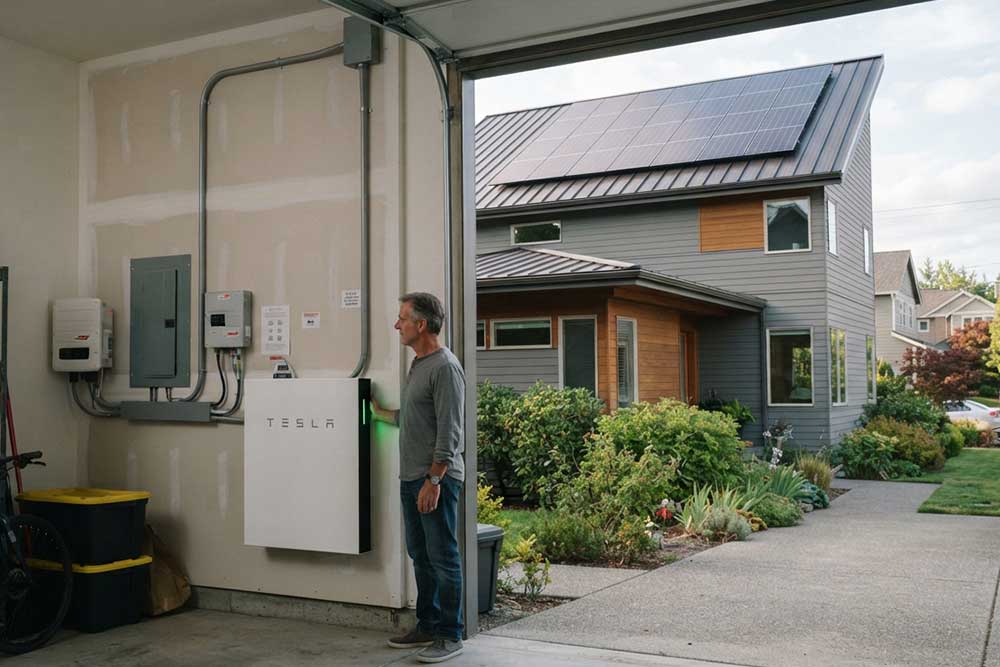
A residential grid-connected system is considerably more than panels sitting on a roof. The electrical equipment has to work as one system.
Inspect, Test, and Commission
Before the system is energized, installers verify connections, polarity, mounting, grounding, equipment settings, and other required electrical and structural details.
For grid-connected rooftop systems in the United States, the Department of Energy explains that permitting and inspection generally occur before the utility connects the system to the grid. Local requirements vary by jurisdiction.
Solar Panel Installation Safety Is Not Optional
Solar installation combines two hazards that deserve particular attention: working at height and electrical energy.
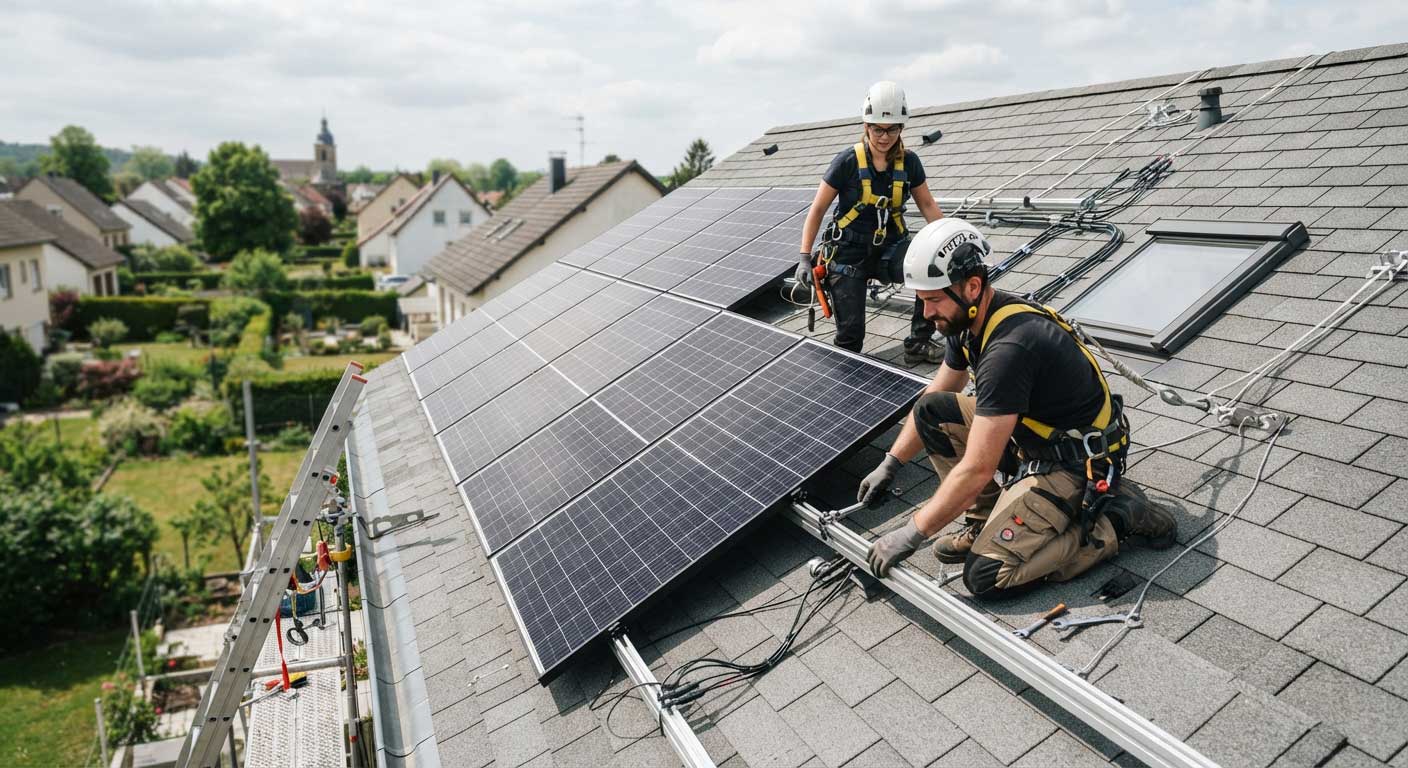
OSHA states that construction workers installing solar panels who are exposed to falls of 6 feet or more must be protected using an appropriate method such as guardrails, safety nets, or personal fall-arrest systems. OSHA also identifies electrical shock and arc-flash hazards associated with solar installation work.
Solar modules can also generate electricity when exposed to light. Covering a panel does not turn an installation into a harmless object, and electrical isolation procedures must follow the applicable equipment and workplace requirements.
How Much Roof Space Do Solar Panels Need?
The required area depends on the number and physical dimensions of the selected modules.
For example, a project requiring ten modules needs enough usable roof area for all ten modules plus the required spacing, access, setbacks, and equipment clearances. The nameplate wattage alone cannot tell you whether an array will physically fit.
A useful planning worksheet should include:
| Item | Why it matters |
|---|---|
| Module dimensions | Determines physical array footprint |
| Module wattage | Determines nominal system capacity |
| Roof orientation | Influences solar exposure |
| Roof pitch | Affects mounting and installation |
| Shading | Can reduce production |
| Roof obstacles | Reduce usable area |
| Setbacks/access | May restrict module placement |
| Structural loading | Determines whether reinforcement is needed |
For B2B projects, these details become even more important when the installation uses custom-size or flexible modules. The physical dimensions should come from the approved product drawing rather than an assumed standard panel size.
How Bright Solar Approaches Solar Panel Installation
Bright Solar supports B2B applications involving flexible and semi-flexible solar panels, including RVs, campers, outdoor power, certain marine applications, and off-grid systems.
The installation method should follow the actual product construction and project conditions. A lightweight flexible module mounted on an RV roof is not installed in exactly the same way as a conventional framed module on a residential pitched roof.
For OEM and ODM projects, confirm these points before finalizing the installation:
- Exact panel dimensions
- Weight
- Bending requirements
- Cell technology
- Connector specification
- Electrical ratings
- Mounting method
- Environmental conditions
- Intended application
- Required customization
That is where product engineering matters. The mounting solution should be designed around the actual panel—not the other way around.
FAQ About How Do You Install Solar Panels?
Can I install solar panels myself?
Small portable systems may be suitable for some users, but permanent rooftop PV installation involves structural, electrical, and fall hazards. Grid-connected systems can also require permits, inspections, and utility approval. Qualified professionals should handle work that exceeds the user’s training or local requirements.
How long does it take to install solar panels?
There is no universal installation time. A small system may be physically installed relatively quickly, while larger or more complex projects require additional structural, electrical, permitting, inspection, and utility coordination.
Do solar panels damage the roof?
A properly designed and installed system should account for the roof structure, attachment method, waterproofing, and manufacturer requirements. Poorly planned penetrations or incompatible mounting practices can create problems. NREL recommends inspecting the roof before PV installation and coordinating with roofing professionals when necessary.
What direction should solar panels face?
The appropriate orientation depends on the location, roof geometry, shading, seasonal sunlight, and system objectives. There is no single direction that is optimal for every property. Solar design software and site assessment can evaluate the actual installation.
Do solar panels need to be installed on a roof?
No. Solar panels can also be installed on ground-mounted structures, carports, RVs, boats, and other suitable surfaces. The mounting system and electrical design must match the application.
What happens after solar panels are installed?
The installer typically performs electrical and system checks, completes required inspections, and, for grid-connected projects, coordinates utility interconnection. The exact process varies by jurisdiction. The U.S. Department of Energy notes that local permitting and inspection requirements differ between jurisdictions.
Can flexible solar panels be installed the same way as rigid panels?
Not necessarily. Flexible panels have different mechanical characteristics and may use different attachment methods. Always follow the specific manufacturer’s installation instructions and verify the surface, bending requirements, adhesives or fasteners, cable routing, and environmental conditions.
Conclusion
How do you install solar panels? Start with the site, roof or mounting surface, structural requirements, sunlight exposure, and electrical design. Then install the appropriate mounting system, secure the modules, route the wiring, connect the balance-of-system equipment, and complete the required testing, inspection, and commissioning.
For Bright Solar applications, the correct installation method depends on the actual panel construction and project environment. A well-installed solar panel is not simply one that is firmly attached—it is one that is structurally supported, electrically compatible, safely installed, and suited to the conditions where it will operate.
The prev: How Do You Connect Solar Panels?The next: How Do You Replace a Roof With Solar Panels?
Related recommendations
-

Can Solar Panels Store Energy?
142No. Solar panels generate electricity but do not store it. A separate battery system can store surplus solar energy for later use.
View details -
How Does a Portable Solar Panel Work?
323How does a portable solar panel work? Learn how portable solar panels convert sunlight into usable electricity for camping, RVs, and backup power systems.
View details -
does a solar panel need direct sunlight?
208does a solar panel need direct sunlight? Learn how solar panels work in cloudy weather, shade conditions, indirect light, and how to maximize solar energy output.
View details -
how do solar panels generate power?
295how do solar panels generate power? Learn how photovoltaic cells convert sunlight into electricity, from solar energy absorption to usable home power systems.
View details