Flexible solar panel 550 watt: High Power Solar Solution for RV, Marine and Off-Grid Use
A flexible solar panel 550 watt delivers high solar output while maintaining a lightweight and adaptable design for RVs, boats, mobile homes, and off-grid applications. A 550W flexible panel can generate approximately 1.5–3kWh of energy daily depending on sunlight conditions, location, and installation angle.
When people hear “550 watts,” they usually imagine a large glass solar module installed on a fixed rooftop.
That assumption is changing.
At Bright Solar, we have worked with customers who needed more power but could not add more weight.
An RV manufacturer in Europe wanted additional energy capacity without reinforcing vehicle roofs.
A marine equipment supplier needed solar power without adding heavy structures to boats.
An off-grid customer wanted a compact solution for a remote cabin.
The common problem was the same:
They needed more electricity, but traditional solar panels created installation limitations.
This is where a flexible solar panel 550 watt solution becomes valuable.
It combines higher power output with the installation freedom of flexible solar technology.
After years working with flexible photovoltaic products, our team has found that high-power flexible panels are not simply about increasing wattage.
They are about making solar possible in places where conventional panels are difficult to install.
What is a flexible solar panel 550 watt?
A flexible solar panel 550 watt is a high-output photovoltaic module designed to produce around 550 watts of rated power while using lightweight materials instead of traditional glass-and-aluminum structures.
Compared with conventional rigid solar panels, flexible modules typically focus on:
- Reduced weight
- Easier transportation
- More installation possibilities
- Better adaptation to curved surfaces
A typical 550W flexible solar panel consists of:
| Component | Function |
|---|---|
| High-efficiency solar cells | Convert sunlight into electrical energy |
| ETFE protective coating | Improves UV and weather resistance |
| Flexible composite layer | Allows lightweight installation |
| Waterproof junction box | Protects electrical connections |
| Bypass diode system | Helps reduce shading losses |
The purpose of flexible solar technology is not to replace every traditional solar system.
Large rooftop projects still benefit from rigid panels.
Instead, flexible 550W panels solve a different problem:
How can more solar power be installed where weight and space are limited?
Why choose a 550W flexible solar panel instead of lower wattage panels?
Solar users often compare:
- 100W flexible panels
- 200W flexible panels
- 300W flexible panels
- 400W flexible panels
- 550W flexible panels
The difference is mainly energy capacity and system design.
A 550W flexible solar panel is suitable when users need:
- Higher daily electricity production
- Fewer individual panels
- Cleaner installation appearance
- Reduced wiring complexity
For example:
| Panel Power | Typical Application |
|---|---|
| 100W | Small electronics and emergency charging |
| 200W | Basic backup systems |
| 300W | RV and mobile applications |
| 400W | Larger battery charging systems |
| 550W | High-demand off-grid and professional applications |
One Bright Solar customer in Australia operated a remote monitoring station.
Originally, the customer planned to install several smaller solar panels.
The problems appeared during installation:
- More mounting points
- More cable connections
- Larger installation area
- More maintenance requirements
After redesigning the system with a 550W flexible solar panel:
- Installation area was reduced
- Wiring became simpler
- The overall system layout became cleaner
The customer was not looking for the cheapest panel.
They needed the most practical power solution for a difficult location.
How much power can a flexible solar panel 550 watt produce?
A 550W flexible solar panel does not produce the same amount of energy every day.
Actual output depends on:
- Solar radiation
- Installation angle
- Temperature
- Weather
- Shading conditions
The basic calculation is:
Daily Energy Production = Solar Panel Wattage × Peak Sun Hours × System Efficiency
Estimated production:
| Region | Approximate Daily Energy |
|---|---|
| Arizona, USA | 2.0–3.0kWh/day |
| Southern Europe | 1.8–2.8kWh/day |
| Northern Europe | 1.2–2.0kWh/day |
According to data from the National Renewable Energy Laboratory (NREL), solar energy production varies significantly depending on geographic location and solar resource availability.
Source:
National Renewable Energy Laboratory – Solar Resource Maps
https://www.nrel.gov/gis/solar-resource-maps.html
A 550W flexible panel may support:
- RV refrigeration systems
- Battery banks
- Marine electronics
- Remote communication equipment
- Small off-grid appliances
However, it is important to understand the application.
A single 550W panel is not designed to power an entire modern house.
Instead, it provides a powerful energy source for targeted applications.

Advantages of flexible solar panel 550 watt technology
The main advantage of high-power flexible solar is installation freedom.
Traditional solar panels require:
- Strong mounting structures
- Flat installation surfaces
- Additional support hardware
Flexible 550W panels provide advantages in:
Lower structural requirements
Weight is a critical factor for mobile applications.
RV and marine users often calculate every additional kilogram.
Reducing panel weight can improve:
- Fuel efficiency
- Vehicle balance
- Installation simplicity
Better space utilization
Many applications have limited available area.
Examples:
- Boat decks
- Camper roofs
- Portable structures
A higher wattage flexible panel allows users to generate more electricity from limited space.
Cleaner installation design
Using fewer panels can reduce:
- Cable connections
- Mounting points
- Visual impact
For commercial applications, this can create a more professional appearance.
How to install a flexible solar panel 550 watt system
Installing a flexible solar panel 550 watt system is usually simpler than installing traditional framed solar modules, but high-power panels still require careful planning.
At Bright Solar, we have seen many installation problems caused not by the solar panel itself, but by incorrect system preparation.
A 550W flexible panel produces significant electrical output.
The installation method must match the environment.
A reliable installation process includes:
Step 1: Evaluate the installation location
Before mounting a 550W flexible solar panel, check:
- Available installation area
- Daily sunlight exposure
- Surface strength
- Temperature conditions
- Cable routing distance
A common mistake is choosing a location based only on available space.
Solar performance depends heavily on sunlight quality.
For example, one customer in Norway planned to install a flexible solar panel on the roof of a remote cabin.
The roof area was large enough, but nearby trees created afternoon shading.
After reviewing the solar exposure:
- The panel position was adjusted
- Average daily production improved
- Additional equipment costs were avoided
The lesson was simple:
Good solar design starts before installation.
Step 2: Prepare the mounting surface
Flexible solar panels are lightweight, but the mounting surface must be clean and stable.
Recommended preparation:
- Remove dust and dirt
- Clean oil or surface contamination
- Ensure the area is dry
- Confirm adhesive or mounting compatibility
Suitable installation surfaces include:
- RV roofs
- Boat decks
- Metal structures
- Composite materials
- Lightweight buildings
For marine applications, additional attention is needed because saltwater environments can accelerate material aging.
Step 3: Install electrical components
A 550W flexible solar panel normally works together with:
| Component | Purpose |
|---|---|
| MPPT controller | Improves charging efficiency |
| Battery bank | Stores generated energy |
| Inverter | Converts DC power to AC power |
| Monitoring system | Tracks performance |
For off-grid systems, battery selection is especially important.
Common combinations include:
- LiFePO4 batteries
- Portable power stations
- Deep-cycle battery systems
A well-designed solar system balances:
Panel output → Charging control → Storage capacity → Energy consumption
Step 4: Test the completed system
After installation, Bright Solar recommends checking:
- Open circuit voltage
- Charging current
- Connector condition
- Battery charging status
- Surface attachment
A monitoring device can help identify:
- Reduced sunlight exposure
- Connection problems
- Unexpected power losses
For professional installations, recording initial performance data creates a useful reference for future maintenance.
Real-world applications of flexible solar panel 550 watt
A 550W flexible solar panel is mainly selected for applications where energy demand is higher but installation conditions are challenging.
RV and mobile homes
RV owners often face three limitations:
- Limited roof space
- Maximum weight restrictions
- Need for independent electricity
A 550W flexible panel can support:
- Refrigerators
- Lighting
- Laptop charging
- Communication equipment
- Battery systems
Compared with installing several smaller panels, one high-power flexible panel can simplify the roof layout.
Marine solar systems
Boats require solar products that handle unique conditions:
- Curved surfaces
- Movement and vibration
- Limited installation space
- Weather exposure
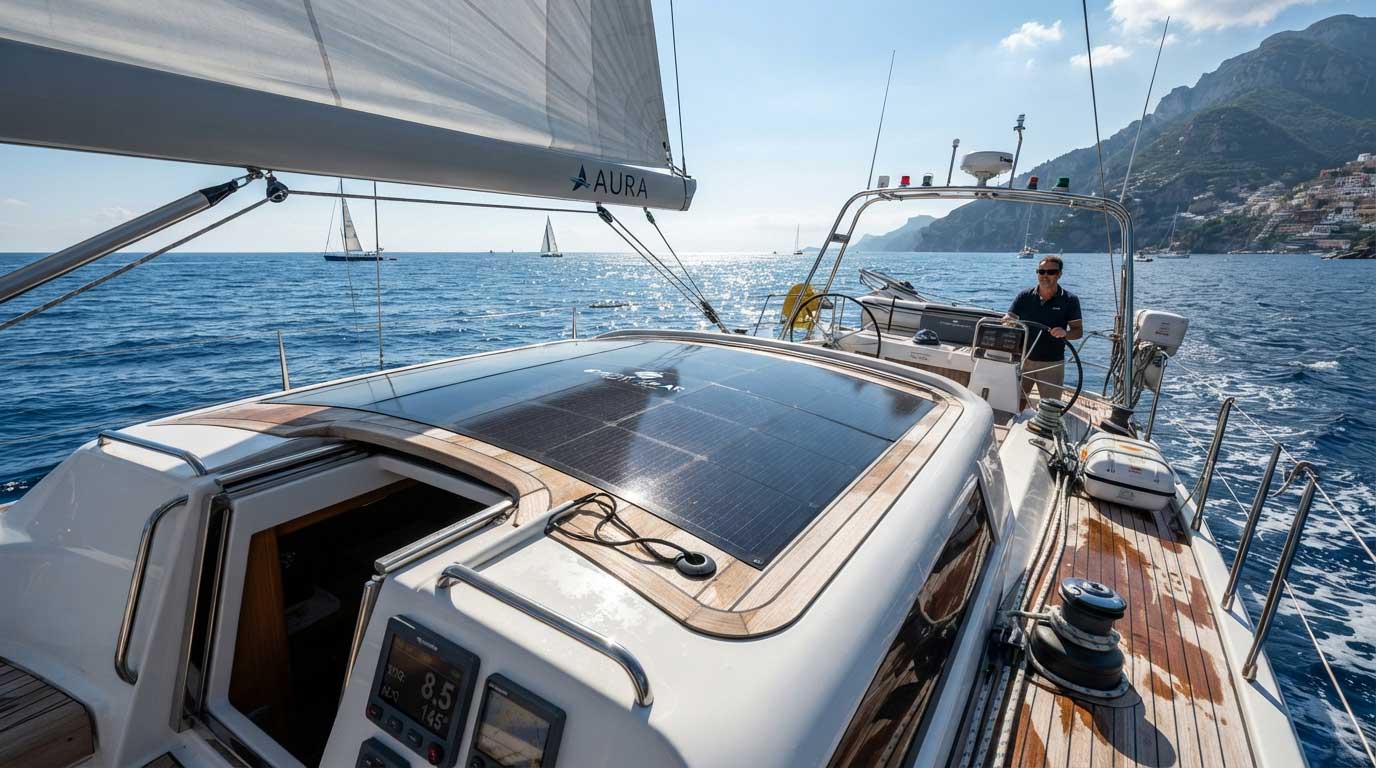
Flexible solar panels are often installed on:
- Yacht roofs
- Cabin surfaces
- Bimini tops
- Deck areas
Reducing weight is especially important for marine applications because every additional kilogram affects efficiency and handling.
Off-grid cabins and remote projects
Remote locations often lack reliable grid access.
A 550W flexible solar system can provide electricity for:
- Communication equipment
- Monitoring devices
- Lighting
- Small appliances
For remote installations, transportation is also an important factor.
A lightweight solar module is easier to move and install compared with large rigid panels.
Commercial portable energy systems
Some businesses use flexible solar technology for:
- Field research stations
- Emergency power systems
- Mobile work sites
- Outdoor events
The ability to deploy solar quickly can be more valuable than maximizing traditional rooftop efficiency.
Materials and durability of flexible solar panel 550 watt
Customers often ask:
“Can a flexible solar panel survive outdoor conditions?”
The answer depends on product design and installation quality.
A high-quality flexible solar panel should consider:
ETFE protective coating
Many premium flexible solar panels use ETFE surface materials because they provide:
- UV resistance
- Weather protection
- Lightweight durability
- Better surface performance
Compared with traditional glass panels, flexible designs focus on reducing weight while maintaining outdoor protection.
Waterproof electrical protection
Outdoor solar systems must handle:
- Rain
- Humidity
- Temperature changes
- Dust exposure
Important protection areas include:
- Junction box sealing
- Cable connections
- Connector protection
Temperature performance
Solar panels operate in changing temperatures.
Performance can be affected by:
- Direct sunlight
- Hot environments
- Cold climates
The installation environment should always be considered when selecting solar equipment.
The International Energy Agency (IEA) highlights that photovoltaic system reliability depends on module quality, environmental conditions, and proper installation practices.
Source:
International Energy Agency – Solar PV Tracking Report
https://www.iea.org/reports/solar-pv
How much does a flexible solar panel 550 watt cost?
The cost of a flexible solar panel 550 watt depends on:
- Solar cell efficiency
- Protective materials
- Manufacturing quality
- Brand reputation
- Warranty support
Typical market pricing:
| Product Type | Estimated Price |
|---|---|
| Basic 550W flexible panel | $500–$700 |
| Premium ETFE 550W panel | $700–$1,000 |
| Complete solar kit | $1,000–$2,000+ |
Price should not be the only purchasing factor.
A lower-cost panel may create additional expenses later:
- Difficult replacement
- Lower durability
- Limited technical support
- Shorter service life
For professional users, reliability usually has a higher value than the lowest initial purchase price.
Maintenance guide for flexible solar panel 550 watt
Flexible solar panels require limited maintenance, but regular inspection improves long-term performance.
Recommended maintenance schedule:
| Maintenance Task | Suggested Frequency |
|---|---|
| Surface cleaning | Every few months or when dirty |
| Cable inspection | Every 6–12 months |
| Performance monitoring | Regularly |
| Connector inspection | Annually |
Clean the solar surface
Dust and environmental residue can reduce sunlight absorption.
Common contaminants:
- Dust
- Leaves
- Bird deposits
- Salt residue
Use appropriate cleaning methods to avoid damaging the protective surface.
Check electrical connections
Inspect:
- Cable damage
- Connector condition
- Junction box sealing
Early detection prevents larger system failures.
Monitor energy production
Unexpected output reduction may indicate:
- Shading changes
- Dirt buildup
- Connection issues
Monitoring helps maintain stable performance.
FAQ About Flexible Solar Panel 550 Watt
How much electricity does a flexible solar panel 550 watt produce?
A 550W flexible solar panel can typically generate around 1.5–3kWh of electricity per day depending on sunlight hours, location, installation angle, and weather conditions.
Can a flexible solar panel 550 watt power an entire house?
A single 550W panel is generally designed for supplemental or off-grid applications. A complete home requires a larger solar array based on household electricity consumption.
Is a 550W flexible solar panel suitable for RV use?
Yes. Many RV users choose high-power flexible panels because they provide more energy while saving roof space and reducing installation weight.
Can a 550W flexible solar panel be installed on curved surfaces?
Yes. Flexible solar panels are designed for applications where traditional rigid modules cannot easily fit, including curved roofs and special structures.
Are flexible solar panels less efficient than rigid panels?
Efficiency depends on the solar cell technology used. Flexible panels may prioritize lightweight design and installation flexibility rather than maximum efficiency alone.
How long can a flexible solar panel 550 watt last?
The lifespan depends on materials, environmental exposure, and installation quality. Premium flexible solar panels are designed for long-term outdoor use.
What battery size is recommended with a 550W flexible solar panel?
Battery size depends on daily energy consumption. Many users combine 550W panels with lithium battery systems for mobile and off-grid applications.
Final Thoughts: Choosing the Right Flexible Solar Panel 550 Watt Solution
A flexible solar panel 550 watt is designed for users who need more energy without adding unnecessary weight or complex installation requirements.
It is especially valuable for:
- RV owners
- Boat operators
- Off-grid homeowners
- Remote project developers
- Mobile energy users
At Bright Solar, our experience shows that solar selection should begin with the application, not simply the wattage number.
A 550W flexible panel is not the right choice for every project.
But when installation space is limited and energy demand is high, it provides a practical balance between power, flexibility, and portability.
The future of solar is not only about larger systems.
It is also about making more surfaces capable of producing clean energy.
Related recommendations
-

Portable Solar Panels with Battery Storage: Complete Guide
171Portable solar panels with battery storage generate electricity during daylight and store it for later use in RVs, camping, boats, work sites, and emergency ...
View details -
Best flexible solar panels for boats: Lightweight Marine Solar Solutions
232Find the best flexible solar panels for boats with Bright Solar. Learn marine installation tips, durability factors, power output, and real-world sailing applications.
View details -
flexible solar panels for marine use: Lightweight Solar Power Solution for Boats and Yachts
133Explore flexible solar panels for marine use with lightweight design, waterproof protection, and reliable energy output for boats, yachts, and offshore applications.
View details -
10 Watt Flexible Solar Panel: Uses, Output and Installation Guide
173A 10 watt flexible solar panel is designed for low-power applications such as sensors, small lights, GPS devices, battery maintenance, and small RV or marine...
View details