Flexible Fabric Solar Panels: Uses, Design and Buying Guide
Flexible fabric solar panels combine photovoltaic technology with a lightweight fabric-compatible structure, making them useful for portable shelters, awnings, RVs, outdoor equipment and custom OEM products where rigid panels are too heavy or inflexible.
What Are Flexible Fabric Solar Panels?
Flexible fabric solar panels are photovoltaic products designed to work with fabric, textile, coated-fabric, or other lightweight flexible structures.
The term can describe several different constructions, so it should not be treated as a specific cell technology.
A fabric solar product may use:
- Flexible crystalline-silicon cells
- Thin-film photovoltaic materials
- Amorphous silicon
- CIGS
- Organic photovoltaic materials
- Small photovoltaic cells integrated into textile structures
- Flexible PV modules attached to a fabric carrier
This distinction is important for B2B purchasing.
A thin flexible solar module mounted onto a canvas surface is not technically the same thing as a photovoltaic textile in which the solar-active material is incorporated into fibers or woven structures.
Research published in Scientific Reports has demonstrated photovoltaic cells incorporated into textiles using conventional weaving processes, while more recent research distinguishes between fiber-based PV, textile-based PV and flat flexible PV attached to mechanically compliant substrates.
For most commercial applications today, the practical category is closer to a flexible photovoltaic module integrated with or mounted onto a fabric structure rather than a conventional piece of cloth that behaves exactly like ordinary textile.
That difference affects durability, bending, cleaning, electrical connections and the way the product should be installed.
Fabric Solar Panels Are Not All the Same
Before requesting samples, identify which construction you actually need.
| Construction | Typical Characteristics | Potential Applications |
|---|---|---|
| Flexible PV module + fabric | Lightweight and conformable | Awnings, shelters, RVs |
| Flexible PV attached to textile | Easier product integration | Outdoor equipment, covers |
| Textile-integrated PV | PV elements incorporated into textile | Wearables, smart textiles |
| Fiber-based PV | Solar-active fibers or yarns | Advanced textile research |
| Foldable flexible module | Designed for repeated handling | Portable power |
This classification prevents a common sourcing mistake: asking a supplier for a “fabric solar panel” without defining whether flexibility, low weight, foldability, sewing, or actual textile integration is the primary requirement.
How Flexible Fabric Solar Panels Generate Electricity
The photovoltaic principle remains the same.
Solar radiation reaches the photovoltaic material, generating electrical charge that is collected through the cell and module circuitry.
What changes is the physical platform supporting that photovoltaic material.
Traditional solar modules use a rigid structure designed around glass, frames and conventional encapsulation.
Fabric-compatible solar products need a different mechanical approach.
The module may need to tolerate:
- Bending
- Rolling
- Curving
- Vibration
- Repeated deployment
- Outdoor temperature changes
- Wind movement
- Moisture exposure
- Handling during transportation
NREL identifies flexible, highly efficient solar cells as an important area of PV research and development, particularly for applications where conventional rigid modules are difficult to integrate.
The engineering challenge is obvious once the product is deployed outdoors.
A rigid solar module can largely keep its shape.
A fabric structure moves.
It wrinkles.
It stretches locally.
It may be folded during transportation and tensioned during installation.
The solar module therefore has to be designed around the movement of the supporting structure rather than simply made thinner.
Flexible Fabric Solar Panel Efficiency and Power Output
There is no single efficiency value for flexible fabric solar panels because the term covers several photovoltaic technologies.
A commercial flexible silicon module, a CIGS thin-film module and a textile-integrated organic photovoltaic device should not be compared as though they were identical products.
The useful measurement is the performance of the finished module under defined test conditions.
For procurement, ask for:
- Rated power
- Module efficiency
- Voc
- Vmp
- Isc
- Imp
- Module dimensions
- Active area
- Weight
- Temperature coefficients
- Test conditions
This becomes especially important when the fabric structure has a large surface area.
A 100W module does not necessarily mean the same thing for every application. If a shelter has 12 square meters of usable roof area, a lower-power-density flexible solution may still provide enough total generation. If a wearable device has only a few hundred square centimeters, power density becomes much more important.
Why Real Installation Conditions Matter
Flexible photovoltaic research has repeatedly shown that mechanical deformation can affect electrical output.
A 2022 Scientific Reports study examining commercially available flexible PV panels for wearable applications found that increasing curvature reduced output power and maximum-power-point voltage in the tested panels. The researchers also highlighted the effects of panel arrangement, orientation and realistic body positions.
That is a valuable practical observation for fabric-based products.
The panel may produce one result when laid flat on a test bench and another when it is:
- Draped over an awning
- Tensioned across a tent
- Rolled around a storage tube
- Bent around a curved roof
- Folded during transport
For B2B development, the deployed geometry should therefore be included in prototype testing.
Where Flexible Fabric Solar Panels Work Best
Fabric-compatible PV becomes particularly interesting when conventional rigid panels interfere with the function of the product.
Solar Awnings and Canopies
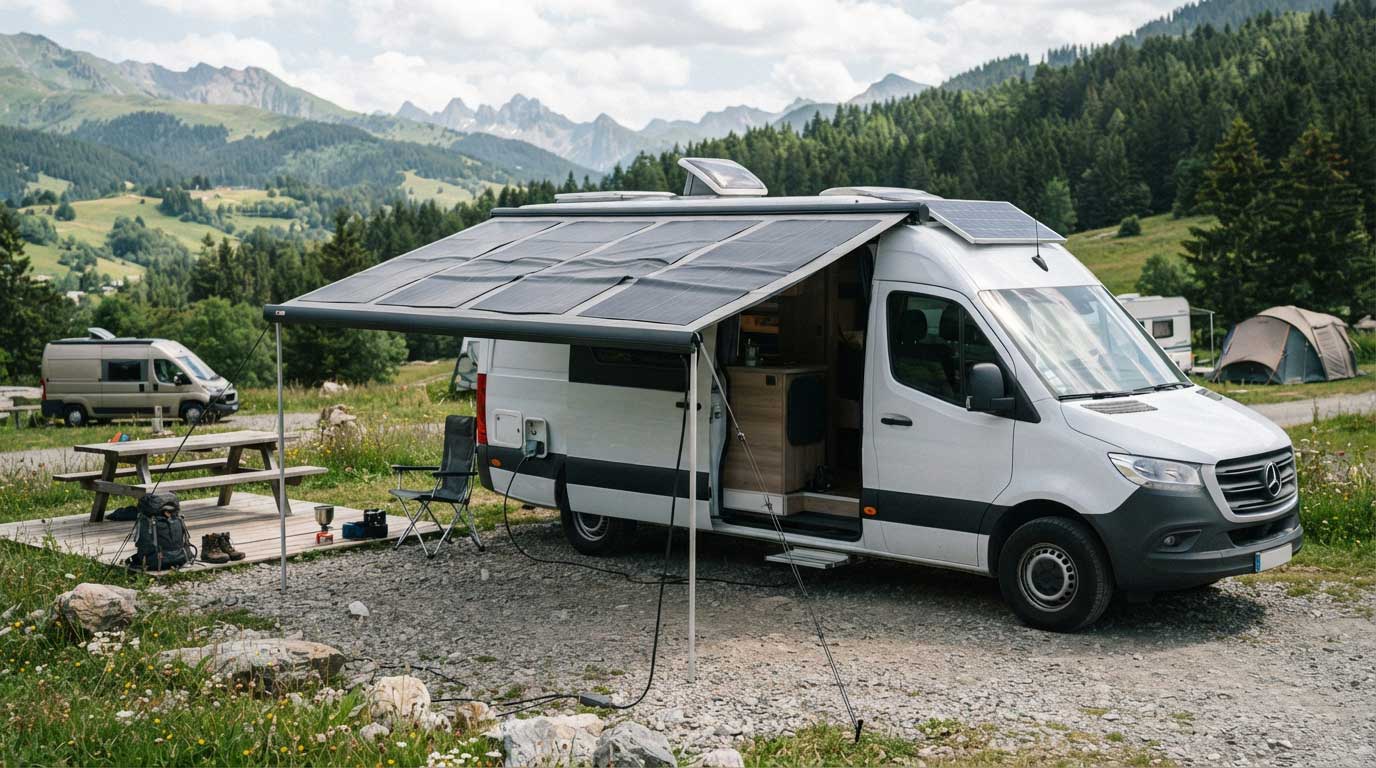
A fabric awning already provides a large surface exposed to sunlight.
Adding photovoltaic generation can turn that surface into a power-producing structure without introducing a conventional glass-and-frame roof.
Potential applications include:
- RV awnings
- Camping shelters
- Outdoor event structures
- Military-style temporary shelters
- Emergency response tents
- Construction-site canopies
- Commercial shade structures
- Mobile field stations
The key is maintaining the original function of the fabric.
If the solar layer makes the awning too heavy to deploy, too stiff to fold, or too difficult to repair, the photovoltaic upgrade may create a new problem.
That is why weight per square meter is often a more useful early specification than nominal wattage.
Flexible Fabric Solar Panels for Tents and Temporary Shelters
Temporary structures present an unusual photovoltaic opportunity.
The roof already exists.
It is lightweight.
It is transported.
It is deployed in the field.
Solar generation can potentially be added without constructing a separate rigid mounting system.
Research into textile-compatible photovoltaics has specifically explored lightweight and flexible energy sources for wearable and textile applications. A Nature Energy study demonstrated ultraflexible organic photovoltaics designed to combine mechanical flexibility with environmental stability, while reporting a device efficiency of 7.9% in its experimental configuration.
That 7.9% figure is a research-device result, not a specification for commercial fabric solar panels.
This distinction should remain clear when discussing textile PV.
For temporary shelters, the more immediate commercial questions are often:
- How much does the system weigh?
- Can two people deploy it?
- Can it be folded?
- Where are the cables?
- How is the module protected during transport?
- What happens when the fabric is tensioned?
- Can damaged sections be replaced?
These are product-design questions, not merely photovoltaic questions.
Flexible Fabric Solar Panels for RV and Camping Applications
RV users already value low-profile solar systems.
A fabric solar solution extends that idea to awnings, tents and removable covers.
An RV roof may be unsuitable for a large framed panel because of vents and air-conditioning equipment. An awning, however, may provide additional usable area.
The practical workflow is straightforward.
Step 1 — Measure the Deployed Fabric
Measure the fabric when fully deployed and tensioned, not when folded.
Record:
- Overall length
- Overall width
- Usable photovoltaic area
- Seam positions
- Attachment points
- Support poles
- Drainage paths
- Areas subject to frequent folding
Step 2 — Identify Movement Zones
Not every part of an awning moves equally.
The area around:
- Hinges
- Corners
- Pole connections
- Rollers
- Fold lines
may experience greater mechanical stress.
Avoid placing rigid electrical components directly across these zones.
Step 3 — Route the Cable
A cable hanging from a fabric awning can become a snag point.
Route it along a controlled edge or dedicated channel where practical.
The connector should remain accessible for inspection while being protected from standing water.
Step 4 — Test the Fabric and Module Together
Do not test only the solar panel.
Deploy the actual fabric.
Tension it.
Fold it according to the intended procedure.
Then inspect the module, wiring and attachment points.
This is where a prototype often reveals problems that a laboratory electrical test cannot show.
Fabric Solar Panels for Marine and Outdoor Equipment
Outdoor fabrics face UV exposure, humidity, temperature changes and mechanical movement.
Marine fabrics add salt spray and persistent moisture.
A photovoltaic product integrated with these materials therefore needs an environmental protection strategy.
A 2026 review in npj Flexible Electronics highlights encapsulation as a central issue for flexible and stretchable optoelectronics. Water vapor and oxygen can accelerate degradation of moisture-sensitive layers, while highly flexible barrier materials can be difficult to reconcile with long-term impermeability.
That is directly relevant to fabric solar development.
The photovoltaic material may perform well in the laboratory.
The outdoor product still has to survive the environment.
What to Ask a Supplier
For an outdoor fabric solar project, request information about:
- UV resistance
- Moisture protection
- Encapsulation
- Thermal cycling
- Mechanical cycling
- Connector protection
- Cable strain relief
- Surface cleaning
- Storage conditions
- Warranty
Do not accept “waterproof” as the complete specification.
Ask how the finished product was tested.
Flexible Fabric Solar Panels vs. Conventional Flexible Panels
These products overlap, but they are not identical.
| Feature | Fabric Solar Panel | Conventional Flexible PV |
|---|---|---|
| Primary structure | Fabric or textile-compatible structure | Flexible polymer/substrate |
| Mechanical behavior | May bend, fold or move with fabric | Usually bends within specified radius |
| Weight | Potentially very low | Low |
| Foldability | Product-dependent | Usually not designed for repeated folding |
| Sewing/integration | Possible in some designs | Usually limited |
| Best applications | Awnings, shelters, textile products | RV roofs, boats, curved surfaces |
| Main design issue | Mechanical movement | Curvature and mounting |
| Electrical integration | Requires flexible cable strategy | More conventional |
The word fabric should therefore trigger a discussion about mechanical behavior.
A product that looks like fabric in a marketing photograph may still contain a conventional flexible PV laminate underneath.
A Practical B2B Case: Solar Camping Shelter
Consider a hypothetical European outdoor-equipment manufacturer developing a premium expedition shelter.
The shelter uses a lightweight coated fabric. The product team wants enough solar generation to run LED lighting, communications equipment and small USB-powered electronics.
The first concept places several conventional Rigid Solar Panels on a separate frame.
The electrical design works.
The product does not.
The frame increases packing volume and changes the shelter’s deployment process.
The second concept distributes flexible PV sections across the roof fabric.
Now a different set of questions appears:
- Does the fabric still fold?
- Does the module survive repeated deployment?
- Where should the seams be placed?
- How much does the solar layer add per square meter?
- Can the electrical connectors survive folding?
- Does the module shade itself when the roof changes shape?
- How is damaged fabric repaired?
The development team builds a full-size prototype rather than testing only a small solar coupon.
That is the right stage to discover whether the solar layer actually belongs on the product.

How to Choose Flexible Fabric Solar Panels for OEM Projects
For B2B development, start with the product’s mechanical requirements.
1. Define the Fabric
Identify:
- Canvas
- PVC-coated fabric
- Polyester
- Nylon
- Composite membrane
- Other coated textile
The solar attachment method must be compatible with the actual material.
2. Define the Movement
Ask whether the fabric:
- Remains permanently deployed
- Is rolled
- Is folded
- Is tensioned
- Is repeatedly removed
- Experiences twisting
- Experiences stretching
These conditions can dramatically change the module specification.
3. Define the Energy Requirement
Calculate the expected load first.
For example:
| Load | Example Daily Use | Daily Energy |
|---|---|---|
| LED lighting | 20W × 4h | 80Wh |
| USB electronics | 15W × 4h | 60Wh |
| Communications device | 10W × 8h | 80Wh |
| Small controller | 5W × 8h | 40Wh |
| Total | 260Wh/day |
This 260Wh/day example is illustrative, not a universal field consumption figure.
Once the energy requirement is known, the solar module, battery and controller can be sized around the actual operating environment.
NREL’s PV research and modeling resources emphasize the importance of location, irradiance and system conditions when estimating PV production rather than relying only on nameplate power.
4. Define the Weight Target
For portable fabric products, weight should be measured as:
solar system weight ÷ usable fabric area
rather than only looking at the weight of one module.
A 1 kg panel may sound light until eight panels are distributed across a shelter.
Fabric Solar Panel Durability and Encapsulation
This is one of the areas where commercial product development becomes more demanding than laboratory research.
A flexible solar panels must remain electrically functional while the surrounding structure moves.
The protective layer needs to block environmental exposure without making the product unnecessarily stiff.
Recent research into flexible and stretchable optoelectronics identifies a fundamental trade-off between barrier performance and mechanical compliance: stronger inorganic barriers can resist moisture effectively but may be less mechanically compliant, while softer organic materials can provide flexibility but may offer weaker moisture resistance.
That trade-off should be considered when selecting a fabric-compatible PV construction.
For a commercial product, durability testing should reflect actual use.
Useful Prototype Tests
Depending on the application, a development program can include:
- Repeated deployment cycles
- Fold/unfold testing
- Controlled bending
- Cable flexing
- Connector insertion/removal
- UV exposure
- Moisture exposure
- Temperature cycling
- Mechanical load testing
- Electrical output before and after cycling
The exact test sequence should be based on the product’s intended environment and the applicable standards.
Common Mistakes When Buying Flexible Fabric Solar Panels
Mistake 1 — Assuming Fabric Means Washable
A photovoltaic textile is not automatically suitable for machine washing, soaking or aggressive cleaning.
Research has demonstrated washable flexible photovoltaic devices, but those are specific experimental constructions with defined encapsulation and testing conditions. One Nature Energy study reported only a 5.4% efficiency decrease after 120 minutes of water immersion for its experimental double-side-coated device.
That result should not be transferred to an ordinary commercial solar fabric.
Mistake 2 — Treating Flexible and Foldable as the Same
A flexible panel may tolerate curvature but not repeated creasing.
Mistake 3 — Ignoring Fabric Movement
The solar module may survive a static bend but fail after thousands of deployment cycles.
Mistake 4 — Testing Only Electrical Output
A prototype should be tested mechanically and electrically.
Mistake 5 — Using the Wrong Attachment Method
Adhesive, sewing, lamination, mechanical fastening and removable attachment have very different consequences for repair and durability.
Mistake 6 — Choosing the Panel Before Defining the Fabric
The substrate and textile structure should be specified before finalizing the solar module.
Bright Solar Flexible Solar Panel Solutions for B2B Projects
Bright Solar develops flexible and semi-flexible solar panel solutions for B2B applications including RVs, campers, outdoor power, selected marine applications and off-grid systems.
For a flexible fabric solar panels project, the product discussion should go beyond wattage.
A useful OEM specification includes:
- Fabric type
- Deployment method
- Folding or rolling frequency
- Required dimensions
- Target wattage
- Weight limit
- Curvature
- Cell technology
- Encapsulation
- Connector position
- Cable routing
- Outdoor environment
- Quantity
- OEM/ODM requirements
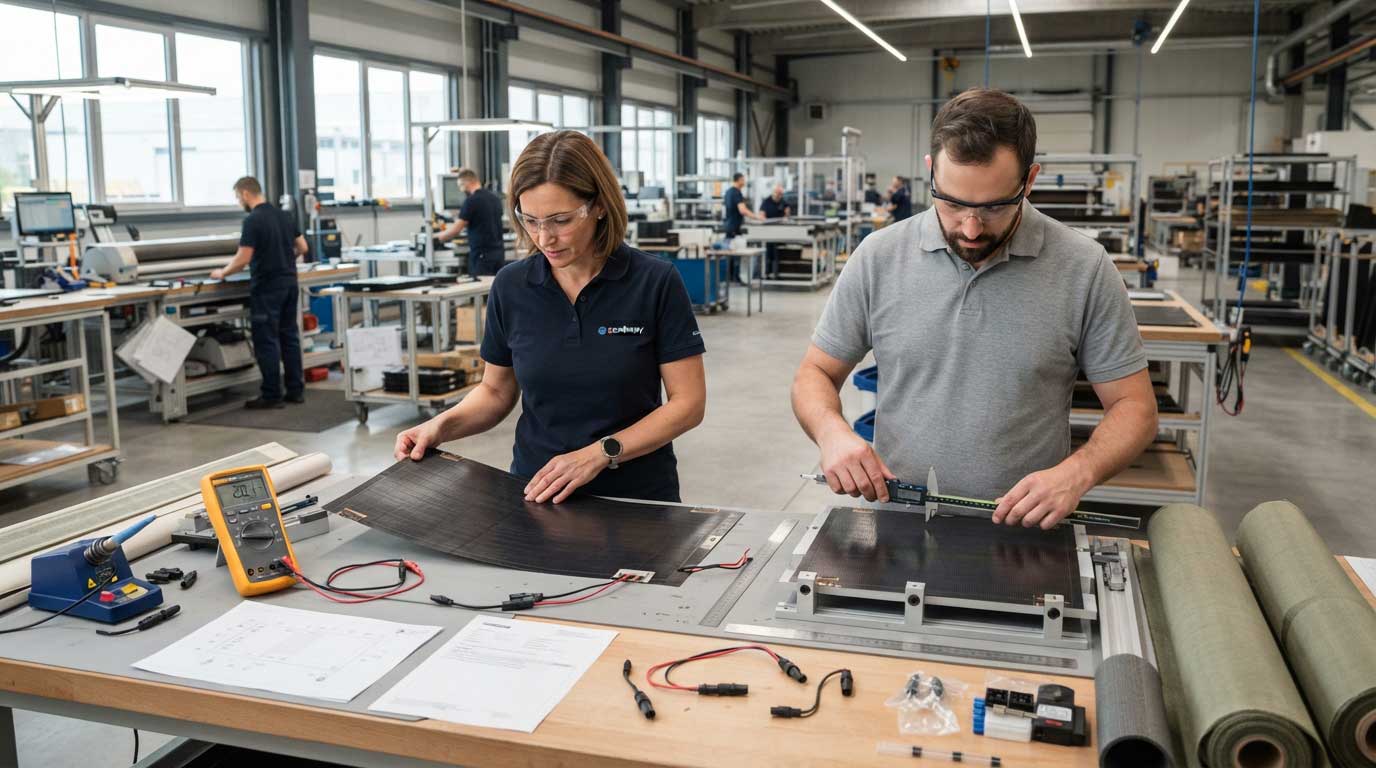
For fabric-integrated applications, a full-size prototype is particularly valuable.
The solar module should be tested together with the actual fabric, attachment system and deployment mechanism.
That is where Bright Solar’s B2B customization approach can be useful: the photovoltaic module needs to be considered as part of the customer’s finished product rather than treated as an isolated component.
FAQ About Flexible Fabric Solar Panels
What are flexible fabric solar panels?
Flexible fabric solar panels are photovoltaic products designed to work with fabric or textile structures. They may use flexible crystalline silicon, thin-film PV, organic photovoltaics or other solar technologies depending on the construction.
Are flexible fabric solar panels waterproof?
Not automatically. Water resistance depends on the complete module, encapsulation, fabric, connectors and attachment method. A supplier should provide environmental test information for the finished product.
Can flexible fabric solar panels be folded?
Some products can be folded or rolled, while others are only designed to bend within a specified radius. Never assume that a flexible solar panel is suitable for repeated folding without a manufacturer’s mechanical specification.
Can solar panels be integrated into tents?
Yes, photovoltaic materials can be integrated with textile structures, and research has demonstrated textile-based and flexible PV approaches. Commercial suitability depends on weight, flexibility, environmental protection, attachment method and required power.
Are fabric solar panels suitable for RV awnings?
They can be suitable when the solar construction is designed for the awning’s folding, tensioning and outdoor conditions. The complete system should be tested in the deployed and stored positions.
Can flexible fabric solar panels be customized?
B2B manufacturers may offer customization of dimensions, electrical configuration, cable position, module arrangement and other parameters depending on production capabilities. The allowable customization should be confirmed before prototype development.
What should I ask a flexible fabric solar panel manufacturer?
Ask for module weight, rated power, dimensions, efficiency, Voc, Vmp, Isc, Imp, bending or folding limits, encapsulation construction, environmental testing, connector specifications, warranty and prototype-testing options.
Conclusion
Flexible fabric solar panels occupy a different space from ordinary rigid photovoltaic modules. Their value comes from fitting solar generation into products that already need to be lightweight, portable, flexible or deployable.
A fabric awning, expedition shelter, RV cover or specialty outdoor structure does not need a conventional framed panel simply because it needs electricity. The photovoltaic layer has to work with the movement and function of the underlying product.
That makes weight, mechanical cycling, attachment, cable routing and environmental protection just as important as rated wattage.
For B2B buyers, the most useful development process is to define the fabric, movement, available area and energy requirement first, then select the photovoltaic construction around those constraints.
For applications requiring flexible fabric solar panels, Bright Solar can evaluate the required dimensions, electrical configuration and customization requirements as part of an OEM/ODM development process.
Related recommendations
-

Panel Solar Flexible 100W for RV, Marine, and Off-Grid Use
150Discover panel solar flexible 100W systems for RVs, boats, vans, and portable power. Lightweight, durable, and built for outdoor performance.
View details -
Foldable Solar Panel for Camping: How to Choose and Use One
64A foldable solar panel for camping provides portable electricity for compatible devices and power stations. Choosing the right panel requires matching wattag...
View details -
300 W Solar Panel Performance Guide for RV, Battery and Off-Grid Systems
332Discover how a 300 w solar panel performs for RVs, boats, cabins, batteries, and off-grid systems. Learn output, applications, sizing, and real-world performance.
View details -
Tiny Homes Solar Power: How to Size a Solar System
307Discover how tiny homes solar power systems are sized for daily loads, batteries, roof space, and off-grid living with practical calculations and expert tips.
View details