Flexible Film Solar Panels: Technology, Applications and Buying Guide
Flexible film solar panels are lightweight photovoltaic modules built on thin, bendable substrates rather than rigid glass. They are designed for curved roofs, vehicles, portable structures, marine surfaces and other applications where conventional framed panels are difficult to install.
What Are Flexible Film Solar Panels?
Flexible film solar panels use a photovoltaic layer deposited or integrated onto a flexible substrate such as polymer, metal foil or another mechanically compliant material. Unlike a conventional rigid module, the finished product can be made thin enough to follow a curved surface.
The important distinction is between thin-film solar technology and flexible module construction. Thin-film describes the photovoltaic material and manufacturing approach. Flexible describes how the finished module is built and how it responds mechanically.
The U.S. Department of Energy explains that thin-film cells are produced by depositing photovoltaic material onto substrates including glass, plastic or metal foil. DOE also notes that the ability to deposit thin films on flexible surfaces creates additional versatility.
Several photovoltaic technologies can be used in flexible-film products, including:
- CIGS, or copper indium gallium diselenide
- Amorphous silicon
- Other thin-film architectures under development
- Emerging flexible organic and perovskite technologies
CIGS has a particularly important history in flexible photovoltaics. NREL documented the development of lightweight flexible CIGS modules and identified flexible substrates such as stainless steel and polyimide as part of the manufacturing pathway.
That history matters when evaluating a supplier. A panel should not be called “flexible film” simply because it is thin. The substrate, encapsulation, electrical interconnection, bending limit and environmental protection all determine whether the finished module is actually suitable for a flexible installation.
Flexible Film vs. Flexible Silicon Panels
These terms are often mixed together in product searches.
A flexible silicon panel can use crystalline-silicon cells assembled into a flexible laminate. A flexible film panel may instead use a thin-film semiconductor deposited directly onto a flexible substrate.
| Feature | Flexible Film Solar Panels | Flexible Silicon Panels | Rigid Silicon Panels |
|---|---|---|---|
| Basic construction | Thin-film photovoltaic layer on flexible substrate | Silicon cells in flexible laminate | Silicon cells in framed rigid module |
| Surface | Thin and conformable | Flexible but usually less conformable | Flat and rigid |
| Curved surfaces | Strong fit for selected designs | Good for moderate curves | Limited |
| Weight | Potentially very low | Low to moderate | Higher |
| Glass frame | Usually not required | Usually not required | Normally used |
| Typical advantage | Thin construction and shape integration | Familiar silicon PV technology with flexibility | High mainstream module efficiency |
| Main engineering concern | Encapsulation and mechanical durability | Cell bending and laminate protection | Weight, mounting and structural loading |
The choice should be made from the complete module construction, not from the word “film” on a product listing.
How Flexible Film Solar Panels Generate Electricity
The electrical principle remains photovoltaic conversion.
Sunlight reaches the active photovoltaic layer. Photons transfer energy to the semiconductor, generating charge carriers. Internal electrical fields separate those carriers, producing direct-current electricity. Cells or cell segments are then interconnected to achieve the required voltage and power.
What changes is the physical architecture.
A rigid module typically relies on a glass front sheet, encapsulant, solar cells, backsheet and aluminum frame. A flexible-film product replaces some of those structural elements with lightweight substrates and protective layers.
That creates an engineering tradeoff.
The module becomes easier to integrate into curved or weight-sensitive surfaces, but the protective package becomes much more important. Moisture, oxygen, ultraviolet radiation, thermal cycling and repeated bending can affect different thin-film architectures in different ways.
NREL has identified improving photovoltaic efficiency, lifetime and manufacturability as continuing research challenges, including the development of flexible, highly efficient solar cells.
Does Flexible Mean Foldable?
No.
This is one of the most common purchasing mistakes.
A flexible module may tolerate a specified bending radius while remaining unsuitable for sharp folding, repeated creasing or uncontrolled rolling. The manufacturer’s stated maximum bending radius should be treated as a design parameter, not as an invitation to fold the product.
For B2B buyers, the mechanical specification should answer four questions:
- What is the minimum bending radius?
- Is the bending radius static or dynamic?
- How many bending cycles have been tested?
- Does the electrical output change after mechanical cycling?
IEC 61215:2021 introduced specific test methods for flexible modules, including a bending test identified as MQT 22. The standard also makes clear that qualification testing is not itself a quantitative prediction of service life.
Flexible Film Solar Panel Efficiency and Power Output
Efficiency is important, but it is not the only metric that determines whether flexible film solar panels are useful.
DOE notes that thin-film technologies have historically had lower efficiency than leading crystalline-silicon technologies. In one DOE overview, thin-film represented approximately 3%–5% of the global PV market at the time of publication, while the cited record thin-film cell efficiency was 22.1% compared with 25% for monocrystalline silicon. Those figures are historical research/market figures from that DOE publication, not current commercial-module averages.
The more useful question for a real project is:
How much usable power can be installed on the available surface?
Consider a curved RV roof.
A rigid 400 W framed module may have excellent electrical performance, but the roof may contain vents, air conditioners, skylights and curved sections. A thinner flexible module can sometimes use otherwise difficult areas. In that situation, the practical system comparison is not simply “panel efficiency versus panel efficiency.”
It is:
- watts installed
- usable roof area
- panel weight
- mounting hardware
- aerodynamic exposure
- cable routing
- shading
- installation labor
- maintenance access
That is where flexible film technology can become commercially interesting.
Power Calculation Example
Suppose a project uses ten 100 W modules.
Nominal array power:
10 × 100 W = 1,000 W
The 1,000 W figure is the rated DC capacity under the applicable test conditions. Actual energy production varies with irradiance, temperature, orientation, shading, wiring losses, controller/inverter efficiency and operating conditions.
NREL provides PVWatts and other modeling tools specifically because rated module power alone cannot determine annual energy production.
For procurement, avoid a supplier that gives only a wattage number. Ask for the complete electrical specification, including:
- Pmax
- Voc
- Isc
- Vmp
- Imp
- module efficiency
- power tolerance
- temperature coefficient
- operating temperature
- connector specification
The system designer can then determine whether the module fits the intended charge controller, inverter or battery architecture.

Where Flexible Film Solar Panels Are Used
The strongest applications are not necessarily the biggest solar installations. They are places where the shape, weight or installation surface creates a problem for rigid modules.Visit our product page: Rigid Solar Panels
RVs, Campervans and Mobile Power
RVs are a natural application because roof space is irregular.
An installer may have only a narrow strip beside an air conditioner or a curved roof section that cannot accommodate a conventional framed module. A flexible laminate can make better use of those areas.
DOE research on vehicle-integrated photovoltaics identifies curvature, vibration, impact, UV resistance and repair access among the technical requirements that must be considered when integrating PV with vehicles. DOE also identifies CIGS modules as attractive for vehicle integration because of their flexibility.
For an RV manufacturer, the question is not simply whether the panel bends. It is whether the complete assembly survives:
- vibration
- temperature changes
- washing
- UV exposure
- water intrusion
- cable movement
- roof maintenance
- repeated vehicle use
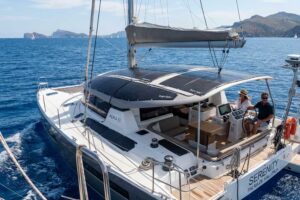
Marine and Boat Applications
Marine installations place additional demands on the module package.
Saltwater exposure, humidity, standing water, deck traffic and difficult maintenance access can change the product specification dramatically.
A marine buyer should ask for environmental protection details rather than assuming “flexible” means “marine rated.”
Important specifications include:
- encapsulation material
- saltwater resistance
- junction-box protection
- connector sealing
- surface wear resistance
- mounting method
- bending limitations
- cable strain relief
For walkable or semi-walkable installations, the mechanical construction of the top surface becomes just as important as the photovoltaic cells.
Tents, Awnings and Temporary Structures
Flexible photovoltaics have been explored for fabric-related applications for decades.
NREL records describe lightweight flexible thin-film CIGS systems deployed on military tents, while DOE research has continued to investigate flexible photovoltaic systems for portable and integrated applications.
For tents and awnings, however, there is a crucial distinction between a flexible solar laminate mounted onto fabric and a photovoltaic textile in which the solar functionality is structurally integrated into the fabric.
They are not the same product.
A B2B project should define the construction before requesting quotations.
Building-Integrated and Specialty Surfaces
Flexible modules can also be considered for:
- curved architectural surfaces
- lightweight shelters
- portable workstations
- outdoor equipment
- specialty transportation
- custom OEM products
- low-load roofs
- curved product housings
DOE’s flexible-PV research has specifically investigated lightweight modules for residential and commercial applications.

What to Check Before Buying Flexible Film Solar Panels
A product sample can look impressive on a showroom table and still be wrong for the final application.
The procurement process should start with the installation environment.
Step 1 — Map the Surface
Measure the usable area, not the theoretical area.
Record:
- length and width
- surface curvature
- obstacles
- drainage areas
- service openings
- shaded sections
- available cable paths
- attachment points
For a vehicle or marine project, make a simple full-scale template from the actual installation surface if possible. This often exposes clearance problems before production begins.
Step 2 — Define the Mechanical Requirement
Specify the required bending radius before asking for a quotation.
Do not write simply:
“We need flexible solar panels.”
Instead, specify:
- static curvature
- dynamic movement
- expected cycle count
- installation direction
- mounting method
- minimum bend radius
- allowable weight
- expected surface temperature
This is particularly important because IEC 61215 now includes bending test methods for flexible PV modules.
Step 3 — Define the Electrical System
The module must match the rest of the system.
Check:
| Parameter | Why It Matters |
|---|---|
| Pmax | Determines rated module power |
| Voc | Important for maximum system voltage |
| Isc | Important for controller and protection sizing |
| Vmp | Helps determine operating voltage |
| Imp | Helps determine operating current |
| Power tolerance | Affects delivered rated output |
| Temperature coefficient | Important for hot and cold conditions |
| Connector | Must match system wiring |
| Bypass protection | Relevant to shading and module architecture |
Cold-weather Voc deserves particular attention. A module’s open-circuit voltage can rise as cell temperature falls, so the maximum system voltage should be checked against the controller and inverter limits.
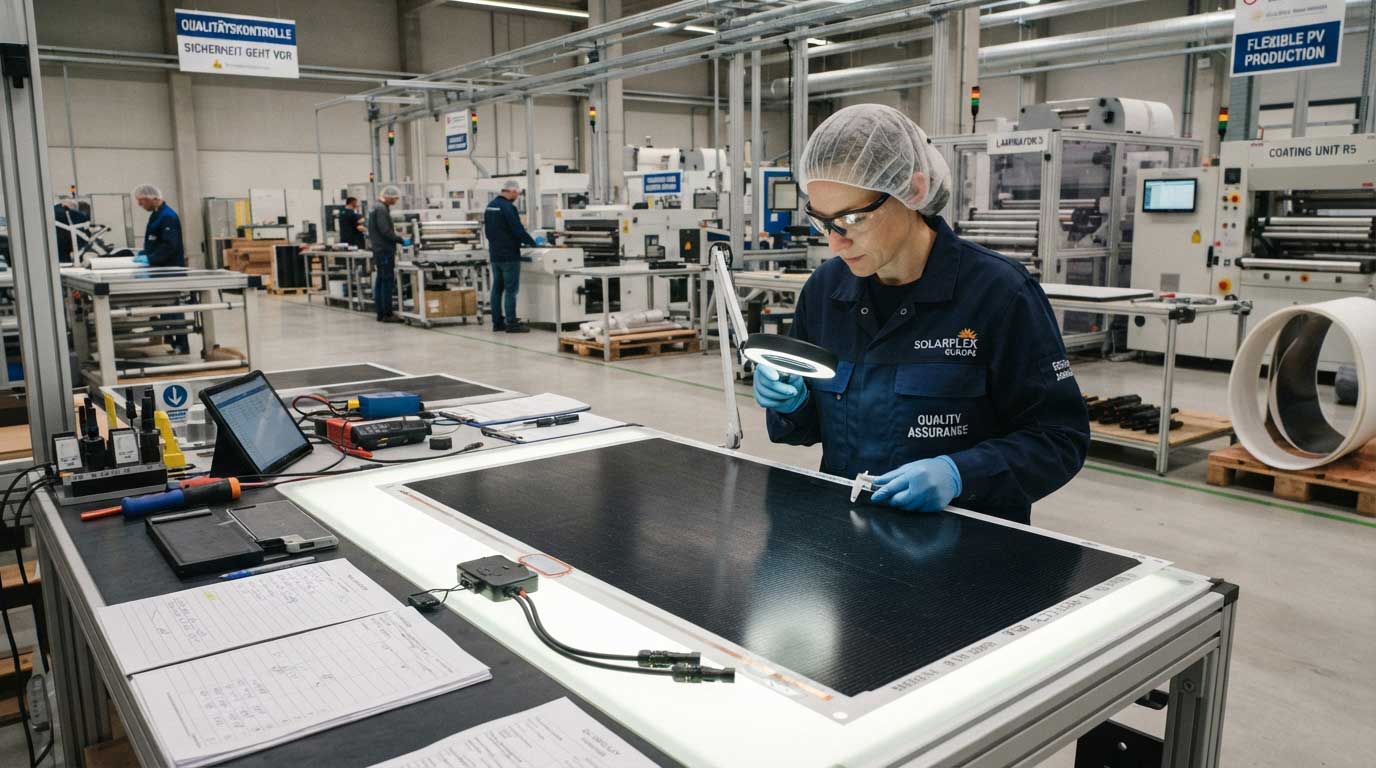
Step 4 — Inspect the Laminate
Look closely at the edges.
Check whether the protective layers are uniform. Look for exposed conductive material, inconsistent adhesive, bubbles, wrinkles or poorly sealed cable exits.
The center of a flexible module is rarely the first place to fail.
Edges, junction areas and transitions between rigid and flexible components deserve more attention.
Step 5 — Ask for Test Documentation
A serious B2B supplier should be able to explain its qualification process.
IEC 61215:2021 covers design qualification and type approval for terrestrial PV modules and includes testing provisions for flexible modules. However, IEC itself states that qualification testing does not provide a quantitative prediction of actual service life.
That distinction is valuable during procurement.
“IEC tested” should not automatically be translated into “will last exactly X years in every environment.”
Ask for the actual test scope.
Durability Depends on Encapsulation, Not Just the Solar Cell
This is where flexible film solar panels become more complicated than they appear.
A photovoltaic cell can perform well in a laboratory while the finished module struggles with moisture ingress, thermal cycling or mechanical fatigue.
NREL’s early flexible CIGS development work specifically identified absorber performance, monolithic integration and encapsulation as major manufacturing challenges.
Modern flexible-module design still has to solve the same basic engineering problem:
Protect a delicate photovoltaic structure without making the product too rigid to be useful.
The protective layer therefore has several jobs:
- block moisture
- limit oxygen ingress
- resist UV exposure
- protect against abrasion
- maintain optical transmission
- accommodate thermal expansion
- survive the intended bending conditions
This is one reason two panels with the same rated wattage can have very different long-term suitability.
A useful purchasing insight is to compare the module package, not merely the cell technology.
A Practical B2B Case: Designing a Flexible Module for an RV Roof
Consider a realistic OEM development scenario.
A North American RV manufacturer wants additional solar capacity but has limited roof area because of skylights, vents and an air-conditioning unit. The roof also has a shallow compound curve.
A rigid framed module creates three problems: clearance, weight and mounting hardware.
The engineering team first creates a roof template. Instead of maximizing the number of watts per individual module, it divides the available surface into several usable zones.
The supplier then provides samples in the proposed dimensions.
The first sample is not immediately mass-produced.
The team checks:
- physical fit against the roof template;
- bending radius;
- cable exit position;
- junction-box clearance;
- surface temperature;
- adhesive or mounting compatibility;
- electrical output;
- visual consistency;
- edge sealing;
- installation time.
A small change in cable location can matter more than a small change in cell efficiency when the roof is crowded.
That is an important OEM lesson: customization is not limited to module length and width.
A useful custom specification may include:
- module outline
- corner radius
- cable length
- cable exit location
- connector type
- surface finish
- cell technology
- rated voltage
- rated power
- mounting method
- encapsulation structure
For a manufacturer such as Bright Solar, this kind of B2B discussion is more useful than simply asking for the “highest efficiency flexible panel.”
Flexible Film Solar Panels vs. Conventional Solar Panels
| Consideration | Flexible Film | Flexible Silicon | Rigid Silicon |
|---|---|---|---|
| Curved installation | Excellent for suitable designs | Good | Limited |
| Weight-sensitive applications | Strong advantage | Advantage | Usually less favorable |
| Installation hardware | Can be reduced | Often reduced | Usually required |
| Surface integration | High | High | Low to moderate |
| Efficiency potential | Technology dependent | Generally strong | Generally strong |
| Mechanical qualification | Critical | Critical | Also important |
| Encapsulation | Major design issue | Major design issue | Important |
| RV use | Strong fit | Strong fit | Possible |
| Marine use | Strong fit when correctly specified | Strong fit | Possible |
| Custom OEM shapes | Highly attractive | Attractive | More constrained |
There is no universal “best” construction. The correct selection depends on what the installation surface allows.
Common Mistakes When Buying Flexible Film Solar Panels
Mistake 1 — Choosing by Wattage Alone
A 200 W panel that cannot fit the available surface is not more useful than a lower-power panel that can be installed properly.
Mistake 2 — Assuming All Flexible Panels Can Be Folded
Flexible does not mean crease-resistant or foldable. Always use the specified bending radius.
Mistake 3 — Ignoring Cable Placement
On an RV, boat or custom product, a cable exit located 300 mm away from the required position can create unnecessary routing, sealing and installation work.
Mistake 4 — Treating Lab Efficiency as Commercial Module Efficiency
Research-cell records and commercial module ratings are different measurements.
NREL maintains separate research-cell and champion-module efficiency resources for exactly this reason.
Mistake 5 — Skipping Environmental Qualification
Outdoor PV is exposed to much more than sunlight.
For mobile applications, consider vibration, impact, UV exposure, water, temperature cycling and maintenance access. DOE identifies several of these as important considerations for vehicle-integrated PV.
Why Choose Bright Solar for Flexible Film Solar Panel Projects?
Bright Solar focuses on flexible and semi-flexible solar panel applications for B2B customers, including OEM, ODM and bulk procurement projects.
For applications where standard panel dimensions do not work, the development discussion can focus on the actual installation conditions rather than forcing the project into a fixed residential-panel format.
Depending on the product configuration, key development areas can include:
- custom dimensions
- flexible module construction
- cell technology selection
- cable and connector configuration
- marine-oriented requirements
- RV and outdoor applications
- off-grid systems
- portable solar products
- private-label and OEM requirements
For procurement teams, the useful starting package is the project specification: available surface, target wattage, voltage architecture, bending requirement, environmental exposure and expected quantity.
That gives the manufacturer something measurable to engineer against.
FAQ About Flexible Film Solar Panels
What are flexible film solar panels?
Flexible film solar panels are photovoltaic modules built with thin-film or similarly lightweight PV structures on flexible substrates. Their construction allows them to conform to selected curved or weight-sensitive surfaces.
Are flexible film solar panels efficient?
Efficiency depends on the photovoltaic technology and complete module design. Thin-film technologies have historically trailed leading crystalline silicon in efficiency, although flexible construction can provide installation advantages that rigid modules cannot. DOE has documented both the efficiency gap and ongoing thin-film development.
Can flexible film solar panels be installed on an RV?
Yes. RV roofs are a practical application when the module construction, bending radius, attachment method, cable routing and environmental protection are suitable. Vehicle-integrated PV also requires attention to vibration, UV, impact and repair access.
Can flexible film solar panels be used on boats?
They can be used for suitable marine applications, but the module must be specified for the actual exposure. Saltwater, humidity, standing water, abrasion and cable sealing should be considered before procurement.
Are flexible film solar panels waterproof?
A product should not be assumed waterproof simply because it is a flexible solar panel. Water resistance depends on the complete module package, connectors, junction box, edge sealing and installation method. Request the manufacturer’s actual ingress-protection and environmental test documentation.
How much can a flexible solar panel bend?
There is no universal bending value. The allowable radius is product-specific. IEC 61215:2021 includes a bending test for flexible PV modules, but actual installation limits must come from the manufacturer’s specification.
Are flexible film solar panels suitable for custom OEM projects?
Yes. They are particularly useful when an OEM product has a curved surface, strict weight limit or non-standard available area. OEM specifications should define dimensions, electrical characteristics, bending requirements, cable configuration and environmental conditions before mass production.
Conclusion
Flexible film solar panels are not simply thinner versions of conventional solar panels. Their value comes from changing where photovoltaic power can be installed.
For RVs, marine equipment, shelters, curved structures and specialized OEM products, weight and geometry can matter as much as nominal efficiency. The strongest projects begin with the installation surface, then define the mechanical, electrical and environmental requirements around it.
For B2B buyers, the practical priority is straightforward: verify the complete module construction, bending specification, qualification data, electrical parameters and customization capability before comparing unit prices.
Flexible film solar panels become most useful when the panel is designed around the product rather than the product being redesigned around a standard panel.
Author & Technical Reference Note
Technical perspective: This article is prepared from a B2B photovoltaic product-engineering perspective, with emphasis on flexible module construction, mechanical integration, encapsulation, electrical matching and OEM specification.
Primary technical references: U.S. Department of Energy (DOE), National Renewable Energy Laboratory (NREL), and International Electrotechnical Commission (IEC). DOE and NREL materials document the development and engineering challenges of flexible thin-film PV, while IEC 61215:2021 provides relevant qualification and bending-test requirements for flexible PV modules.
Related recommendations
-

1000W Solar Panel: Complete Guide to Size, Power Output, Cost, and System Setup
233Explore 1000w solar panel size, cost, power output, and system setup. Learn how to choose the right 1000 watt solar solution for RV, off-grid, and backup energy needs with Bright Solar.
View details -
Installing Solar Panels on RV: Complete Step-by-Step Guide for Reliable Off-Grid Power
218Learn installing solar panels on rv with expert steps, wiring tips, battery setup, and real RV solar experience from Bright Solar for reliable off-grid power.
View details -
Flexible solar panel boat: Lightweight Marine Solar Solution for Modern Vessels
169Discover flexible solar panel boat solutions from Bright Solar. Learn how lightweight marine solar panels improve boat energy efficiency, installation flexibility, and off-grid performance.
View details -
ETFE Flexible Solar Panels: Benefits, Uses and Buying Guide
94ETFE flexible solar panels use ETFE film as a protective front layer and may suit RV, marine, and off-grid applications. Selection should be based on the com...
View details