ECO WORTHY 130W Flexible Solar Panel: Features, Uses and Buying Guide
The ECO WORTHY 130W flexible solar panel is a product-specific option to evaluate for RV, campervan, and other space-conscious solar installations. Before buying, check its current datasheet for dimensions, voltage, current, weight, connector type, bend limits, and mounting instructions. These details determine whether it fits your surface and works with your charge controller.
What to Know About the ECO WORTHY 130W Flexible Solar Panel
When researching a particular solar panel, the product name alone is not enough to establish compatibility. A 130W rating describes nominal power under specified test conditions; it does not tell you how much energy the panel will deliver each day or whether its physical construction suits your installation.
For the ECO WORTHY 130W flexible solar panel, buyers should distinguish three questions:
- Will it fit? Confirm the module’s exact dimensions and whether the intended roof or deck shape is within its approved bending limits.
- Will it work electrically? Check its operating voltage and current against the controller, battery system, and any other connected equipment.
- Will it suit the environment? Verify the product’s permitted operating conditions, mounting method, and warranty requirements.
Product listings and specifications can change. The model-specific datasheet and installation manual supplied for the exact item should take precedence over assumptions based on the wattage or the word “flexible.”
What Does 130W Mean?
A panel’s rated power is measured under defined test conditions. It is not a promise of 130 watts throughout the day.
The National Renewable Energy Laboratory’s System Advisor Model uses reference conditions including 1,000 W/m² irradiance and a 25°C cell temperature when describing PV module performance parameters. Real installations experience changing sunlight, temperature, orientation, shading, and electrical losses.
That means a 130W panel may deliver less than its rated output during cloudy weather, early morning, late afternoon, or when part of the module is shaded. The energy available over a day depends on the local solar resource and the complete system.
Key Specifications to Verify Before Buying
A reliable product comparison starts with the datasheet. Avoid filling gaps in a specification table with figures copied from a different wattage or a visually similar panel.
| Specification | What to confirm for the 130W model | Why it matters |
|---|---|---|
| Rated power | Confirm the stated 130W rating and its test conditions | Establishes the nominal output for comparison |
| Vmp | Voltage at maximum power | Helps assess controller compatibility |
| Imp | Current at maximum power | Affects controller sizing and wiring |
| Voc | Open-circuit voltage | Must remain within equipment voltage limits, including relevant cold-weather conditions |
| Isc | Short-circuit current | Relevant to system design and electrical protection |
| Dimensions | Exact length, width, and thickness | Determines whether the module fits the usable surface |
| Weight | Product weight and any separately supplied hardware | Important for vehicle and mobile installations |
| Cell technology | Confirm from the manufacturer’s datasheet | Helps identify the module’s construction |
| Bending limits | Permitted radius and direction, if specified | Prevents forcing the panel beyond its design limits |
| Connectors and cables | Connector type, cable length, and exit position | Affects installation and compatibility |
| Environmental rating | Confirm applicable ingress and operating ratings | Helps determine suitability for the intended exposure |
| Warranty | Coverage, exclusions, and installation conditions | Clarifies the manufacturer’s terms |
Do not assume the panel has a particular voltage, connector, IP rating, or bend radius simply because another flexible panel uses those specifications. If a listing omits a detail, request written confirmation before designing the system around it.
ECO WORTHY 130W Flexible Solar Panel Specifications
ECO-WORTHY’s product page lists an 18BB, 130W flexible monocrystalline solar panel. The specifications below are taken from that listing. Confirm the datasheet supplied with the exact SKU before installation, especially if purchasing through a reseller or comparing an older version.
| Parameter | Listed specification |
|---|---|
| Rated power | 130W |
| Maximum power voltage (Vmp) | 21.10V |
| Maximum power current (Imp) | 6.16A |
| Open-circuit voltage (Voc) | 24.50V |
| Short-circuit current (Isc) | 6.50A |
| Solar cell type | Monocrystalline |
| Dimensions | 37.8 × 27.1 × 0.1 in |
| Weight | 6.28 lb |
| Temperature range | −40°C to +85°C |
| Output tolerance | ±3% |
| Connector | MC4 |
| Extension cables | 4 mm² (11 AWG), listed as 2.9 ft cables |
| Junction box | IP68, as stated on the product listing |
| Installation features | Six reinforced mounting holes |
Important: The product page also advertises a maximum bending angle of up to 270°. This is the manufacturer’s stated feature, not a recommendation to force the panel into any arbitrary curve. Confirm the permitted installation geometry and handling instructions in the manual.
Understanding the Listed Electrical Values
The Vmp and Imp values describe the voltage and current at the module’s maximum power point under the relevant test conditions. Multiplying the listed values gives approximately 130W:
21.10V × 6.16A ≈ 130W
Voc is the open-circuit voltage when the panel is not supplying current, while Isc is the short-circuit current under specified test conditions. These values are important when checking the controller’s input limits and selecting suitable wiring and protection.
Do not size a charge controller using rated wattage alone. Check the panel’s voltage and current, the controller’s limits, the battery-system voltage, and any additional modules that may be connected.
What Applications Is the ECO WORTHY 130W Flexible Solar Panel Intended For?
ECO-WORTHY identifies applications including RVs, boats, cabins, tents, trailers, trucks, yachts, and other irregular surfaces. The product listing describes it as thin and lightweight and highlights its flexible construction and pre-drilled mounting holes. Actual suitability still depends on the mounting surface, exposure, and installation requirements.
RVs and Campervans
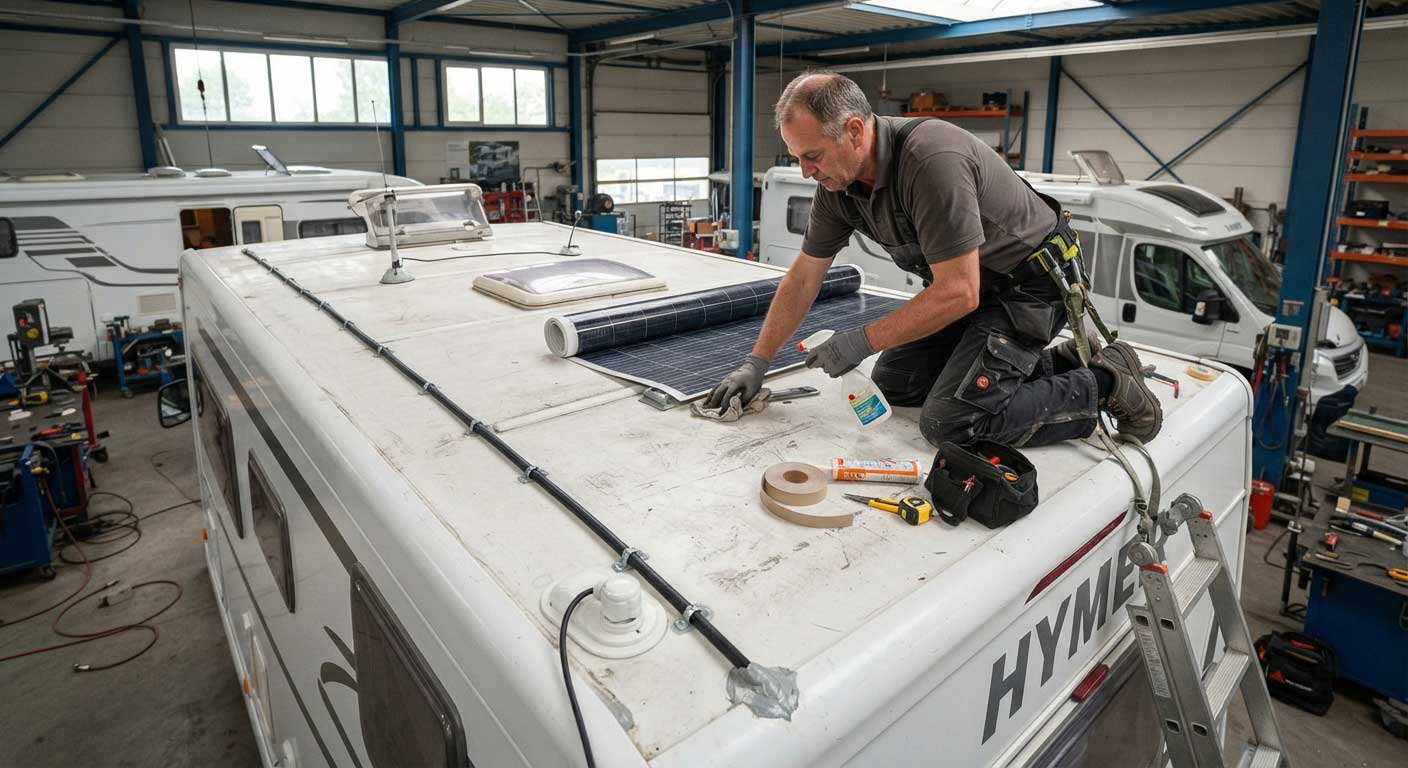
On a recreational vehicle, roof space is often interrupted by vents, skylights, air conditioners, and antennae. A low-profile flexible panel may be worth considering where a framed module is difficult to accommodate.
Before committing to the panel:
- Measure the usable roof area, not just the overall roof dimensions.
- Check clearances around vents and service points.
- Confirm that the roof surface is compatible with the chosen attachment method.
- Plan a protected cable route into the vehicle.
- Consider heat buildup if the module is mounted close to the roof.
A panel that fits neatly between roof accessories still needs to be compatible with the vehicle’s electrical system and mounting requirements.
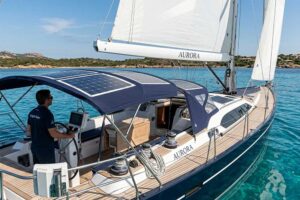
Boats and Yachts
The manufacturer lists boats and yachts among the intended applications. On a vessel, however, buyers should pay particular attention to moisture exposure, saltwater, movement, vibration, and the surface to which the panel will be attached.
A flexible panel is not automatically suitable for every marine location. Confirm the exact product’s environmental ratings and installation guidance. If the panel will be placed where people walk, do not assume it is walkable unless the manufacturer explicitly confirms that use for the model.
Cabins, Trailers, and Off-Grid Equipment
For a cabin or trailer, a 130W module may form part of a small charging system or be combined with other modules. Whether it meets the energy requirement depends on sunlight, shading, orientation, temperature, battery charging, and the connected loads.
For equipment with an irregular surface, take measurements and provide a photograph before selecting a mounting method. The product’s flexibility does not remove the need for a stable attachment and safe cable routing.

How Much Energy Can a 130W Flexible Solar Panel Produce?
A 130W rating is a measure of power under specified conditions, not a daily energy figure. Daily energy is measured in watt-hours (Wh) or kilowatt-hours (kWh), and depends on how much usable sunlight reaches the module and how efficiently the system converts and stores the electricity.
ECO-WORTHY advertises up to 520Wh per day under four hours of full sunlight for this product. That figure is a manufacturer estimate based on the stated sunlight assumption, not a guaranteed output for every location or installation.
A Simple Energy Estimate
A useful first-pass calculation is:
Estimated daily energy = rated power × peak sun hours × system performance factor
For example, using 130W, four peak sun hours, and an assumed performance factor of 0.75:
130W × 4 hours × 0.75 = 390Wh per day
The 0.75 factor is an illustrative assumption, not a measured ECO-WORTHY result. Actual output may differ because of shading, temperature, roof angle, dirt, wiring losses, controller behavior, and battery charging conditions. Use location-specific solar data and the real system design for a project estimate.
Loads a Small Panel Might Support
The table below gives illustrative energy consumption. It is not a promise that the panel will support these loads every day.
| Example load | Assumed daily use | Energy |
|---|---|---|
| LED lights, 10W | 4 hours | 40Wh |
| Phone charging, 12W | 2 hours | 24Wh |
| Small fan, 20W | 5 hours | 100Wh |
| Laptop, 60W | 2 hours | 120Wh |
| Total | — | 284Wh/day |
Under favorable conditions, a 130W panel could contribute meaningfully to modest charging and lighting needs. It should not be assumed to power high-demand appliances such as an air conditioner without a complete load calculation, suitable storage, and an appropriately designed system.
How to Connect the ECO WORTHY 130W Flexible Solar Panel
Use the manufacturer’s manual for the exact model and follow applicable electrical requirements. The official ECO-WORTHY download page lists a manual specifically for its 130W flexible solar panel.
Step 1 — Check System Compatibility
Before connecting anything, compare the panel’s electrical values with the charge controller’s limits. The product listing gives Vmp of 21.10V and Voc of 24.50V; the controller must be suitable for the panel configuration and battery system.
Check:
- Maximum PV input voltage, including cold-weather considerations.
- Permitted PV current and power.
- Battery nominal voltage and charging profile.
- Connector polarity and compatibility.
- Required fuses, disconnects, and cable ratings.
If connecting multiple panels, calculate the combined voltage and current for the chosen series or parallel arrangement. Do not assume that adding a second panel is automatically compatible with the existing controller.
Step 2 — Prepare the Mounting Surface
Inspect the roof, deck, or other mounting surface. It should be suitable for the specified attachment method and free from contamination that could interfere with adhesion.
The ECO-WORTHY listing mentions reinforced mounting holes and several possible attachment approaches, including adhesive and other fixing methods. Treat those as options to verify against the current manual and the material of your installation surface—not as permission to use any adhesive or fastener indiscriminately.
Step 3 — Mount and Route the Cables
Position the module so that it does not cover vents, hatches, or service points. Avoid sharp creases and keep the panel within its approved bending limits.
Route cables away from sharp edges, hot components, moving parts, and locations where water can pool. Secure wiring appropriately and protect connectors from strain and abrasion. If drilling or penetrating a roof, follow the vehicle or vessel manufacturer’s requirements and use suitable sealing practices.
Step 4 — Connect and Verify
Follow the sequence and precautions in the product and controller manuals. Solar modules can produce electricity when illuminated, so handle connectors and wiring with care.
After installation, verify polarity, controller settings, and system readings using appropriate procedures. If you are uncertain about DC wiring, overcurrent protection, grounding, or the applicable code, have a qualified installer check the system before use.
ECO WORTHY 130W Flexible Solar Panel: Practical Project Example
Consider a hypothetical campervan owner in the UK who wants to support lighting, phone charging, and a small ventilation fan during weekend trips. The roof has a skylight, so the owner is considering a flexible panel that can fit on a clear section without blocking access.
The following numbers are illustrative planning values, not a measured field test or a product performance guarantee.
| Item | Example |
|---|---|
| Panel under consideration | One 130W flexible module |
| Daily energy target | Approximately 250–300Wh |
| Main loads | LED lights, phone charging, small fan |
| Main roof constraint | Skylight and limited clear mounting space |
| Key checks | Dimensions, bend limits, controller compatibility, cable route, attachment method |
| Before regular use | Confirm installation, polarity, protection, and controller settings |
Using four peak sun hours and an assumed performance factor of 0.75 gives a rough estimate of 390Wh per day. That is a planning calculation only. Shading from roof fittings, cloudy weather, high module temperature, and system losses may reduce actual energy production.
The owner should measure the usable roof area, compare it with the panel’s listed dimensions, and check the controller’s input limits. If the panel does not fit, it should not be trimmed or forced around the skylight. The installation layout or product choice needs to change instead.
This example highlights a practical point: the nominal wattage is only one part of the decision. Fit, electrical compatibility, installation quality, and the actual energy requirement all matter.

ECO WORTHY 130W Flexible Solar Panel vs. Other Options
A fair comparison should focus on how each panel suits the project rather than treating flexibility as an automatic advantage.
| Factor | ECO-WORTHY 130W flexible panel | Conventional rigid panel |
|---|---|---|
| Form | Thin, flexible construction | Usually framed, with a rigid front structure |
| Roof profile | May sit close to a suitable surface | Usually requires space for the frame and mounting arrangement |
| Curved surfaces | Can accommodate only the curves allowed by its design | Generally suited to flat or appropriately bracketed mounting |
| Airflow | Close mounting may limit airflow, depending on installation | Raised mounting may allow air to circulate underneath |
| Physical protection | Depends on the module’s polymer layers and construction | Glass-fronted designs provide a different type of surface protection |
| Installation | Surface and attachment compatibility are important | Roof structure, brackets, and fasteners need to be assessed |
| Service | Adhesive removal may complicate replacement in some installations | Access to mounting hardware may make removal easier in some layouts |
The ECO-WORTHY listing gives this particular panel a 0.1-inch thickness and a weight of 6.28lb. Those values may be relevant where profile and weight are constraints, but they do not establish that the panel is the right choice for every RV or boat.
Bright Solar’s Perspective on Flexible Solar Panel Selection
Bright Solar manufactures flexible and semi-flexible solar panels for applications including RVs, marine projects, and off-grid systems. When evaluating a product such as the ECO WORTHY 130W flexible solar panel, buyers should compare the exact technical specifications and installation requirements with those of the alternative being considered.
Bright Solar’s L Series uses monocrystalline PERC cells and a DuPont ETFE surface, with a specified maximum flexibility of 30%. Its H Series is designed for marine and yacht applications and features double ETFE construction, a walkable design, and an IP67 junction box. These are Bright Solar product-family characteristics; they should not be assumed to apply to ECO-WORTHY panels or to every flexible solar module.
For a project inquiry, prepare the application, mounting dimensions, photographs, target wattage, system voltage, controller information, environmental exposure, cable requirements, and expected quantity. This gives the technical team a basis for discussing which product specifications need to be checked.
FAQ About ECO WORTHY 130W flexible solar panel
Is the ECO WORTHY 130W flexible solar panel suitable for an RV?
ECO-WORTHY lists RVs, trailers, and trucks among the panel’s intended applications. Suitability for a particular vehicle depends on roof dimensions, surface compatibility, mounting requirements, electrical configuration, and environmental conditions.
How much power can the 130W panel produce per day?
The manufacturer advertises up to 520Wh per day under four hours of full sunlight. Actual energy production varies with sunlight, temperature, shading, orientation, and system losses, so this should be treated as an estimate rather than a guarantee.
Can I bend the panel to fit any roof?
No. The product listing advertises a maximum bending angle, but that does not mean every curve or installation is permitted. Check the manual for the allowed bending geometry and do not crease, fold, or force the module beyond its instructions.
Can I connect the panel directly to a battery?
Do not assume direct connection is appropriate. A battery-charging system generally needs a compatible charge controller unless the equipment manufacturer specifies an integrated alternative. Match the controller to the panel’s electrical values and the battery’s charging requirements.
Is the panel waterproof?
The product listing states that its pre-installed junction box has an IP68 rating. That rating should not be interpreted as proof that every part of the panel or every installation method is suitable for immersion or all marine conditions. Check the complete product documentation.
Can I connect more than one 130W panel?
Multiple panels may be used in an appropriately designed system, but the series or parallel configuration must remain within the controller’s voltage, current, and power limits. Recalculate the array values and follow the controller and panel manuals before expanding the system.
Where can I find the product manual?
ECO-WORTHY lists a dedicated 130W 12V Flexible Mono Solar Panel Manual on its official manual-download page. Use the documentation matching the exact model and version you purchased.
Conclusion
The ECO WORTHY 130W flexible solar panel is a specific lightweight, thin-profile module that ECO-WORTHY markets for applications such as RVs, boats, cabins, and other surfaces. Its listed electrical values, dimensions, mounting features, and stated flexibility provide a starting point for evaluation—but they do not replace checking the exact manual and installation conditions.
For buyers comparing flexible solar products, the practical decision comes down to roof fit, energy needs, controller compatibility, environmental exposure, attachment, and service considerations. Bright Solar can also review project requirements and discuss its flexible and semi-flexible product options for RV, marine, and off-grid applications.
Related recommendations
-

ETFE Solar Panel Flexible: Benefits, Uses and Buying Guide
158An ETFE solar panel flexible uses an ETFE front surface and a bendable module construction. It can suit RV, marine, and off-grid projects, but selection depe...
View details -
300 Watt Solar Panel: Practical Power for Homes, RVs, and Off-Grid Systems
289300 watt solar panel systems deliver reliable off-grid and residential energy. Learn output, efficiency, installation tips, and real-world performance.
View details -
Flexible Solar Panels Marine Solutions for Boats and Offshore Power
160Discover how flexible solar panels marine solutions provide lightweight, durable power for boats, yachts, and offshore vessels. Learn installation, efficiency, and marine benefits.
View details -
Flexible Solar Panels 200W: Lightweight Solar Power for RV, Marine and Off-Grid Applications
174Flexible solar panels 200w deliver lightweight, efficient solar power for RVs, boats, and off-grid systems. Explore Bright Solar technology, real applications, and installation insights.
View details