100w 12v Flexible Solar Panel: Output, Wiring and Installation Guide
A 100w 12v flexible solar panel is a compact solar module for RVs, camper vans, boats, cabins, and small off-grid systems. It provides 100 watts of rated power, while actual daily energy depends on sunlight, temperature, shading, orientation, wiring, and the charge controller.
The important detail is that 100 watts describes rated power, not daily energy production.
A 100W panel receiving the equivalent of four peak sun hours has a simple theoretical production of about 400Wh before system losses. Real output changes throughout the day because sunlight intensity and module temperature are constantly changing.
For a 12V battery system, the panel also needs to be matched with the correct charge controller and wiring. That is where a seemingly simple 100W installation can go wrong.
In practical solar installation work, I would check the roof layout and electrical specifications before deciding where the panel goes. On an RV, for example, a vent or air conditioner can create a surprisingly awkward shadow. On a boat, the curved deck may be more important than the nominal panel dimensions.
The U.S. Department of Energy explains that PV module ratings are measured under standard test conditions using 1,000 W/m² irradiance and a 25°C cell temperature. Actual operating conditions are usually different.
What Is a 100w 12v Flexible Solar Panel?
A 100w 12v flexible solar panel is a lightweight photovoltaic module designed to produce a maximum rated power of 100 watts under defined test conditions and to work within a nominal 12V battery-system architecture.
The word 12V needs some clarification.
A solar panel marketed for a 12V system does not normally produce exactly 12 volts at its operating point.
The panel’s actual electrical specifications include values such as:
- Maximum power voltage (Vmp)
- Maximum power current (Imp)
- Open-circuit voltage (Voc)
- Short-circuit current (Isc)
- Maximum system voltage
For example, a hypothetical 100W module might operate around the high-teens or low-20V range at maximum power while charging a nominal 12V battery through a suitable controller.
The exact values must always come from the manufacturer’s datasheet.
That is why I would never select a controller simply because the panel is labeled “12V.”
Why Flexible Construction Matters
A flexible solar panel is useful when the installation surface is not a conventional flat mounting plane.
Typical applications include:
- RV roofs
- Camper vans
- Boat decks
- Yacht cabins
- Curved metal roofs
- Small off-grid cabins
- Portable power systems
- Remote monitoring equipment
The advantage is physical rather than magical.
A flexible module can follow an appropriate curved surface where a rigid framed module may be difficult to position.
But flexible does not mean unlimited bending.
IEC 61215:2021 introduced test methods specifically for flexible PV modules, including the MQT 22 bending test. IEC also states that qualification testing should not be interpreted as a quantitative prediction of module lifetime.
That distinction matters when a panel is installed on a curved RV or marine roof.
How Much Power Does a 100w 12v Flexible Solar Panel Produce?
A 100w 12v flexible solar panel is rated at 100W under standard test conditions, but its daily energy production depends on available sunlight and operating conditions.
A simple planning formula is:
Daily energy = Panel power × equivalent peak sun hours
For a 100W panel:
| Equivalent Peak Sun Hours | Simple Daily Estimate |
|---|---|
| 2 hours | 200Wh |
| 3 hours | 300Wh |
| 4 hours | 400Wh |
| 5 hours | 500Wh |
| 6 hours | 600Wh |
These figures are useful for preliminary sizing, not promises of actual output.
For example, if a 100W panel receives four equivalent peak sun hours:
100W × 4h = 400Wh
That is 0.4kWh before considering system losses.
Cloud cover, roof orientation, temperature, shading, cable resistance, controller efficiency and battery charging conditions can all reduce the energy reaching the battery.
DOE identifies solar resource, time of day, season, angle of incidence, clouds, temperature and module age as factors affecting PV performance.
Why the Panel Does Not Produce 100W Constantly
A common misunderstanding is expecting a 100W module to produce 100W every hour between sunrise and sunset.
It does not work that way.
At sunrise, irradiance is low.
As the sun rises, output increases.
Around the strongest solar period, output can become much higher than the morning level.
Then production falls again in the afternoon.
Temperature changes the picture as well.
NREL‘s PVWatts model calculates cell temperature using irradiance, wind speed and ambient temperature. It also treats roof-mounted systems differently because restricted airflow can produce higher operating temperatures than open-rack mounting.
That is particularly relevant to low-profile flexible modules.
100w Flexible Solar Panel Output in Real Applications
A 100W module is not designed to run large appliances continuously.
Its strength is small, consistent loads.
A typical mobile setup might use the panel to support:
- LED lighting
- Phone charging
- Tablet charging
- Small DC fans
- GPS equipment
- Battery maintenance
- Sensors
- Communication equipment
- Small pumps
- Security cameras
- Basic marine electronics
Consider a simple RV example.
Suppose the daily loads are:
| Load | Approx. Daily Energy |
|---|---|
| LED lights | 100Wh |
| Phones/tablets | 50Wh |
| Small fan | 120Wh |
| Router/communications | 100Wh |
| Miscellaneous DC loads | 80Wh |
| Total | 450Wh/day |
A 100W panel producing around 400–500Wh on a favorable solar day could cover a substantial portion of that simplified consumption.
It would not guarantee energy independence every day.
That is the distinction I would make when sizing the system for a customer.
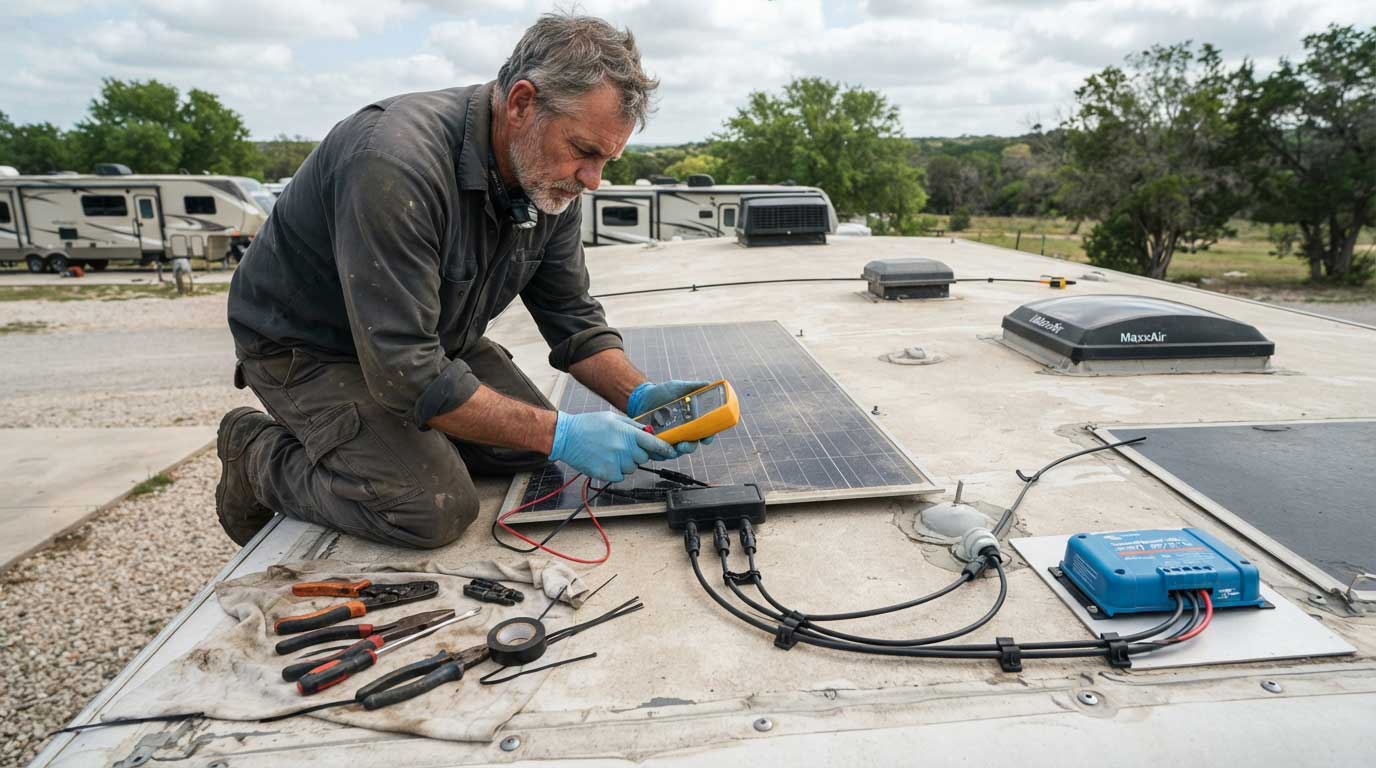
100w 12v Flexible Solar Panel for RV
The RV is one of the easiest places to understand the value of a 100W flexible module.
You may have only a small roof area.
There may already be a vent in the middle of it.
An air conditioner occupies another section.
The remaining space is fragmented.
A rigid panel might fit, but the mounting hardware can become more complicated than the panel itself.
A flexible module offers another approach.

What I Check Before Installing on an RV
Before installation, I would physically place the panel on the roof.
Then check:
- Does it fit without covering a vent?
- Is the roof curvature within the panel specification?
- Where will the cable enter the RV?
- Is there a shadow from the air conditioner?
- Can the roof still be serviced?
- Is the mounting surface clean and compatible?
- Can the cable be protected from abrasion?
That physical dry-fit is worth doing.
A drawing can tell you that a 100W panel fits.
Standing on the roof tells you whether the installation fits.
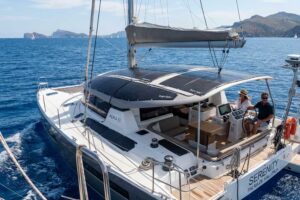
100w 12v Flexible Solar Panel for Boats
Marine applications create a different set of problems.
The available deck space can be irregular.
A rigid frame can become a trip hazard or simply look out of place.
A flexible module can provide a lower-profile solution when the surface and module are suitable for the application.
Typical loads might include:
- Navigation electronics
- Cabin lighting
- Battery monitoring
- Communication equipment
- Small pumps
- GPS systems
- USB charging
Saltwater exposure also makes material selection important.
When comparing products, look beyond wattage and examine:
- Surface material
- Encapsulation
- Environmental protection
- Connector quality
- Cable protection
- Manufacturer installation requirements
- Warranty
- Applicable certifications
The marine environment is not forgiving of poorly protected electrical connections.
12V Battery Sizing for a 100W Flexible Solar Panel
A 100W solar panel can work with a 12V battery system, but the battery size should be based on energy consumption rather than panel wattage alone.
The basic battery-energy equation is:
Battery energy = Voltage × Amp-hours
For example:
12V × 50Ah = 600Wh
So a nominal 12V 50Ah battery contains approximately 600Wh of stored energy.
That does not mean all 600Wh should necessarily be treated as usable energy.
Actual usable capacity depends on battery chemistry, allowable depth of discharge, temperature and manufacturer specifications.
Example: 100W Panel + 12V 50Ah Battery
A 12V 50Ah battery gives a simple nominal storage figure of 600Wh.
If a 100W panel produces around 400Wh on a particular day before system losses, it can theoretically replace a significant portion of the energy used during that day.
This pairing can make sense for relatively modest loads.
It becomes less suitable if the system is expected to operate refrigerators, inverters, heaters or other high-energy appliances for extended periods.
The solar panel and battery should be treated as one system.
How to Wire a 100w 12v Flexible Solar Panel
The basic system layout is:
Solar panel → Charge controller → 12V battery → Loads
For a small 12V system, the charge controller is an important component.
PWM vs MPPT
A PWM controller can be appropriate for simple, cost-sensitive systems.
An MPPT controller can extract energy more effectively when the panel’s operating voltage is higher than the battery voltage, because it can convert the input voltage/current combination into a more suitable charging output.
The choice should be based on:
- Panel Vmp
- Panel Voc
- Panel current
- Battery voltage
- Controller input range
- Controller output current
- Installation environment
Do not select the controller from the “100W” label alone.
Check the Panel’s Actual Voltage
A 12V-rated solar module is designed around a 12V battery application, but its Vmp is normally higher than 12V so that the controller has charging headroom.
This is why the datasheet should show:
Vmp
Voc
Imp
Isc
These four values tell you much more about electrical compatibility than the marketing phrase “12V solar panel.”
How to Install a 100w 12v Flexible Solar Panel
The installation process is straightforward if the preparation is done first.
Step 1 — Inspect the Surface
Clean the mounting surface and inspect it for:
- Dirt
- Oil
- Loose coatings
- Cracks
- Moisture
- Uneven areas
Do not install a panel over a surface that is already failing.
Step 2 — Dry-Fit the Panel
Place the panel exactly where it will be installed.
Check the cable exit.
Check the roof curvature.
Check nearby shadows.
Check service access.
Take a photograph before permanent attachment.
Step 3 — Plan Cable Routing
Keep the cable path as short and protected as practical.
Avoid:
- Sharp metal edges
- Moving hinges
- Hot exhaust components
- Areas where water collects
- Unsecured cable loops
Cable protection matters just as much as panel placement.
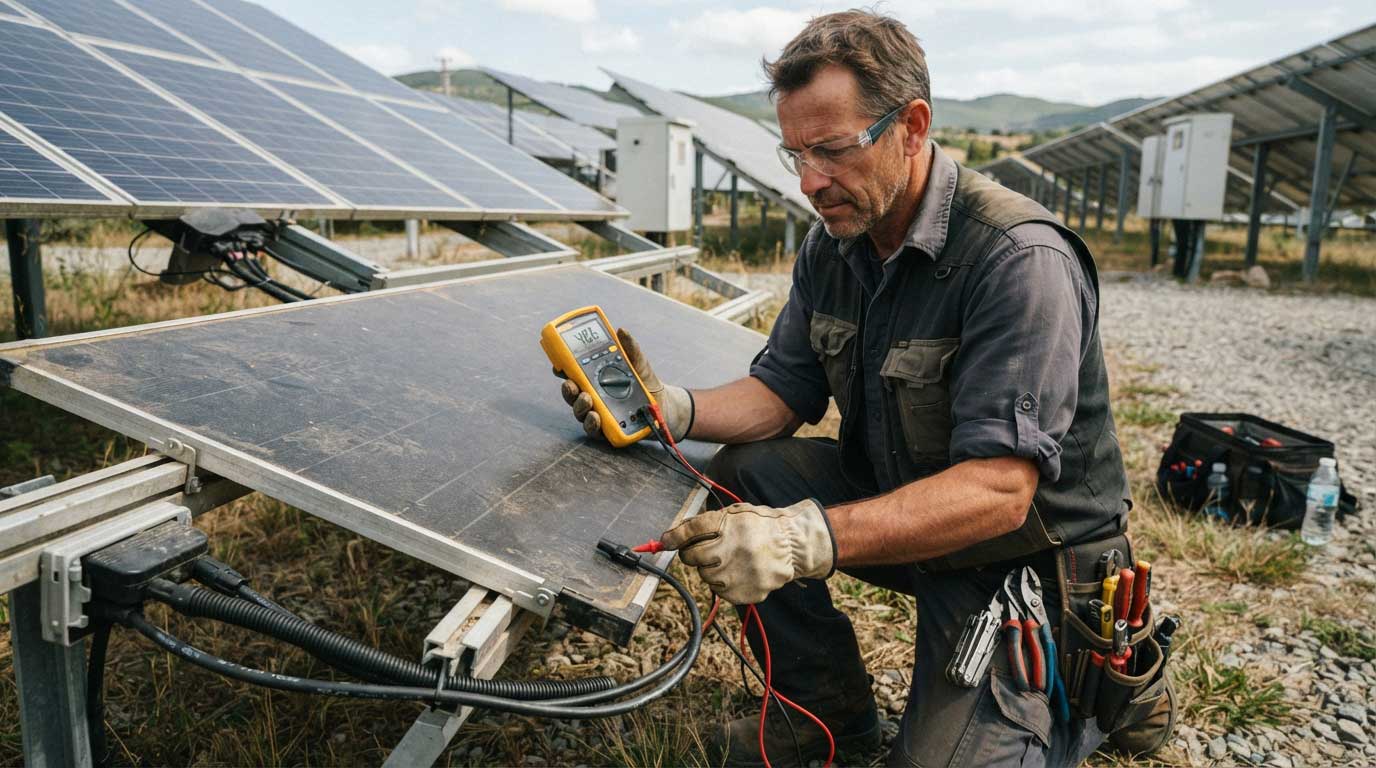
Step 4 — Confirm Polarity
Before connecting the panel to the controller, confirm positive and negative polarity with appropriate test equipment.
Do not rely on connector orientation alone.
Step 5 — Connect the Charge Controller
Follow the controller manufacturer’s installation sequence and voltage/current limits.
Verify that the panel’s Voc remains below the controller’s maximum PV input voltage.
Step 6 — Connect the Battery and Loads
Use appropriately rated wiring, overcurrent protection and connectors for the actual system.
The cable size should be selected from current, distance, installation conditions and allowable voltage drop—not simply because the panel is 100W.
Step 7 — Monitor the System
During the first several days, check:
- Morning charging
- Midday charging
- Battery voltage
- Controller status
- Cable temperature
- Unexpected voltage drop
- Shading
A functioning controller is not the same thing as a well-performing system.
Flexible vs Rigid 100W Solar Panels
For a 100W application, both technologies can work well.
The installation environment usually determines which one makes more sense.
| Feature | Flexible 100W Panel | Rigid 100W Panel |
|---|---|---|
| Weight | Generally lower | Generally higher |
| Profile | Very low | Raised |
| Curved surface | Excellent fit | Limited |
| Roof appearance | Low-profile | More visible |
| Mounting hardware | Potentially reduced | Usually required |
| Rear airflow | Often limited | Usually better |
| RV applications | Very suitable | Suitable |
| Boat applications | Very suitable | Depends on mounting area |
| Flat roof | Suitable | Often easier |
Flexible is not automatically better.
If the roof is flat and there is plenty of room, a conventional rigid module may be the simpler long-term choice.
If the surface is curved and low profile is important, flexible construction becomes much more attractive.
Temperature and 100W Solar Panel Performance
Temperature is easy to overlook during a product comparison.
PV modules are rated at a reference cell temperature of 25°C under STC. Real modules can become significantly hotter in direct sunlight. DOE notes that PV output changes with temperature and other operating conditions.
NREL’s PVWatts documentation also models roof-mounted systems with different thermal assumptions because restricted airflow can increase operating temperature compared with open-rack installations.
For a flexible panel mounted close to a roof surface, this is worth remembering.
The panel can be receiving excellent sunlight and still not operate at its laboratory rating.
That is normal PV behavior.
Shading Can Be More Important Than Panel Wattage
When inspecting an RV, I would rather have a well-positioned 100W panel with fewer shading problems than a larger theoretical array placed in poor locations.
Look at the roof at different times.
A vent that causes almost no shadow at 11 a.m. may shade part of the panel later.
The same issue occurs with:
- Air conditioners
- Antennas
- Roof racks
- Chimneys
- Trees
- Nearby buildings
For mobile systems, vehicle orientation changes the shading pattern again.
How Long Does a 100w 12v Flexible Solar Panel Last?
There is no universal lifetime number that applies to every flexible solar panel.
Service life depends on construction, materials, installation, climate, UV exposure, mechanical stress and operating conditions.
DOE states that PV module efficiency degrades at about 0.5% per year as a general performance consideration.
That is a fleet-level/general performance consideration, not a guarantee for a particular flexible panel.
IEC also makes an important distinction: qualification testing is not a quantitative prediction of useful module lifetime.
When evaluating a 100W flexible module, I would therefore check:
- Product warranty
- Power warranty
- Cell technology
- Encapsulation
- Surface material
- Bend specifications
- Environmental protection
- Connector design
- Temperature range
- Electrical certifications
The construction matters just as much as the wattage.
Bright Solar 100w 12v Flexible Solar Panel
Bright Solar designs flexible solar solutions around practical installation requirements rather than treating wattage as the only specification.
For a 100W 12V system, the first questions should be:
- What loads need to be powered?
- How much energy is required each day?
- What battery chemistry is being used?
- What is the available roof or deck area?
- What curvature does the installation surface have?
- Which charge controller will be used?
- How long is the cable run?
- What environmental conditions will the panel experience?
For an RV, the objective may be battery maintenance and daily DC loads.
For a boat, it may be keeping electronics and lighting supplied while away from shore power.
For a cabin, the same 100W module might be one part of a larger off-grid array.
The module is only one piece of the system.
Common Mistakes With a 100W 12V Flexible Solar Panel
Mistake 1 — Assuming 100W Means 100W Every Hour
The 100W rating is a reference power value under standard test conditions.
It is not continuous daily output.
Mistake 2 — Choosing a Controller From Wattage Alone
Check Vmp, Voc, Imp and Isc.
The controller must be electrically compatible with the actual module.
Mistake 3 — Ignoring Cable Length
A longer cable run increases voltage drop.
This becomes particularly relevant when the system operates at relatively low voltage and modest current margins.
Mistake 4 — Over-Bending the Panel
Flexible does not mean foldable.
Respect the manufacturer’s mechanical specifications.
IEC 61215 includes a specific bending test method for flexible modules.
Mistake 5 — Installing Before Checking Shadows
A perfect-looking roof location can become a poor solar location at another time of day.
Mistake 6 — Forgetting Future Maintenance
Do not position a solar module where it prevents access to important roof equipment.
That mistake is particularly annoying on an RV.
FAQ: 100w 12v Flexible Solar Panel
What can a 100w 12v flexible solar panel power?
It is suitable for modest electrical loads such as LED lighting, phones, tablets, small fans, communication equipment, sensors, GPS equipment and battery charging. It is not normally intended to continuously power high-consumption appliances.
How much energy does a 100W flexible solar panel produce per day?
A simple calculation gives 200–600Wh with two to six equivalent peak sun hours, respectively. Actual energy will vary because of sunlight, temperature, shading, orientation, wiring and controller losses.
Is a 100W flexible solar panel good for an RV?
Yes. It can be a practical option for small RVs and camper vans, especially for battery maintenance and modest daily DC loads. Larger electrical loads may require multiple panels.
Can I connect a 100W flexible solar panel directly to a 12V battery?
A solar panel should normally be connected through an appropriate solar charge controller rather than directly to the battery. The controller manages the charging process and must be compatible with the panel and battery specifications.
Is a 100W flexible solar panel waterproof?
The answer depends on the specific product’s construction and environmental rating. Do not assume every flexible module has the same water-resistance capability. Check the manufacturer’s datasheet and installation instructions.
Can a 100W flexible solar panel be installed on a curved roof?
Yes, if the panel is designed for the intended curvature and installed within its specified mechanical limits. Flexible does not mean unlimited bending.
Is a flexible solar panel better than a rigid 100W panel?
It depends on the installation. Flexible modules are particularly useful for curved, low-profile or weight-sensitive applications. Rigid panels can be preferable where conventional mounting, rear airflow and flat surfaces are available.
Final Takeaway
A 100w 12v flexible solar panel is a practical choice for compact RV, marine, camper van and small off-grid applications where low profile, light weight and installation flexibility matter.
The 100W rating tells you the module’s rated power. It does not tell you how much energy the system will deliver every day.
For a reliable installation, look at the complete picture: sunlight, temperature, shading, panel specifications, battery capacity, charge-controller compatibility, cable length, roof geometry and future maintenance.
That is the approach I would use when evaluating a Bright Solar 100W flexible module: start with the actual load and installation surface, then build the electrical system around those conditions rather than choosing components from wattage labels alone.
Technical Sources
- U.S. Department of Energy — Optimizing Solar Photovoltaic Performance for Longevity.
- U.S. Department of Energy — Understanding Solar Photovoltaic System Performance.
- National Renewable Energy Laboratory — PVWatts Version 5 Manual.
- International Electrotechnical Commission — IEC 61215-1:2021.
- International Electrotechnical Commission — IEC 61215-2:2021.
Related recommendations
-

Flexible solar panel boat: Lightweight Marine Solar Solution for Modern Vessels
229Discover flexible solar panel boat solutions from Bright Solar. Learn how lightweight marine solar panels improve boat energy efficiency, installation flexibility, and off-grid performance.
View details -
Durable Flexible Solar Panel: Built for Long-Term Solar Performance
202Explore durable flexible solar panel solutions designed for RV, marine and off-grid applications. Learn durability factors, materials, testing, and real installation experience from Bright Solar.
View details -
flexible solar panels 100w: Lightweight Solar Solution for Portable Energy Applications
223Discover flexible solar panels 100w from Bright Solar with lightweight design, high efficiency, and durable ETFE protection for RV, marine, camping, and off-grid energy.
View details -
flexible solar panels for van roof: Lightweight Solar Solution for Camper Conversions
140Explore flexible solar panels for van roof with lightweight design, easy installation, and reliable off-grid power solutions for camper conversions and travel vehicles.
View details