100 Watt Folding Solar Panel Kit: Power, Setup and Buying Guide
A 100 watt folding solar panel kit provides portable electricity for camping, RV trips, outdoor activities and small off-grid loads. In suitable sunlight, it may generate roughly 300–425Wh per day with four to five peak sun hours and typical system losses.
That energy can be useful for phones, lights and small electronics, but it is not a guarantee of all-day 100W output. Actual production depends on weather, panel angle, shading, temperature and the charging equipment connected to it.
What Is a 100 Watt Folding Solar Panel Kit?
A 100W folding solar panel kit is a portable photovoltaic system built around a panel that folds for transport and opens for use. Many models have a fabric or protective backing, integrated handles and adjustable support legs. Depending on the package, the kit may also include cables, adapters or a charge controller.
The word kit needs a closer look before purchase. Some products include only the panel and output cable; others are designed to connect to a portable power station or a standalone battery. A battery is not automatically included.
Components to check before buying
| Component | Purpose | Important detail |
|---|---|---|
| Folding solar panel | Converts sunlight into DC electricity | Rated power, voltage, weight and folded dimensions |
| Output cable | Connects the panel to charging equipment | Connector type, polarity and cable length |
| Solar charge controller | Regulates charging for a compatible battery | Battery chemistry and voltage settings |
| Kickstand | Holds the panel at a useful angle | Stability and adjustment range |
| Portable power station or battery | Stores energy for later use | Capacity in watt-hours and solar input limits |
A power station usually has its own internal charging electronics. If its manufacturer specifies that a compatible solar panel can connect directly to the solar input, an extra controller may not be necessary. For a standalone battery, a suitable controller is normally required unless the system documentation specifies another approved arrangement.
Bright Solar supplies flexible and semi-flexible solar panels for applications such as RVs, outdoor power and off-grid systems. These products are different from a folding portable kit. A folding panel is intended to be deployed and packed away; a flexible module is intended for installation on an appropriate surface according to its mounting and bending specifications.
How Much Electricity Can a 100W Folding Solar Panel Generate?
The 100W rating is the panel’s nominal power under specified test conditions, not the amount of energy it produces in a day. To estimate daily energy, multiply rated power by equivalent peak sun hours and account for system losses.
Daily energy (Wh) = panel power (W) × peak sun hours × system efficiency
For planning purposes, the examples below assume an illustrative overall efficiency of 75%–85%. These are estimates rather than measured results for a particular panel or location.
| Peak sun hours | Estimated daily energy from a 100W panel |
|---|---|
| 2 hours | 150–170Wh |
| 3 hours | 225–255Wh |
| 4 hours | 300–340Wh |
| 5 hours | 375–425Wh |
| 6 hours | 450–510Wh |
Peak sun hours are equivalent hours at a reference irradiance of 1,000 watts per square metre. They are not simply the number of hours between sunrise and sunset.
For location-based solar resource estimates, the NREL PVWatts Calculator is a useful starting point. It estimates photovoltaic energy production using location and system assumptions. A folding panel’s real-world results can differ because it may be moved during the day, positioned poorly, shaded by nearby objects or used with a portable battery system.
What can 300–425Wh power?
Consider the following illustrative energy requirements. Actual device consumption varies by model and usage.
| Device or activity | Example daily energy use | Practical interpretation |
|---|---|---|
| Smartphone charging | 10–20Wh per charge | Several charges may be possible |
| LED camping light | 5W × 4 hours = 20Wh | A relatively small load |
| Laptop charging | 50–80Wh per charge | One or more charges may be possible |
| Portable fan | 10W × 5 hours = 50Wh | A manageable load in good conditions |
| Compressor cooler | 300–600Wh per day as an illustrative range | May use most or all of the day’s production |
These values are examples for planning, not universal device specifications. Conversion losses, battery charging efficiency and operating patterns all affect the energy that reaches a device.
A cooler deserves particular attention. Its compressor may cycle rather than run continuously, and energy consumption changes with outside temperature, ventilation and the selected temperature. Check the manufacturer’s daily energy estimate or measure actual consumption when possible.
Why your panel may not reach 100 watts
Seeing 55W or 75W on a power station display does not necessarily indicate a faulty panel. Output changes throughout the day.
- Sun angle: A panel lying flat may receive less direct sunlight than one angled toward the sun.
- Partial shade: A shadow from a tree branch, tent edge or vehicle can reduce output significantly, depending on the panel’s cell layout and electrical design.
- Clouds and haze: Diffuse light still produces electricity, but often at a lower rate.
- Cell temperature: Solar modules typically lose voltage as their cells heat up.
- Charging limits: A power station may restrict input based on its voltage range, maximum current or temperature.
The practical advantage of a folding panel is that it can be repositioned. On a clear afternoon, adjusting the panel after moving the campsite chair or vehicle can matter more than expected. The trade-off is that the panel needs space and attention; it is not necessarily collecting energy while packed away or left in deep shade.
How to Set Up a 100 Watt Folding Solar Panel Kit
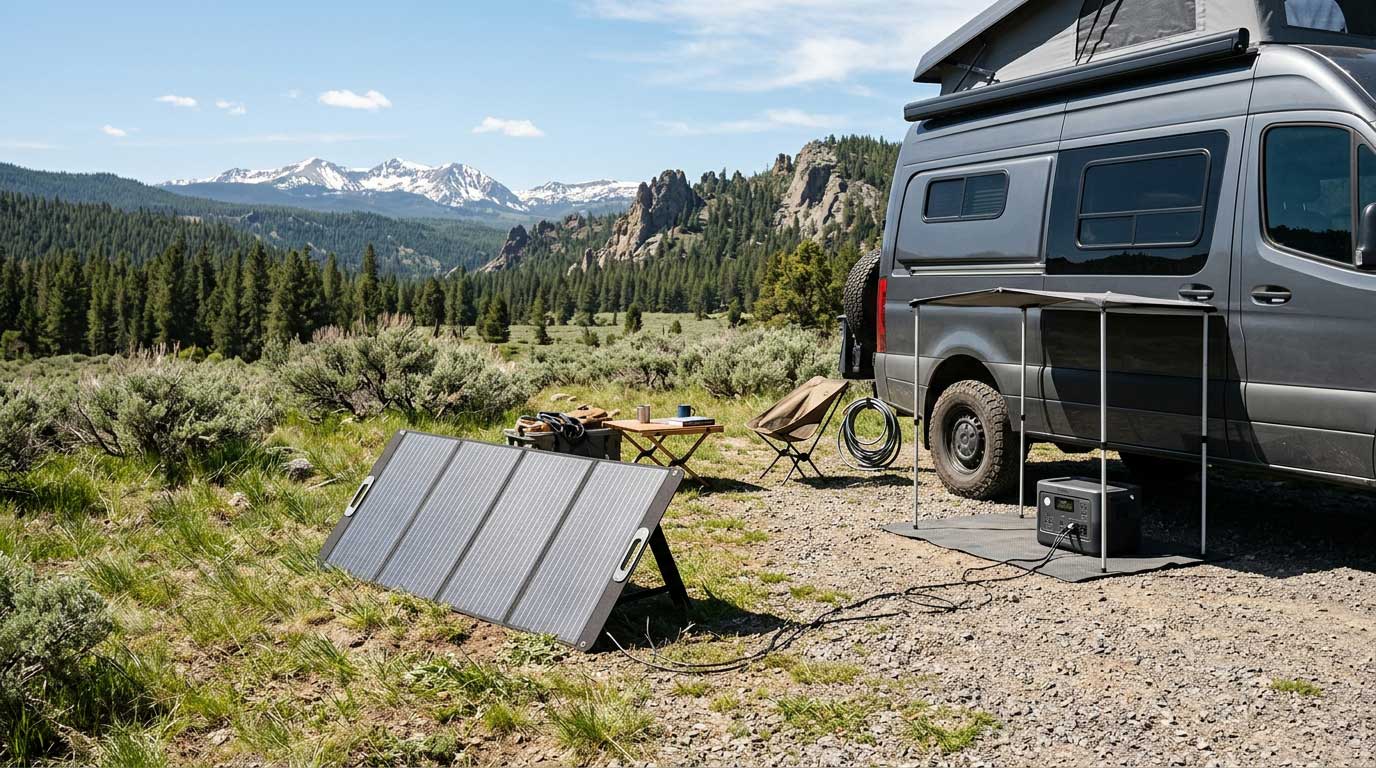
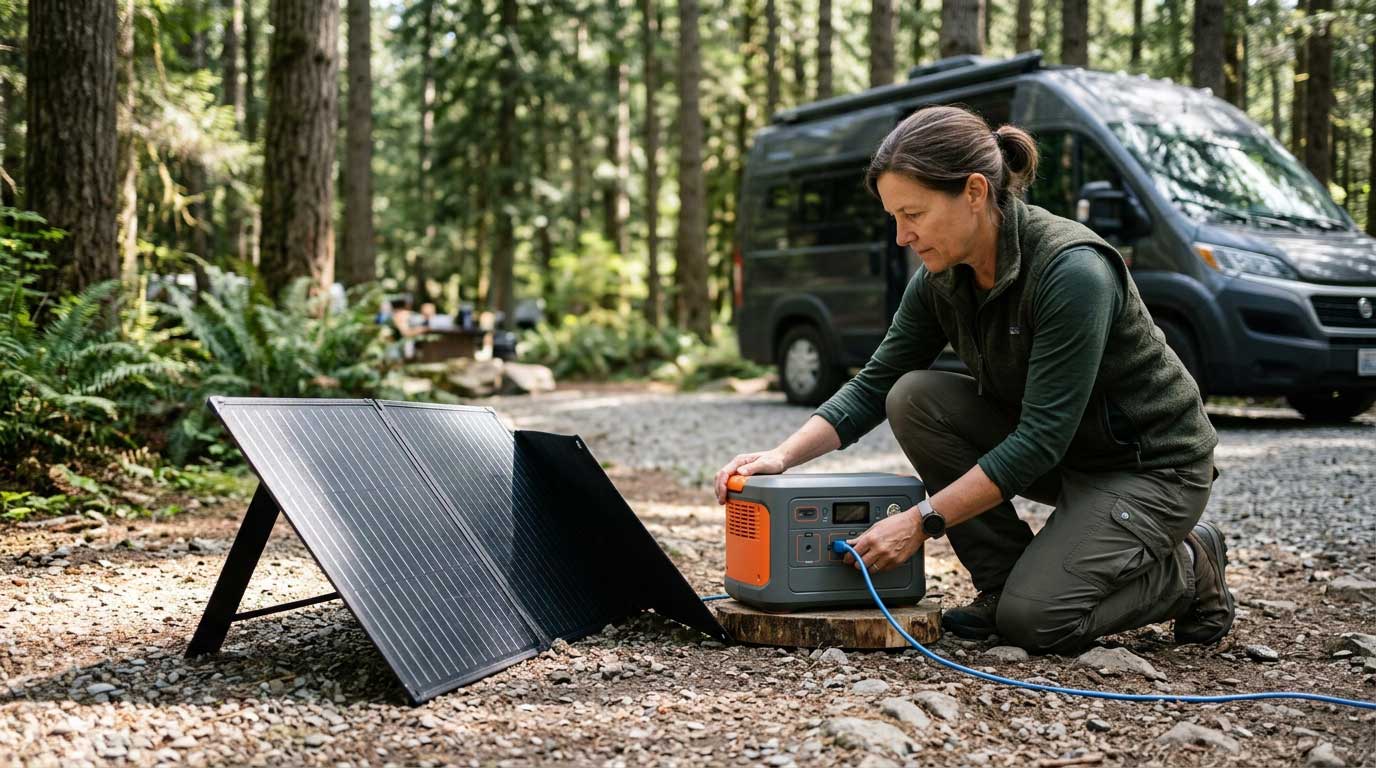
Portable Solar Panel setup is simple when the panel, battery and connectors are compatible. The safest approach is to follow the instructions for the exact equipment instead of assuming every 100W kit connects the same way.
Step 1 — Find an open, stable position
Open the panel fully on stable ground. Choose a location with direct sunlight and minimal shade from trees, tents, awnings and the vehicle itself. Check the kickstands before walking away; gusts can tip over a lightweight panel.
Keep the panel out of vehicle paths and avoid placing it where people may trip over the cable. Leave the power station in a ventilated location and follow its operating-temperature guidance.
Step 2 — Verify voltage and connector compatibility
Before connecting anything, compare the panel’s electrical specifications with the receiving device’s solar input requirements. Important details include:
- Panel operating voltage and open-circuit voltage.
- Maximum permitted input voltage and current.
- Connector type and polarity.
- Battery chemistry and charging requirements, if using a separate battery.
- Whether the kit includes a charge controller.
A connector that physically fits is not proof of compatibility. Do not use an improvised adapter unless its ratings and wiring are suitable for the system.
Step 3 — Connect the panel in the specified sequence
Follow the manufacturer’s connection sequence for the power station or charge controller. Some standalone controller systems require the battery to be connected before the solar panel; integrated power stations may be designed for direct solar input.
Do not connect a panel directly to a battery unless the manufacturer explicitly approves that arrangement. Keep connectors dry, inspect cables for damage and avoid handling exposed electrical connectors in wet conditions.
Step 4 — Check the charging display
If the power station has an input display, check whether it detects solar power. Move the panel into a clearer patch of sunlight and observe whether the reading changes. Output can fluctuate as clouds pass or the sun angle shifts.
If the display reads zero or shows much less power than expected, check for shade, loose connections, incorrect adapters, voltage incompatibility and input limits before assuming the panel is defective.
Step 5 — Fold and store it correctly
Disconnect the equipment as directed by the manufacturer. Let the panel cool if necessary, fold it without forcing the hinges or fabric joints, and store the cable so that connectors do not press against the cells.
Before packing up, check for dirt, moisture and damaged wires. Avoid folding a panel while connectors or cables are trapped between sections.
Choosing a Folding Solar Panel Kit for RVs and Camping
A good buying decision starts with the equipment you already own. If you have a power station, check its manual before buying a panel. If you are building a battery system from scratch, compare the panel, controller and battery as a complete setup.
Compare the specifications that affect daily use
| Buying factor | What to look for | Why it matters |
|---|---|---|
| Rated power | 100W nominal output | Establishes the panel’s rated capacity, not guaranteed daily production |
| Folded dimensions | Fits your storage area | Determines how easily the kit fits in a car, RV or gear compartment |
| Weight | Comfortable to carry and position | Important when setting up alone or moving between campsites |
| Solar input compatibility | Voltage, current and connector match | Prevents charging problems and incompatible connections |
| Included accessories | Cables, adapters, stands and controller | Avoids unexpected additional purchases |
| Environmental protection | Manufacturer’s ratings and instructions | Helps determine what conditions the equipment can tolerate |
| Warranty and support | Clear terms and accessible technical help | Useful if the kit will be used regularly or purchased for a business |
Do not judge portability by panel weight alone. A panel may be light but awkward to carry when folded, or require extra adapters that add bulk. For frequent camping, setup time and how securely the panel packs away can be as important as a small difference in rated output.
Is a battery included, and how much storage do you need?
A panel collects energy only when sunlight is available. A battery or power station stores energy so it can be used at night or when clouds pass.
Battery capacity is usually expressed in watt-hours (Wh). A 300Wh power station, for example, stores a nominal amount of energy equivalent to a 30W load running for ten hours under ideal arithmetic. Real usable energy will be lower because of conversion losses and the device’s operating limits.
Also check the maximum solar input power. A power station may accept less than the panel’s rated output, or require a particular voltage range. Buying a 100W panel does not guarantee that every power station will accept 100W from it.
Folding panels versus flexible panels
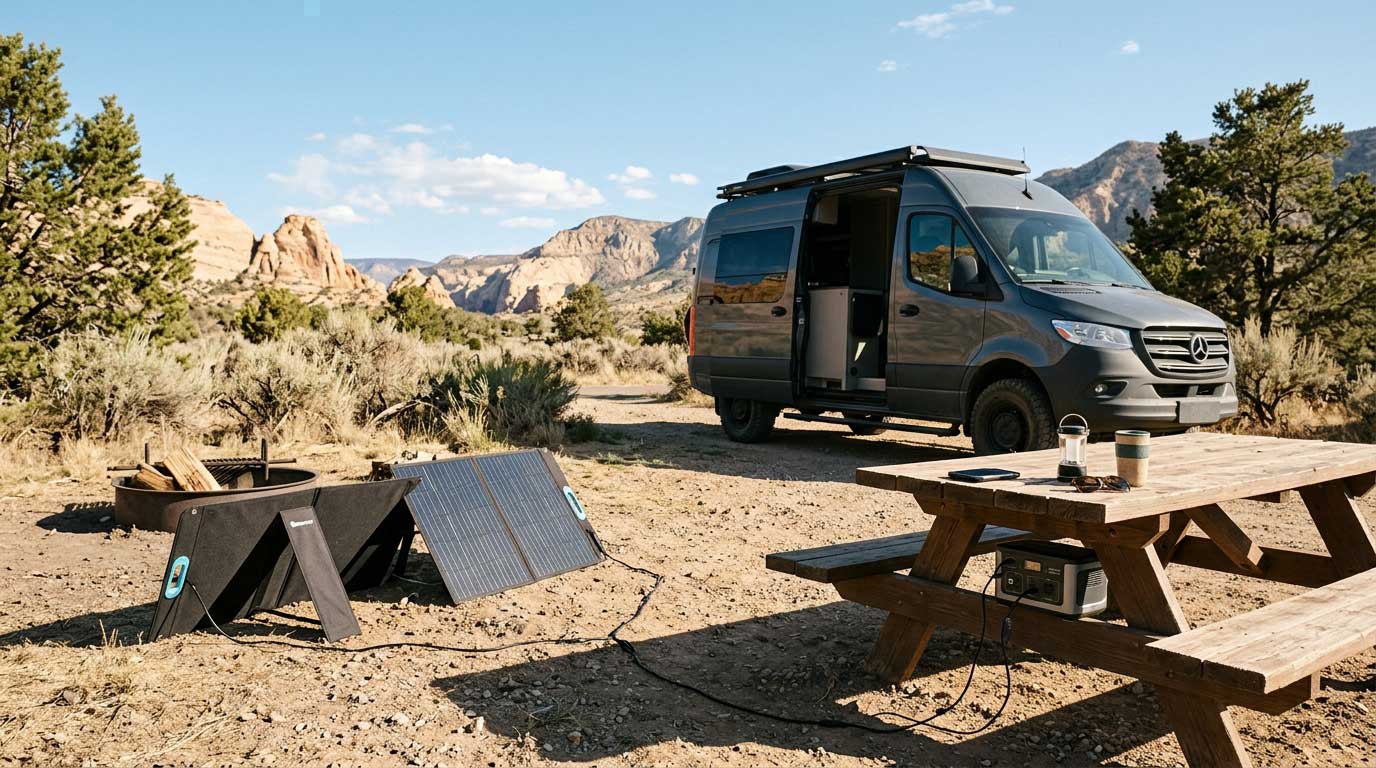
A folding solar panel kit is best suited to temporary use: open it at camp, collect energy, then pack it away. Flexible panels are intended for suitable mounting surfaces and may be more appropriate for certain RV roofs, marine installations or custom off-grid designs.
Bright Solar’s L Series flexible panels are designed for applications such as RVs, campers and selected off-grid and marine uses. The series has a stated maximum bending capacity of 30%, but the exact mounting method and permissible installation conditions must be verified from the relevant product specifications. That bending capability does not mean the panel should be folded and unfolded like a portable kit.
For B2B buyers, OEM projects or installers choosing a panel format, compare installation requirements, dimensions, electrical output, mounting conditions and the intended operating environment. Select a folding product for portable deployment and a flexible module only when the surface and installation method are suitable.
A Practical Energy-Budget Example for a Weekend Trip
Imagine a camper spending two nights at a campsite and using a phone, a small LED light and a USB fan. An illustrative daily energy budget might be:
| Device | Example use | Energy per day |
|---|---|---|
| Smartphone | Two charges at 15Wh each | 30Wh |
| LED light | 5W × 4 hours | 20Wh |
| USB fan | 10W × 3 hours | 30Wh |
| Total | 80Wh |
If the panel delivers 300Wh of usable energy on a sunny day, this 80Wh load is below the estimated production. Some energy could remain for battery storage, depending on the power station’s charging behavior and when the devices are used.
Now add a cooler consuming an illustrative 400Wh per day. Total demand becomes 480Wh, more than the example’s 300Wh daily generation. The system may fall short even when the panel is working normally.
This is a calculated scenario, not a field test of a named product. Its lesson is practical: a 100W panel can be useful for light electronics without necessarily being sufficient for refrigeration. For a real trip, list your devices, estimate watt-hours per day and allow for cloudy weather rather than sizing the system around a perfect afternoon.
FAQ About 100 Watt Folding Solar Panel Kit
How much power does a 100 watt folding solar panel kit produce per day?
With four to five peak sun hours and an illustrative 75%–85% overall efficiency, a 100W panel may deliver around 300–425Wh per day. Actual production depends on location, season, shade, temperature, orientation and system losses.
Can a 100W folding solar panel charge a power station?
Yes, if the panel’s voltage, current and connector are compatible with the power station’s solar input. Check the power station’s permitted input range and the panel’s electrical specifications before connecting them.
How long will it take to charge a 300Wh battery?
At a constant 100W input, 300Wh divided by 100W equals three hours in ideal arithmetic. In practice, solar output changes during the day and charging has losses, so the actual time is usually longer. Battery charge limits can also affect the result.
Does a folding solar panel work on cloudy days?
Yes, it can generate electricity from diffuse daylight, but output is generally lower than under clear, direct sunlight. Thick cloud cover may reduce production substantially, so leave a margin if you rely on solar charging for essential equipment.
Can I leave a folding solar panel outside in the rain?
Only if the manufacturer’s environmental ratings and instructions allow the conditions involved. A panel’s weather resistance does not automatically apply to its connectors, cables, controller or power station. Keep electrical connections protected and follow the product manual.
Is a folding solar panel kit suitable for an RV roof?
It can be used temporarily when the RV is parked, provided it is placed securely and the cable connection is suitable. For a permanent roof installation, a panel specifically designed for that mounting application may be more appropriate. Do not leave a portable panel unsecured on a moving vehicle.
Is a 100W folding panel better than a flexible solar panel?
Neither is universally better. A folding panel suits temporary portable use and can be stored between trips. A Flexible Solar Panel may suit a permanent installation on an appropriate curved or lightweight surface. Choose based on mounting requirements, portability and the intended application.
Conclusion
A 100 watt folding solar panel kit is a useful option for portable charging when you understand its realistic output and match it to your daily energy budget. It can support phones, lights and other modest loads in suitable conditions, but it should not be treated as a guaranteed power source for high-consumption appliances.
Before buying, check the complete package contents, connector compatibility, solar input limits, folded dimensions and expected energy production. Use the NREL PVWatts Calculator to understand local solar resources, remembering that its standard estimates may not precisely represent a portable panel’s performance. For projects that need a permanently mounted module rather than a folding kit, compare the application with Bright Solar’s flexible solar panel options and verify the relevant product specifications.
Authoritative References
– National Renewable Energy Laboratory (NREL) — PVWatts Calculator: https://pvwatts.nrel.gov/ Estimates photovoltaic energy production using location and system assumptions.
– U.S. Department of Energy — Solar Photovoltaic System Design Basics: https://www.energy.gov/cmei/systems/solar-photovoltaic-system-design-basics Explains core PV system components and design considerations.
– U.S. Department of Energy — Solar Photovoltaic Technology Basics: https://www.energy.gov/cmei/systems/solar-photovoltaic-technology-basics Provides background on how photovoltaic cells and modules convert sunlight into electricity.
Related recommendations
-

400w Flexible Solar Panels: Complete Guide for RV & Off-Grid Use
328Explore 400w flexible solar panels for RVs, boats and off-grid systems. Learn sizing, output, installation, wiring, efficiency and practical selection tips.
View details -
Flexible solar panel boat: Lightweight Marine Solar Solution for Modern Vessels
270Discover flexible solar panel boat solutions from Bright Solar. Learn how lightweight marine solar panels improve boat energy efficiency, installation flexibility, and off-grid performance.
View details -
Thin Film Flexible Solar Panel: Lightweight Solar Solutions for Modern Applications
176Discover thin film flexible solar panel technology for RV, marine and off-grid applications. Learn benefits, performance, installation tips and real project insights.
View details -
Zonergy demonstrates innovative energy storage solutions in Europe
328Zonergy Corporation presents cutting-edge energy storage solutions and smart microgrid products at EES Europe. With advanced photovoltaic and storage technologies, Zonergy leads in residential, commercial, and large-scale renewable energy projects...
View details