Off Grid Solar Power System: Complete Guide for Energy Independence
Introduction
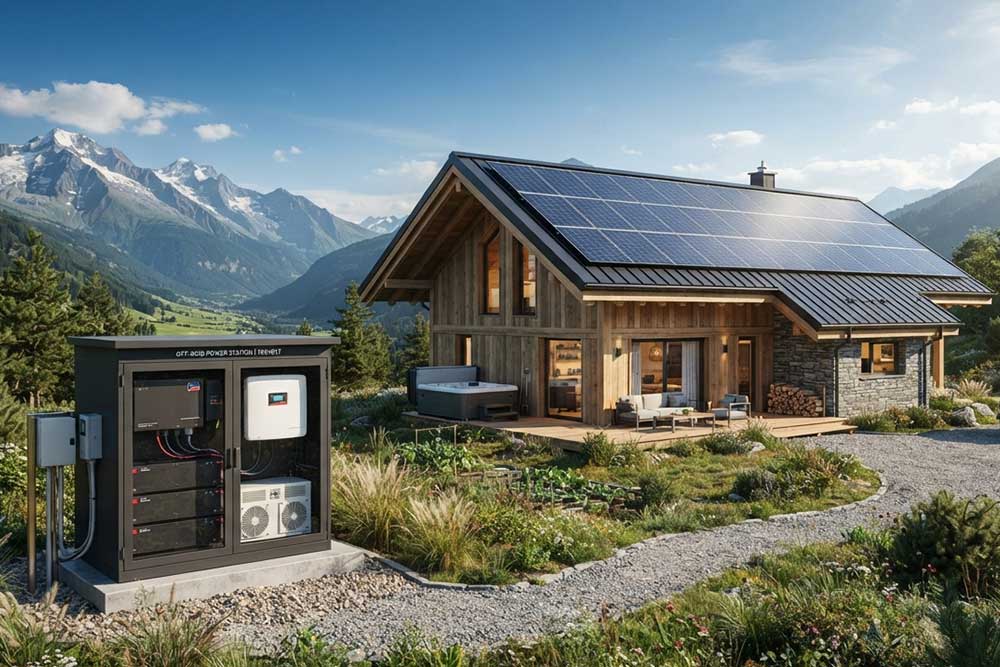
An off grid solar power system is a standalone energy solution that generates electricity from solar panels and stores power in batteries without depending on the public utility grid. It is commonly used for remote homes, RVs, cabins, farms, marine applications, and areas where reliable grid access is unavailable.
Unlike grid-connected solar systems, an off-grid system must produce, store, and manage all the electricity required by the user. This means every component, including solar panels, batteries, inverters, and controllers, needs to be carefully selected based on actual energy demand.
With the continuous improvement of solar technology, off-grid systems have become more practical and efficient. Modern solutions using high-efficiency solar panels and lithium battery storage can provide stable electricity for daily appliances, communication equipment, lighting, and essential devices.
At Bright Solar, we have worked with different solar applications, including portable systems, RV energy solutions, and customized off-grid projects. From our experience, successful off-grid installations depend not only on choosing powerful solar panels but also on creating a balanced system design that matches the user’s real energy needs.
What Is an Off Grid Solar Power System?
An off grid solar power system is a self-sufficient solar energy system that operates independently from the traditional electricity grid. It uses photovoltaic panels to convert sunlight into electricity, stores excess energy in batteries, and supplies power to electrical devices through an inverter.
The biggest difference between an off-grid system and a traditional grid-connected solar system is energy independence.
A grid-connected solar system can rely on utility electricity when solar production is insufficient. An off-grid system cannot. It must have enough solar generation and battery capacity to meet energy requirements day and night.
A complete off-grid solar system usually includes:
- Solar panels
- Solar charge controller
- Battery storage
- Solar inverter
- Mounting structure
- Monitoring system
- Electrical protection devices
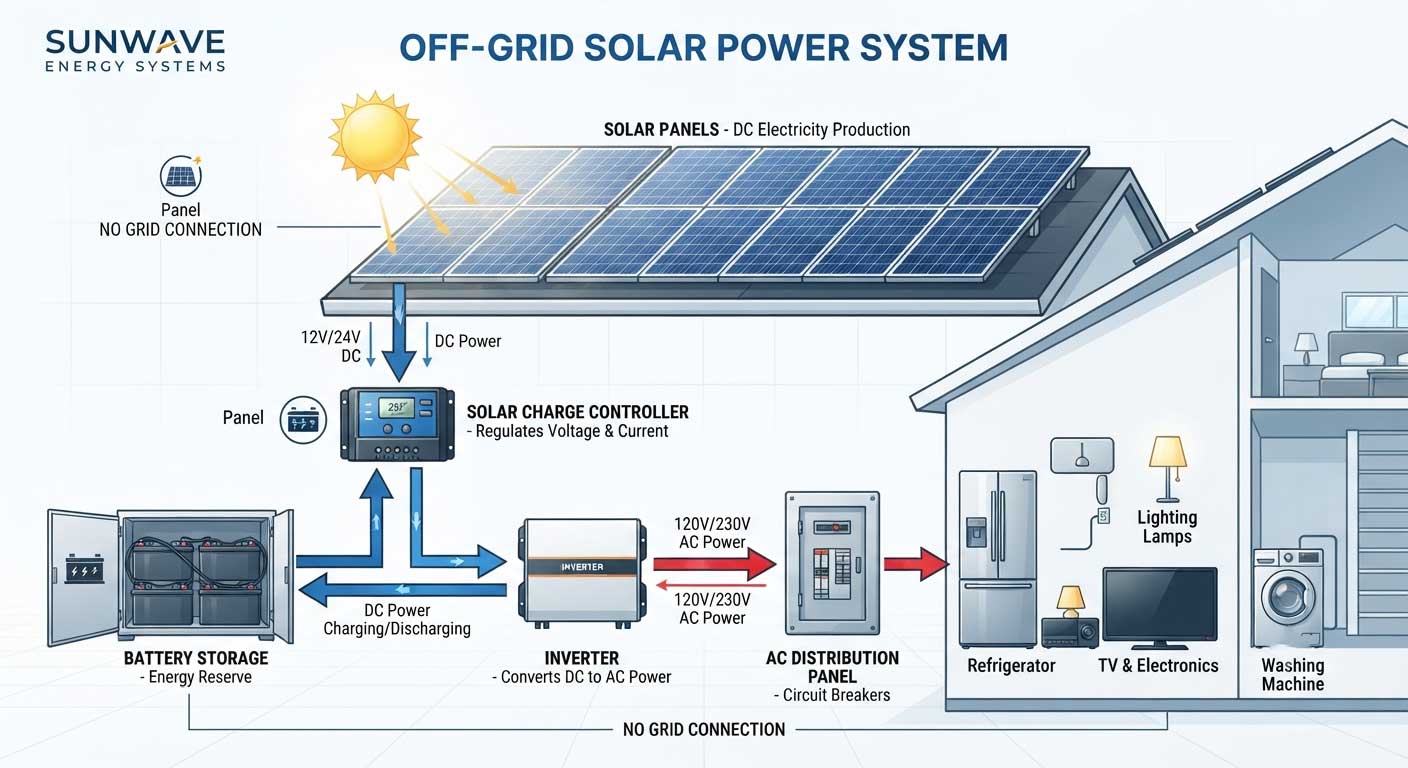
The system works as a complete energy ecosystem:
Solar panels generate electricity → batteries store energy → inverter converts power → appliances use electricity
Where Are Off Grid Solar Power Systems Used?
Off-grid solar systems are especially valuable in locations where connecting to the electricity grid is expensive, difficult, or impossible.
Common applications include:
Remote Homes
Many rural houses and cabins use off-grid solar systems because extending power lines to remote areas can be costly.
A properly designed system can support:
- Lighting
- Refrigerators
- Internet equipment
- Water pumps
- Home appliances
RVs and Camper Vans
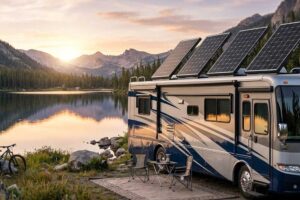
Mobile users often choose off-grid solar systems to achieve energy independence while traveling.
Flexible solar panels are especially popular in RV applications because they are:
- Lightweight
- Easy to install
- Suitable for curved surfaces
- Space efficient
Farms and Agricultural Projects
Remote farms can use solar power for:
- Irrigation pumps
- Monitoring equipment
- Security systems
- Storage facilities
Marine Applications
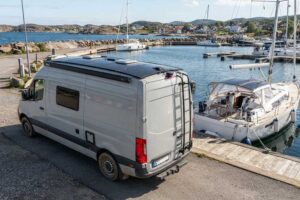
Boats and yachts often rely on off-grid solar solutions because access to shore power is limited.
Marine solar systems require:
- Waterproof components
- Corrosion resistance
- Reliable battery storage
Off Grid Solar Power System vs Traditional Electricity
A traditional electricity system depends on a centralized power network. The user purchases electricity from a utility provider and receives continuous power through the grid.
An off-grid solar system creates electricity locally.
The main differences include:
| Feature | Off Grid Solar System | Traditional Grid Power |
|---|---|---|
| Energy source | Solar energy | Utility electricity |
| Grid connection | Not required | Required |
| Battery storage | Required | Usually optional |
| Energy independence | High | Low |
| Initial investment | Higher | Lower |
| Long-term control | Higher | Lower |
For users who prioritize independence, remote accessibility, or renewable energy, an off-grid solar system can be a practical long-term solution.
How Does an Off Grid Solar Power System Work?
An off-grid solar power system works by capturing solar energy, converting it into usable electricity, storing excess power, and distributing energy to connected devices.
The entire process involves several key stages.
Step 1: Solar Panels Generate Electricity
The process begins when sunlight reaches the solar panels.
Photovoltaic cells inside the panels convert sunlight into direct current (DC) electricity through the photovoltaic effect.
The amount of electricity generated depends on:
- Solar panel wattage
- Sunlight intensity
- Installation angle
- Weather conditions
- Panel efficiency
For off-grid applications, selecting the correct solar panel capacity is critical because the system cannot rely on external electricity when solar production is low.
Step 2: Charge Controller Regulates Power
The electricity generated by solar panels flows to the charge controller.
The charge controller manages the charging process and protects the battery from:
- Overcharging
- Over-discharging
- Excess current
Most modern off-grid systems use MPPT (Maximum Power Point Tracking) controllers because they can improve solar energy harvesting, especially when sunlight conditions change.
Step 3: Battery Stores Energy
Battery storage is one of the most important parts of an off-grid solar system.
During sunny periods:
- Solar panels power appliances
- Extra electricity charges the battery
At night or during cloudy weather:
- The battery supplies stored electricity
Common battery options include:
Lithium Iron Phosphate (LiFePO4)
Advantages:
- Long cycle life
- High efficiency
- Lightweight
- Low maintenance
Lead-Acid Batteries
Advantages:
- Lower initial cost
Limitations:
- Shorter lifespan
- Lower usable capacity
For modern off-grid applications, lithium batteries are becoming increasingly popular due to their durability and performance.
Step 4: Inverter Converts Electricity
Solar panels and batteries produce DC electricity, but most household appliances require alternating current (AC).
The inverter converts DC power into usable AC electricity.
A quality inverter should provide:
- Stable output voltage
- High conversion efficiency
- Safety protection features
For sensitive electronics, pure sine wave inverters are usually recommended because they provide cleaner power.
Step 5: Energy Management Controls the System
Modern off-grid solar systems often include monitoring and energy management tools.
These systems help users track:
- Solar production
- Battery status
- Energy consumption
- System performance
This information helps users optimize energy usage and identify potential problems early.
Practical Example: Daily Operation
A typical day of an off-grid solar system may work like this:
Morning
Solar panels begin generating electricity.
↓
Daytime
Solar power runs appliances and charges batteries.
↓
Evening
Stored battery energy powers lighting and devices.
↓
Night
Battery continues supplying essential loads until the next solar cycle.
A well-designed off-grid solar system should balance energy generation, storage capacity, and consumption. Bright Solar focuses on helping customers select suitable solar solutions based on real application requirements rather than simply choosing the highest power rating.
Main Components of an Off Grid Solar Power System
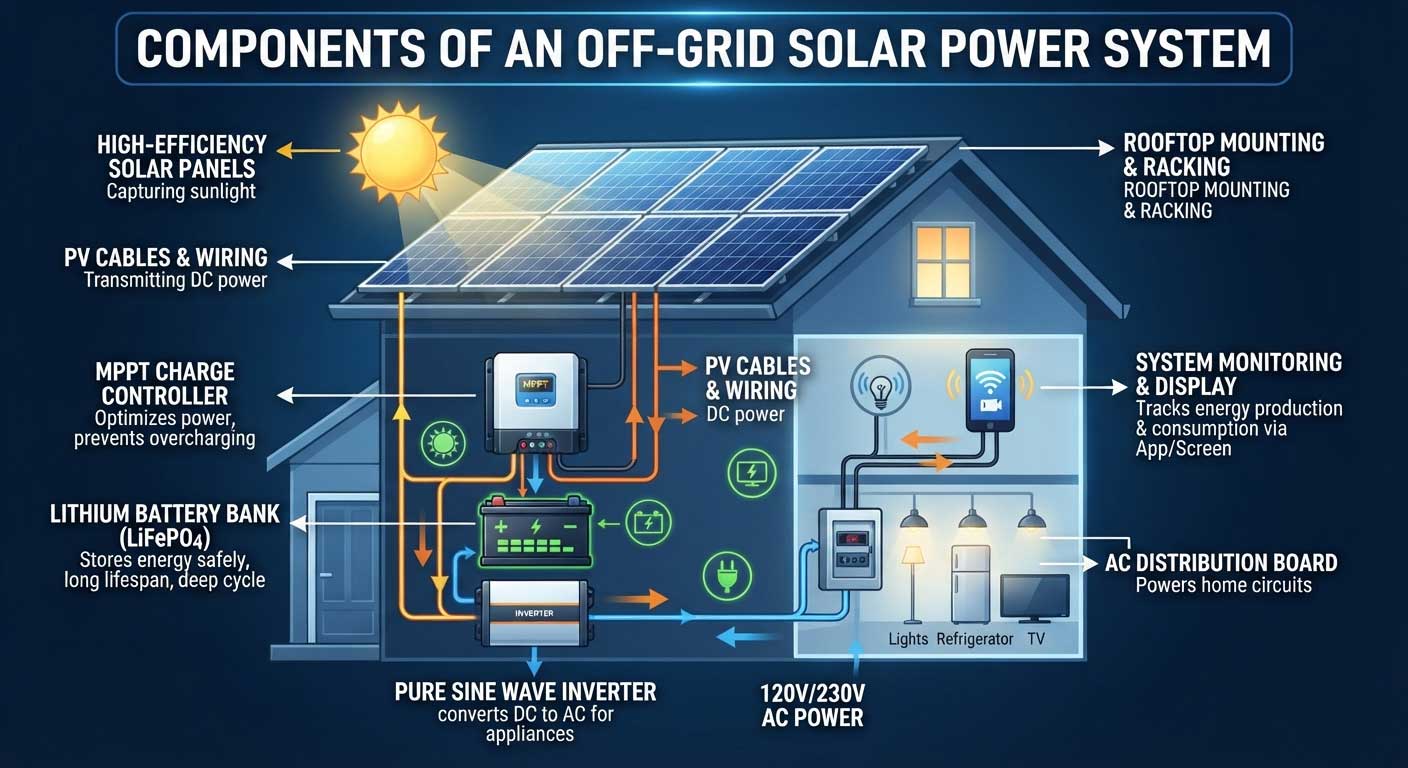
A complete off grid solar power system depends on multiple components working together. Unlike grid-connected solar systems that can rely on utility power when solar production is insufficient, an off-grid system must independently generate, store, and manage electricity.
Each component plays an important role. Selecting the right combination of solar panels, batteries, inverters, and control equipment directly affects system reliability, efficiency, and operating cost.
A typical off-grid solar system includes:
- Solar panels
- Solar charge controller
- Battery storage
- Solar inverter
- Mounting system
- Monitoring and protection equipment
Solar Panels: The Energy Generation Source
Solar panels are the first and most visible part of an off-grid solar power system. Their main function is converting sunlight into DC electricity.
The amount of energy produced depends on:
- Panel power rating
- Solar radiation
- Installation location
- Panel orientation
- Temperature conditions
For off-grid applications, solar panels must generate enough electricity to meet daily consumption while also charging the battery system.
Types of Solar Panels for Off Grid Systems
Monocrystalline Solar Panels
Monocrystalline panels are widely used because they offer high efficiency and good performance in limited spaces.
Advantages:
- High conversion efficiency
- Long service life
- Better performance in smaller installation areas
They are commonly used for:
- Homes
- Cabins
- RV systems
- Remote power projects
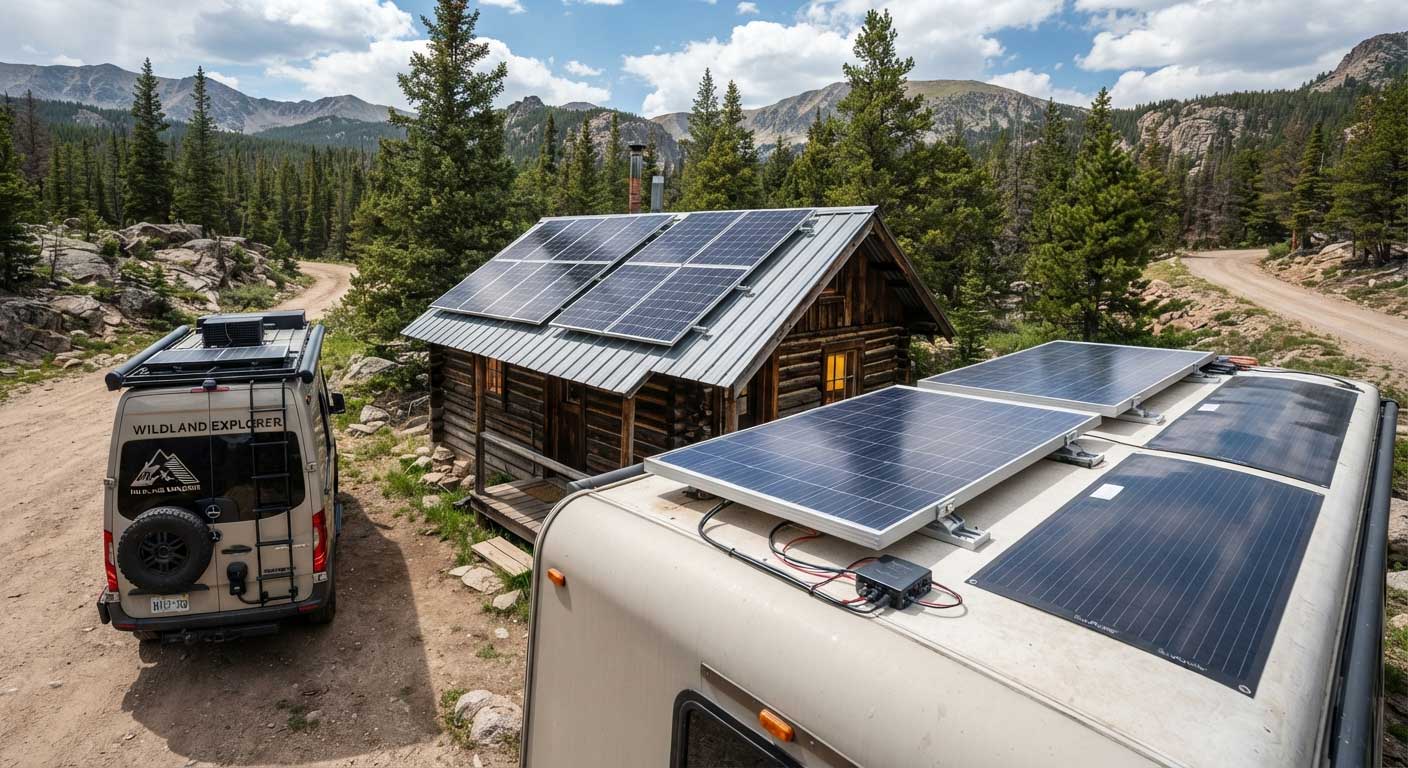
Flexible Solar Panels
Flexible solar panels are becoming increasingly popular in mobile and customized off-grid applications.
Their advantages include:
- Lightweight design
- Low-profile installation
- Ability to fit curved surfaces
They are suitable for:
- RV roofs
- Camper vans
- Boats
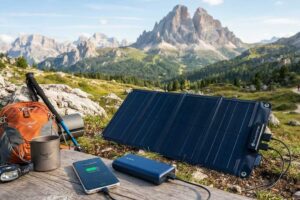
- Portable solar systems
Bright Solar develops flexible solar solutions for applications where traditional rigid panels may not be practical, especially when weight and installation flexibility are important considerations.
Solar Charge Controller: Protecting Battery Performance
The solar charge controller manages the electricity flowing from solar panels to the battery.
Its main functions include:
- Controlling charging voltage
- Preventing battery overcharging
- Improving charging efficiency
- Protecting battery health
There are two common types:
PWM Charge Controllers
PWM (Pulse Width Modulation) controllers are basic and cost-effective.
Advantages:
- Lower price
- Simple operation
Limitations:
- Lower charging efficiency
- Less suitable for larger systems
They are usually used for small solar applications.
MPPT Charge Controllers
MPPT (Maximum Power Point Tracking) controllers are more advanced and commonly recommended for off-grid solar systems.
Advantages:
- Higher energy harvesting efficiency
- Better performance in changing weather conditions
- Suitable for larger systems
For residential and commercial off-grid projects, MPPT controllers are often the preferred choice because they maximize available solar energy.
Battery Storage: The Core of Energy Independence
Battery storage is one of the most important components of an off-grid solar system.
Since solar panels only generate electricity during daylight hours, batteries store excess energy for use:
- At night
- During cloudy weather
- During periods of high demand
The battery capacity determines how long the system can operate without sufficient sunlight.
Common Battery Types
Lithium Iron Phosphate (LiFePO4) Batteries
LiFePO4 batteries are becoming the preferred option for modern off-grid systems.
Advantages:
- Long cycle life
- High energy efficiency
- Lightweight structure
- Low maintenance requirements
- Better usable capacity
They are commonly used in:
- RV solar systems
- Residential off-grid systems
- Portable power solutions
Lead-Acid Batteries
Lead-acid batteries have been used in solar systems for many years.
Advantages:
- Lower initial cost
- Widely available
Disadvantages:
- Shorter lifespan
- Heavier weight
- Lower usable capacity
They may still be suitable for budget-focused projects with lower energy demands.
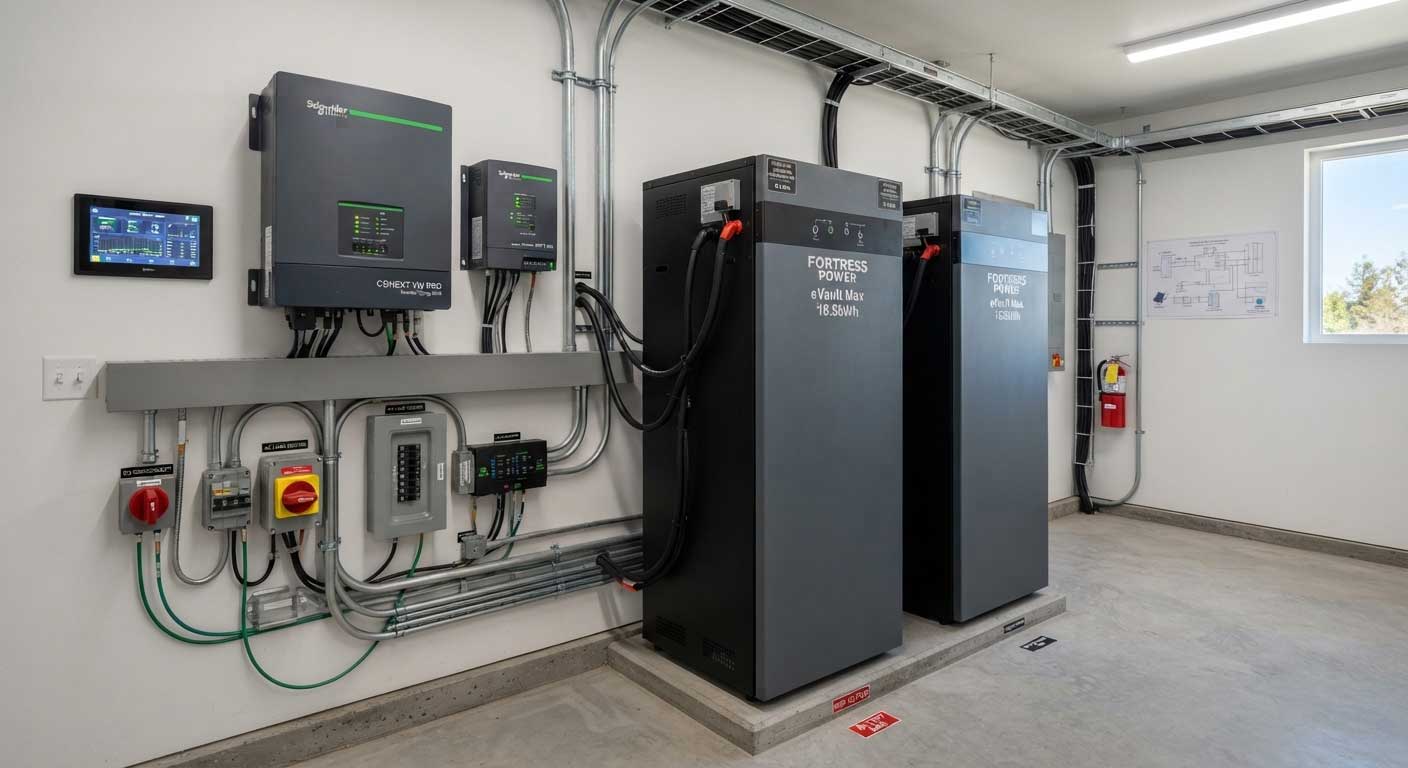
Solar Inverter: Converting Solar Energy Into Usable Power
The inverter converts DC electricity from solar panels and batteries into AC electricity used by most household appliances.
A properly selected inverter should match:
- System voltage
- Load requirements
- Peak power demand
Types of Solar Inverters
Pure Sine Wave Inverter
Pure sine wave inverters provide cleaner electricity and are suitable for sensitive devices such as:
- Computers
- Medical equipment
- Communication devices
Modified Sine Wave Inverter
These inverters are usually cheaper but may not work efficiently with some electronic equipment.
For reliable off-grid operation, pure sine wave inverters are generally recommended.
Mounting System and Solar Accessories
Although often overlooked, mounting structures and accessories affect the long-term reliability of an off-grid solar system.
Important components include:
- Solar mounting brackets
- Solar cables
- MC4 connectors
- Circuit breakers
- Fuses
- Monitoring devices
The mounting system should be selected according to the installation environment.
Examples:
Fixed Ground Installation
Suitable for:
- Farms
- Remote houses
- Large solar projects
Roof Installation
Suitable for:
- Homes
- Cabins
- Commercial buildings
Mobile Installation
Suitable for:
- RVs
- Boats
- Portable systems
Monitoring and Protection Equipment
Modern off-grid systems often include monitoring tools that help users understand system performance.
Monitoring systems can display:
- Solar generation
- Battery charging status
- Energy consumption
- System alerts
Protection equipment helps reduce risks caused by:
- Short circuits
- Overcurrent
- Voltage problems
- Electrical faults
A reliable off-grid system is not only about generating electricity but also about managing energy safely.
Off Grid Solar System vs Grid-Tied vs Hybrid Solar System
Before choosing a solar solution, it is important to understand the difference between off-grid, grid-tied, and hybrid systems.
Each type has different advantages depending on energy goals, location, and budget.
Off Grid Solar System
An off-grid solar system operates independently without connection to the utility grid.
Main features:
- Requires battery storage
- Provides complete energy independence
- Suitable for remote locations
Best for:
- Remote homes
- Cabins
- RVs
- Farms
- Emergency power systems
Advantages:
- No dependence on electricity providers
- Works in areas without grid access
- Provides backup during grid outages
Limitations:
- Higher upfront investment
- Requires careful system sizing
- Battery replacement costs
Grid-Tied Solar System
A grid-tied system connects directly to the utility network.
During sunny periods:
- Solar panels generate electricity
- Excess energy may be sent back to the grid
Advantages:
- Lower installation cost
- Simple design
- No large battery requirement
Limitations:
- Usually stops working during grid outages
- Depends on utility availability
Hybrid Solar System
A hybrid system combines grid connection with battery storage.
It provides:
- Solar energy generation
- Battery backup
- Grid support
Advantages:
- More flexible energy management
- Backup power capability
- Lower battery dependence compared with fully off-grid systems
Hybrid systems are popular for homeowners who want energy savings while maintaining backup capability.
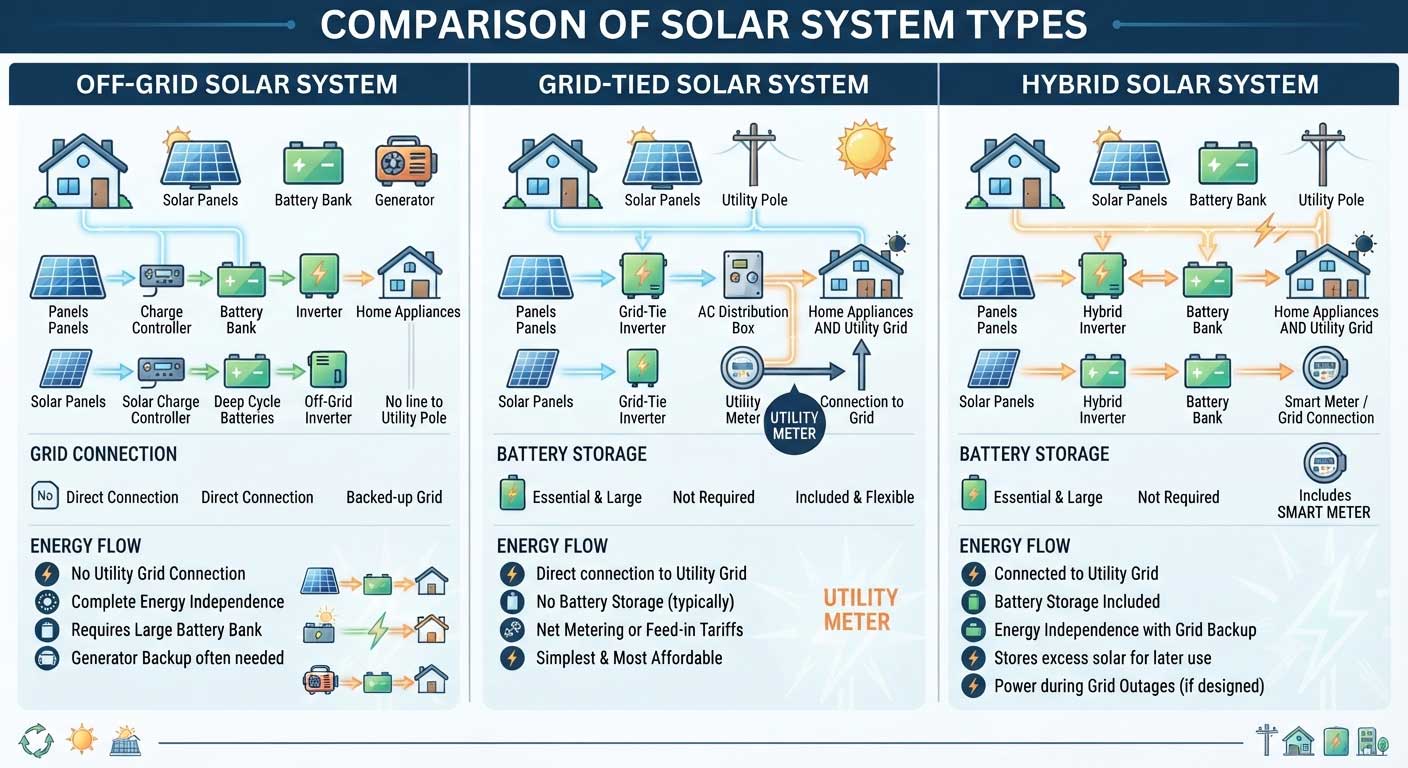
Comparison Table: Off Grid vs Grid-Tied vs Hybrid Solar Systems
| Feature | Off Grid Solar | Grid-Tied Solar | Hybrid Solar |
|---|---|---|---|
| Grid connection | No | Yes | Yes |
| Battery storage | Required | Optional | Required |
| Energy independence | Excellent | Limited | High |
| Backup power | Yes | Usually no | Yes |
| Installation cost | Higher | Lower | Medium |
| Best application | Remote areas | Connected homes | Homes needing backup |
How to Size an Off Grid Solar Power System
Correct system sizing is one of the most important steps when designing an off grid solar power system.
An incorrectly sized system may create problems such as:
- Insufficient power generation
- Battery shortages
- Higher operating costs
- Poor user experience
The goal is to balance:
Energy consumption + Solar generation + Battery storage
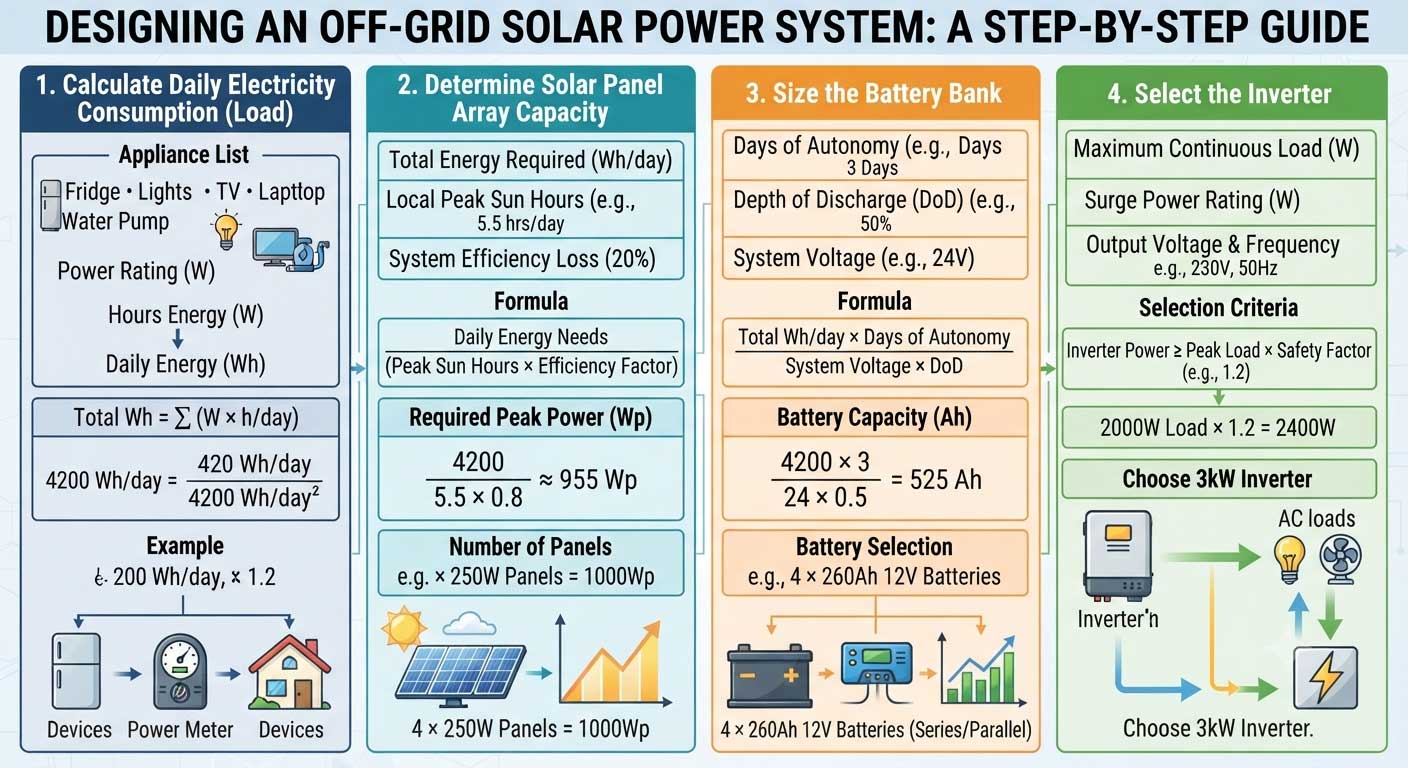
Step 1: Calculate Daily Energy Consumption
Start by listing all electrical devices and their usage.
Example:
| Device | Power | Daily Usage |
|---|---|---|
| LED lights | 40W | 5 hours |
| Refrigerator | 100W | 10 hours |
| Laptop | 60W | 4 hours |
| Water pump | 300W | 1 hour |
Calculate total daily energy consumption in watt-hours (Wh).
Formula:
Power (W) × Operating Time (hours) = Energy Consumption (Wh)
Step 2: Determine Solar Panel Capacity
Solar panel capacity depends on:
- Daily energy requirement
- Local sunlight hours
- System efficiency
Basic calculation:
Required Solar Power = Daily Energy Consumption ÷ Effective Sun Hours
Example:
If a system needs 5kWh per day and receives 5 hours of effective sunlight:
5,000Wh ÷ 5 hours = approximately 1,000W solar capacity
Additional capacity is usually recommended to compensate for:
- Weather changes
- System losses
- Seasonal variation
Step 3: Calculate Battery Capacity
Battery size depends on:
- Daily energy usage
- Required backup time
- Battery depth of discharge
A larger battery provides longer operation during:
- Cloudy days
- Rainy periods
- Higher energy demand
Lithium batteries are often preferred because they provide higher usable capacity compared with traditional lead-acid batteries.
Step 4: Select the Correct Inverter Size
The inverter should handle both:
- Continuous power demand
- Starting power requirements
Some appliances require higher startup power, including:
- Refrigerators
- Pumps
- Motors
- Air conditioners
Choosing an undersized inverter may cause system shutdowns or reduced performance.
A properly sized off-grid solar system provides better reliability, longer component life, and improved return on investment. Bright Solar recommends designing systems according to real energy consumption rather than selecting components based only on maximum available power.
How Many Solar Panels Are Needed for an Off Grid System?
The number of solar panels required for an off grid solar power system depends on several factors, including electricity consumption, available sunlight, panel wattage, and system efficiency.
There is no universal panel quantity that works for every project. A small cabin, an RV, and a full off-grid home have completely different energy requirements.
The correct approach is to calculate the daily energy demand first and then select enough solar capacity to meet that demand.
The basic calculation is:
Required Solar Panel Capacity = Daily Energy Consumption ÷ Available Sun Hours ÷ System Efficiency
For example:
If a home uses 6kWh of electricity per day and receives about 5 peak sunlight hours:
6,000Wh ÷ 5 hours = 1,200W
Considering system losses, a solar array around 1.5kW may be more suitable.
Small Off Grid Solar Systems (500W–2kW)
Small off-grid systems are designed for basic electricity needs.
Common applications:
- Small cabins
- Camping setups
- RVs
- Emergency backup systems
- Remote monitoring equipment
Typical appliances:
- LED lighting
- Mobile devices
- Small refrigerators
- Internet equipment
- Small water pumps
Example configuration:
- 500W–1000W solar panels
- 1–5kWh battery storage
- 1000W–2000W inverter
Flexible solar panels are often used in these applications because they reduce weight and simplify installation.
For RV owners, lightweight solar solutions can provide reliable energy without adding unnecessary load to the vehicle.
Medium Off Grid Solar Systems (3kW–8kW)
Medium-sized systems are commonly used for residential and agricultural applications.
Suitable for:
- Small houses
- Larger RVs
- Farms
- Remote workshops
They can support:
- Refrigerators
- Lighting systems
- Computers
- Kitchen appliances
- Water systems
Typical configuration:
- 3kW–8kW solar array
- 5–20kWh battery storage
- 3kW–8kW inverter
These systems require more detailed planning because daily energy consumption is usually higher and more variable.
Large Off Grid Solar Systems (10kW+)
Large off-grid systems are designed for high energy demand.
Applications include:
- Large homes
- Commercial buildings
- Remote industrial sites
- Agricultural operations
They may support:
- Multiple buildings
- Heavy equipment
- Water pumping systems
- Communication infrastructure
Large systems require professional design because factors such as battery management, electrical protection, and system expansion become more complex.
Factors That Affect Solar Panel Quantity
Several factors influence how many solar panels are needed.
Energy Consumption
The most important factor is how much electricity you use.
A system designed for:
- Basic lighting
will require much less solar capacity than one powering:
- Air conditioning
- Heating equipment
- Large appliances
Location and Sunlight Availability
Solar production varies by location.
Important factors include:
- Average sunlight hours
- Seasonal weather
- Cloud coverage
- Installation angle
A system installed in a sunny region may require fewer panels than one installed in an area with frequent cloudy weather.
Solar Panel Wattage
Modern solar panels come in different power ratings.
For example:
A 400W solar panel produces more energy than a 200W panel under the same conditions.
However, higher wattage is not always better because available installation space and system design also matter.
Battery Backup Requirements
A larger battery bank allows the system to operate longer without sunlight.
Users who need power during:
- Multiple cloudy days
- Winter seasons
- Extended outages
usually require larger battery capacity.
How Much Does an Off Grid Solar Power System Cost?
The cost of an off grid solar power system varies widely depending on system size, battery capacity, equipment quality, installation complexity, and location.
Unlike grid-tied solar systems, off-grid systems usually cost more upfront because they require battery storage and additional energy management equipment.
A typical off-grid system includes costs from:
- Solar panels
- Batteries
- Inverters
- Charge controllers
- Mounting hardware
- Wiring
- Installation labor
Average Cost Range of Off Grid Solar Systems
Small Off Grid Systems
Approximate range:
$1,500–$5,000
Suitable for:
- Camping
- RVs
- Small cabins
- Basic backup power
Typical equipment:
- Small solar array
- Portable or compact battery
- Basic inverter system
Medium Off Grid Systems
Approximate range:
$5,000–$20,000
Suitable for:
- Small homes
- Farms
- Larger RV systems
Includes:
- Larger solar array
- Lithium battery storage
- Higher-capacity inverter
Full Home Off Grid Solar Systems
Approximate range:
$20,000–$50,000+
Suitable for:
- Full-time off-grid living
- Large residential properties
- Remote buildings
The final cost depends heavily on:
- Electricity usage
- Battery requirements
- Installation conditions
- Local labor costs
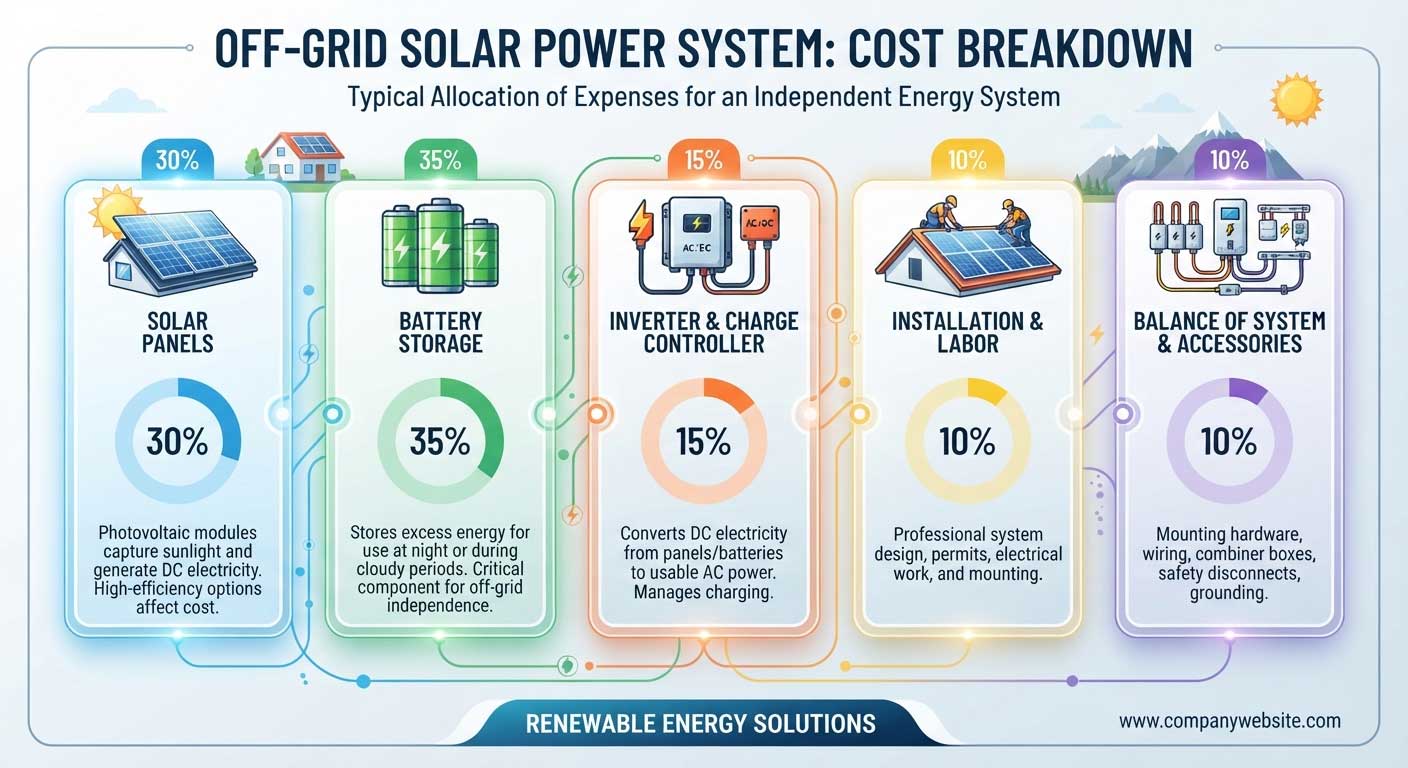
Off Grid Solar System Cost Breakdown
A typical cost structure includes:
| Component | Approximate Cost Share |
|---|---|
| Solar panels | 15–30% |
| Battery storage | 30–50% |
| Inverter and controller | 10–20% |
| Mounting and electrical equipment | 10–15% |
| Installation | 10–30% |
Battery storage is usually the largest expense because an off-grid system must store enough energy to operate when sunlight is unavailable.
Factors That Increase System Cost
Larger Energy Requirements
Higher electricity consumption requires:
- More solar panels
- Larger batteries
- Higher-capacity inverter
More Backup Days
A system designed to survive several cloudy days requires additional battery capacity.
For example:
A weekend cabin may need only limited storage, while a full-time off-grid home requires much more.
Harsh Installation Environments
Certain applications require additional protection.
Examples:
Marine systems need:
- Waterproof components
- Corrosion resistance
RV systems need:
- Vibration-resistant installation
- Lightweight components
Remote industrial systems may require:
- Advanced monitoring
- Heavy-duty equipment
Benefits of Off Grid Solar Power Systems
An off grid solar power system provides several advantages for users who want energy independence and reliable electricity without relying on traditional utility infrastructure.
1. Complete Energy Independence
The biggest advantage of an off-grid solar system is independence from the electricity grid.
Users can generate their own power through:
- Solar energy production
- Battery storage
- Smart energy management
This is especially valuable in remote areas where grid access is unavailable or expensive.
2. Power Availability in Remote Locations
Off-grid solar systems make electricity possible in locations where traditional power infrastructure is difficult to install.
Common examples:
- Mountain cabins
- Remote farms
- Islands
- Construction sites
- Outdoor facilities
Instead of extending power lines over long distances, solar systems can provide a local energy solution.
3. Reduced Long-Term Energy Costs
Although the initial investment is higher, an off-grid solar system can reduce dependence on purchased electricity.
After installation, sunlight becomes the primary energy source.
Long-term savings depend on:
- System size
- Local electricity prices
- Energy consumption habits
4. Reliable Backup Power
An off-grid solar system can continue providing electricity during:
- Grid failures
- Natural disasters
- Emergency situations
Battery storage allows important devices to keep operating when external power is unavailable.
5. Environmentally Friendly Energy
Solar energy produces electricity without direct carbon emissions.
Using an off-grid solar system can help reduce dependence on fossil fuels while supporting cleaner energy use.
6. Flexible Applications
One of the biggest advantages of off-grid solar technology is adaptability.
Systems can be customized for:
- Residential use
- Mobile applications
- Commercial projects
- Agricultural operations
Bright Solar provides flexible solar solutions designed for different off-grid applications, helping users build reliable renewable energy systems based on their specific requirements.
Challenges of Off Grid Solar Systems
Although off-grid solar systems offer energy independence, they also require careful planning.
Understanding the challenges helps users make better decisions before investing.
1. Higher Initial Investment
The upfront cost is usually higher compared with grid-connected solar.
The main reasons include:
- Battery storage requirements
- Additional control equipment
- Larger system design requirements
However, the investment provides long-term energy independence.
2. Requires Accurate System Design
An improperly designed system may cause:
- Battery shortages
- Insufficient electricity
- Reduced equipment lifespan
Accurate calculations are needed for:
- Solar capacity
- Battery size
- Inverter rating
3. Battery Maintenance and Replacement
Battery storage is one of the most important maintenance considerations.
Battery lifespan depends on:
- Battery chemistry
- Charging cycles
- Temperature
- Usage patterns
Modern lithium batteries generally offer longer service life compared with traditional lead-acid batteries.
4. Weather Dependence
Solar production depends on sunlight availability.
During:
- Long cloudy periods
- Winter seasons
- Heavy rain
solar generation may decrease.
A properly designed system compensates through:
- Larger solar capacity
- Adequate battery storage
- Efficient energy management
5. Requires Energy Management
Unlike grid electricity where power is always available, off-grid users need to manage consumption.
Good practices include:
- Using energy-efficient appliances
- Monitoring battery levels
- Prioritizing essential loads
A well-designed off-grid solar system balances energy generation, storage, and consumption. Bright Solar recommends evaluating real usage patterns before selecting equipment to ensure reliable performance throughout the year.
How to Install an Off Grid Solar Power System
Installing an off grid solar power system requires careful planning because the system must independently generate and store enough electricity to meet daily energy needs.
Unlike a simple solar panel installation, an off-grid system involves multiple components that must work together, including solar panels, batteries, charge controllers, inverters, and electrical protection devices.
A proper installation process includes:
- Energy assessment
- System design
- Solar panel installation
- Battery and inverter connection
- Electrical testing
- System monitoring
Step 1: Assess Energy Requirements
Before purchasing equipment, calculate how much electricity the system needs to provide.
Start by listing all appliances and devices, including:
- Power rating
- Daily operating hours
- Frequency of use
Typical loads may include:
- Lighting
- Refrigerators
- Computers
- Water pumps
- Communication equipment
- Home appliances
The goal is to understand daily energy consumption in kilowatt-hours (kWh).
A common mistake is designing a system based only on solar panel capacity while ignoring actual electricity usage.
A correctly sized system should balance:
Energy demand + Solar production + Battery storage
Step 2: Design the Solar System
After calculating energy requirements, select the appropriate system components.
The design should consider:
Solar Panel Capacity
The solar array must generate enough electricity to:
- Power daily loads
- Charge batteries
- Compensate for system losses
Battery Capacity
Battery storage should match:
- Daily energy consumption
- Required backup time
- Local weather conditions
For example, an off-grid home in an area with frequent cloudy days may require more battery capacity than a system installed in a consistently sunny location.
Inverter Size
The inverter should support:
- Normal operating loads
- Appliance startup power
Large appliances such as pumps, refrigerators, and air conditioners often require additional startup power.
Step 3: Install Solar Panels
The installation location has a direct impact on solar performance.
Before mounting solar panels, consider:
- Sun exposure
- Roof or ground conditions
- Installation angle
- Shading risks
Avoid locations affected by:
- Trees
- Buildings
- Other structures
Common Installation Locations
Rooftop Installation
Suitable for:
- Homes
- Cabins
- Buildings
Advantages:
- Uses existing space
- Reduces land requirements
Ground Installation
Suitable for:
- Farms
- Remote properties
- Large solar systems
Advantages:
- Easier maintenance
- Flexible positioning
Mobile Installation
Suitable for:
- RVs
- Boats
- Portable systems
Flexible solar panels are often preferred for mobile applications because they offer:
- Lower weight
- Easier installation
- Better compatibility with curved surfaces
Step 4: Install Battery Storage and Inverter
After solar panels are installed, connect the energy storage system.
A typical connection sequence is:
Solar Panels → Charge Controller → Battery Bank → Inverter → Electrical Loads
Important considerations:
- Correct cable sizing
- Proper polarity connection
- Battery ventilation requirements
- Electrical protection
Battery installation should follow manufacturer recommendations, especially for lithium battery systems.
Step 5: Test the System
Before using the system regularly, perform a complete inspection.
Check:
- Solar panel output voltage
- Battery charging status
- Inverter operation
- Protection devices
- Monitoring system
Testing helps identify problems before they affect daily operation.
Step 6: Monitor and Maintain the System
After installation, regular monitoring improves reliability.
Track:
- Solar production
- Battery level
- Energy consumption
- System warnings
Modern monitoring platforms allow users to understand how their system performs and adjust energy usage when necessary.
Best Applications for Off Grid Solar Power Systems
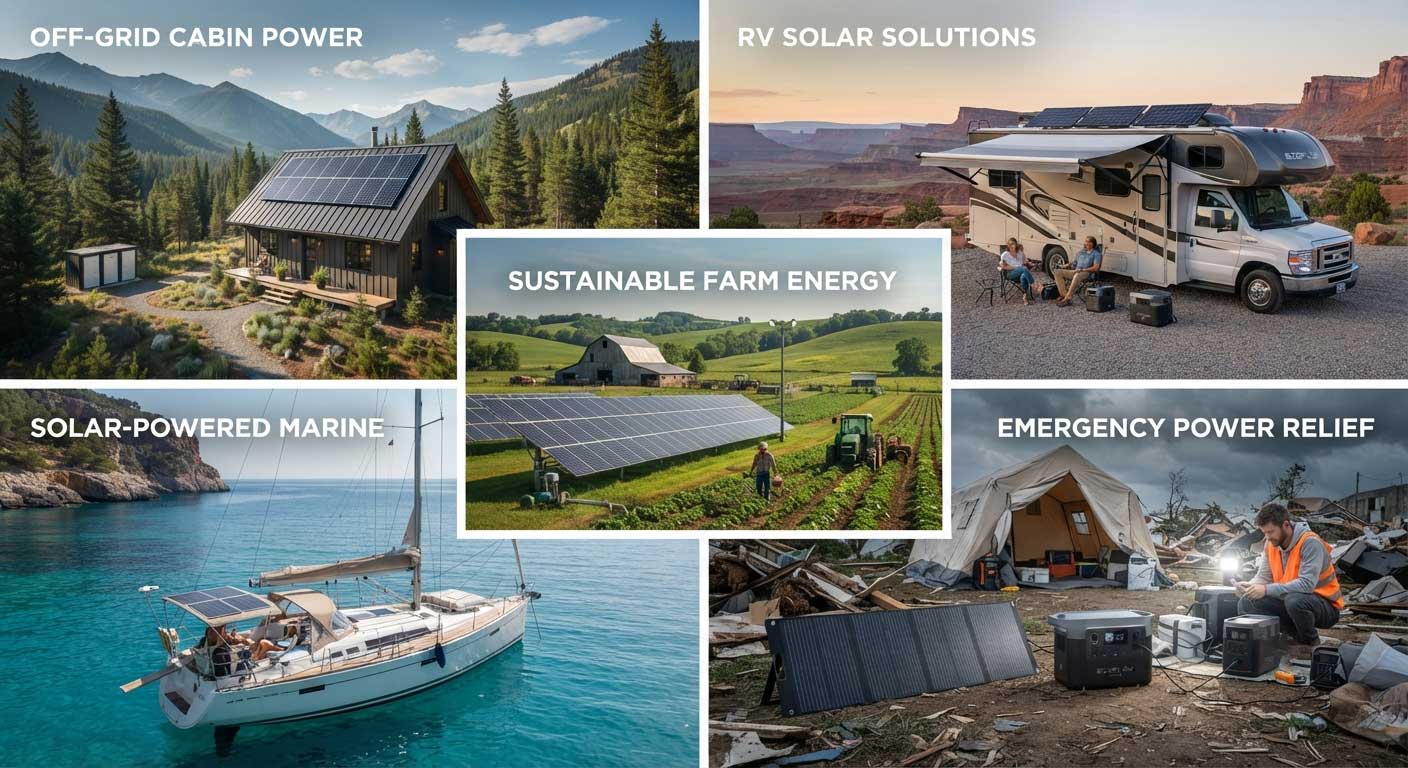
An off grid solar power system can be used in many situations where reliable electricity is required without access to traditional grid infrastructure.
The flexibility of solar technology makes it suitable for residential, mobile, commercial, and emergency applications.
Off Grid Homes
Off-grid homes are one of the most common applications.
They are especially suitable for:
- Rural properties
- Mountain cabins
- Remote houses
- Vacation homes
A properly designed system can provide power for:
- Lighting
- Kitchen appliances
- Heating and cooling equipment
- Internet systems
- Water pumps
Many homeowners choose off-grid solar because extending utility lines to remote locations can be expensive and time-consuming.
RV and Camper Solar Systems
RV owners often use off-grid solar systems to achieve energy independence while traveling.
Advantages include:
- No need for campground electricity
- Quiet operation
- Lower fuel consumption
- Flexible installation options
Flexible solar panels are particularly suitable for RV applications because they are:
- Lightweight
- Space-saving
- Easy to mount on curved roofs
Bright Solar offers flexible solar solutions designed for mobile applications where traditional solar panels may not be practical.
Remote Farms and Agricultural Projects
Agricultural operations often require electricity in areas far from utility infrastructure.
Solar systems can power:
- Irrigation pumps
- Livestock monitoring systems
- Security equipment
- Greenhouses
- Storage facilities
Off-grid solar helps reduce dependence on fuel generators and provides a cleaner energy alternative.
Marine Applications
Boats and marine equipment frequently require independent power systems.
Off-grid solar systems can support:
- Navigation equipment
- Communication devices
- Refrigeration systems
- Lighting
Marine installations require special attention to:
- Waterproof protection
- Corrosion resistance
- Secure mounting
Emergency and Backup Power Systems
Off-grid solar technology is also used for emergency power applications.
Examples include:
- Disaster response equipment
- Remote communication systems
- Medical equipment backup
- Temporary power stations
Battery storage allows these systems to provide electricity even when traditional power sources fail.
How Long Does an Off Grid Solar System Last?
The lifespan of an off grid solar power system depends on the quality of components, installation method, environment, and maintenance.
A well-designed system can provide reliable energy for many years, but different components have different service lives.
Solar Panels
High-quality solar panels typically last:
25 years or more
Performance gradually decreases over time, but panels can continue producing electricity beyond their expected lifespan.
Factors affecting panel life include:
- Material quality
- UV exposure
- Weather conditions
- Installation quality
Batteries
Battery lifespan depends on battery technology.
Typical ranges:
Lithium Iron Phosphate Batteries
Approximately:
8–15 years
Advantages:
- High cycle life
- Better efficiency
- Lower maintenance
Lead-Acid Batteries
Approximately:
3–7 years
They may require more frequent replacement due to lower cycle durability.
Solar Inverters
Most solar inverters typically last:
10–15 years
Their lifespan depends on:
- Operating temperature
- Load conditions
- Installation environment
Factors That Improve System Lifespan
A longer-lasting off-grid solar system requires:
- Proper system sizing
- Quality components
- Correct installation
- Regular inspections
- Good battery management
At Bright Solar, we focus on reliable solar designs that consider real-world conditions, helping customers achieve stable performance throughout the system lifecycle.
How to Choose the Best Off Grid Solar Power System
Selecting the right off grid solar power system depends on your energy needs, location, budget, and future expansion plans.
The best system is not always the largest one. It is the system that matches your actual requirements.
1. Calculate Your Energy Needs
Before choosing equipment, understand:
- Daily electricity consumption
- Peak power demand
- Essential appliances
This prevents overspending on unnecessary capacity or experiencing power shortages.
2. Select Reliable Solar Panels
Important factors include:
- Efficiency
- Durability
- Weather resistance
- Installation requirements
For mobile and curved surfaces, flexible solar panels may provide better installation flexibility.
3. Choose the Right Battery Technology
Battery selection affects:
- System cost
- Backup time
- Long-term reliability
For many modern applications, lithium batteries provide advantages in:
- Weight
- Efficiency
- Lifespan
4. Consider Future Expansion
A good solar system design should allow future upgrades.
Consider:
- Additional solar panels
- Larger battery capacity
- Increased electricity demand
Planning ahead reduces future modification costs.
5. Work With an Experienced Solar Provider
Professional guidance helps avoid:
- Incorrect sizing
- Component mismatch
- Installation problems
A manufacturer with practical application experience can provide better recommendations based on real operating conditions.
Common Off Grid Solar System Mistakes
Although an off grid solar power system can provide reliable and independent electricity, poor planning or incorrect installation can reduce performance and increase long-term costs.
Many system problems are not caused by solar technology itself but by incorrect sizing, unsuitable components, or improper installation practices.
Understanding common mistakes can help users build a more efficient and reliable solar solution.
1. Choosing the Wrong System Size
One of the most common mistakes is selecting a solar system based only on available budget or panel wattage instead of actual energy requirements.
An undersized system may cause:
- Frequent battery shortages
- Insufficient power supply
- Reduced user experience
An oversized system may result in:
- Unnecessary investment
- Unused capacity
- Higher upfront costs
The correct approach is to calculate:
- Daily energy consumption
- Peak power demand
- Required backup time
A balanced system design ensures better performance and cost efficiency.
2. Underestimating Battery Capacity
Battery storage is critical in an off-grid system because it provides electricity when solar energy is unavailable.
A common mistake is choosing a battery that is too small.
Insufficient battery capacity may cause:
- Power interruptions at night
- Reduced battery lifespan
- Poor system reliability
When selecting batteries, consider:
- Daily energy usage
- Number of backup days required
- Battery depth of discharge
- Local weather conditions
For many modern off-grid applications, LiFePO4 batteries are preferred because they offer longer cycle life and higher usable capacity.
3. Installing Solar Panels in Poor Locations
Solar panels require sufficient sunlight exposure to operate efficiently.
Common installation problems include:
- Excessive shading
- Incorrect orientation
- Poor tilt angle
- Obstructions from trees or buildings
Even high-quality solar panels cannot perform well if the installation location receives limited sunlight.
Before installation, evaluate:
- Sun path throughout the day
- Seasonal changes
- Surrounding structures
4. Using Low-Quality Components
An off-grid solar system is a long-term investment.
Choosing low-cost components without considering quality may lead to:
- Lower efficiency
- More maintenance
- Shorter service life
Important components requiring quality consideration include:
- Solar panels
- Batteries
- Inverters
- Charge controllers
- Electrical connectors
A reliable system should prioritize overall performance rather than only the lowest initial price.
5. Ignoring Cable and Electrical Protection
Many installation issues come from overlooking electrical details.
Incorrect cable selection can cause:
- Energy losses
- Overheating
- Reduced efficiency
Proper systems should include:
- Correct cable sizing
- Fuses
- Circuit breakers
- Surge protection
- Proper grounding
Safety is especially important for larger residential and commercial off-grid systems.
6. Not Planning for Future Energy Needs
Energy consumption often increases over time.
For example, users may later add:
- More appliances
- Additional lighting
- Electric vehicles
- Larger equipment
A good off-grid solar design should consider future expansion.
Planning for upgrades may include:
- Expandable battery storage
- Additional solar panel capacity
- Modular inverter systems
7. Lack of Regular Maintenance
Although solar systems require less maintenance than traditional generators, they still need periodic checks.
Recommended maintenance includes:
- Cleaning solar panels
- Checking electrical connections
- Monitoring battery performance
- Inspecting cables and mounting structures
Regular maintenance helps maintain efficiency and extends system lifespan.
FAQ About Off Grid Solar Power Systems
What is an off grid solar power system?
An off grid solar power system is an independent solar energy solution that generates electricity using solar panels and stores energy in batteries without connecting to the utility grid.
It is commonly used for remote homes, RVs, farms, cabins, and locations where grid electricity is unavailable.
Can an off-grid solar system power a house?
Yes, an off-grid solar system can power an entire house when it is correctly designed.
The system size depends on:
- Household electricity consumption
- Solar resources
- Battery capacity
- Appliance requirements
A properly sized system can support:
- Lighting
- Refrigerators
- Internet equipment
- Kitchen appliances
- Heating and cooling systems
How many solar panels do I need for an off-grid home?
The number of solar panels depends on daily electricity usage and local sunlight conditions.
For example:
- Small cabins may require several hundred watts to a few kilowatts
- Full homes may require several kilowatts or more
The correct calculation should consider:
- Daily kWh consumption
- Solar hours
- Panel efficiency
- Battery requirements
How long can an off-grid solar battery last?
Battery lifespan depends on the battery type and usage conditions.
Typical lifespan:
- LiFePO4 batteries: around 8–15 years
- Lead-acid batteries: around 3–7 years
Factors affecting battery life include:
- Charging cycles
- Temperature
- Depth of discharge
- Maintenance
Is an off-grid solar system worth it?
An off-grid solar system can be a valuable investment for users who need energy independence or live in areas without reliable grid access.
It is especially suitable for:
- Remote properties
- RV travelers
- Farms
- Emergency applications
However, users should evaluate:
- Energy requirements
- Installation costs
- Long-term maintenance
before choosing a system.
Can flexible solar panels be used for off-grid systems?
Yes, flexible solar panels can be used in many off-grid applications.
They are especially useful for:
- RVs
- Boats
- Portable solar systems
- Curved surfaces
Their lightweight design and installation flexibility make them an excellent option when traditional rigid panels are difficult to install.
Bright Solar provides flexible solar panel solutions designed for mobile and off-grid applications where weight, durability, and installation convenience are important.
What maintenance does an off-grid solar system need?
Maintenance requirements are relatively low but should not be ignored.
Regular tasks include:
- Cleaning solar panels
- Checking cable connections
- Monitoring battery condition
- Inspecting mounting systems
Proper maintenance helps maintain system efficiency and extends component lifespan.
Conclusion: Building a Reliable Off Grid Solar Power System
An off grid solar power system provides a practical way to achieve energy independence by combining solar panels, battery storage, and intelligent power management.
Unlike traditional electricity solutions, off-grid systems allow users to generate and manage their own power in locations where grid access is limited or unavailable.
A successful system depends on several key factors:
- Accurate energy calculation
- Proper solar panel selection
- Suitable battery capacity
- Reliable inverter performance
- Professional installation
- Regular system monitoring
Whether the application is a remote home, RV, farm, marine project, or emergency power solution, choosing the right components is essential for long-term reliability.
With the development of high-efficiency solar technology, off-grid energy systems are becoming more accessible and practical. Bright Solar focuses on providing flexible and reliable solar solutions that help customers build efficient renewable energy systems for different environments and applications.
By designing the system around real energy needs instead of simply selecting the largest equipment, users can achieve better performance, longer service life, and greater energy independence.
Related recommendations
-

12 Volt Solar Panel: How to Choose the Right System for Reliable Off-Grid Power
210Discover how to choose the right 12 volt solar panel for RVs, boats, cabins, and battery charging. Learn sizing, performance, installation tips, and real-world applications from Bright Solar.
View details -
Bifacial Flexible Solar Panel: Design, Performance, and Applications
198A bifacial flexible solar panel generates power from both sides when rear-side light is available. Its value depends on clearance, reflectivity, curvature, t...
View details -
USB Solar Panel Flexible: Portable Solar Charging Solution for Outdoor Power Needs
185USB solar panel flexible provides lightweight portable charging for camping, hiking, and emergency power. Explore Bright Solar technology, performance, and real outdoor applications.
View details -
Qcells to Expand Solar Panel Manufacturing in Dalton, Zodiac
301Qcells PV module manufacturing in Dalton, Zodiac, with a new 3.1 GW solar panel facility, increasing flexible solar panel production, strengthening the U.S. solar supply chain, and creating new clean energy manufacturing jobs.
View details