How to Wire Solar Panels in Series?
How to Wire Solar Panels in Series?
To wire solar panels in series, connect the positive (+) terminal of one solar panel to the negative (-) terminal of the next panel. This increases the total system voltage while keeping the current (amps) the same, making series wiring ideal for many MPPT charge controller and off-grid solar applications.
The first solar system I wired in series wasn’t on an RV or a cabin.
It was on a remote irrigation pump in western Texas.
Three 100W panels.
One MPPT controller.
Nearly 200 feet of cable between the array and the equipment shed.
At first glance, parallel wiring seemed simpler.
Then we ran the voltage-drop calculations.
Series wiring reduced cable losses dramatically and allowed the system to perform far better than expected.
That project taught me something I still explain to customers today:
Series wiring isn’t just about connecting panels.
It’s about improving system efficiency under the right conditions.
What Does Wiring Solar Panels in Series Mean?
A series connection creates a chain.
The positive output from one panel connects to the negative input of the next.
Electricity flows through the entire string before reaching the charge controller.
Think of batteries in a flashlight.
Each battery adds voltage.
Solar panels behave similarly.
Basic Series Connection Example
Panel 1 (+) → Panel 2 (-)
Panel 2 (+) → Panel 3 (-)
Panel 3 (+) → Charge Controller Positive
Panel 1 (-) → Charge Controller Negative
The voltage adds together.
The current remains unchanged.
Example:
| Panel Specification | Single Panel | Three Panels in Series |
|---|---|---|
| Voltage (Voc) | 22V | 66V |
| Current (Imp) | 5A | 5A |
| Power | 110W | 330W |
This is the core reason series wiring is popular in RV, marine, and off-grid systems.
Why Many Installers Prefer Series Wiring
After reviewing hundreds of customer projects at Bright Solar, I’ve noticed experienced installers often default to series wiring whenever the equipment allows it.
The reason is simple.
Higher voltage usually means lower transmission losses.
According to the U.S. Department of Energy, electrical losses in conductors increase as current increases, making higher-voltage systems advantageous for reducing wiring losses.
Source:
https://www.energy.gov
That benefit becomes especially noticeable when:
- Cable runs are long
- Solar arrays are distant from batteries
- RV roofs have limited wiring space
- Off-grid systems require efficient energy transfer
One customer with a motorhome gained nearly 7% more usable charging performance simply by reconfiguring his panels from parallel to series and upgrading to an MPPT controller.
The panels never changed.
The wiring did.
Before Wiring Solar Panels in Series
This step gets skipped far too often.
Not all solar panels should be mixed together.
Ideally, every panel in a series string should have:
- Identical wattage
- Identical voltage
- Identical current rating
- Similar age
- Same manufacturer
Mismatched panels can reduce overall performance.
The weakest panel effectively limits the entire string.
Check Your Charge Controller First
Before connecting anything, verify:
- Maximum PV voltage rating
- Maximum input current
- MPPT compatibility
Many modern MPPT controllers are specifically designed to take advantage of higher-voltage series arrays.
According to the National Renewable Energy Laboratory (NREL), MPPT technology can significantly improve energy harvest compared with simpler controller designs under varying operating conditions.
Source:
https://www.nrel.gov
Step-by-Step: How to Wire Solar Panels in Series
The physical wiring process is surprisingly simple.
Step 1: Turn Off System Components
Disconnect:
- Charge controller
- Inverter
- Battery bank
Safety comes first.
Never work on live circuits when possible.
Step 2: Identify Positive and Negative Leads
Most solar panels use MC4 connectors.
Typically:
- Male MC4 = Positive
- Female MC4 = Negative
Always verify manufacturer markings.
Step 3: Connect Panels Together
For two panels:
Panel 1 Positive → Panel 2 Negative
Remaining free leads become the array output.
For three or more panels:
Continue the chain.
Positive to negative.
Positive to negative.
Positive to negative.
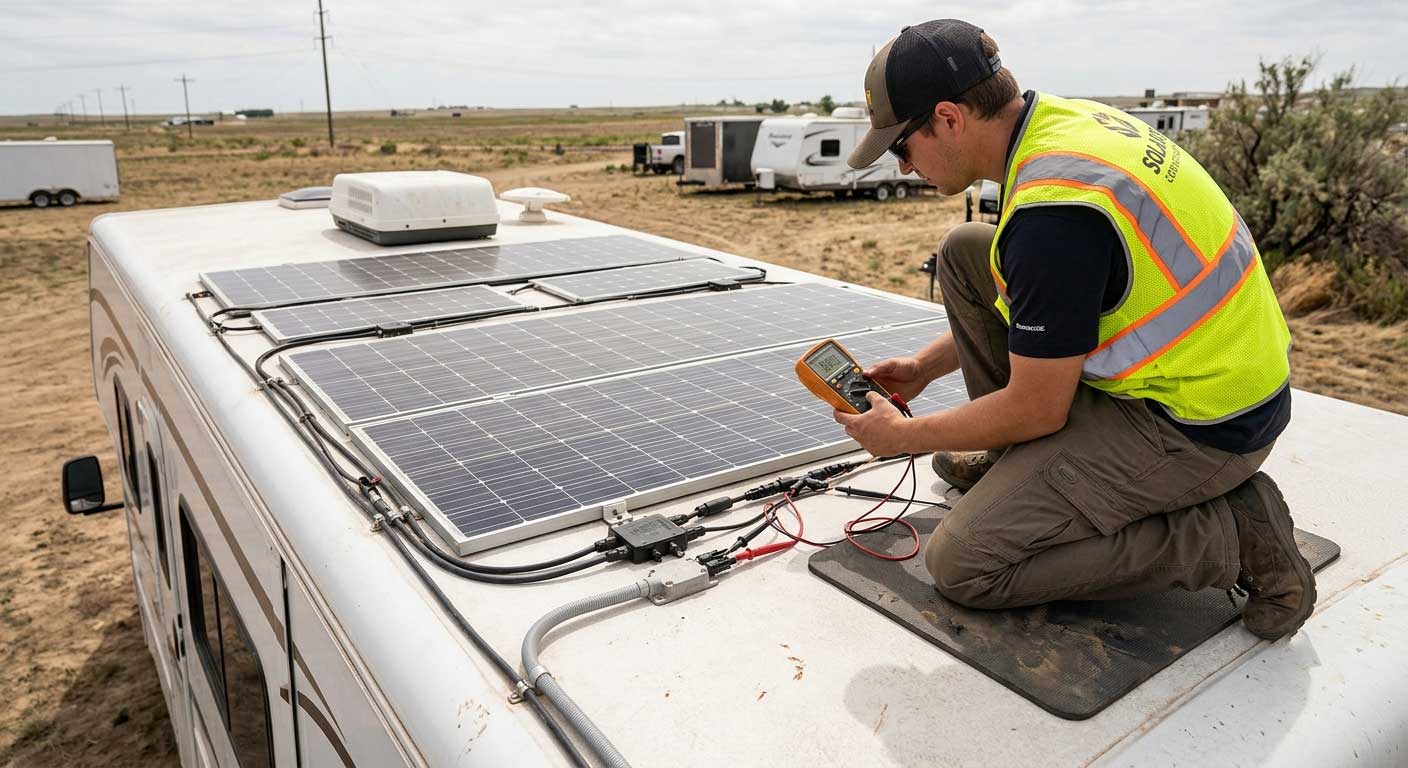
Step 4: Measure Voltage
Before connecting to the controller:
Use a multimeter.
Verify expected voltage.
Example:
Three 22V panels ≈ 66V open-circuit voltage.
Small variations are normal.
Step 5: Connect to MPPT Controller
Once voltage is verified:
- Array Positive → Controller PV Positive
- Array Negative → Controller PV Negative
Only then reconnect batteries and system components.
Common Mistakes I See in the Field
The mistakes are rarely complicated.
They’re usually rushed.
Exceeding Controller Voltage Limits
One customer connected four high-voltage panels to a controller rated for only 100V.
Cold weather pushed array voltage beyond the limit.
The controller failed.
Voltage calculations matter.
Mixing Different Panels
Different voltage ratings create imbalance.
Performance suffers.
Ignoring Shade
Series strings are sensitive to shading.
If one panel becomes shaded, the output of the entire string may be reduced.
The International Energy Agency (IEA) notes that shading remains one of the most significant factors affecting photovoltaic system performance.
Source:
https://www.iea.org
Series vs Parallel Wiring
Many customers ask which method is better.
The answer depends on the application.
| Factor | Series Wiring | Parallel Wiring |
|---|---|---|
| Voltage | Higher | Same |
| Current | Same | Higher |
| Cable Losses | Lower | Higher |
| Shade Tolerance | Lower | Better |
| MPPT Compatibility | Excellent | Good |
| Long Cable Runs | Excellent | Fair |
For RVs, boats, and off-grid systems using MPPT controllers, series wiring is often preferred.
For partially shaded environments, parallel wiring may offer advantages.
Real-World Example
A recent Bright Solar customer installed:
- Four 200W flexible solar panels
- One 40A MPPT controller
- 24V lithium battery bank
Originally, he planned parallel wiring.
The roof-to-controller distance exceeded 25 feet.
After calculating voltage drop, we recommended a series configuration.
The result:
- Smaller cable requirements
- Reduced transmission losses
- Cleaner installation
- Improved charging performance
The panels generated the same sunlight.
The wiring simply delivered energy more efficiently.
FAQ About How to Wire Solar Panels in Series?
How to wire solar panels in series safely?
Turn off all equipment, connect positive to negative between panels, verify voltage with a multimeter, and confirm the charge controller can handle the combined voltage.
What happens when solar panels are wired in series?
The voltages add together while current remains the same.
Is series wiring better than parallel?
Neither is universally better. Series wiring excels in high-voltage MPPT systems, while parallel wiring performs better when partial shading is common.
Can I wire different solar panels in series?
It is possible but generally not recommended because mismatched electrical characteristics reduce performance.
How many solar panels can be wired in series?
The number depends on the maximum voltage rating of your charge controller and system design.
Final Thoughts
Understanding how to wire solar panels in series is less complicated than many first-time installers expect. Connect positive to negative between panels, verify voltage carefully, and ensure your charge controller supports the resulting array voltage. When designed correctly, a series configuration can reduce wiring losses, improve charging efficiency, and create a cleaner, more effective solar power system for RVs, boats, cabins, and off-grid applications.
The prev: How Hot Do Flexible Solar Panels Get?The next: How Long Does a Flexible Solar Panel Last?
Related recommendations
-

How much electricity does one solar panel produce?
202How much electricity does one solar panel produce? Learn daily output, wattage calculations, energy factors, and real solar production examples.
View details -
How to Mount Solar Panels on Roof?
185Learn how to mount solar panels on roof safely with proper solar panel roof mounts, rails, and installation methods for reliable home solar power systems.
View details -
do solar panels damage roof?
198do solar panels damage roof? Learn how solar installations affect roofing, prevent leaks, protect shingles, and understand professional mounting practices.
View details -
How Much Does It Cost to Get Solar Panels?
184How much does it cost to get solar panels? Explore real installation costs, system sizes, incentives, and long-term savings with expert insights from Bright Solar.
View details