How to Install Flexible Solar Panels to Rubber RV Roof?
How to Install Flexible Solar Panels to Rubber RV Roof?
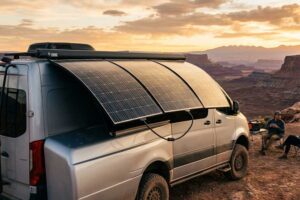
To install flexible solar panels to a rubber RV roof, thoroughly clean the membrane surface, position the panel away from roof obstructions, use a compatible adhesive approved for EPDM or TPO roofing, route cables through waterproof glands, and connect the system to a charge controller and battery bank. Proper surface preparation is often more important than the adhesive itself.
Several years ago, I inspected an RV that had traveled nearly 40,000 miles across the western United States. The owner proudly showed me his solar setup.
The panels looked great from a distance.
Up close, the edges were beginning to peel away from the roof.
The surprising part?
The adhesive wasn’t defective.
The installer had bonded the panels directly over a layer of oxidation and roof treatment residue.
The panels never had a chance to form a proper bond.
That experience reinforced something I still tell customers today: flexible solar panels usually fail at the installation stage long before they fail electrically.Learn more about “Flexible Solar Panel Installation Guide“
Why Rubber RV Roofs Require a Different Installation Approach
Many RV roofs use either:
- EPDM rubber roofing
- TPO roofing membranes
- Hybrid synthetic roofing materials
Unlike aluminum roofs or fiberglass roofs, rubber roofs expand and contract more dramatically with changing temperatures.
That movement matters.
A summer afternoon in Arizona can push roof temperatures beyond 150°F (65°C). Overnight temperatures may drop by more than 50°F (10°C).
The roof moves.
The solar panel moves.
The adhesive must accommodate both.
According to the U.S. Department of Energy, rooftop solar installations are subjected to significant thermal cycling throughout their service life, making material compatibility a critical design factor.
Source:
This is why installing flexible solar panels on a rubber RV roof isn’t simply a matter of sticking them down and hoping for the best.
Understanding Your Roof Material First
Before purchasing adhesives or mounting supplies, identify your roofing material.
I’ve seen many installations where owners skipped this step entirely.
Common Rubber Roof Types
| Roof Material | Common on RVs | Compatible with Adhesive Mounting |
|---|---|---|
| EPDM | Very Common | Yes |
| TPO | Very Common | Yes |
| Fiberglass | Common | Yes |
| Aluminum | Less Common | Yes |
The installation process is similar across these surfaces, but adhesive compatibility can vary.
Always verify the adhesive manufacturer’s recommendations before installation.
Planning the Solar Layout
This is where most experienced installers spend their time.
Not wiring.
Not mounting.
Planning.
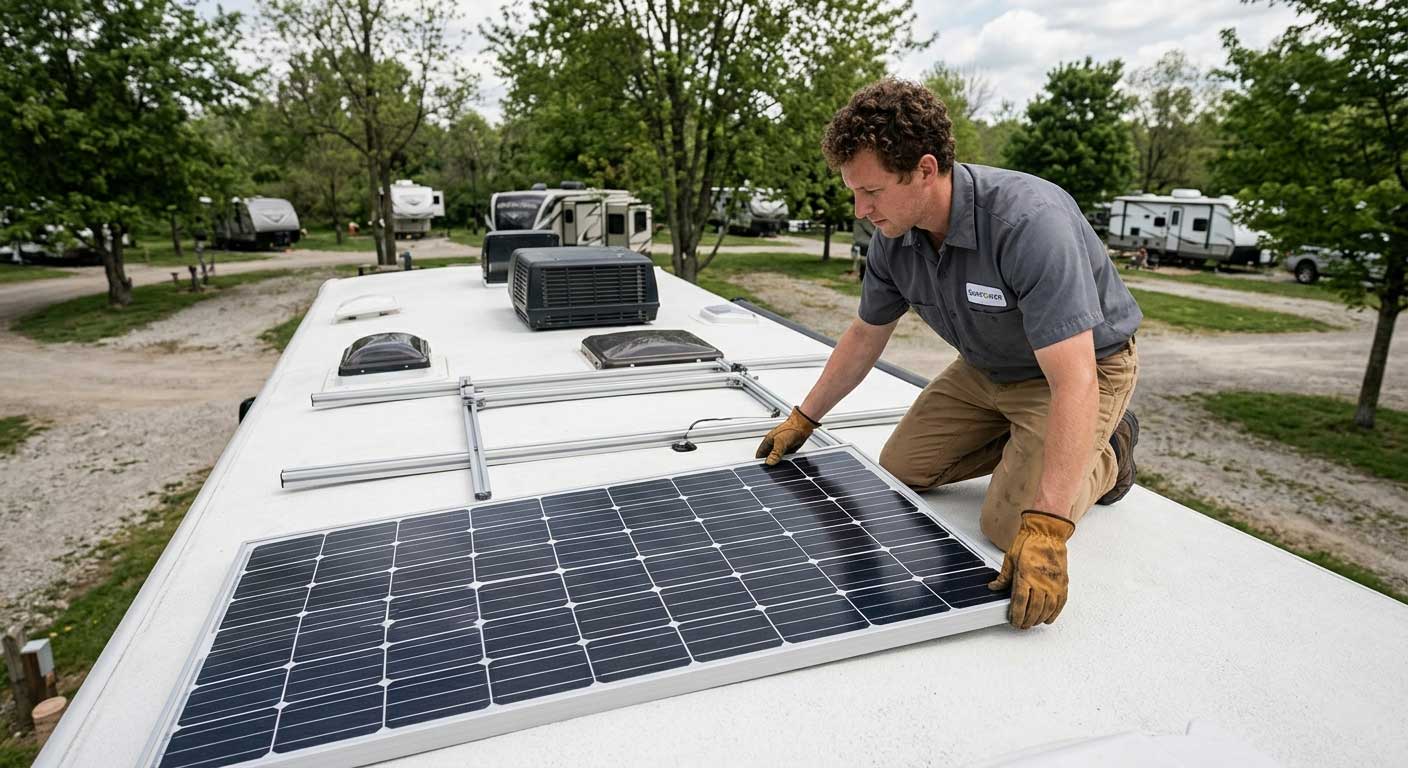
Avoid Roof Shadows
Inspect the roof carefully.
Potential shade sources include:
- Air conditioners
- Roof vents
- Skylights
- Satellite dishes
- Roof racks
According to research published by the National Renewable Energy Laboratory (NREL), even partial shading can significantly reduce photovoltaic performance.
Source:
One RV I worked on lost nearly a quarter of its daily energy production because a vent cover shaded part of a panel during morning hours.
The owner initially blamed the batteries.
The batteries were fine.
Think About Future Maintenance
Leave room around:
- Roof vents
- Air conditioner shrouds
- Inspection points
- Cable entries
Solar panels should never make roof maintenance impossible.
Tools and Materials I Actually Use
Over time my installation kit has become surprisingly simple.
| Tool or Material | Purpose |
|---|---|
| Flexible Solar Panel | Power generation |
| MPPT Controller | Charging optimization |
| MC4 Connectors | Waterproof connections |
| Roof Entry Gland | Cable penetration |
| Isopropyl Alcohol | Surface preparation |
| Soft Scrub Pads | Cleaning roof membrane |
| Structural Adhesive | Panel bonding |
| Multimeter | Testing system output |
The least expensive item on this list is often the most important.
Cleaning supplies.
How to Install Flexible Solar Panels to Rubber RV Roof
Step 1: Deep Clean the Roof Surface
This is where many installations succeed or fail.
Remove:
- Dirt
- Road grime
- Wax residue
- Roof protectants
- Oxidation
Wash the roof thoroughly.
Then wipe the installation area using isopropyl alcohol.
Allow it to dry completely.
I’ve seen installers rush this step.
Months later, they’re reinstalling panels.
Step 2: Test Fit the Panel
Place the panel on the roof before applying adhesive.
Check:
- Sun exposure
- Roof obstructions
- Cable routing
- Future service access
Then step away for a few minutes.
Come back and review the layout again.
I still do this on every project.
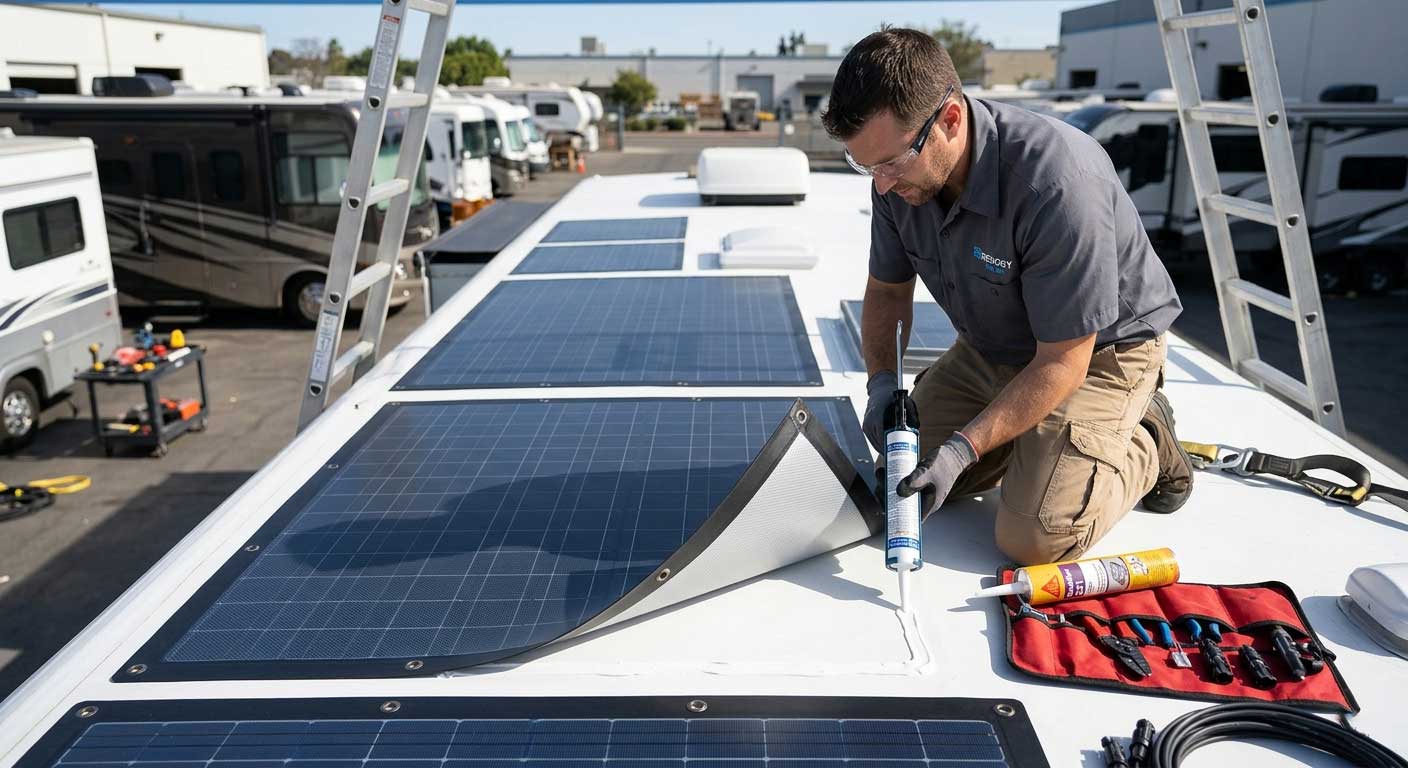
Step 3: Apply Compatible Adhesive
Not every adhesive works well on rubber roofing.
Use products specifically approved for EPDM or TPO compatibility.
Apply adhesive evenly.
Avoid excessive buildup.
Large adhesive pockets can trap heat and create uneven support.
Step 4: Secure and Cure
After positioning the panel:
- Apply uniform pressure
- Verify full contact
- Follow manufacturer curing times
- Avoid driving immediately if possible
Many bonding failures occur because panels were subjected to highway speeds before the adhesive fully cured.
Step 5: Route the Wiring
Install waterproof cable entry glands.
Protect wiring from:
- UV exposure
- Abrasion
- Standing water
Water intrusion is far more expensive to repair than solar wiring.
The Most Common Mistakes I See
Some installation errors appear repeatedly.
Installing Over Dirty Roof Membranes
This remains the number one problem.
The adhesive bonds to dirt instead of the roof.
Eventually the panel lifts.
Ignoring Heat Expansion
Rubber roofs move.
Flexible panels move.
Good installations account for both.
Using Construction Adhesive from Hardware Stores
I’ve inspected installations where general-purpose construction adhesives softened during summer heat.
Solar installations require products designed for exterior environmental exposure.
Heat Management Matters More Than Most People Realize
Flexible solar panels naturally operate at elevated temperatures.
In summer testing, I’ve recorded panel temperatures exceeding 160°F (71°C) on dark-colored RV roofs parked in direct sunlight.
That sounds alarming.
It’s actually fairly normal.
According to NREL, photovoltaic efficiency generally decreases as module temperatures rise above standard test conditions.
Source:
What matters is minimizing excessive heat buildup.
Practical strategies include:
- Avoid overcrowding panels
- Avoid blocked airflow zones
- Use high-quality ETFE-coated modules
- Maintain clean panel surfaces
Real-World Results from Proper Installation
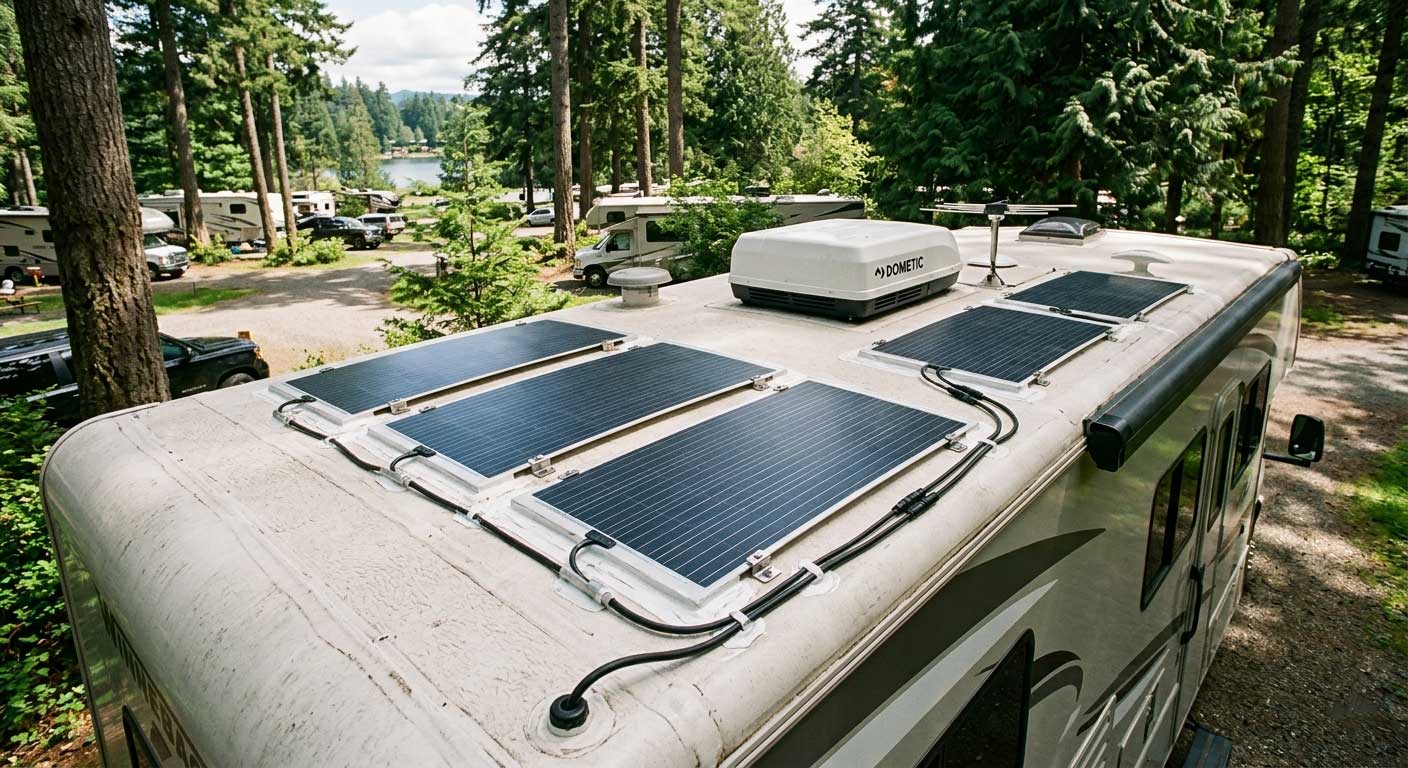
One Bright Solar customer installed three flexible panels on a fifth-wheel trailer that regularly travels between Colorado and Florida.
After four years:
- No panel lifting
- No water intrusion
- Stable energy production
- Minimal maintenance
The difference wasn’t luck.
It was preparation.
Most successful installations share that same characteristic.
FAQ:How to Install Flexible Solar Panels to Rubber RV Roof?
Can flexible solar panels be glued directly to a rubber RV roof?
Yes. Most flexible solar panels can be bonded directly to EPDM or TPO roofing when compatible adhesives and proper surface preparation are used.
What adhesive works best for rubber RV roofs?
Marine-grade or roofing-compatible structural adhesives approved for EPDM and TPO surfaces are generally preferred.
Do I need to drill holes in the roof?
Usually only for cable entry. Waterproof cable glands help protect against leaks.
Can flexible solar panels damage a rubber roof?
When properly installed, they should not damage the roof. Problems usually arise from incompatible adhesives or poor installation practices.
How long will flexible solar panels stay attached?
A properly installed panel using compatible materials can remain securely bonded for many years under normal RV operating conditions.
Visit the product page:Flexible Solar Panel
Final Thoughts
Anyone researching how to install flexible solar panels to rubber RV roof should focus less on adhesives and more on preparation. In my experience, successful installations begin with careful cleaning, thoughtful panel placement, compatible materials, and patience during curing. The solar panel itself is only part of the system. The quality of the installation ultimately determines whether that system performs reliably for years of travel ahead.
Related recommendations
-

What Direction Should Solar Panels Face?
201Discover what direction should solar panels face for maximum energy output. Learn the best orientation, optimal angle, and installation tips from Bright Solar.
View details -
What can 100 watt solar panel run?
271What can 100 watt solar panel run? Discover real examples, power calculations, and practical applications for RV, camping, battery charging, and off-grid systems with Bright Solar.
View details -
How Long Do Flexible Solar Panels Last?
353How long do flexible solar panels last in real outdoor use? Learn the true lifespan, degradation rates, maintenance tips, and durability facts from Bright Solar.
View details -
Do I Need to Clean My Solar Panels?
225Yes, solar panels sometimes need cleaning, but frequent washing is rarely necessary. Inspect for buildup and clean when deposits remain or performance change...
View details