How to Attach Flexible Solar Panel to Van Roof?
How to Attach Flexible Solar Panel to Van Roof?
A flexible solar panel can be attached to a van roof using industrial adhesive, VHB tape, or low-profile mounting hardware. Proper airflow, roof preparation, and waterproof cable routing matter more than the actual sticking method if you want the panel to last beyond a few summers.
I learned that the hard way in Arizona.
Back in 2023, I helped retrofit a Mercedes Sprinter camper for a couple traveling through Nevada and Utah. The flexible panel itself survived. The adhesive did not. After six months of heat cycling, the center section started bubbling because the installer bonded the panel directly onto bare painted metal with almost no ventilation gap.
That failure taught me something important: flexible solar panels are lightweight, but they are not “install and forget” products.
According to the U.S. Department of Energy, solar module efficiency and lifespan are heavily affected by operating temperature. Heat buildup accelerates degradation in both cells and adhesives.
Source:
https://www.energy.gov/eere/solar/solar-photovoltaic-cell-basics
So if you’re asking how to attach flexible solar panel to van roof properly, the answer is not just “use glue.” The real answer involves airflow, surface prep, cable protection, and realistic expectations.
Why Flexible Solar Panels Are Popular for Vans
Van owners choose flexible panels for one reason first: weight.
Traditional framed solar modules can weigh 18–26 lbs each. A flexible panel of similar output often weighs below 6 lbs. On curved van roofs, that changes everything.
For stealth campers and compact vans, flexible panels also sit lower to the roof, reducing wind drag and visual attention.
Common Vehicles Using Flexible Panels
- Mercedes Sprinter
- Ford Transit
- Ram ProMaster
- VW Transporter
- Camper trailers
- Off-grid expedition vans
Another advantage is simplified installation. You usually do not need aluminum roof racks unless the system is large.
But there’s a tradeoff.
Flexible panels generally run hotter than rigid framed modules because airflow underneath is limited. Higher temperature means faster efficiency loss over time.
The National Renewable Energy Laboratory (NREL) notes that solar panel efficiency typically decreases as cell temperature rises.
Source:
https://www.nrel.gov
The Best Ways to Attach Flexible Solar Panel to Van Roof
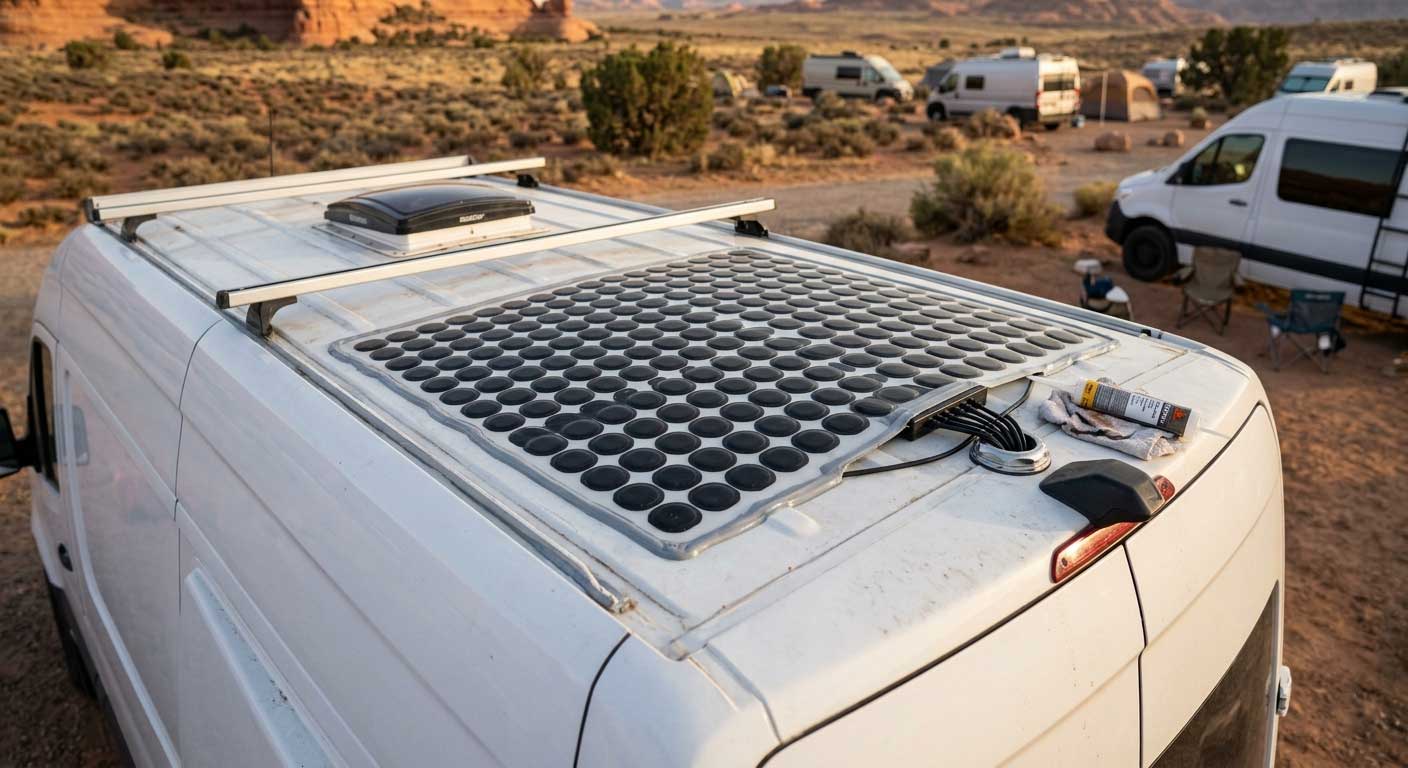
There are three methods most installers use.
| Method | Strength | Roof Damage Risk | Recommended |
|---|---|---|---|
| VHB Tape | High | Low | Yes |
| Polyurethane Adhesive | Very High | Low | Yes |
| Screws & Brackets | Extremely High | Medium | Sometimes |
Personally, I avoid screws unless the van already has roof rails.
Every hole in a van roof becomes a future leak risk if the sealing ages badly.
Real Installation Approaches for Vans, RVs, and Mobile Roof Systems
Mounting Flexible Solar Panels on Different Vehicle Roof Types
When discussing mounting flexible solar panels, many people assume the process is identical across every vehicle. It isn’t.
A flat service van, a curved camper roof, and a fiberglass RV roof all behave differently once temperatures start changing throughout the day.
At Bright Solar, we’ve worked with customers using:
- flexible solar panels for van roof applications
- installing flexible solar panels on RV roof projects
- fitting flexible solar panels to caravan roof conversions
- compact expedition vehicles
- mobile work trailers
The attachment method often depends less on the panel itself and more on the roof construction underneath.
For example, a fiberglass roof can expand differently than painted steel. An adhesive that performs perfectly on one vehicle may experience additional stress on another after years of thermal cycling.
Attaching Flexible Solar Panels to Van Roof and RV Roof Surfaces
One thing I noticed after several mobile solar installations is that people focus heavily on the panel while ignoring the roof.
In reality, attaching flexible solar panels to van roof surfaces starts with understanding how the roof moves. Driving vibration, temperature swings, and vehicle flex all influence long-term reliability.
The same principle applies when attaching flexible solar panels to RV roof structures.
Some owners attempt full-surface bonding. Others create small airflow channels beneath the module. In hotter regions, that ventilation gap often helps preserve both panel efficiency and adhesive performance.
When fixing solar panel to van roof structures, I generally prefer solutions that balance holding strength with future serviceability. A solar installation should survive years of travel, but maintenance access should not become impossible.
Flexible Solar Panel Van Roof Designs That Last Longer
The best flexible solar panel van roof installations are rarely the most complicated.
A typical setup may include:
- quality ETFE flexible modules
- UV-resistant adhesive systems
- waterproof cable glands
- protected wiring routes
- sufficient airflow where possible
Many successful van flexible solar panel systems follow surprisingly simple layouts. Clean cable management and proper roof preparation often contribute more to longevity than expensive accessories.
One customer drove his camper throughout the Southwest for nearly four years with a single flexible solar panel on van roof installation. The panel remained functional because attention was paid to airflow and sealing from the beginning.
Solar Panels for Van Roof Applications: Practical Considerations
When choosing solar panels for van roof installations, available space usually becomes the first limitation.
Roof vents, air conditioners, antennas, and storage boxes often reduce usable mounting area. That is why some builders choose flexible modules instead of traditional van roof mounted solar panels.
For smaller vehicles, a compact solar panel for van roof top setup may be sufficient to support lighting, communication devices, battery charging, and refrigeration.
I have also seen successful systems using multiple solar panels for top of van layouts where owners wanted additional energy production without increasing roof height significantly.
The common goal remains the same: reliable power without turning the vehicle into a rolling solar rack.
Fitting Flexible Solar Panels for Mobile Off-Grid Systems
Whether someone is fitting flexible solar panels, fitting solar panel to van roof, or fitting flexible solar panels to van roof during a DIY build, patience matters more than speed.
Rushed installations often create problems later:
- trapped moisture
- poor cable routing
- uneven adhesive contact
- excessive heat buildup
The same lessons apply when installing flexible solar panels on van projects intended for long-term travel.
A few additional hours spent on preparation can prevent years of frustration.
Beyond Vans: Flexible Solar Panel on Car Roof Applications
Although less common, some users install a flexible solar panel on car roof systems for auxiliary battery charging, overlanding setups, emergency communication equipment, or lightweight recreational applications.
In these cases, the challenge is usually available surface area rather than mounting difficulty.
Smaller roofs produce less power, but flexible technology makes installation possible where traditional framed modules would simply be impractical.
Sticking Solar Panel to Van Roof: The Most Common DIY Approach
Today, sticking solar panel to van roof surfaces with high-quality adhesive systems has become one of the most common installation methods among DIY van builders.
The appeal is obvious:
- no roof penetrations
- lower profile appearance
- reduced wind resistance
- simplified installation
However, the success of solar panels on top of van projects depends heavily on preparation quality. Even the best adhesive cannot compensate for contamination, trapped moisture, or poor surface cleaning.
That is why Bright Solar always recommends treating roof preparation as seriously as panel selection itself. In mobile solar systems, the installation method often determines whether the system performs well for two years or ten.
Surface Preparation Matters More Than Glue
This is where many DIY installations fail.
A flexible solar panel is only as secure as the surface underneath it.
Proper Roof Preparation Checklist
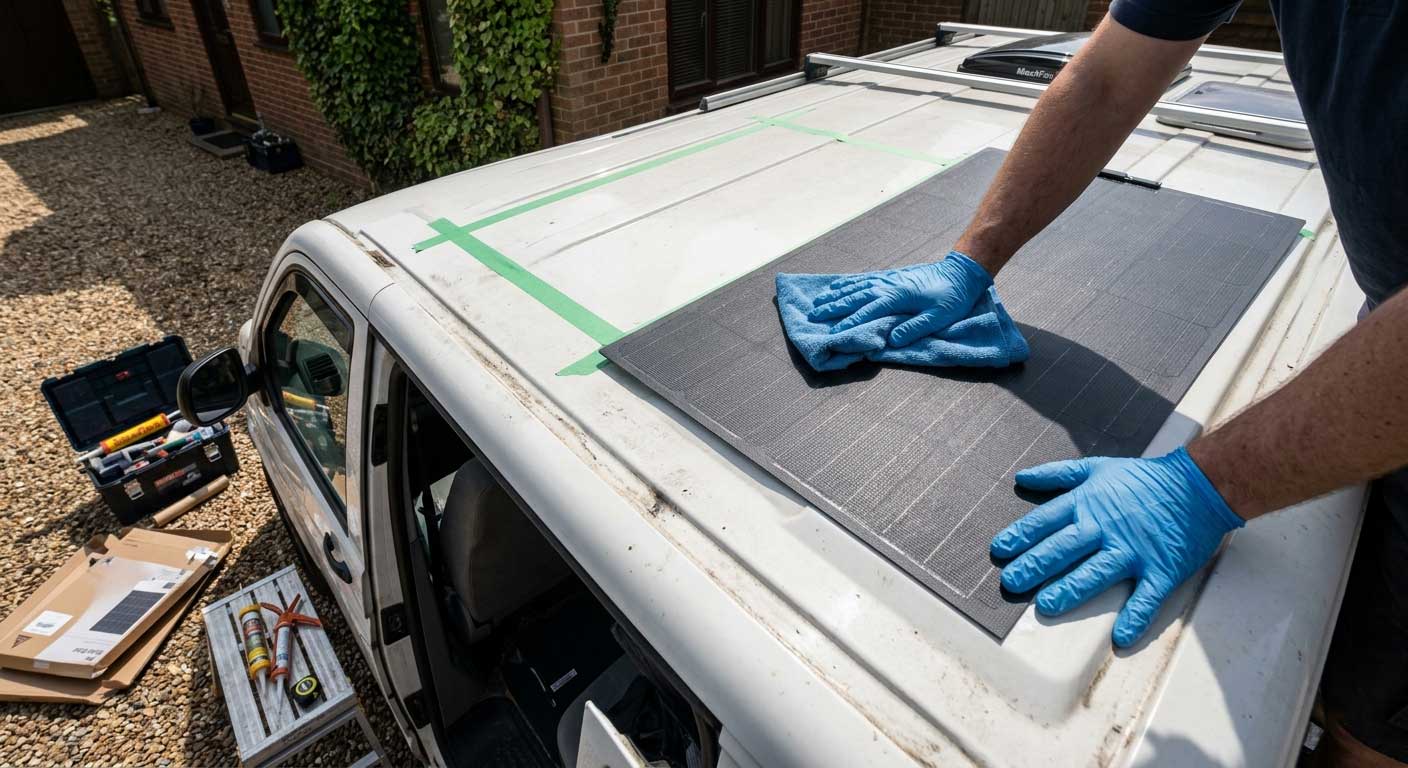
Before attaching the panel:
- Wash the roof thoroughly
- Remove wax or silicone residue
- Degrease using isopropyl alcohol
- Dry completely
- Test-fit panel alignment first
I usually let the roof sit dry for 30–40 minutes before bonding anything. Humidity trapped under adhesive becomes a long-term problem later.
On older vans, oxidized paint should be lightly scuffed before adhesive application.
Should You Leave an Air Gap Under Flexible Solar Panels?
Yes. Absolutely.
This is one of the biggest differences between professional installs and rushed installs.
A panel glued completely flush to metal can trap enormous heat.
In summer testing on dark van roofs, I’ve measured surface temperatures exceeding 70°C (158°F). At that temperature:
- adhesive softens faster
- output drops
- laminate layers age quicker
Recommended Airflow Gap
A small airflow channel of even 10–20 mm helps.
Some installers use:
- corrugated plastic backing
- spacer strips
- marine mounting pads
- aluminum composite sheets
That tiny ventilation space dramatically improves cooling.
Best Adhesive for Flexible Solar Panels on Vans
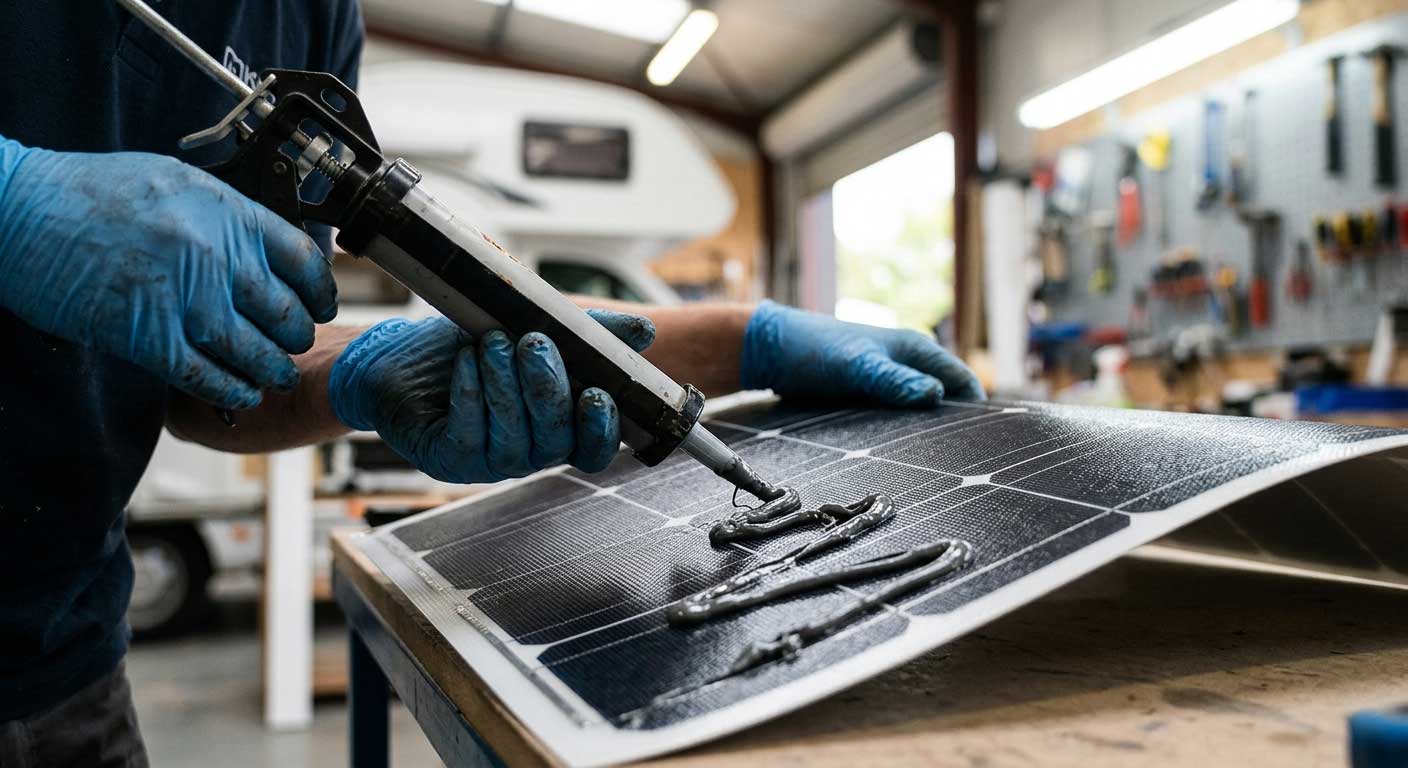
After testing multiple products, polyurethane marine adhesive consistently performs best for mobile applications.
Commonly Used Adhesives
| Adhesive Type | Typical Use |
|---|---|
| Sikaflex 252 | RV & marine bonding |
| 3M VHB Tape | Fast low-profile mounting |
| Dicor Lap Sealant | Waterproof roof sealing |
| Sikaflex 221 | Flexible weatherproof seal |
Avoid cheap hardware-store silicone.
Silicone becomes brittle after prolonged UV exposure and vibration.
Van roofs flex constantly while driving. The adhesive needs elasticity, not just strength.
Wiring Flexible Solar Panels on a Van Roof
Most failures I see are not panel failures.
They are wiring failures.
Critical Wiring Mistakes to Avoid
- exposed roof cable holes
- undersized wire gauge
- no fuse protection
- unsupported MC4 connectors
- sharp metal edge contact
Use waterproof cable glands whenever possible.
For small van systems:
| Panel Wattage | Recommended Wire |
|---|---|
| 100W | 10 AWG |
| 200W | 10 AWG |
| 300W+ | 8 AWG |
The Solar Energy Industries Association (SEIA) recommends proper overcurrent protection and outdoor-rated wiring for mobile solar systems.
Source:
https://www.seia.org
How Long Will a Flexible Solar Panel Last on a Van?
Realistically?
Usually 5–10 years under mobile outdoor use.
Some premium ETFE-coated models last longer, especially with airflow underneath.
What Reduces Lifespan Fastest
- constant overheating
- poor adhesive bonding
- roof flex vibration
- standing water
- cheap laminate materials
In contrast, rigid framed panels often exceed 20 years because they dissipate heat better.
That does not mean flexible panels are bad. They simply prioritize lightweight portability over maximum lifespan.
Real-World Installation Insight From Van Builds
One thing I’ve noticed after multiple van projects: curved roofs behave differently in different climates.
In humid coastal regions, trapped moisture becomes the main enemy.
In desert climates, heat expansion becomes the issue.
A van parked in direct sun all day can experience massive thermal cycling between morning and night. That expansion gradually stresses adhesives and cable seals.
That’s why the best installations are slightly overbuilt.
A little extra airflow. Better sealant. Thicker wiring. Cleaner routing.
Those details are boring until the first storm arrives.
FAQ:How to Attach Flexible Solar Panel to Van Roof?
H3: Can I glue flexible solar panels directly to my van roof?
Yes, but direct full-surface bonding without airflow can increase heat buildup and reduce lifespan.
Do flexible solar panels fly off while driving?
Not if properly mounted with high-quality adhesive and surface preparation.
Is drilling holes necessary?
Usually no. Many van owners use adhesive-only mounting systems successfully.
What roof types work best?
Aluminum, fiberglass, and painted steel roofs work well when cleaned correctly.
Are flexible solar panels waterproof?
Most quality models are weather-resistant and rated for outdoor use, but cable entry points still require waterproof sealing.
Final Thoughts on How to Attach Flexible Solar Panel to Van Roof
The safest installation is not always the fastest one.
If you prepare the roof properly, leave room for cooling, and use quality adhesive materials, a flexible solar panel can survive years of highway vibration, rain, and heat without issue.
That’s ultimately the difference between a weekend DIY setup and a system still producing power five summers later.
And when people ask me whether flexible solar panels are worth using on vans, my answer is usually simple:
For lightweight mobile setups, yes — if they’re installed with patience instead of shortcuts.
Related recommendations
-

What Is IRC Certificate for Solar Panels?
94An IRC reference for solar panels concerns residential building-code compliance, not a standalone solar product certification.
View details -
How Much Is a Portable Solar Panel?
265How much is a portable solar panel in 2026? Discover real pricing, wattage costs, durability, and buying tips from field-tested portable solar experts at Bright Solar.
View details -
How Much Are Solar Panels for My House?
141How much are solar panels for my house? Discover real 2026 installation costs, pricing by home size, expert insights, and practical ways to estimate your residential solar investment with Bright Solar.
View details -
How Solar Energy Is Converted Into Electricity?
197How solar energy is converted into electricity? Learn how solar cells generate power, the photovoltaic process, and expert solar insights from Bright Solar.
View details