
How Solar Panels Manufactured?
How Solar Panels Manufactured?
Solar panels are manufactured through a multi-stage process that transforms raw silicon into photovoltaic cells, assembles them into modules, and tests them for electrical performance, durability, and safety. The production process includes silicon purification, wafer cutting, cell processing, module assembly, and quality inspection.
When customers visit Bright Solar and ask how solar panels are manufactured, they often imagine a simple assembly line where cells are placed under glass. In reality, producing a reliable photovoltaic module requires highly controlled material processing, precision equipment, and multiple inspection stages.
After working with solar equipment suppliers and reviewing manufacturing processes for photovoltaic projects, our engineering team has found that the quality differences between panels often begin long before installation. The manufacturing decisions made during silicon processing, cell production, and module assembly directly influence long-term energy output.
A solar panel is not simply a collection of cells. It is an engineered electrical product designed to operate outdoors for 25 years or longer.Visit the product page: Flexible Solar Panel
What Materials Are Used to Manufacture Solar Panels?
Modern solar panels are mainly made from semiconductor materials, protective layers, and electrical components.
The primary materials include:
| Component | Main Material | Purpose |
|---|---|---|
| Solar cells | Crystalline silicon | Converts sunlight into electricity |
| Front glass | Tempered solar glass | Protects cells from weather impact |
| Encapsulant | EVA or POE film | Seals and protects cells |
| Back sheet | Polymer composite | Electrical insulation and protection |
| Frame | Aluminum alloy | Provides structural support |
| Junction box | Electrical components | Transfers generated power |
The most common technology used today is crystalline silicon photovoltaic technology, including:
- Monocrystalline silicon.
- Polycrystalline silicon.
- TOPCon cells.
- Heterojunction (HJT) cells.
According to the International Energy Agency (IEA), crystalline silicon technologies represent the dominant share of global photovoltaic module production due to their combination of efficiency, reliability, and manufacturing scalability.
Reference:
https://www.iea.org/topics/solar-pv
How Solar Panels Manufactured: Step-by-Step Process
1. Silicon Purification and Ingot Production
The manufacturing process begins with raw quartz sand, which contains silicon dioxide.
However, solar-grade silicon requires extremely high purity.
The basic process includes:
- Extracting silicon from quartz.
- Purifying the material through chemical processes.
- Melting purified silicon.
- Growing silicon crystals into large cylindrical ingots.
For photovoltaic applications, silicon purity is typically around 99.9999%, allowing the material to function effectively as a semiconductor.
The quality of the silicon crystal structure affects how efficiently electrons move when sunlight strikes the solar cell.
This early stage is where many performance characteristics are established.
2. Cutting Silicon Ingots Into Wafers
After silicon ingots are produced, specialized wire saws cut them into extremely thin wafers.
A typical wafer manufacturing process includes:
- Precision cutting.
- Surface cleaning.
- Damage removal.
- Texturing preparation.
Modern solar wafers are usually around 150–200 micrometers thick, although manufacturers continue developing thinner wafer technologies to reduce material consumption.
The wafer surface is carefully textured because microscopic patterns improve light absorption and reduce reflection.
A small difference in surface quality can influence the final efficiency of the solar cell.
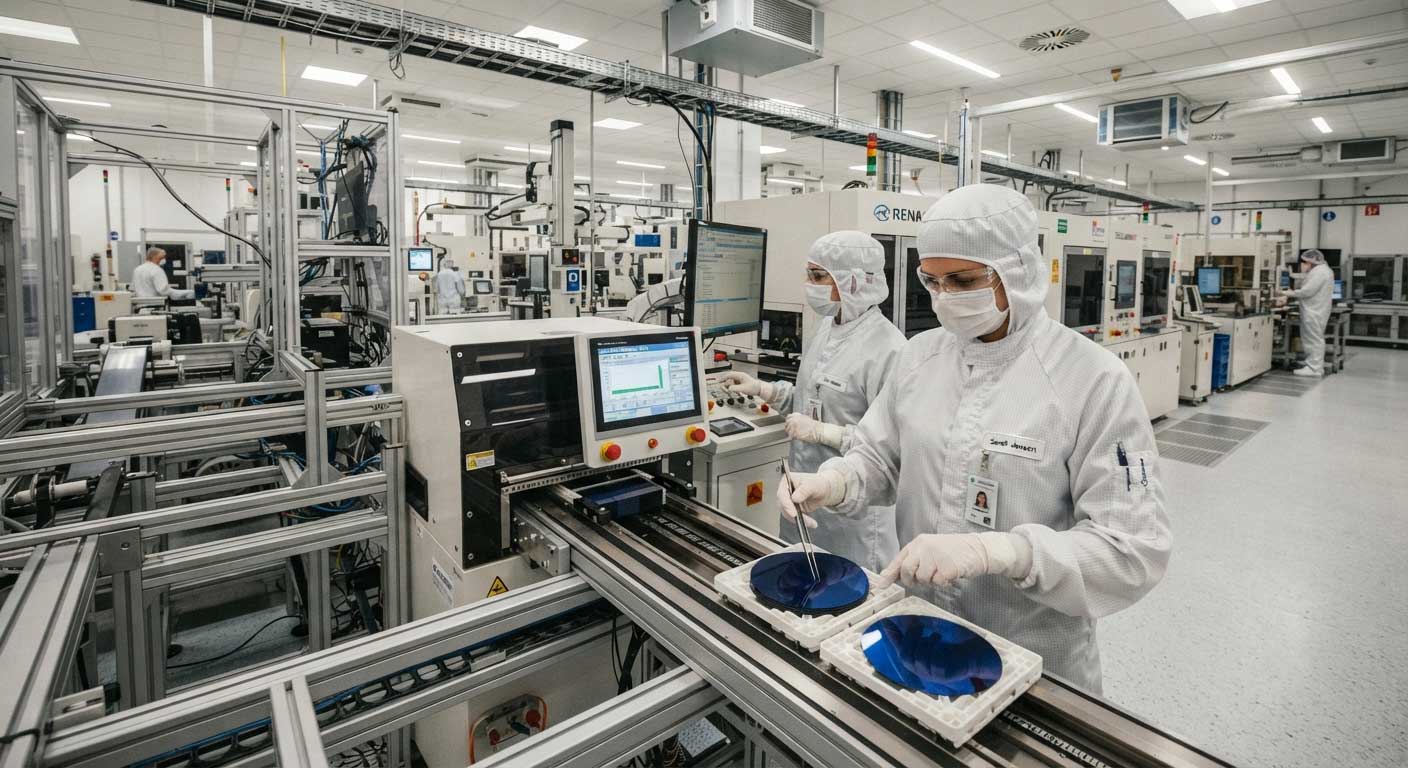
How Silicon Wafers Become Solar Cells
3. Creating the Photovoltaic Cell
The silicon wafer itself cannot generate electricity immediately. It must be processed into a photovoltaic cell.
During this stage, manufacturers create the electrical properties needed to convert sunlight into usable energy.
The main steps include:
Surface Treatment
The wafer surface is cleaned and textured to improve light absorption.
Doping Process
Small amounts of specific elements are introduced into silicon to create positive and negative electrical layers.
This creates the p-n junction, which is essential for photovoltaic operation.
Anti-Reflection Coating
A coating layer is applied to reduce sunlight reflection and increase energy absorption.
Metal Contact Printing
Fine conductive lines are printed onto the cell surface to collect generated electrical current.
According to the National Renewable Energy Laboratory (NREL), improvements in photovoltaic cell design, including advanced contact structures and passivation technologies, have played an important role in increasing commercial solar efficiency.
Reference:
How Solar Cells Are Tested Before Module Assembly
Before individual cells become solar panels, manufacturers perform electrical testing.
Typical inspections include:
| Test | Purpose |
|---|---|
| Electroluminescence testing | Detects hidden cracks and defects |
| Efficiency testing | Measures electrical performance |
| Visual inspection | Checks physical quality |
| Current-voltage testing | Confirms output characteristics |
Electroluminescence imaging is especially important because tiny internal cracks may not be visible during normal inspection but can affect long-term reliability.
At Bright Solar, we consider manufacturing quality data an important factor when evaluating module suppliers because field performance depends heavily on production consistency.
4. Connecting Solar Cells Into Strings
Individual solar cells produce limited voltage, so manufacturers connect multiple cells together.
The process involves:
- Arranging cells into rows.
- Soldering electrical connections.
- Creating cell strings.
- Inspecting connections.
A typical residential solar module may contain:
- 60 cells.
- 72 cells.
- 108 half-cut cells.
- 120 half-cut cells.
Half-cut cell technology has become common because it reduces electrical losses and improves performance under partial shading conditions.
How Solar Modules Are Assembled After Cell Production
After individual solar cells pass electrical inspection, they move into the module assembly stage. This is where separate photovoltaic cells become the finished solar panels installed on rooftops, commercial buildings, and solar farms.
The assembly process usually includes:
- Cell string arrangement.
- Electrical connection.
- Layer stacking.
- Vacuum lamination.
- Frame installation.
- Junction box attachment.
- Final performance testing.
Each layer has a specific function. The goal is not only to generate electricity but also to protect delicate semiconductor materials from decades of exposure to sunlight, moisture, temperature changes, and mechanical stress.
5. Solar Cell Interconnection and Layout
Solar cells are connected together using thin metal ribbons called busbars or interconnect ribbons.
During this stage, manufacturers carefully control:
- Cell alignment.
- Soldering temperature.
- Ribbon placement.
- Electrical resistance.
A small manufacturing defect in this step can create performance problems later, such as increased resistance or hot spots.
Modern panels often use multi-busbar (MBB) technology, which reduces current losses and improves reliability compared with older designs.
The number of busbars has increased over time:
| Technology | Typical Design |
|---|---|
| Older modules | 2–4 busbars |
| Modern modules | 9–16 busbars |
| Advanced modules | Multi-busbar + optimized contacts |
6. Layer Stacking and Lamination
Once solar cells are connected, manufacturers place them between protective materials.
A typical module structure from front to back:
- Tempered glass.
- Encapsulant film (EVA or POE).
- Solar cells.
- Encapsulant film.
- Protective backsheet or rear glass.
- Aluminum frame.
The assembled layers enter a laminator where heat and vacuum pressure bond everything together.
This process is critical because it prevents:
- Moisture penetration.
- Cell movement.
- Air bubbles.
- Material separation.
Poor lamination quality can lead to long-term problems such as potential-induced degradation (PID) or delamination.
According to the International Electrotechnical Commission (IEC), photovoltaic modules undergo environmental qualification testing to evaluate durability against conditions including temperature cycling, humidity exposure, and mechanical stress.
Reference:
7. Installing the Frame and Junction Box
After lamination, the module receives its structural components.
The aluminum frame provides:
- Mechanical strength.
- Easier installation.
- Protection around the glass edges.
The junction box is attached to the rear of the module and contains bypass diodes.
These components help:
- Manage electrical current.
- Reduce shading-related losses.
- Improve system safety.
The completed panel then moves into final inspection.
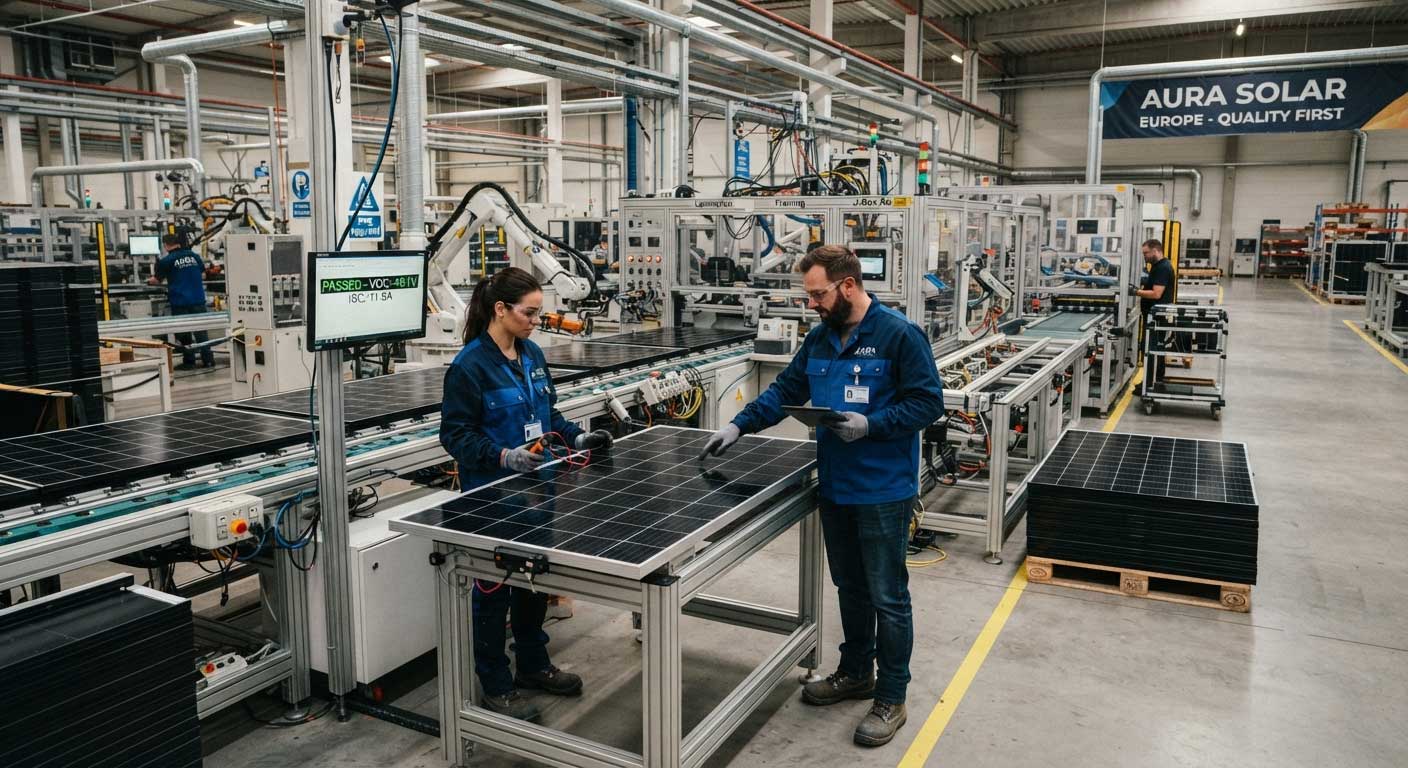
How Solar Panels Are Tested Before Shipping
A finished solar panel is not immediately packaged after assembly.
Manufacturers perform several quality checks to confirm that the module meets performance and safety requirements.
Common factory tests include:
| Test | Purpose |
|---|---|
| Flash test | Measures actual power output |
| Electroluminescence inspection | Detects invisible cell defects |
| Insulation test | Checks electrical safety |
| Visual inspection | Identifies physical damage |
| Mechanical load test | Evaluates structural strength |
| Thermal cycling test | Simulates temperature changes |
A panel labeled as 450W, for example, must demonstrate performance within the manufacturer’s rated tolerance range.
This quality control process explains why two panels with the same wattage can have different long-term reliability.
How Manufacturing Quality Affects Solar Panel Lifespan
Solar panels are designed for long operating periods.
Most manufacturers provide:
- 10–15 year product warranties.
- 25–30 year performance warranties.
However, warranty length alone does not determine quality.
Important manufacturing factors include:
Cell Quality
High-quality silicon wafers reduce defects that may affect energy output.
Encapsulation Quality
Reliable encapsulation protects cells from moisture and environmental damage.
Thermal Management
Better materials help reduce stress caused by repeated heating and cooling cycles.
Production Consistency
Advanced factories use automated inspection systems to detect defects before products leave the facility.
At Bright Solar, we evaluate solar modules based on technical specifications, manufacturing consistency, warranty conditions, and expected field performance—not only the advertised efficiency number.
Difference Between Premium and Low-Cost Solar Panels
Two solar panels may look almost identical from the outside but perform differently over time.
Key differences often include:
| Feature | Premium Module | Low-Cost Module |
|---|---|---|
| Silicon quality | Higher consistency | Variable |
| Quality control | Multiple automated inspections | Depends on manufacturer |
| Warranty support | Strong manufacturer backing | May vary |
| Degradation rate | Lower annual loss | Potentially higher |
| Long-term reliability | More predictable | Less predictable |
A lower purchase price may be attractive, but solar panels are long-term equipment. Small differences in degradation and reliability can influence electricity production over decades.
FAQ About Solar Panel Manufacturing
How solar panels manufactured from raw materials?
Solar panels are manufactured by purifying silicon, creating wafers, processing photovoltaic cells, connecting cells into strings, assembling protective layers, laminating modules, and completing quality testing.
What material are most solar panels made from?
Most modern solar panels use crystalline silicon because it provides reliable photovoltaic performance and has become the dominant commercial solar technology.
How long does it take to manufacture a solar panel?
The actual production process can take several hours once materials enter an automated factory line, although raw material preparation and quality testing require additional time.
Are all solar panels manufactured the same way?
No. Manufacturing processes vary between companies depending on cell technology, automation level, materials, quality control systems, and production standards.
Why is solar panel quality different between manufacturers?
Differences come from silicon quality, production equipment, inspection procedures, material selection, and manufacturing experience.
How long do manufactured solar panels last?
Most modern solar panels are designed to operate for 25 years or longer, with many manufacturers providing long-term performance warranties.
Conclusion
Understanding how solar panels manufactured helps explain why panel quality depends on much more than appearance or rated wattage. From purified silicon and wafer production to cell processing, lamination, and factory testing, every manufacturing stage influences the reliability and energy output of the final module.
At Bright Solar, we believe a solar panel should be evaluated as a complete engineered product. Manufacturing precision, material quality, and inspection standards determine how well a module performs after years of outdoor exposure.
For homeowners, installers, and businesses selecting photovoltaic equipment, understanding the manufacturing process provides valuable insight into long-term system performance and investment decisions.
The prev: How Much for Solar Panels?The next: How Long Do Solar Panels Last on a House?
Related recommendations
-

How Much for One Solar Panel?
195How much for one solar panel? Discover real solar panel prices, wattage options, cost factors, and expert buying advice from Bright Solar.
View details -
How Many Solar Panels to Power House?
135How many solar panels to power house depends on energy use, location, and panel output. Learn sizing methods, real data, and expert tips from Bright Solar.
View details -
How to Transfer Solar Energy to Electricity?
128How to transfer solar energy to electricity explained with photovoltaic technology, energy conversion steps, system components, and expert solar insights.
View details -
How Much Are Solar Panels for My House?
142How much are solar panels for my house? Discover real 2026 installation costs, pricing by home size, expert insights, and practical ways to estimate your residential solar investment with Bright Solar.
View details