How Does Solar Panels Work on a House?
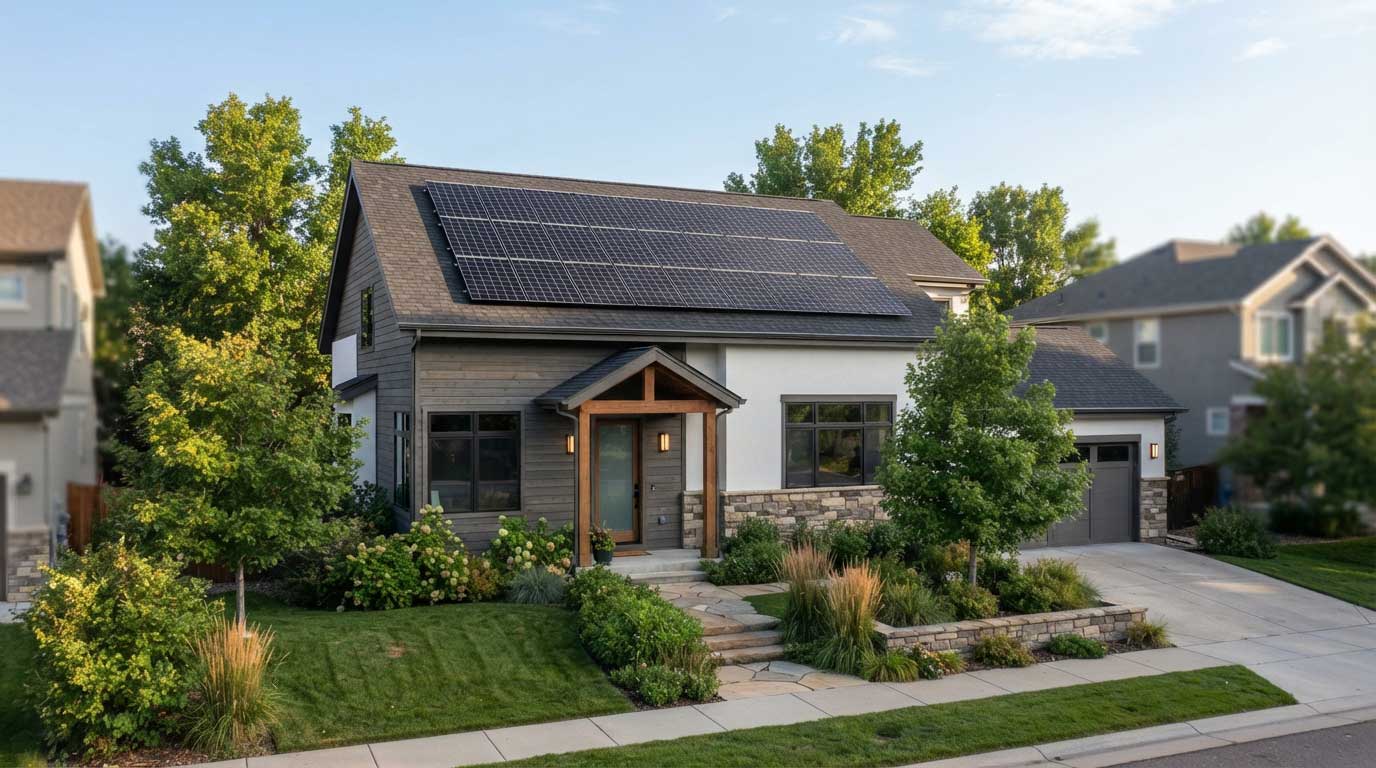
How does solar panels work on a house? Solar panels convert sunlight into direct current (DC) electricity through photovoltaic cells. A home’s inverter changes that electricity into alternating current (AC) for household circuits. The home uses solar power as it is generated, while excess electricity may flow to the grid or charge a battery, depending on the system design.
How Do Solar Panels Generate Electricity for a Home?
Solar panels work through the photovoltaic effect. When sunlight reaches the semiconductor material inside a solar cell, it transfers energy to electrons. The cell’s internal electric field helps those charges move, producing an electric current.
The U.S. Department of Energy explains that photovoltaic cells absorb sunlight and generate electrical charges that move in response to the cell’s electric field. Multiple cells are connected into modules, and modules are combined into an array sized for the property.
The panels do not need to “store” sunlight to make electricity. They generate power while light reaches them, with output varying according to irradiance, temperature, shading, orientation, and system design.
What Happens to the Electricity After It Leaves the Panels?
A typical grid-connected home solar system includes several connected components:
| Component | Function |
|---|---|
| Solar panels | Generate DC electricity from sunlight |
| Inverter | Converts DC electricity into household AC |
| Mounting system | Secures panels to the roof or another structure |
| Electrical protection and wiring | Connect and protect the system |
| Utility meter | Measures grid electricity flows according to local arrangements |
| Optional battery | Stores energy for later use when configured for storage |
The inverter is essential because most household appliances use AC electricity. The DOE also notes that inverters can monitor system operation, while advanced inverter and battery configurations may support additional functions.
How Does Solar Power Reach the Appliances in Your House?
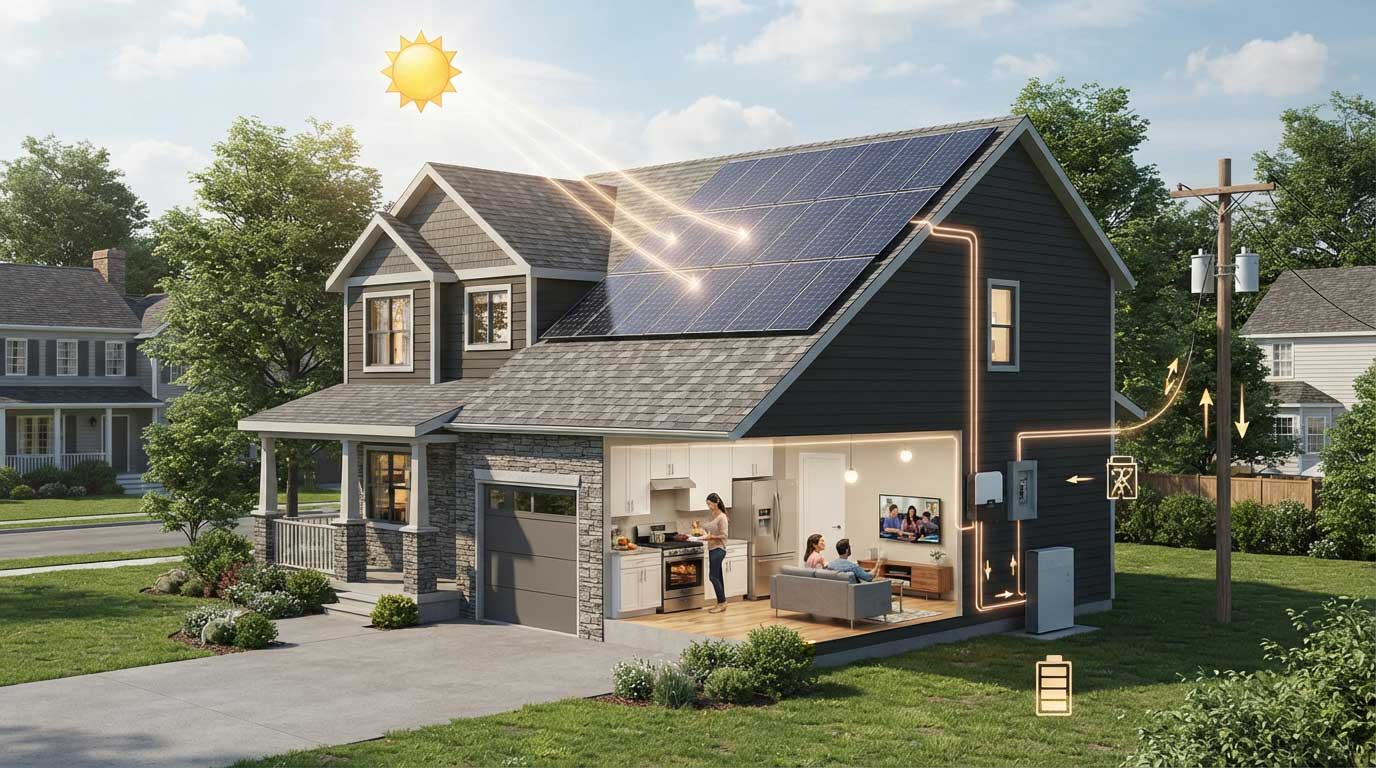
During daylight, the panels generate DC electricity. The inverter converts it into AC power, which can then supply the home’s electrical circuits. The electricity generated by the panels is used alongside the utility connection or battery system, depending on how the installation is configured.
A grid-connected system commonly works like this:
- Sunlight reaches the panels. The photovoltaic cells produce DC electricity.
- The inverter converts the power. The electricity is converted into AC for household use.
- The home consumes available solar power. Appliances such as refrigerators, lights, and computers draw electricity through the home’s electrical system.
- Surplus power may be exported. If production exceeds household demand, excess electricity may flow to the grid under the local utility arrangement.
- Grid electricity makes up any shortfall. When solar generation is insufficient, the home can draw power from the utility.
Net metering and other export-credit arrangements vary by utility and jurisdiction, so exporting electricity does not automatically mean the homeowner receives a one-for-one credit.
What Happens at Night or During a Power Outage?
Solar panels generally produce little or no electricity at night because they need light to generate power. A home can still receive electricity from the grid after sunset, or use stored energy if it has a suitable battery system.
A battery stores electricity for later use. DOE explains that solar-plus-storage systems can help households use solar energy when it is needed, including after daylight hours. However, having solar panels does not automatically mean a home will have power during a grid outage. Backup operation depends on the inverter, battery, system configuration, and required electrical controls.
| Situation | Typical system response |
|---|---|
| Sunny day, home using electricity | Solar power can supply household demand |
| Solar production exceeds demand | Surplus may be exported or stored, if configured |
| Nighttime, no battery | Electricity is typically supplied by the grid |
| Nighttime, battery installed | Stored energy may supply selected or supported loads |
| Grid outage | Backup power is available only if the system is designed and equipped for it |
For homeowners who need backup power, it is worth asking which circuits can be supported, how the system isolates from the grid, and how much usable battery energy is available. A battery’s presence alone does not establish that every appliance can run during an outage.
How Much Electricity Can Solar Panels Produce on a House?
There is no single output figure that applies to every home. The system’s rated capacity is only the starting point. Actual production depends on sunlight, roof direction and tilt, shading, local weather, temperature, equipment, and losses throughout the system.
As a reference point, NREL’s 2024 Annual Technology Baseline models a representative residential rooftop PV system at 7.9 kW DC. This is a modeling assumption, not a recommendation or a claim that every home needs a system of that size.
A household’s suitable system size should be based on its electricity use and the property’s solar resource—not copied from a neighbor’s roof.
What Affects Solar Output?
- Roof orientation and tilt: These influence how much sunlight reaches the modules over the day and year.
- Shade: Trees, chimneys, nearby buildings, and other obstructions can reduce production.
- Temperature: Solar output changes with operating conditions; hotter modules may produce less power than under standard test conditions.
- System losses: Inverters, wiring, soiling, and other factors affect the energy delivered.
- Household demand: A system’s usefulness also depends on when the home consumes electricity.
DOE advises homeowners to assess roof suitability, including roof condition and shading, before installing solar. Its system-design guidance also describes mounting structures, inverters, and storage as parts of the complete PV system.
Can Flexible Solar Panels Work on a House?
Flexible and semi-flexible panels can be useful in applications where conventional framed modules or standard mounting arrangements are not suitable. However, they are not automatically a replacement for conventional residential rooftop panels.
Before choosing a flexible panel for a building, confirm that the product is designed and approved for the intended installation surface, attachment method, electrical configuration, and outdoor conditions. Roof material, ventilation, waterproofing, fire requirements, and local building rules remain important.
Bright Solar supplies flexible and semi-flexible solar panel solutions for B2B applications such as RVs, campers, outdoor power, selected marine uses, and off-grid systems. For OEM and ODM projects, panel dimensions and configuration can be discussed against the actual application requirements. Product suitability should be verified for each proposed building installation rather than assumed from flexibility alone.
FAQ About How Does Solar Panels Work on a House?
Do solar panels power a house directly?
They generate DC electricity, which an inverter converts into AC power suitable for household circuits. The home can use that power while it is being produced.
Do solar panels work when the sun is not shining?
They can produce some electricity from diffuse daylight, but output is reduced when sunlight is weak and typically stops at night. The home may then use grid electricity or stored energy.
Does a house with solar panels still need the electric grid?
Many homes remain grid-connected. The grid can supply electricity when solar production is lower than household demand, while surplus solar electricity may be exported under local utility rules.
Will solar panels keep my house running during a blackout?
Not necessarily. A standard grid-tied system may shut down during an outage for safety. Backup power requires compatible equipment and a system designed to operate safely during grid interruptions.
What is the inverter’s role in a home solar system?
The inverter converts the DC electricity generated by solar modules into AC electricity used by most household appliances. Some inverters also provide monitoring and support system-control functions.
Can solar panels reduce my electricity bill?
They can reduce the amount of electricity a home needs to buy from the utility, but the actual bill impact depends on system output, household usage, electricity rates, fixed charges, and local export-credit rules.
Conclusion
How does solar panels work on a house? Photovoltaic cells turn sunlight into DC electricity, an inverter converts it into AC, and the home uses that power through its electrical system. Grid electricity or battery storage can cover periods when solar generation is not enough. The right system depends on the home’s roof, energy use, location, and backup requirements.
The prev: How Does Leasing Solar Panels Work?The next: How Many Kilowatts Can Solar Panels Produce?
Related recommendations
-

How Much Does Solar Panels Cost?
100How much does solar panels cost? Discover real solar panel prices, installation factors, system costs, and expert advice to plan your solar investment.
View details -
How to attach solar panels to rv roof?
178Learn how to attach solar panels to rv roof with secure mounting methods, practical tips, and expert advice for long-lasting RV solar installations from Bright Solar.
View details -
What Is the Price of Solar Panels?
157What is the price of solar panels? Learn real solar panel costs, pricing factors, system expenses, and expert buying insights from Bright Solar.
View details -
how to prepare solar panels?
173Learn how to prepare solar panels before installation with expert tips, inspection steps, tools, and Bright solar guidance for better performance.
View details