Flexible Solar Panels for Curved Surfaces: Radius, Adhesion and Cell Layout
A flexible solar panel follows a curve only as far as its construction allows. ETFE-laminated cells tolerate a minimum bend radius around 300 mm and up to about 30% surface flex; PET laminates crack cells well before that; and anything designed to be walked on should stay nearly flat. This guide covers the three decisions that matter — how much curve, how to bond, and what the cell layout has to do differently — using the same criteria we apply to custom orders at the factory.
The rule: curvature is decided by cell width and laminate type, not by how flexible the panel feels in your hand.
What Counts as a Curved Surface
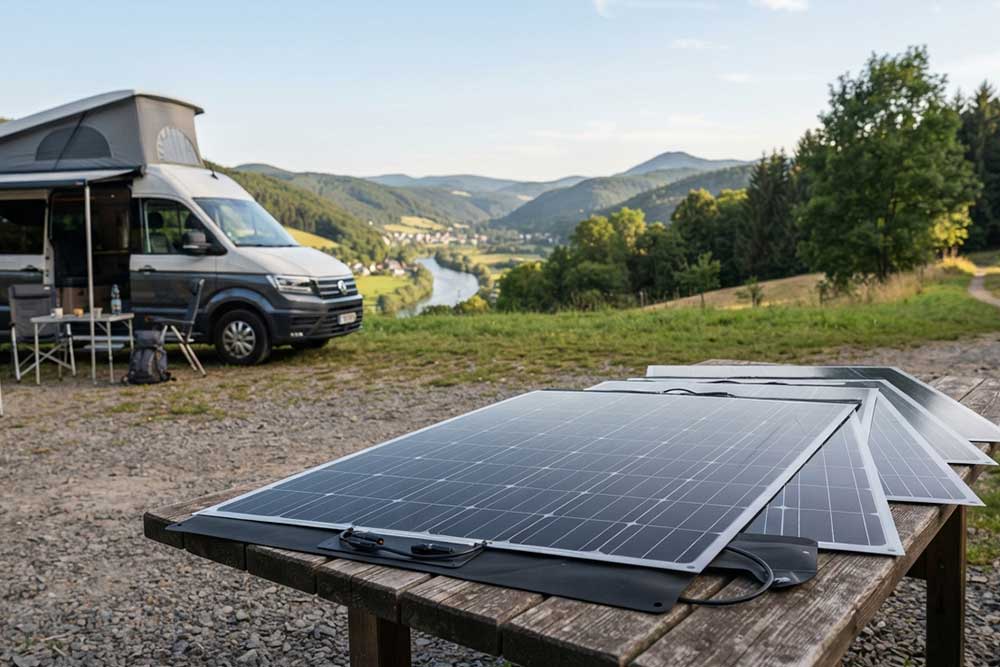
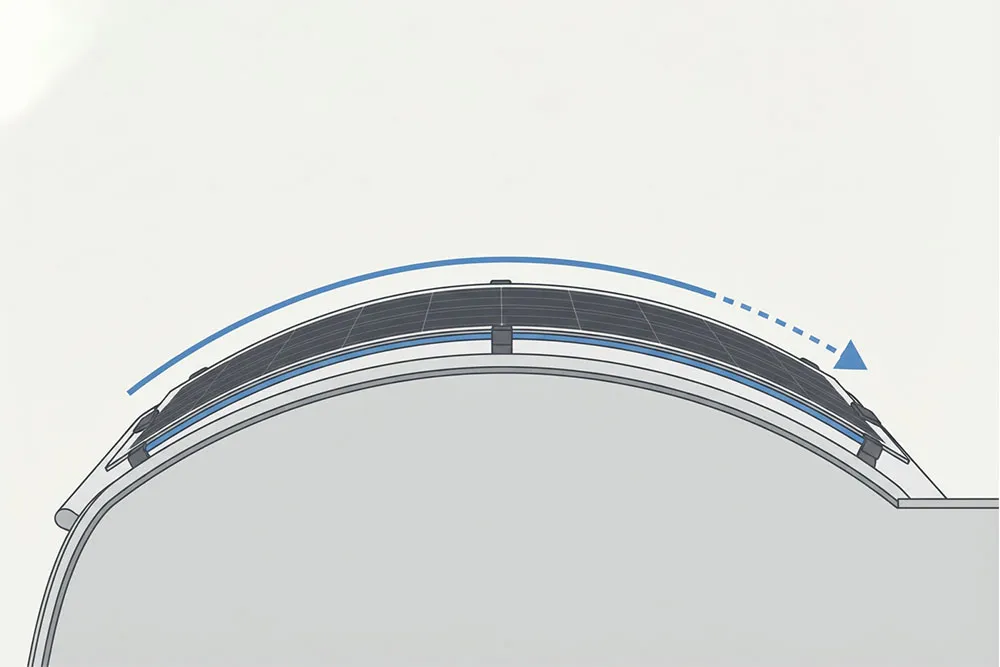
Six surfaces account for nearly every curved-panel request we quote: the tapered front cap of an RV, a yacht coachroof, a bimini top, a van roof with ribs and fan cut-outs, a balcony railing module, and a truck topper. Two of them — the RV cap and the coachroof — are gentle one-direction curves that a standard panel can follow. The other four involve compound curves, fabric, or cut-outs, and those are drawing jobs, not catalogue jobs.
How Much Curve Each Construction Tolerates
| Construction | Max arc / flex | Min bend radius | What fails first |
|---|---|---|---|
| PET laminate, thin cells | 10-15 degrees | about 500 mm | Cell micro-crack along the string |
| ETFE semi-flex, mono PERC | up to 30% surface flex | about 300 mm | Edge-seal stress at the corner |
| Walkable ETFE marine | near-flat, slight camber | not applicable | Denting under foot traffic |
Bending is an arc, not a fold. Measure your surface with a string line across the shortest span, divide the rise by the span, and if the panel would need a crease anywhere, stop — that is a custom cutting job, not a flexible panel purchase.
Bonding: Four Methods and Where Each One Fails
| Method | Best for | Watch out for |
|---|---|---|
| MS polymer structural adhesive | Permanent installs on GRP/metal | Full cure 48-72 h at 20 C; no repositioning once skinned |
| VHB acrylic foam tape | Light panels, quick installs | Fails on textured or dusty surfaces; primer needed on plastics |
| Grommets and lacing | Fabric mounts (bimini tops) | Point loads — always use load-spreading washers |
| Frame holes and bolts | Deck and walkable panels | Seal every hole; keep the IP67 box facing down-drain |
The rule: adhesion is a surface-prep problem, not an adhesive problem. Most bond failures we see are cured contamination — wax, silicone polish, or release agent — not the wrong glue. Wipe with isopropyl alcohol, tape off the outline, and test-lift a corner after 24 hours.
How the Cell Layout Changes on a Curve
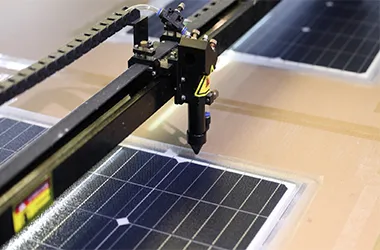
On a flat panel, cells tile in neat columns. On a curved or cut-out panel, the outline decides the layout: cells are laser-cut to follow the shape, corner cells get trimmed, and every cut-out for a vent, antenna or fan removes cells whose wattage has to be re-planned around the rest. That is why two panels with the same footprint can differ by 10-15 W — the outline, not the cell, sets the final number. If your surface has any cut-out or a compound curve, send a dimensioned drawing rather than a wattage: the layout is confirmed at drawing stage, not promised in a quote.
Three Builds From Our Order Book
The bimini top: fabric moves, so nothing rigid survives. The answer is a lighter ETFE laminate with grommets and load-spreading lacing, laid flat between the bow lines. The full decision trail is in our bimini case note.
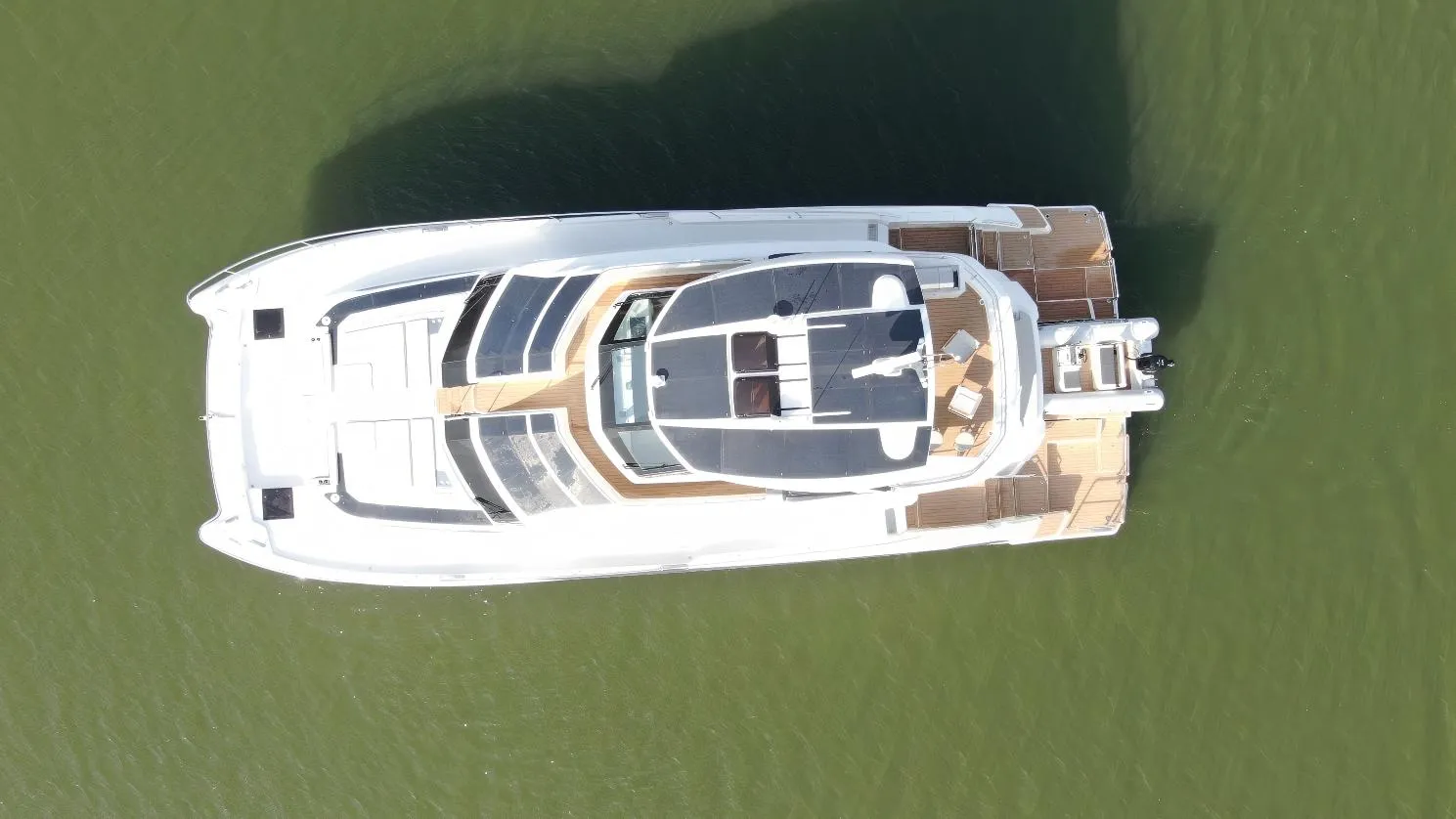
The yacht coachroof: a gentle one-direction curve that a semi-flex panel follows without exceeding its radius — the work is in choosing where the cable exits relative to the deck run. Documented with the customer’s outline in our yacht case note.
The special RV roof: a compound curve with a fan cut-out that no standard rectangle could clear. Cells were re-planned around the cut-out, which cost some wattage and bought a panel that actually fit. See our special RV roof case note.
Curved-Surface Buying Checklist
| What to send | Why it matters here |
|---|---|
| Outline drawing with the tightest radius marked | The radius decides the construction, before wattage |
| Cut-outs and their positions | Every cut-out removes cells and re-plans the layout |
| Vmp and Voc at your climate | Curved installs run hotter; mismatch shows up sooner |
| Target wattage and tolerance | Re-planned layouts land below the ideal — set the tolerance first |
| Mounting method | Adhesive, tape, lacing or bolts changes the backsheet |
| Cable exit and length | Exits on the concave side wick water; exits matter more on curves |
| Quantity, first order | One-off curves are prototype jobs; series curves are tooling jobs |
| Brand or logo requirement | Silkscreen on curved laminate has its own limits — ask early |
FAQ
Can you put flexible solar panels on a curved roof?
Yes, within the construction’s bend limit — about 300 mm minimum radius for ETFE semi-flex laminate, and only gentle one-direction curves. Compound curves need a custom-cut layout.
How much can you bend a flexible solar panel?
ETFE semi-flex panels tolerate up to about 30% surface flex; PET laminates crack cells at roughly half that. Bend across the arc, never fold across a cell line, and never crease a panel to test it.
Do curved installations lose output?
Not from the curve itself. Losses come from the re-planned cell layout around cut-outs (typically 10-15 W on an unusual outline) and from heat if the curve traps the panel against a hot surface with no air gap.
Can I bond a panel to a painted or gelcoat surface?
Yes with prep: abrade, wipe with isopropyl alcohol, and prime plastics. Gelcoat and fresh paint need full off-gassing first — bonding over paint younger than two weeks is the most common failure we hear about.
Conclusion: Three Numbers Decide a Curved Install
Everything above comes down to three numbers. The radius you can hold — about 300 mm for ETFE semi-flex, about 500 mm for PET, near-flat for walkable panels. The cure you allow — 48-72 hours at 20 C before the bond is trusted, doubled below 10 C. And the wattage your outline actually supports — landing 10-15 W below the rectangle is normal once a cut-out or a compound curve re-plans the cells. Get those three right and a curved panel behaves like a flat one: bond it, leave it alone, and let the sun do the rest.
If your surface fails the string-line test anywhere, stop shopping catalogues — that outline is a drawing job. Send the dimensioned drawing with the tightest radius marked to our custom panel team, and we will confirm the cell layout before we quote a wattage.
Related recommendations
-

Cost of Flexible Solar Panels: Prices, Factors and Buying Guide
331The cost of flexible solar panels varies by power, technology, materials, dimensions, customization, quantity, and installation requirements.
View details -
flexible solar panels for sailboats: Lightweight Marine Solar Power Solution
290Explore flexible solar panels for sailboats from Bright Solar with lightweight design, marine durability, and reliable solar energy for cruising, yachts, and offshore adventures.
View details -
Solar Bus Station Solutions from Bright Solar
391Solar Bus Station solutions from Bright Solar use pole-mounted solar power systems to light bus stops and shelters all night or on demand, offering reliable, off-grid lighting for transit routes in sunny locations.
View details -
12 Volt PV Panels: The Complete Guide for Reliable Battery Charging and Off-Grid Power
354Discover how 12 volt PV panels power RVs, boats, cabins, and battery systems. Learn sizing, charging performance, installation tips, and expert buying advice.
View details