Flexible 300W Solar Panel: Output, Uses and Installation Guide
A flexible 300W solar panel is a lightweight photovoltaic module designed to provide up to 300 watts of rated power under specified test conditions. Its adaptable construction can suit certain RV roofs, campervans, boats, and off-grid installations where conventional Rigid Solar Panels may be difficult to fit. Actual energy production depends on sunlight, temperature, shading, orientation, and system losses.
The 300W rating is a power measurement, not a promise of how much electricity the panel will generate each day. Before selecting a module, check its dimensions, weight, electrical characteristics, permitted bending, mounting method, and compatibility with the charge controller and battery system. For OEM buyers and system integrators, these details are central to deciding whether a flexible panel is appropriate for a particular project.
What Is a Flexible 300W Solar Panel?
A flexible solar panels converts sunlight into direct-current electricity, like a rigid photovoltaic module. The key difference is its construction: flexible modules are designed to accommodate a degree of bending within manufacturer-defined limits. They are not automatically foldable, rollable, or suitable for every curved surface.
A 300W panel may be considered for projects that need a higher nominal output from a limited installation area. However, wattage alone does not establish whether a panel will fit. Buyers should compare the actual module dimensions and account for roof curvature, mounting clearances, cable routing, and areas that may be shaded by vents, masts, or other equipment.
What the 300W rating actually means
The rated power is generally measured under standard test conditions (STC), which provide a common basis for comparing photovoltaic modules. STC uses an irradiance of 1,000 W/m², a cell temperature of 25°C, and a defined solar spectrum.
In real installations, module temperature, cloud cover, orientation, shading, dirt, wiring, and conversion losses affect output. A panel rated at 300W should therefore not be expected to deliver 300W continuously throughout the day.
For background on photovoltaic performance and system estimates, consult the U.S. Department of Energy and NREL resources:
- U.S. Department of Energy: Solar Photovoltaic Technology Basics
- NREL PVWatts: PVWatts Calculator
How Much Power Can a Flexible 300W Solar Panel Produce?
A flexible 300W solar panel has a nominal power rating of 300 watts under its specified test conditions. Daily energy depends on the amount of usable sunlight reaching the module and on the losses between the panel and the loads or battery.
A simple planning estimate is:
Daily energy (Wh) = Rated power (W) × equivalent peak-sun-hours × overall system factor
For example, using an illustrative assumption of 4 peak-sun-hours and an assumed system factor of 0.8:
300W × 4 hours × 0.8 = 960Wh, or 0.96kWh per day
This is a planning example, not a performance guarantee for a particular Bright Solar module or installation. The 4-hour sunlight assumption and 0.8 system factor are illustrative inputs, not measured product data. Actual results may be lower or higher depending on location, season, weather, panel orientation, temperature, shading, and equipment.
Example energy estimates
The table below uses several hypothetical peak-sun-hour scenarios with the same illustrative 0.8 system factor.
| Equivalent peak-sun-hours per day | Calculation | Estimated daily energy |
|---|---|---|
| 2 hours | 300W × 2 × 0.8 | 480Wh |
| 4 hours | 300W × 4 × 0.8 | 960Wh |
| 5 hours | 300W × 5 × 0.8 | 1,200Wh |
| 6 hours | 300W × 6 × 0.8 | 1,440Wh |
These figures help explain the relationship between sunlight and energy, but they should not replace a location-specific assessment. For project planning, NREL’s PVWatts tool can estimate photovoltaic production using location and system inputs. Its results are estimates based on modeled conditions, not guarantees for a particular flexible module.
Why the panel may produce less than 300W
Common reasons include:
- High cell temperature: photovoltaic output can change as the module heats up.
- Partial shading: a small shadow from a roof fitting, mast, or nearby object can affect production.
- Poor orientation: a panel mounted away from the useful solar direction may receive less irradiance.
- Surface contamination: dust, leaves, salt deposits, and other residue can reduce light reaching the cells.
- Electrical losses: cables, connectors, charge controllers, and inverters affect the energy delivered to the load.
- Roof conditions: restricted airflow or a mounting arrangement that traps heat can influence operating temperature.
A useful field habit is to record the installation conditions alongside production data. A wattage reading without the time, weather, module temperature, and shading context can be misleading.
Where Can a Flexible 300W Solar Panel Be Used?
A 300W flexible module may be suitable for mobile and off-grid projects where the mounting surface, available space, or weight requirements influence the design. Suitability still depends on the exact panel construction and the installation environment.
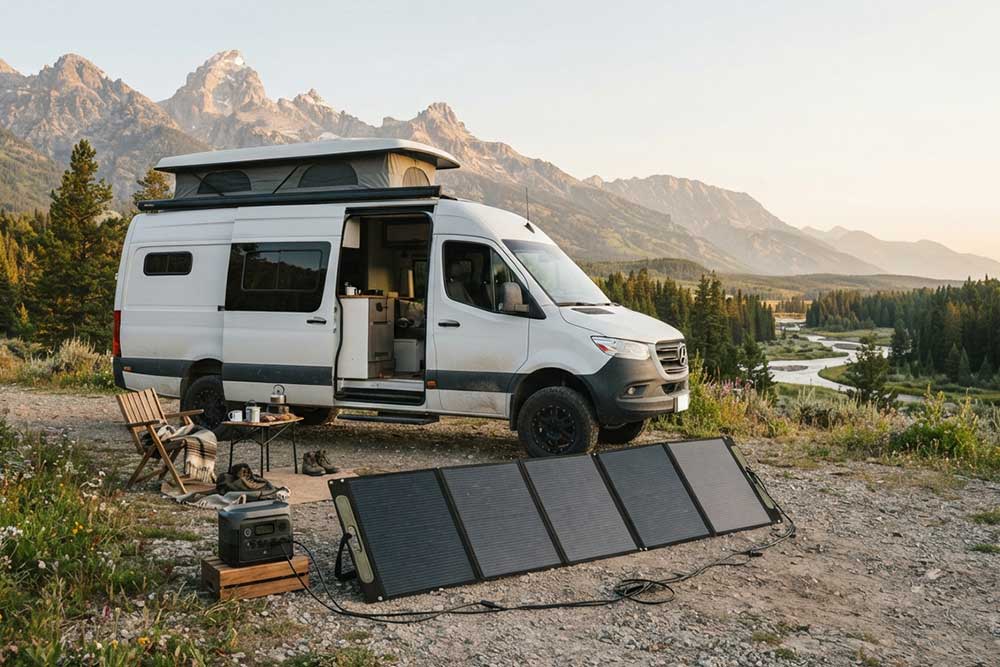
RVs and campervans
RV roofs often include air conditioners, vents, antennas, skylights, and curved sections. These features can make it difficult to use every available square inch. A flexible panel may help accommodate certain roof shapes, provided its bending and mounting limits are respected.
Before installation, measure the usable roof area rather than the roof’s overall dimensions. Leave room for maintenance access and avoid locations where equipment regularly casts shadows across the panel.
Boats and marine applications
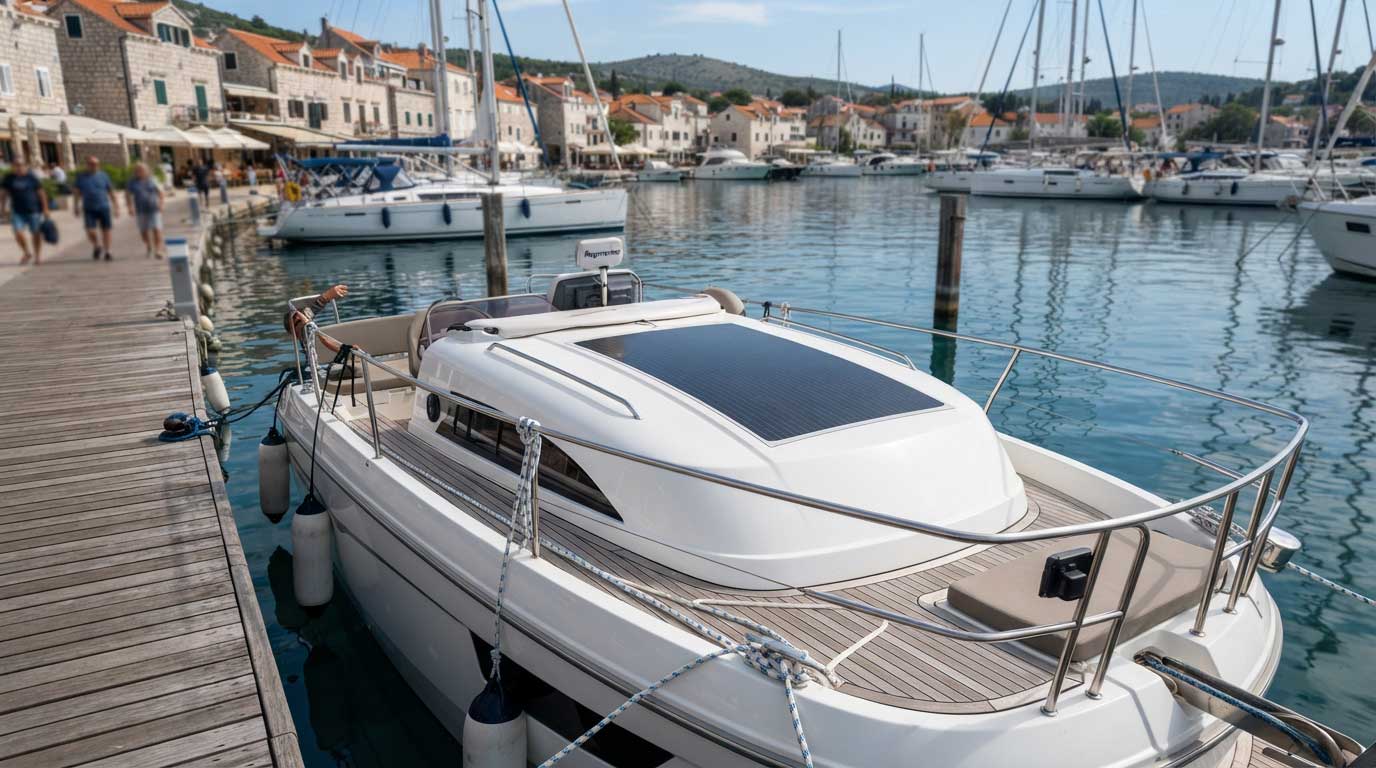
Flexible modules may be considered for selected marine applications where a low-profile panel is desirable. But a boat environment brings additional factors: salt exposure, vibration, water ingress, foot traffic, and limited cable-routing options.
Do not assume that a flexible panel is automatically walkable, waterproof in every installation, or suitable for permanent marine exposure. Verify the module’s own environmental ratings and installation instructions. For marine projects, also consider whether the mounting surface can dissipate heat and whether the panel can be inspected and replaced without damaging the deck or roof.
Off-grid and remote power systems
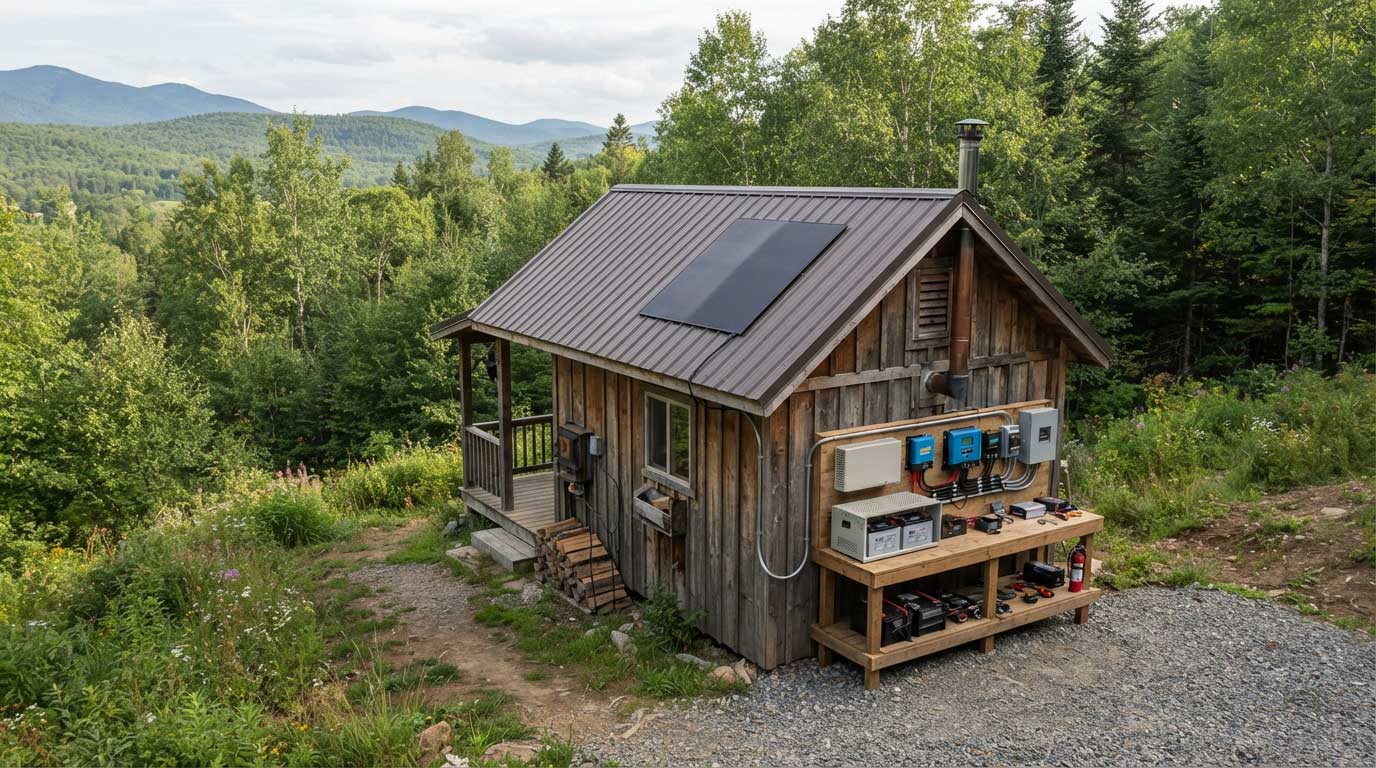
A flexible 300W panel can form part of an off-grid array for lighting, communications, monitoring equipment, or battery charging. The panel alone is not a complete power system. The designer must also consider the battery chemistry and capacity, charge-controller limits, DC protection, wiring, and the load profile.
Where energy availability is critical, use conservative solar-resource assumptions and include a plan for periods of poor weather. A single panel’s output can vary considerably from day to day.

What to Check Before Buying a Flexible 300W Solar Panel
A nominal power rating does not provide enough information to approve a module for a project. For procurement and system design, request the technical datasheet and installation manual, then review the following items.
| Checkpoint | Why it matters |
|---|---|
| Rated power and tolerance | Establishes the module’s stated output and the manufacturer’s rating conditions. |
| Dimensions and weight | Determines whether the panel fits the available mounting area and project weight limits. |
| Maximum permitted bending | Defines the limits for any curvature; exceeding them may damage the module. |
| Voc and Isc | Open-circuit voltage and short-circuit current are essential for electrical design and controller compatibility. |
| Vmp and Imp | Help determine operating voltage and current under the specified test conditions. |
| Temperature limits | Confirm that the expected installation environment falls within the manufacturer’s permitted range. |
| Connector and cable details | Supports correct wiring, connector matching, and installation planning. |
| Environmental protection | Review applicable ingress, UV, salt, or other resistance claims against the actual datasheet. |
| Warranty and installation conditions | Clarifies coverage and any mounting, maintenance, or use restrictions. |
For B2B orders, request the same information for each proposed configuration. A change in size, cell technology, connector, or laminate construction can affect how the module should be integrated. Do not treat a specification from one model as automatically applicable to another.
Questions to send a supplier
When requesting a quotation, provide the intended application and ask for:
- The full technical datasheet for the specific 300W model.
- The permitted bending radius or bending limit, with clarification of how it is measured.
- Recommended mounting methods and any restrictions on adhesives or mechanical fixing.
- Electrical values and the applicable test conditions.
- Operating-temperature and environmental ratings.
- Available customization options, minimum order quantity, sample availability, and lead time.
- Warranty terms and the documentation supplied with bulk orders.
These questions help prevent a common procurement mismatch: a panel that looks suitable in a product image but does not meet the project’s electrical, mechanical, or environmental requirements.
How to Install a Flexible 300W Solar Panel
Installation should follow the exact module manufacturer’s instructions. Flexible construction does not remove the need for sound mechanical support, safe DC wiring, and appropriate electrical protection.
Step 1 — Inspect and measure the mounting surface
Clean and inspect the surface before positioning the module. Check for sharp edges, raised fasteners, damaged coatings, standing-water areas, and sections that may flex independently. A surface that appears smooth from a distance may still contain small protrusions capable of stressing the panel.
Mark the proposed position and check that cables can reach the controller without being pinched or exposed to avoidable abrasion.
Step 2 — Confirm the bending and mounting limits
Use only the curvature permitted by the manufacturer. Do not crease the panel, force it around a tight corner, or assume it can be repeatedly flexed during use. Also confirm whether the module is intended for adhesive mounting, mechanical fixing, or another specified method.
The National Institute of Advanced Industrial Science and Technology (NEDO) in Japan has published design and construction guidance for flexible solar-cell systems. Its guidance highlights that flexible installations require attention to structural design, fixing methods, and material-related considerations—not just the fact that a module can bend.
Step 3 — Plan the electrical system
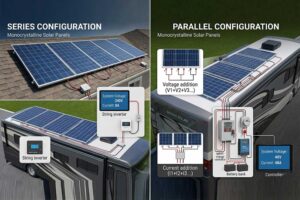
Check the panel’s Voc and Isc against the charge controller, wiring, connectors, and protective devices. For systems with multiple panels, calculate the combined voltage and current for the chosen series or parallel arrangement.
Do not connect modules in a configuration simply because their nominal wattages match. Electrical values, controller limits, temperature-related voltage changes, and the battery system must all be considered.
Step 4 — Secure the module and route the cables
Follow the manufacturer’s specified mounting procedure. Keep cables away from sharp edges, hot components, moving parts, and locations where water may collect. Use appropriate strain relief and ensure that connectors are compatible and properly mated.
If the installation involves a vehicle or vessel, consider vibration and movement as part of the design. A mounting method suitable for a stationary demonstration may not be suitable for a moving platform.
Step 5 — Test and document the installation
Before regular use, inspect the module, mounting, connectors, and cable routing. Test the system according to the equipment instructions and record baseline readings. Include the date, weather, approximate time, battery state, and any visible shading so future measurements can be compared meaningfully.
For fixed electrical installations, follow applicable local codes and use a qualified installer where required. Disconnecting or working on DC circuits can present shock, arc, and equipment-damage risks.
Flexible 300W Solar Panel vs. Rigid Solar Panel
Flexible and rigid modules serve overlapping purposes, but their construction and installation requirements differ. Neither format is universally suitable for every project.
| Consideration | Flexible solar panel | Rigid solar panel |
|---|---|---|
| Mounting surface | May accommodate limited curvature if the manufacturer permits it | Typically designed for a flat or appropriately angled mounting structure |
| Profile | Often lower-profile, depending on construction | Usually has a framed or otherwise more substantial structure |
| Mechanical limits | Bending and handling limits must be followed carefully | Frame, glass, and mounting loads must be considered |
| Roof integration | Can be useful where a compatible curved or space-constrained surface is available | Often suited to roofs or racks designed to support framed modules |
| Maintenance access | Depends on mounting method and installation layout | Depends on rack design and access clearances |
| Selection criteria | Datasheet, curvature limit, mounting compatibility, electrical values, and environmental rating | Datasheet, frame dimensions, load requirements, electrical values, and mounting compatibility |
A flexible module should not be chosen solely because it is thin or lightweight. If the surface is flat and a rigid mounting structure is available, compare both formats against the project’s cost, durability requirements, maintenance plan, and expected operating environment.
Practical Project Example: Planning a 300W Panel for a Campervan
The following is a hypothetical planning example, not a verified Bright Solar customer installation or a measured product result.
A campervan owner wants to add solar charging while preserving roof access for existing fittings. The owner considers one 300W flexible module, but the first task is not to assume that the panel will meet every daily energy need. The task is to check whether the roof layout and electrical system can support it.
The project team would begin by measuring the usable roof area and mapping shadows from vents, roof accessories, and nearby structures. Next, the team would review the module’s datasheet for dimensions, weight, permitted bending, Voc, Isc, Vmp, and Imp. Those values would be compared with the selected charge controller and battery system.
For a preliminary energy estimate, the team might use an explicitly stated scenario of 4 equivalent peak-sun-hours per day and a 0.8 assumed system factor:
300W × 4 hours × 0.8 = 960Wh/day
That estimate would then be compared with a measured or itemized daily load profile. If the expected loads exceed the estimated solar contribution, the design may need a larger array, reduced consumption, additional charging sources, or more battery capacity. A battery stores energy; it does not increase the amount generated by the panel.
During commissioning, the installer would record actual operating readings under known conditions. If production seems unexpectedly low, the team would check for partial shading, loose or mismatched connectors, cable losses, controller settings, and module temperature before concluding that the panel itself is at fault.
This type of documented assessment is more useful than treating a nominal 300W rating as a fixed daily energy supply. It also creates a baseline for later maintenance and troubleshooting.
Common Mistakes to Avoid
A few oversights can undermine an otherwise sensible solar installation.
- Treating rated watts as daily energy: watts measure power; watt-hours and kilowatt-hours measure energy over time.
- Ignoring shade from small roof fittings: a vent, antenna, or rail can create a recurring shadow as the sun moves.
- Exceeding the bending limit: flexibility is a defined mechanical allowance, not permission to crease or sharply fold the module.
- Choosing a controller by wattage alone: voltage and current limits matter, as do the battery configuration and system topology.
- Assuming every flexible panel is marine-ready: verify environmental ratings and permitted applications for the exact model.
- Using unsupported product claims: do not infer walkability, salt-water resistance, IP rating, or service life from the word “flexible.”
- Skipping baseline measurements: without commissioning records, it can be difficult to distinguish changing weather from a wiring or equipment issue.
Bright Solar Flexible Solar Panel Solutions for B2B Projects
Bright Solar supplies flexible and semi-flexible solar panel solutions for business applications. For OEM, ODM, and bulk procurement projects, module selection should be based on the intended application and the technical requirements confirmed for the specific product configuration.
When evaluating a flexible 300W solar panel for a commercial project, buyers can prepare a short specification brief that includes:
- Application and installation environment
- Required rated power and usable mounting dimensions
- Surface shape and any permitted curvature requirement
- Electrical-system voltage and controller details
- Environmental exposure and relevant compliance requirements
- Expected order quantity and customization needs
Bright Solar’s product documentation should be used to confirm the specifications of the model under consideration. Buyers should request the current datasheet and installation instructions before finalizing mechanical or electrical integration. Product features and available customization can vary by model and order configuration; they should not be assumed without confirmation.
FAQ About flexible 300W solar panel
What is a flexible 300W solar panel?
It is a photovoltaic module with a nominal rated power of 300 watts under specified test conditions. Its flexible construction allows only the degree of bending permitted by the manufacturer. The rating does not guarantee a fixed amount of daily energy.
How much electricity can a flexible 300W solar panel generate per day?
There is no single daily figure for every location. As an illustration, 4 peak-sun-hours and an assumed 0.8 system factor give 960Wh per day. Actual production depends on solar resource, temperature, shading, orientation, and system losses.
Can I install a flexible 300W solar panel on an RV?
Potentially, if the specific module is compatible with the RV roof, mounting surface, curvature, and electrical system. Check its dimensions, bending limits, mounting instructions, and electrical ratings before installation.
Can a flexible 300W solar panel be used on a boat?
Some flexible modules may be suitable for selected marine applications, but suitability depends on the manufacturer’s environmental ratings, mounting requirements, and permitted use. Do not assume that a panel is walkable or suitable for continuous salt-water exposure unless its documentation confirms this.
Does a flexible solar panel need a charge controller?
For a typical battery-charging system, a compatible charge controller is used to regulate the power supplied to the battery. The controller must be selected according to the module’s electrical characteristics and the battery system’s requirements.
Is a flexible 300W solar panel better than a rigid 300W panel?
The two formats have different construction and mounting characteristics. The appropriate choice depends on the installation surface, mechanical requirements, environmental conditions, maintenance access, and the specifications of the actual modules. Compare datasheets rather than choosing by format or wattage alone.
What should B2B buyers request before ordering?
Request the model-specific datasheet, installation manual, electrical parameters, dimensions, weight, bending limits, environmental ratings, warranty terms, and details of available customization. Confirm that the documentation applies to the exact configuration being quoted.
Conclusion
A flexible 300W solar panel can be a candidate for RV, campervan, selected marine, and off-grid projects where the mounting surface or installation constraints make flexibility relevant. Its suitability depends on more than the rated wattage: buyers and installers need to verify mechanical limits, electrical compatibility, environmental ratings, and the expected energy profile.
For Bright Solar B2B projects, confirm the specifications of the exact model and configuration before making design or procurement decisions. A realistic output estimate, careful mounting plan, and documented commissioning process help turn the panel’s nominal rating into a better-informed system design.
Related recommendations
-

Solar Bus Station Solutions from Bright Solar
298Solar Bus Station solutions from Bright Solar use pole-mounted solar power systems to light bus stops and shelters all night or on demand, offering reliable, off-grid lighting for transit routes in sunny locations.
View details -
Flexible Folding Solar Panels: Portable Power, Design and Buying Guide
126Flexible folding solar panels provide portable solar power in a compact package that unfolds into a larger photovoltaic array.
View details -
Parallel vs Series Solar Panels: Which Wiring Method Actually Performs Better?
162Learn the differences between parallel vs series solar panels. Compare voltage, current, shading performance, efficiency, and real-world applications to choose the best solar wiring method.
View details -
100w Flexible Solar Panel Kit: Lightweight Portable Solar Power Solution
194Explore the 100w flexible solar panel kit from Bright Solar. Learn how lightweight solar technology delivers reliable off-grid power for RVs, boats, camping, and portable energy applications.
View details